

Strong budget value in Australia usually sits around AUD 150 to 200, because shoes under AUD 100 often use materials that break down faster. For most recreational runners, a discounted mid-range daily trainer with a durable outsole is a smarter buy than the cheapest pair on the shelf.
You're standing in a sports retailer with a modest budget, comparing two pairs that look similar. One is comfortably below AUD 100. The other costs more, but its outsole feels denser, the upper holds your foot more securely, and the midsole looks built for regular road use. The cheaper shoe wins on the receipt, yet may lose once heat, wet weather, pavements and repeated training expose its weaker materials.
That's the central problem with finding the best budget running shoes. A low sticker price tells you what you spend today. It doesn't tell you how long the shoe will remain comfortable, whether the tread will survive your usual routes, or whether you'll replace it sooner. Australian runners need to judge value per kilometre, not the sale label.
Why cheapest isn't always the smartest choice
A recreational runner in Melbourne might train on concrete footpaths, asphalt roads and a park loop during the same week. A runner in Brisbane may deal with heat, humidity and sudden rain, while someone in Perth may combine firm paths with compacted gravel. In each case, the shoe faces more than a treadmill's predictable surface.
A cheap pair can work perfectly well for walking, occasional run-walk sessions or short easy outings. It becomes a less convincing bargain when the runner uses it frequently and the upper stretches, the outsole wears unevenly or the cushioning loses its useful feel. CHOICE reports that running shoes under AUD 100 generally use cheaper materials that break down faster, while the AUD 150–200 range typically offers stronger stability and cushioning, with premium pricing mainly adding durability through more midsole cushioning. CHOICE's running-shoe buying guide is a useful reference when comparing those price bands.
The receipt is only the first cost
Consider two hypothetical purchases. A AUD 120 shoe that lasts 400 km works out at about AUD 0.30 per kilometre. A AUD 90 shoe that lasts only 300 km also costs about AUD 0.30 per kilometre, despite costing less at checkout. Those examples come from Decathlon Australia's running-shoe guidance, which uses service-life estimates of approximately 300–500 km with regular care.
That calculation isn't a promise. Runner weight, pace, surface, weather and whether the shoes are also used for walking all change the result. It is still a better starting point than assuming the lowest price represents the lowest cost.
Practical rule: Buy the least expensive shoe that gives you a secure fit, suitable cushioning and an outsole you trust on your regular surfaces. Don't buy the cheapest shoe by default.
Australian demand also shows why this decision matters beyond competitive running. ABS data recorded jogging or running participation among Australians aged 15 and over at 4.3% in 2005–06, rising to nearly 8% by 2011–12, with the bureau describing running as one of the country's rapidly growing recreational activities. The Australian Bureau of Statistics release shows a broad recreational market, not just a specialist group buying racing footwear.
How to choose the right budget running shoes
Start with the job the shoe must perform. A neutral daily trainer is often the sensible default for road running, park paths, treadmill sessions and occasional firm trails because it balances cushioning, flexibility and everyday usability. A highly structured stability shoe may suit a runner who already knows that its geometry feels comfortable, but the label alone doesn't establish that it's necessary.
Use the following table as a screening tool rather than a substitute for trying shoes on.
Budget Shoe Criteria Quick Reference
| Criterion | What to look for | Who it helps most |
|---|---|---|
| Fit | Secure heel, comfortable midfoot and room for toes to spread | Every runner, especially online shoppers |
| Cushioning | Moderate cushioning that feels stable rather than excessively soft | Road and pavement runners |
| Outsole | Rubber coverage in the areas that contact the ground most | Frequent runners and hard-surface users |
| Upper | Breathable material with no pressure points or sliding | Runners in warmer conditions |
| Stability | A guided feel that remains comfortable, not a corrective sensation | Runners who prefer structured support |
| Flexibility | Smooth transition without forcing the foot into a rigid stride | Beginners and easy-pace runners |
Foot shape matters more than brand loyalty. A broad forefoot needs space across the toes, while a narrow heel needs enough rearfoot hold to prevent slipping. If the shoe fits everywhere except under the arch, don't assume you need a different support category. First check whether the insole shape is the problem. Runners who need extra underfoot support can compare resources that help them pick the best insoles for running, but an insole should improve comfort, not compensate for a poor shoe fit.
Surface should influence the outsole decision. Smooth road rubber may be quiet and efficient on pavements, while a light-trail shoe needs more dependable traction and protection. A very soft foam can feel pleasant in a shop, yet a moderately cushioned shoe may offer better control on uneven urban routes.
Before a run, use gentle mobility rather than forcing a new shoe through a hard session. A practical dynamic stretching routine for the legs can help you prepare, but it won't turn an unsuitable fit into a suitable one. The shoe should feel comfortable during walking and easy jogging before you commit to regular training.
Understanding budget versus mid-range value
The Australian market gives shoppers a useful reference point. Industry figures compiled by the Australian Sporting Goods Association put the 2024 full-year Australian footwear market at A$3.80 billion, with running footwear representing approximately A$1.02 billion and a 27% market share. The same summary estimates 3.48 million adult runners and an average running-footwear unit value of A$156.44. These figures appear in the Australian Sporting Goods Association industry research.
That average isn't a recommended minimum. It includes premium, technical and specialist products. It does show that a shoe materially below A$156.44 is being judged against a real national market benchmark, rather than against the price of every shoe sold in Australia.
Price Band Value Overview
| Price band | Typical durability | Best for |
|---|---|---|
| Under AUD 100 | Cheaper materials may break down faster | Walking, occasional running and tight short-term budgets |
| AUD 150–200 | Often stronger cushioning, stability and construction | Regular recreational runners seeking dependable value |
| Above AUD 200 | More specialised materials and increased durability may appear | Runners who specifically need advanced or specialist features |
The strongest bargain is often a previous-season model from the middle band. Brands frequently change colours, uppers or foam arrangements without making the older version useless. If the previous model fits your foot and has the outsole coverage you need, a discount can remove much of the premium while retaining the construction that made the shoe suitable for daily training.
Replace by evidence, not optimism
The Australian Podiatry Association says most daily trainers should be replaced after roughly 600–800 km, although heavier runners and hard-surface training can shorten that interval. Its running-shoe sports-performance guidance also identifies visible outsole wear, uneven wear and increased post-run aches as practical replacement warnings.
Those figures differ from Decathlon Australia's approximate 300–500 km service-life guidance because replacement depends on the shoe, runner and use. Treat mileage as a tracking prompt, then inspect the shoe. A mid-range pair that remains stable and intact can be cheaper over its useful life than several lower-priced pairs that need early replacement.
Top budget running shoe picks by use case
There isn't one universal winner among the best budget running shoes. A road-focused runner needs a different compromise from someone who trains indoors, walks as much as they run or regularly moves onto gravel.
Best Budget Picks for Common Running Scenarios
| Use case | Recommended shoe type | Key benefit |
|---|---|---|
| Road running | Moderate-cushioning daily trainer | Balanced comfort and pavement durability |
| Treadmill training | Flexible neutral trainer | Predictable feel and easy transitions |
| Mixed pavements and parks | Versatile road-to-path trainer | Useful across changing firm surfaces |
| Light trails | Road shoe with dependable grip or light-trail model | Better traction without excessive bulk |
| Run-walk beginners | Comfortable entry-level trainer | Lower upfront commitment and easy use |
| Faster short sessions | Lightweight trainer | More responsive feel without requiring a racing shoe |
For road running, look first at the discounted previous-season daily trainer. It should have enough rubber under the heel and forefoot, a breathable upper and cushioning that feels controlled. New Balance Fresh Foam 680-style shoes, Brooks Launch-style trainers and older versions of established neutral road models are the sort of category to investigate, but fit and current construction matter more than the logo.
Treadmill runners can favour a lighter, flexible neutral shoe because the surface is consistent and traction demands are lower. That doesn't mean choosing the thinnest shoe available. If your calves or feet feel overloaded, the model is asking more of you than your training currently supports.
For mixed pavements, choose moderate cushioning and an outsole that extends beyond isolated heel patches. A shoe with exposed foam may feel light, but repeated contact with rough paths can accelerate wear. Light trails require more caution. If the route includes loose rock, mud or wet surfaces, a genuine trail outsole is preferable to a road shoe marketed as versatile.
Readers comparing models and categories can also consult Swift Running's guide to affordable performance trainers. For training context, a practical good 5K time guide can help you match shoe choice to the type of sessions you complete, rather than to an aspirational race plan.
A beginner doing short run-walk intervals doesn't need the same shoe as a runner accumulating frequent long road sessions. Spend on the feature that affects your use most, usually fit and outsole durability, rather than paying for racing technology you won't use.
Sizing and fit tips for Australian runners
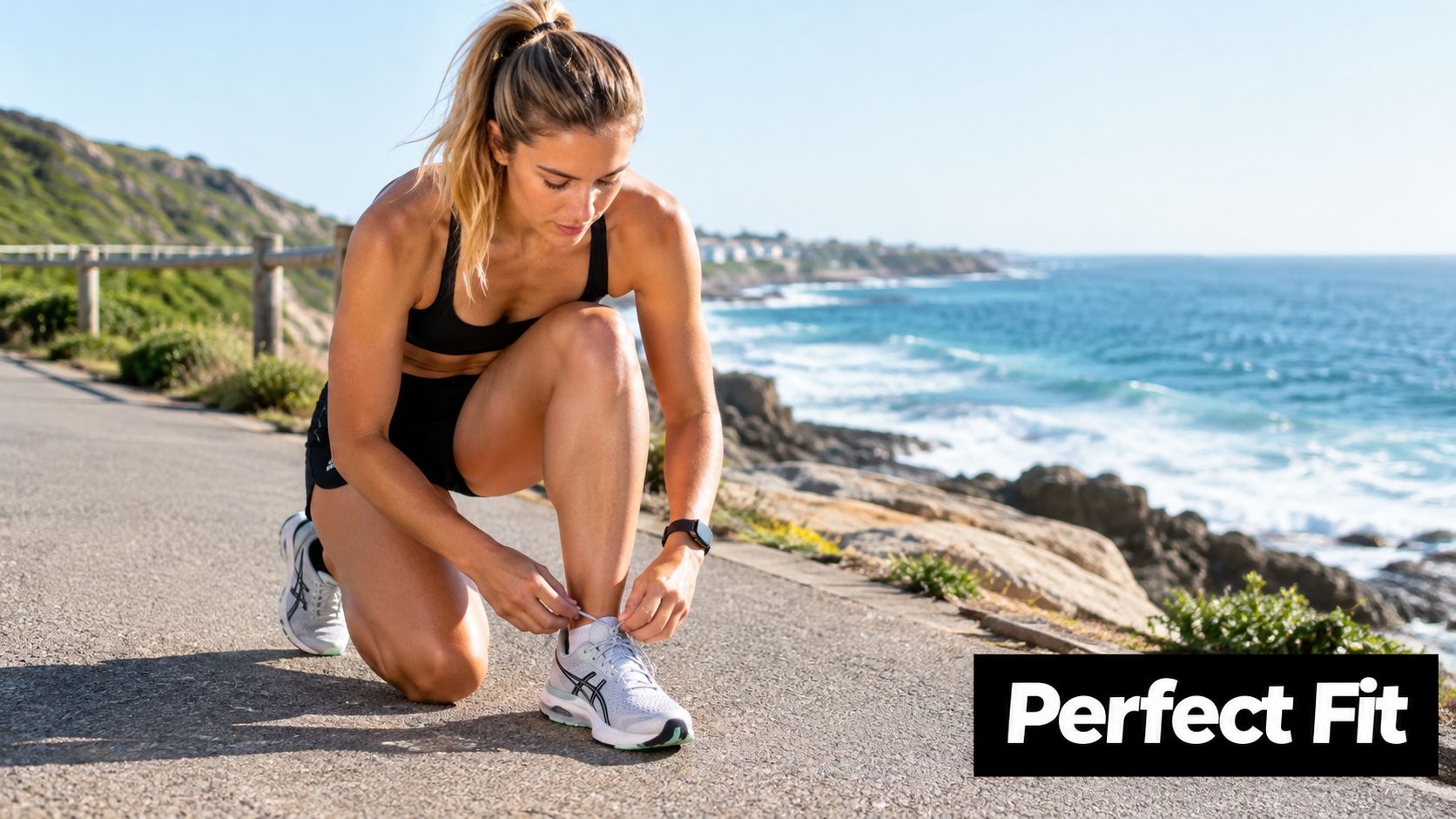
A good budget shoe becomes an expensive mistake if it causes blisters, numb toes or heel movement. Try shoes later in the day when your feet have had time to expand, and wear the socks you normally use for running. Australian heat can make swelling and moisture more noticeable, so a perfect morning fit may feel restrictive on a warm afternoon.
A simple fit check
- Check the toe box. With your heel seated, leave comfortable space in front of the longest toe. Your toes should be able to move without touching the front during a downhill step.
- Secure the heel. Lace the shoe firmly enough that your heel doesn't lift when you walk or jog. It shouldn't create pressure across the top of your foot.
- Assess the width. The upper should touch your foot without squeezing the forefoot or spilling over the midsole. Look for wide options if your toes feel compressed.
- Walk and jog. Test the shoe with your normal stride. A soft in-store sensation isn't useful if the heel slips or the arch rubs once you move.
- Compare both feet. Feet often differ slightly in length or width. Fit the larger foot and adjust the lacing on the smaller one.
If you're between sizes, sizing up can help when your toes contact the front, but it won't fix an overly narrow shape. A larger size may create heel slip, so try another last or width before adding length. Online buyers should check the retailer's measurement chart and return conditions before removing tags or taking the shoe outdoors.
A short movement test can reveal more than standing still.
Don't judge stability by the word printed on the box. If the shoe feels intrusive, pushes your foot sideways or changes your stride immediately, try a less structured alternative. Comfort during actual movement is the more useful test.
How to maintain budget running shoes
A budget shoe only stays cheap if it lasts. If a lower-priced pair breaks down early, your cost per kilometre rises fast, and that is where many runners lose the value they thought they were getting.
Start with basic care after each run. Brush off grit, especially after gravel paths, dusty shoulders or park loops, because fine debris can wear the upper and outsole faster than many runners expect. Clean the upper with a soft brush and mild soapy water, then rinse lightly. Don't leave the whole shoe soaking.
Drying habits matter just as much as cleaning. After a wet run, take out the insoles, loosen the laces and leave the shoes somewhere with airflow. Heat can warp foam, weaken glue and age the upper before the tread is done. Strong sun and a clothes dryer may speed up the process, but they also shorten the useful life of the shoe.
Use the pair for its intended job
If you want a fair read on value, keep running shoes for running as much as possible. Commuting, gym sessions and long casual walks all add wear, but many runners forget to count that use when judging whether a pair was a good buy. A shoe that seemed inexpensive at checkout can become poor value if half its life went into errands.
Using two pairs can help. Each pair gets time to dry, and changes in cushioning or fit are easier to notice when you alternate. Australian sports-medicine guidance also supports gradual footwear changes rather than abrupt switches, especially when moving toward more minimal designs, The Australian sports-medicine review. Rotation still has limits. It does not rescue a shoe that is already worn out.
Inspect the shoe, not just the odometer
Mileage helps, but condition matters more. I tell runners to check the shoe every few runs and trust what they see and feel.
Look for:
- Uneven tread: Heavy wear on one edge or under the forefoot can change ground contact.
- Midsole creasing: Deep or lopsided creases often mean the foam is no longer compressing evenly.
- Sole separation: Peeling between the outsole, midsole and upper is a clear sign the shoe is near the end.
- New aches: If the same pair starts leaving you with repeat soreness after ordinary runs, treat that as a warning sign.
Replacement timing depends on surface, body load and frequency of use. Hard pavement, heavier impact and frequent running usually wear shoes faster than occasional treadmill sessions. Keep a simple note of purchase date, main routes and any new discomfort, then judge the pair on total wear, not the price you paid for it.
Where to buy affordable running shoes in Australia
The safest discount is usually a genuine reduction on a known model, not an unexplained price that makes authenticity difficult to verify. Start with authorised brand stores, established Australian running retailers and reputable sporting-goods chains. Compare the exact model name, version and width, because a similar-looking shoe may belong to a different construction tier.
Buying options that usually work
- Previous-season releases: Often the strongest value when the fit and outsole suit you.
- Outlet stock: Useful for colour changes, overstock and discontinued sizes, provided the retailer is reputable.
- End-of-season sales: Good for runners who can wait and who don't need a rare size.
- In-store fitting: Worth prioritising if you have a history of blisters, heel slip or unusual width needs.
- Online purchases: Practical when you already know the model, but only after checking returns and exchange conditions.
Don't assume an advertised percentage discount proves value. Calculate the purchase price against the service you expect, then confirm that the retailer accepts returns for unworn shoes and provides clear Australian contact details. For online orders, avoid outdoor testing until you're confident you can return the pair.
If you find a discounted mid-range shoe at a price close to entry-level models, inspect the outsole, upper stitching and midsole for storage damage. A good deal still needs a current, comfortable fit. The cheapest authentic shoe that doesn't fit is more expensive than a suitable pair bought at a smaller discount.
Frequently asked questions
Can rotating two affordable pairs improve value?
It can. Rotation lets one pair dry while you use the other, and it gives you a useful comparison when cushioning or stability begins to change. La Trobe's evidence summary reports a small protective effect from rotating between two or more pairs, but the financial case depends on whether both pairs suit your training and receive enough use.
A practical rotation might pair one road trainer with one lighter treadmill or short-run shoe. Do not rotate just to delay replacing a visibly damaged pair. Keep notes for each shoe separately, including route type and any new aches.
Do expensive stability shoes prevent injuries?
Australian sports-medicine evidence doesn't support a universal promise. A review reported no injury-rate difference when 81 female runners with pronated, neutral and supinated foot types received shoes with different stability levels, while another trial found no injury difference between hard- and soft-soled shoes over five months. The Australian review also notes that high-quality studies haven't conclusively shown that traditional shoe prescription prevents running injuries, although motion-control shoes may help some recreational runners with pronation.
Choose stability because the shoe feels comfortable and suits your movement, not because a marketing label promises protection. A sudden switch to a much lower-drop or thinner shoe can increase demands on tissues below the knee, so transition gradually.
How should I calculate cost per kilometre?
Divide the Australian purchase price by the kilometres you get from the shoe. A AUD 100 pair lasting 600 km costs about 16.7 cents per kilometre, while a AUD 150 pair lasting 800 km costs about 18.8 cents per kilometre, based on the replacement framework from the Australian Podiatry Association's guidance.
Use the result as a comparison, not a guarantee. A trail shoe, treadmill shoe and road trainer face different surfaces, and a runner's weight and training pattern alter wear. Replace the shoe when the outsole, midsole or your comfort indicates that it has stopped doing its job, even if the calculation looks attractive.
If you track runs with a wearable, choose a device that makes mileage easy to review. A guide to sports watches for ladies can help you compare practical tracking features, but a notebook works just as well. The important step is recording enough use to judge the shoe fairly.
Everti creates durable titanium essentials for kitchens, tables and everyday routines, with a focus on long-term use rather than disposable value. Explore the range and visit Everti to find thoughtfully made products designed to last.