

You're standing in a kitchen shop, comparing a glossy navy Dutch oven with a lighter blue frying pan. Both look beautiful, both promise reliable cooking, and both may be described as “blue cookware”. Yet colour alone tells you very little about how either piece will behave. The blue might come from a glass-like enamel layer, a hardened aluminium surface, or a non-stick coating, and each construction brings different expectations for heat, scratches, cleaning and long-term care.
That distinction matters in Australia, where cookware supply is heavily dependent on imported products. One market analysis estimates that overseas supply accounts for about 85–95% of domestic cookware consumption by value, with China contributing roughly 65–75% of import value. The same analysis estimates annual retail sales at AUD 700–900 million, with non-stick cookware representing the largest segment by volume at about 40–45% of units sold. The market overview published by The Sydney Morning Herald explains why colour-finished imported cookware is such a familiar part of Australian kitchens.
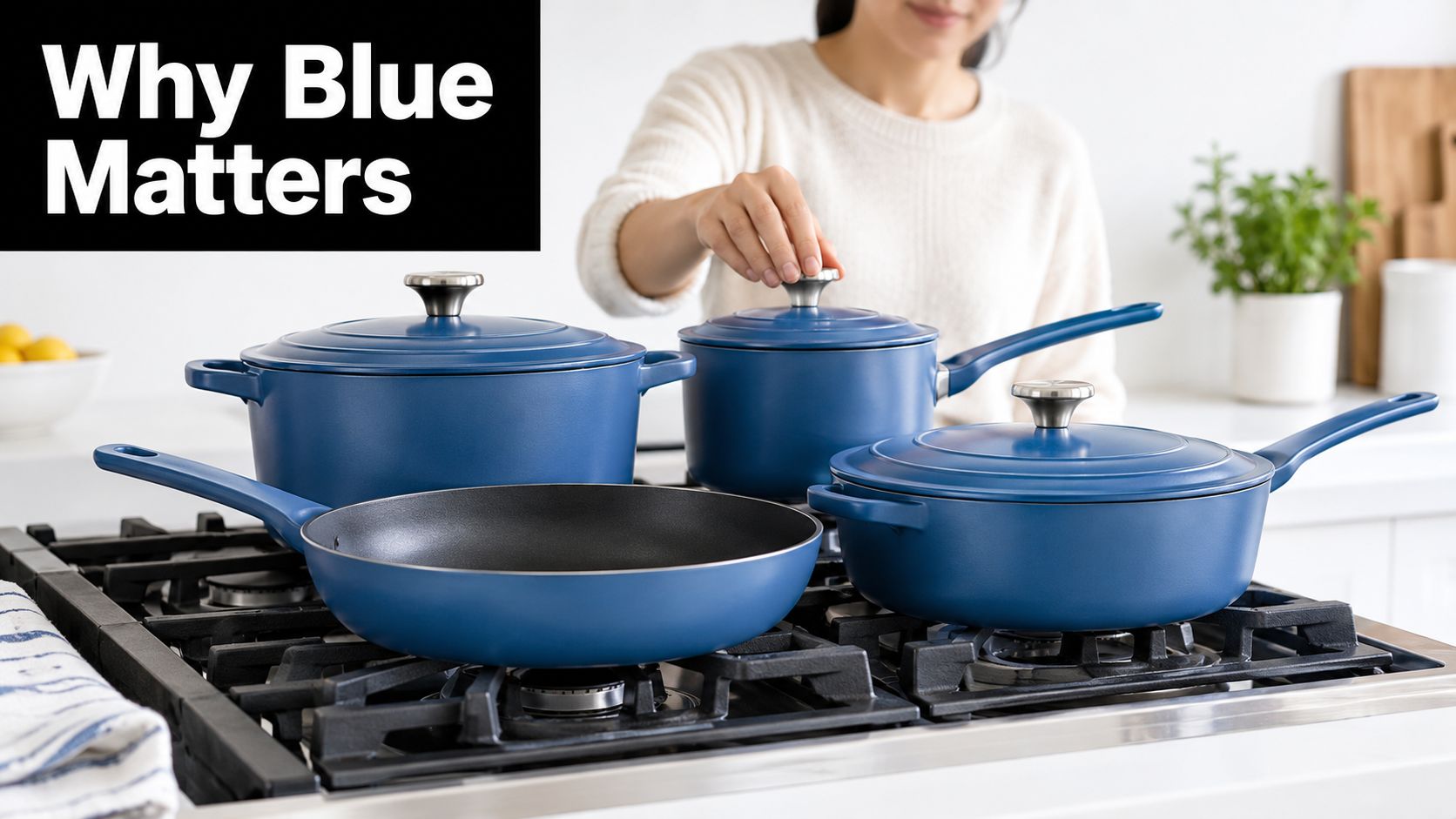
This guide treats blue pots and pans as more than a decorating choice. You'll learn how manufacturers create the colour, how enamel differs from anodized aluminium and coated non-stick surfaces, what Australian buyers should ask about PFAS-related chemistry, and which care habits protect the finish. Once you understand the surface beneath the colour, choosing cookware becomes much easier.
Introduction to Blue Pots and Pans and Why Colour Matters
A blue pan can be the piece that makes an open shelf look organised and inviting. It can also be the pan you reach for every morning, so its appearance needs to match its construction. A glossy blue casserole designed for slow cooking behaves differently from a thin blue coated skillet intended for delicate foods, even if both have similar product photography and equally confident packaging.
The colour is a clue, not a specification. Manufacturers can produce blue through several surface systems, and the metal underneath may be cast iron, steel or aluminium. That underlying combination affects weight, heat response, resistance to abrasion and whether the pan needs careful treatment around utensils, detergents or sudden temperature changes.
The practical question: Don't ask only whether the cookware is blue. Ask what creates the blue surface and what sits underneath it.
Blue has a long history in premium enamelled cookware. Le Creuset began after a meeting at the Brussels Fair in 1925, then introduced a blue enamel colour inspired by Elizabeth David's Mediterranean travels in 1965, as described in this account of Le Creuset's colour history. That history shows blue enamel isn't merely a passing visual trend. It has become an established design language associated with cookware intended to move from stovetop to table.
Australia's wider pots and pans category also gives blue cookware commercial relevance. The market was estimated at USD 255.75 million in 2024, with a projected rise to USD 378.3 million by 2033, and pots were identified as the largest product category in the Australia market analysis from IndexBox. Those figures describe the category overall, not blue products specifically, but they help explain why buyers see so many imported finishes, shapes and colour options.
The most useful way to shop is to separate three questions:
- How is the colour made? This reveals the surface's strengths and limits.
- What cooking do you do? High-heat searing, slow braising and quick egg cooking place different demands on a pan.
- How will you care for it? Gentle cleaning and suitable utensils often matter as much as the initial material choice.
How Blue Colour Is Created on Modern Cookware
Blue cookware usually gets its colour through one of three broad approaches. Think of enamel as a glass coat, anodizing as armour formed from the metal itself, and non-stick as a functional surface layer applied over a base. The colour may look similar from a distance, but the bond between colour and pan changes the way you should use and clean it.
Enamel creates a glass-like surface
Porcelain enamel starts with a glass-based material that's fused to a metal body during manufacturing. On cast iron or steel, the result can be a glossy, smooth blue surface that doesn't behave like bare metal. The enamel is non-reactive in normal cooking use, and its colour comes from mineral pigments within the glassy layer.
This construction gives blue pots their distinctive shine and makes them suitable for stovetop-to-table cooking. It isn't indestructible, though. A sharp impact can chip the surface, especially around rims, handles or the base. Enamel also dislikes abrupt temperature changes, so moving a very hot pot directly onto a cold or wet surface can create unnecessary stress.
Anodizing hardens the aluminium surface
Hard anodizing changes the outer structure of aluminium through an electrochemical process. The treatment creates a hardened oxide layer, rather like turning the surface into a thin protective shield. Manufacturers can add colour to the exterior or surface system, producing blue cookware with a more restrained, often satin appearance.
Anodized aluminium is generally lighter to handle than cast iron. It also responds quickly to changes in burner temperature, which can suit cooks who want direct control. The exact interior construction still matters, because a blue hard-anodized pan might include a separate cooking surface. Read the specification carefully rather than assuming the exterior colour describes every layer.
Coated non-stick adds a separate cooking layer
A blue non-stick pan uses a coating applied over a metal base. The coating may be described as ceramic, sol-gel ceramic or another non-stick system, and the blue shade may come from pigments within that layer. This is closer to painting a functional surface onto a prepared object than to fusing glass to metal or transforming the metal's outer structure.
The coating's performance depends on formulation, application and use. High heat, metal utensils, abrasive cleaners and stacking can shorten its useful life. A product labelled “ceramic” also deserves a closer look, because the word can describe a surface technology rather than a solid ceramic pan.
Manufacturers use controlled heat and surface treatments to create different finishes. For a simple explanation of how heat changes materials, see this guide to the heat treatment process, while remembering that cookware manufacturers may use different processes for different metals and products.
The three categories overlap in marketing language, so product specifications matter more than a colour name. Look for terms such as porcelain enamel, hard-anodized aluminium, ceramic non-stick or fluoropolymer non-stick, then check whether the manufacturer explains the base metal, interior surface and care limits.
Durability Heat Performance and Care by Finish Type
The same blue colour can ask for completely different kitchen habits. Enamel rewards steady heating and careful handling around hard edges. Anodized aluminium tends to offer lighter handling and a tough exterior, while coated non-stick cookware prioritises easy release and low-friction cooking over rough treatment.
A side-by-side comparison
| Finish Type | Heat Tolerance | Scratch and Chip Resistance | Care Needs |
|---|---|---|---|
| Enamel | Handles sustained cooking well when heated gradually, but sudden temperature changes can stress the glass-like surface. | Resistant to ordinary abrasion, but impacts can cause chips, particularly on rims and edges. | Use wooden or silicone tools, avoid dropping the pan, and wash with a non-abrasive sponge. |
| Hard-anodized aluminium | Responds quickly to burner changes and can be suitable for everyday stovetop cooking, subject to the maker's limits. | The hardened exterior resists ordinary scratching, though the interior may use a different surface with separate limits. | Follow the manufacturer's cleaning instructions and prevent stacking damage with protective separators. |
| Coated non-stick | Usually performs best within the stated low-to-medium or manufacturer-specified heat range. | More vulnerable to scratching, scuffing and surface wear than enamel or a hardened exterior. | Choose wood, silicone or approved utensils, avoid abrasive cleaners, and replace the pan if the cooking surface deteriorates. |
Enamel's main care challenge is impact, not ordinary stirring. Set a heavy lid down rather than dropping it, and don't use a chipped cooking surface as though it were unchanged. A small cosmetic mark on an exterior may be different from damage on the food-contact surface, so inspect the location and follow the manufacturer's advice.
Hard-anodized cookware can be forgiving in busy kitchens, but “hard-anodized” doesn't automatically mean every part of the pan is bare anodized aluminium. Some products combine an anodized body with another interior coating. The interior specification controls your utensil and heat choices.
Care habit that pays off: Let cookware cool before washing it. Gradual cooling reduces thermal stress and makes stuck food easier to soften without aggressive scrubbing.
Coated non-stick surfaces need the gentlest routine. Keep the burner moderate, avoid heating an empty pan for long periods and don't use steel wool or powdered abrasives. Dishwasher claims vary by product, and repeated harsh cycles can affect handles, coatings and exterior colour even when a label says dishwasher-safe. Hand washing with warm water, dish detergent and a soft sponge is the safer default when the instructions are unclear.
Colour fading can also have several causes. Pigments may respond to prolonged heat, strong detergents or UV exposure, while a dull appearance may just be residue. Clean gently before assuming the blue itself has failed.
Safety and Compliance Considerations for Blue Cookware in Australia
Blue pigment isn't automatically a food-safety problem. The relevant question is whether the food-contact surface and its coating system are suitable for use, correctly manufactured and properly documented. A blue exterior may be enamel, anodized aluminium or a non-stick layer, and those materials need different questions.
Read the coating description, not just the colour label
Start by identifying the surface that touches food. An enamel interior is a glass coating, while hard anodizing creates a hardened aluminium surface. A non-stick pan has a separate coating whose chemistry and temperature limits should be stated by the manufacturer. Australian government guidance explains that PFOA-related chemicals were previously used in local non-stick cookware manufacture but states that these chemicals aren't present in finished cookware. The Australian Government PFAS guidance therefore supports a practical focus on the finished surface and its documented composition.
Australia's regulatory position is especially important for imported blue cookware. Under the national IChEMS framework, PFOS, PFOA and PFHxS were scheduled as Schedule 7 chemicals, with import, manufacture, export and industrial use prohibited from 1 July 2025, apart from narrow exemptions such as research or unavoidable trace contamination. This Australian food-contact materials update on PFAS restrictions outlines the compliance context.
That doesn't mean every blue non-stick pan is unsafe. It does mean retailers and importers should be able to explain the coating class and provide relevant compliance information.
Questions to ask before buying
Use a product page, packaging or retailer support channel to check:
- What touches the food? Is it enamel, anodized aluminium, ceramic non-stick or a fluoropolymer coating?
- Is the composition documented? Look for a clear PFAS statement that describes the finished product, not just a broad “non-toxic” slogan.
- Are enamel pigments tested? Ask whether the enamel is tested for relevant heavy metals such as lead and cadmium.
- What are the heat limits? Check separate ratings for the body, lid, handles and coating.
- Who is responsible for compliance? A reputable Australian retailer should be willing to identify the importer or manufacturer and explain available documentation.
A certification label can help, but the label should identify what was tested and against which requirement. For a plain-language explanation of certification terminology, consult this guide to SGS certification. Certification doesn't replace reading the care instructions or checking whether the product's actual construction matches your cooking routine.
A useful buying standard: If a seller can describe the colour but can't describe the food-contact surface, you don't yet have enough information to compare products responsibly.
Aesthetic Appeal Versus Practical Performance Trade Offs
Blue cookware earns its place in many kitchens because it can serve two roles. It cooks dinner, then becomes part of the room when it sits on a cooktop, shelf or table. The practical trade-off appears when the finish, base material and handling requirements don't match the way you use the kitchen.
For stovetop-to-table cooking
A blue enamelled cast-iron Dutch oven creates a strong visual centrepiece. Its substantial body suits slow cooking and can hold heat steadily, but that same mass makes it less convenient to lift, wash and store. If you regularly serve soups, stews or baked dishes straight from the pot, the appearance may justify the extra weight and careful handling.
For a compact kitchen, a lighter blue anodized pan may be easier to reach for every day. It can look coordinated without requiring the storage space or lifting effort associated with a large cast-iron piece. The colour may appear more satin than glossy, which can be an advantage if you prefer a quieter finish.
For quick meals and delicate foods
A blue coated non-stick skillet appeals to cooks who make eggs, pancakes, fish or other foods that benefit from easy release. It's often the most convenient option for rapid preparation, but the surface asks for disciplined heat and utensil choices. The colour can remain attractive when the pan is treated as a coated tool rather than as an all-purpose roasting vessel.
A mixed collection can therefore make more sense than a matching set. You might choose enamel for a serving-friendly pot, anodized aluminium for responsive sautéing and a carefully specified non-stick pan for delicate foods. Matching colours across different constructions creates a cohesive kitchen without pretending that every piece performs the same job.
Interior styling can also influence the choice. If the cookware stays visible, a durable enamel exterior may offer long-term visual value. If everything lives in a drawer, handle comfort, nesting, lid storage and weight deserve more attention than sheen.
For more ideas about how coloured cookware can fit into a kitchen scheme, explore this guide to coloured pots and pans. The central decision remains practical: choose the surface that suits your cooking first, then select the blue shade you'll enjoy seeing.
How to Choose High Quality Blue Pots and Pans and Care for Them
A good purchase starts with construction details, not a colour swatch. Before adding blue cookware to your kitchen, check the body, base, handles, lid and food-contact surface as separate parts. A pan can have a beautiful exterior and still be poorly suited to your burner, storage space or cooking habits.
Use this buying check
- Inspect the finish in strong light. Look for an even colour, consistent gloss or satin texture, and clean edges around rims and handles. On enamel, check for chips, pinholes or rough spots. On coated cookware, look for bubbles, exposed metal or uneven application.
- Test the balance. Hold the pan by its main handle and, if possible, its helper handle. It should feel controlled rather than front-heavy, especially when empty.
- Check the lid fit. A lid that sits securely helps contain moisture and reduces rattling. Glass lids should have a protected rim and a handle that stays comfortable during use.
- Match the base to your cooktop. Confirm compatibility with induction, gas, ceramic or electric cooking before buying. A manufacturer's compatibility statement is more useful than a general claim that the pan is “all stovetop”.
- Ask about the surface. Find out whether the blue is enamel, anodized aluminium, ceramic non-stick or another coating. Ask for PFAS-related composition information where a non-stick surface is involved, and keep the warranty and care instructions.
For wider kitchen planning, this Bay Area kitchen efficiency guide offers useful ideas about arranging tools around the way you prepare meals. Efficient storage matters because stacking blue cookware without protection can create avoidable scratches and edge impacts.
Build simple care habits
Enamel: Warm the pot gradually, use silicone or wooden utensils, and allow it to cool before washing. Clean with a soft sponge and mild detergent. Don't drop lids or strike the rim with metal tools.
Hard-anodized aluminium: Follow the manufacturer's instructions for dishwasher use and cleaning products. If the interior has a separate non-stick coating, treat that inner surface according to its coating limits rather than relying on the tougher exterior.
Coated non-stick: Use low to moderate heat unless the maker specifies otherwise, avoid empty preheating and choose soft utensils. Wash by hand when the instructions are uncertain, dry fully and store with a cloth or pan protector between pieces.
Everti offers an Everti Titanium Pan as an uncoated cookware option described in its review content for searing and versatile kitchen use. It won't provide the same blue enamel or coated appearance, so consider it when surface simplicity and material choice matter more than colour matching.
Final Thoughts on Choosing Blue Cookware That Lasts
Blue pots and pans become easier to understand once you stop treating colour as the product specification. Enamel creates a glass-like finish, anodizing hardens the aluminium surface, and non-stick systems add a separate functional layer. Each choice changes how the pan responds to heat, utensils, cleaning and storage.
Use a simple filter before you buy:
- Identify the food-contact surface. Don't rely on “blue”, “ceramic” or “premium” alone.
- Match construction to cooking. Choose enamel for a durable, display-friendly pot, anodized aluminium for lighter responsive handling, or a documented non-stick surface for easy-release cooking.
- Check Australian compliance information. Imported cookware should come with clear composition, use and care details, especially where non-stick chemistry is involved.
- Plan for maintenance. Gentle utensils, gradual heating, soft cleaning tools and protected storage will preserve both performance and colour.
A beautiful pan earns its place when it fits your daily routine. Choose the finish deliberately, read the specifications closely and treat the surface according to its construction. That approach lets blue cookware remain both a design choice and a dependable kitchen tool.
If you're comparing durable kitchen tools and cookware surfaces, visit Everti to explore uncoated titanium essentials designed for practical everyday use. Choose the pieces that match your priorities for clean materials, easy care and long-term kitchen performance.