

There’s nothing more frustrating—or dangerous—in the kitchen than a dull knife. A good cooking knife sharpener is the one tool that can transform that blunt, hazardous blade back into the safe, precise instrument it's meant to be. It’s the secret to safer, easier, and far more enjoyable cooking.
Why a Sharp Knife Is Your Most Important Kitchen Tool
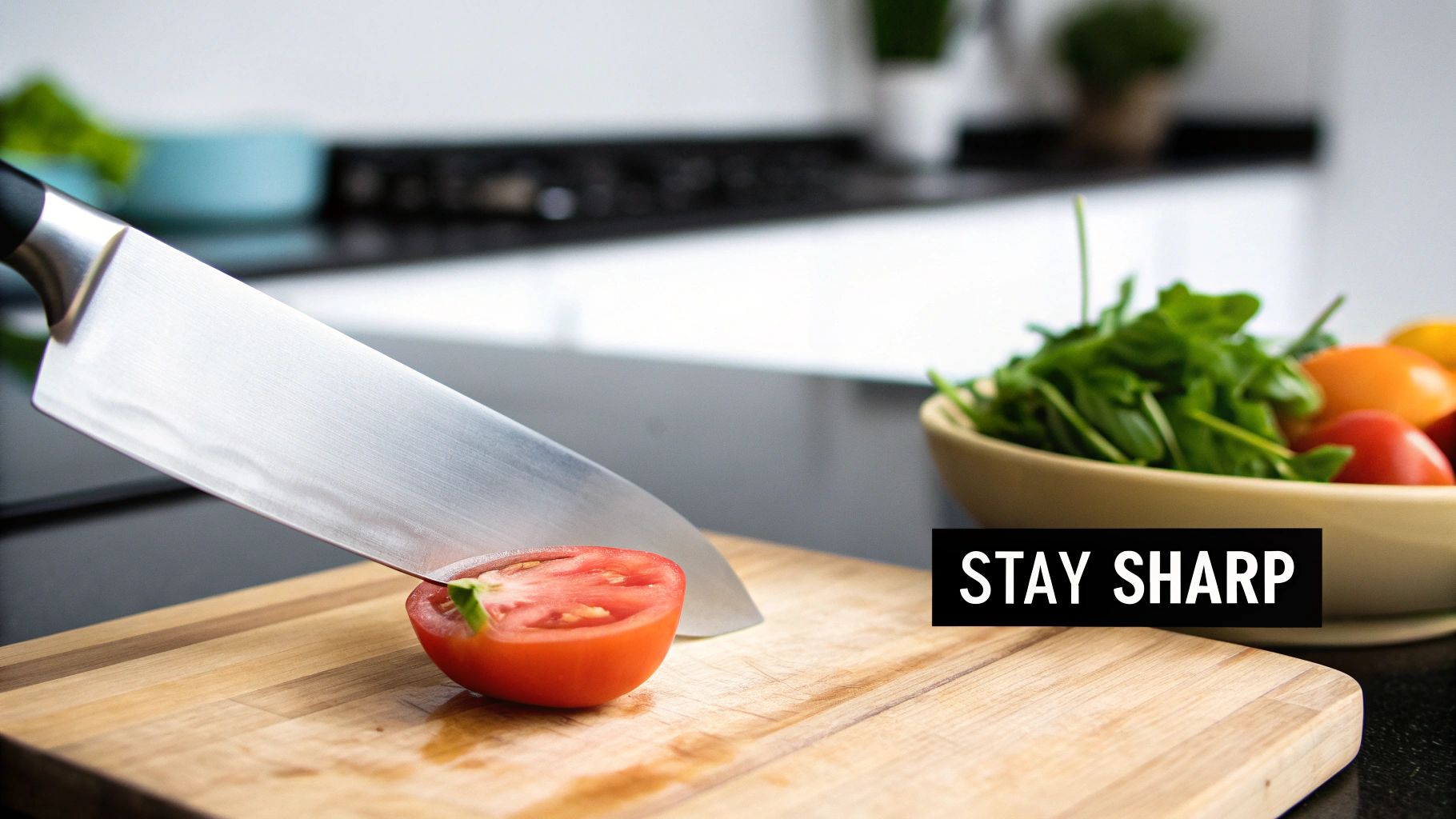
Trying to chop with a dull knife is like trying to draw a fine line with a blunt crayon. You have to push down hard, the results are clumsy and torn, and you’re far more likely to slip and hurt yourself. A razor-sharp edge, however, glides through food with almost no effort, giving you total control.
This isn’t just for professional chefs. A properly sharpened knife lets you:
- Make clean, precise cuts for food that looks as good as it tastes.
- Work faster and with much less effort.
- Massively reduce the risk of the blade slipping off your food and onto your fingers.
A knife is only as good as its maintenance routine. Investing in a quality sharpener ensures your most important kitchen tool performs safely and effectively every single time you use it.
Of course, the knife is just one piece of the puzzle. If you want to dive deeper into the different types of knives out there, this comprehensive chef knife guide is a fantastic resource. And don’t forget, the surface you cut on is just as important for keeping that edge sharp; knowing the best cutting board material for health will make all the difference.
The Hidden Dangers of a Dull Knife
It's one of the biggest myths in the kitchen: that an incredibly sharp knife is the most dangerous thing in your drawer. The truth is actually the complete opposite. A dull blade isn't just frustrating to use; it's a genuine safety hazard that seriously ups your chances of getting hurt.
Let’s get microscopic for a second. A sharp knife edge is like a perfect row of tiny, sharp teeth. They effortlessly sever food fibres, gliding through whatever you're cutting. But over time, those microscopic teeth get bent, rolled, and bashed out of alignment, creating a blunt, rounded edge.
Why You Shouldn't Use Brute Force
This is where things get risky. To push a dull blade through something like a tough capsicum skin or a slippery onion, you have to apply a whole lot of downward pressure. Instead of slicing cleanly, the blade is far more likely to slip off the food's surface and find a much softer target—like your fingers.
A sharp knife does the work for you, following your hand's direction with precision. A dull knife makes you do all the work, forcing you to use strength instead of technique. That's when accidents happen.
This exact slip-and-cut scenario is one of the most frequent injuries in home kitchens. A good cooking knife sharpener isn't just about making your prep work faster; it's a crucial piece of safety equipment.
The Aussie Appetite for Sharper Tools
As Australians have embraced home cooking with more gusto, we're using better ingredients and tackling more ambitious recipes. Naturally, that means we need better tools to get the job done right. This shift is clearly visible in the demand for quality knife maintenance gear.
The Australian knife sharpener market recently hit $7.197 million in sales and is on track to climb to $8.382 million. This isn't surprising when you think about it. We're all realising that a dull blade is a major cause of kitchen injuries, and keeping our knives sharp is the easiest way to slash that risk. You can dig deeper into the knife sharpener market trends to see the full picture.
Choosing the Right Cooking Knife Sharpener for You
Walking into the world of knife sharpeners can feel a bit daunting, but picking the right one is easier than you might think. It really just boils down to your cooking style, the knives you own, and how hands-on you want to be. The goal is to find a tool that feels right and fits naturally into your kitchen routine.
Think of a whetstone as the artisan's choice. It gives you absolute control, letting you grind a brand-new edge onto a hopelessly dull blade. There’s a learning curve, for sure, but the results are incredible if you enjoy the craft.
A honing rod, on the other hand, is more like daily maintenance. It doesn't actually remove steel to sharpen; instead, it straightens out the microscopic teeth along the blade's edge. You’d use this every few days to keep an already sharp knife performing at its peak between proper sharpenings.
This simple idea highlights a fundamental truth about kitchen safety.
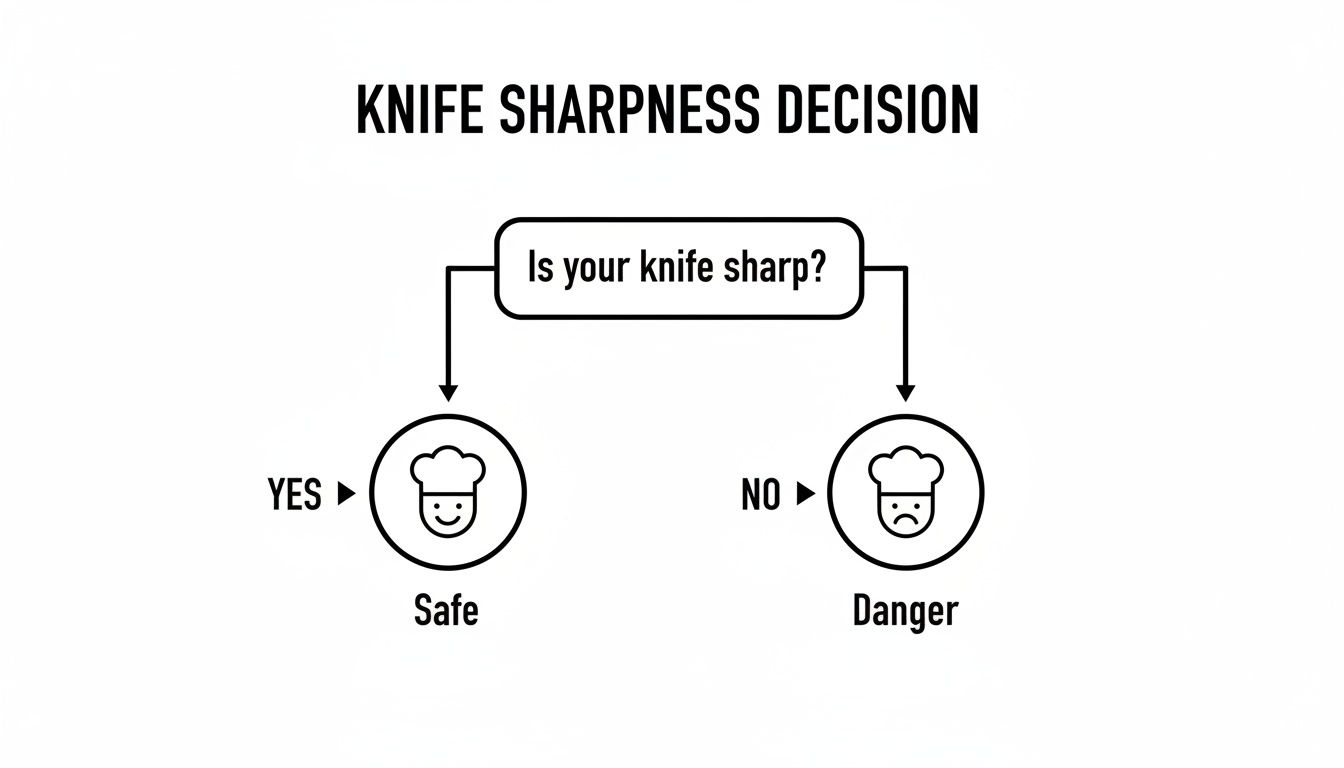
As you can see, a sharp knife isn’t just about better cooking—it's one of the most important safety tools you can have.
Finding Your Perfect Match
If speed and simplicity are what you're after, electric and pull-through sharpeners are your best friends. These gadgets are designed to be foolproof, with pre-set angles that remove all the guesswork. They get the job done quickly and consistently, perfect for busy home cooks who just need to fix a dull knife without any fuss.
The key is to match the tool to the task. Are you performing major surgery on a neglected blade (whetstone), doing a daily health check-up (honing rod), or seeking a fast and reliable fix (electric/pull-through)?
Getting this right is a big deal, and it's why the Australian knife sharpener market is on the rise. It's currently valued at around $7.2 million and growing steadily at over 4%. This reflects a bigger trend: as more people invest in good knives, they realise they need to look after them. You can dive deeper into these figures in this Australian knife industry report.
To help you visualise the options, here is a quick side-by-side comparison of the most popular knife sharpener types to help you choose the right one for your needs.
Cooking Knife Sharpener Comparison Guide
| Sharpener Type | Best For | Skill Level | Pros | Cons |
|---|---|---|---|---|
| Whetstones | Re-profiling a blade or fixing a very dull/damaged knife | Advanced | Complete control over angle and finish; best possible edge | Steep learning curve; time-consuming |
| Honing Rods | Daily/weekly maintenance to realign the blade's edge | Beginner | Quick and easy to use; extends time between sharpenings | Doesn't actually sharpen a dull knife |
| Pull-Through Sharpeners | Quick touch-ups and general sharpening for beginners | Beginner | Very easy to use; compact and affordable | Can remove too much metal; fixed angles may not suit all knives |
| Electric Sharpeners | Fast, consistent sharpening with minimal effort | Beginner | Extremely fast and convenient; consistent results | Can be expensive and bulky; removes more metal than manual methods |
Each of these tools has its place in the kitchen, and the best one for you depends entirely on what you're looking for.
Ultimately, the best cooking knife sharpener is the one you'll actually use. Think about your budget, how much space you have, and the time you're willing to put in. Whether you go for the meticulous control of a whetstone or the plug-and-play ease of an electric model, you’re making a smart investment in a safer, more enjoyable kitchen.
How Your Cutting Board Impacts Your Knife's Edge
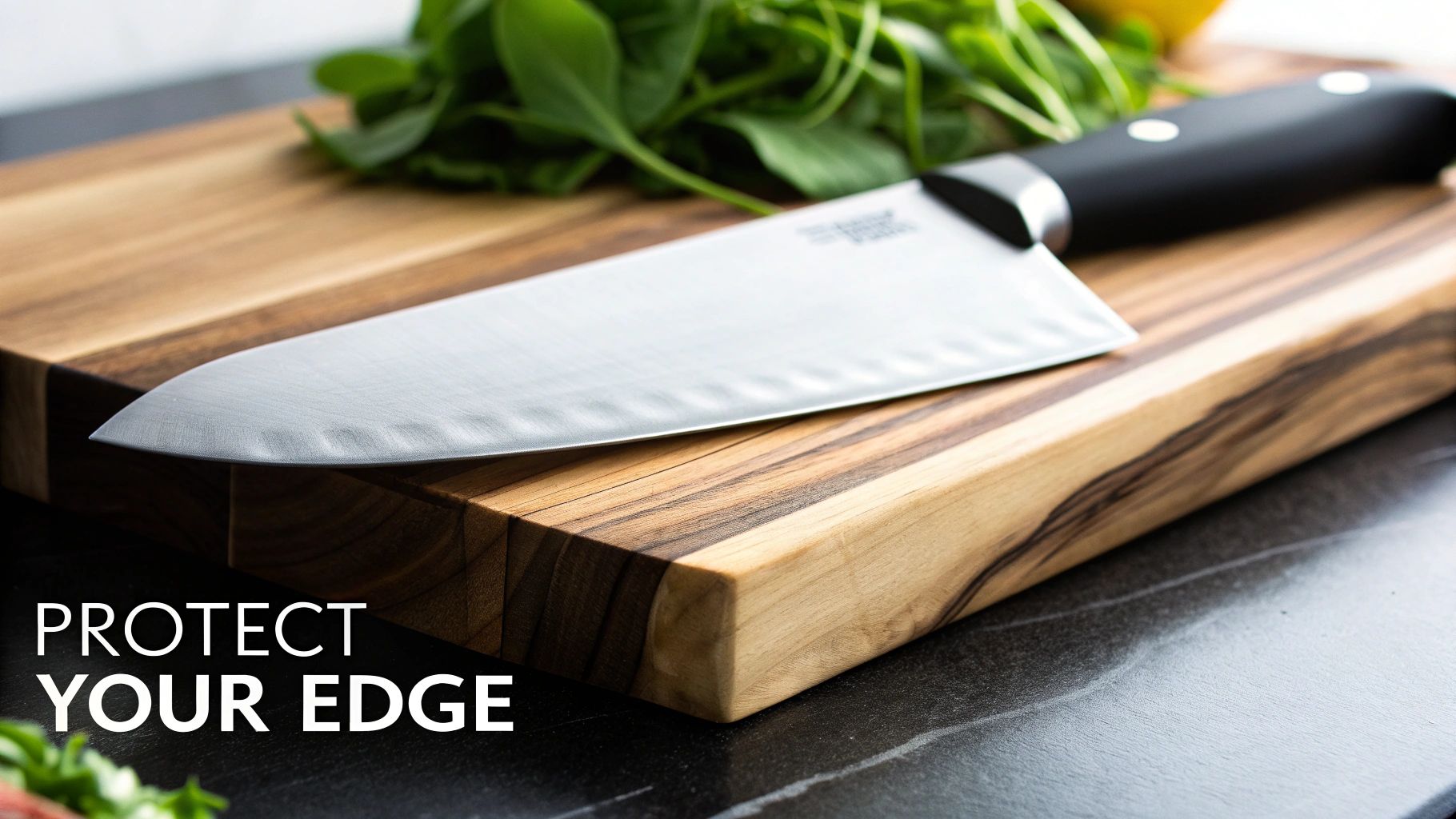
Having a great cooking knife sharpener is fantastic, but it's only half of the sharpness equation. The other, often-overlooked half, is the surface your knife lands on hundreds of times with every meal you prepare: your cutting board. The wrong board can undo all your hard work in a surprisingly short amount of time.
Think about what happens when your knife’s finely honed edge strikes a hard surface like glass, granite, or ceramic. On a microscopic level, it’s a tiny car crash. These unyielding materials act like a brick wall, causing the delicate steel edge to roll over, chip, and dull with every slice. This is why a perfectly sharpened knife can feel blunt again after just a few uses.
Creating a Blade-Friendly Partnership
The real secret to lasting sharpness lies in the partnership between your knife and its cutting surface. A board with the right amount of "give" will cushion the blade’s impact, preserving its razor-sharp edge for much, much longer. This synergy dramatically cuts down on how often you'll need to pull out the sharpener.
Think of it this way: A good cutting board protects your investment in both your knives and your sharpener. It's the unsung hero of a sharp, safe, and efficient kitchen.
This is where the material of your board really matters. For instance, a pure titanium cutting board, like the ones from Everti, offers a surface that’s far kinder to stainless steel knives than those traditional hard options. It supports the blade's edge while also providing a hygienic, non-porous station for your food prep. To keep your knives in top condition, it pays to explore different cutting board choices that protect your blade.
Here in Australia, we're seeing this play out as more people get serious about their home cooking. Health-conscious families now drive over 55% of the demand for sharpening, with home cooks looking for tools that minimise edge damage. By choosing the right board, you can learn more about keeping your knives sharp for longer.
A Practical Guide to Sharpening Your Knives
Ready to bring that dangerously dull blade back to life? Let's walk through how to use two of the most popular tools out there: the whetstone and the honing rod. We'll turn what seems like a tricky task into a satisfying kitchen ritual with a few simple, actionable steps.
The idea here is to get you feeling confident, not intimidated. A good knife sharpener isn't just another gadget; it's your key to a safer, more efficient kitchen. First up, we'll tackle the artisan's choice for creating a brand-new edge from scratch.
Using a Whetstone Correctly
A whetstone works by grinding away a tiny amount of steel to forge a new, razor-sharp edge. The absolute most important part of this whole process is keeping a consistent angle. Here's a neat little trick: slide a matchbook under the spine of your knife. This will give you an angle of about 15-20 degrees, which is the sweet spot for most kitchen knives.
- Soak Your Stone: If the manufacturer recommends it, pop your whetstone in some water and leave it until the bubbles stop rising.
- Find Your Angle: Use that matchbook trick to get a feel for the right angle against the stone.
- Sharpen in Sections: Start at the heel of the blade. Push the knife away from you in one smooth, sweeping motion. Do this 5-10 times, then move on to the middle section, and finish with the tip.
- Repeat on the Other Side: Flip the knife over and do the exact same thing, making sure to use the same number of strokes on each section to keep the edge balanced.
Mastering the Honing Rod
A honing rod doesn't actually sharpen your knife; it realigns an edge that's already sharp. The best way to think of it is like combing the microscopic "teeth" of your blade back into a straight line. Hold the rod vertically, planting the tip firmly on a non-slip surface like your cutting board.
The most common mistake is treating a honing rod like a sharpener. It is a maintenance tool for frequent use, not a solution for a truly dull knife.
Swipe the knife down the rod, from heel to tip, at that same 15-20 degree angle. Make sure you alternate sides with each pass. You really only need about 5-8 strokes per side before most cooking sessions. Regular honing keeps your edge in top shape and your board clean, which is why proper titanium cutting board cleaning is another crucial part of a hygienic kitchen.
Your Knife Sharpening Questions, Answered
Even with the best gear, a few questions are bound to pop up. Let's tackle some of the most common ones about using a cooking knife sharpener so you can keep your blades in top shape with complete confidence.
Think of this as your go-to FAQ for keeping your knives ready for anything.
How Often Should I Actually Sharpen My Knives?
Honestly, it all comes down to how much you use them. For the average home cook, a proper sharpening session on a whetstone every six to twelve months is usually plenty. This is the big reset that grinds a fresh, new edge onto the blade.
Honing, on the other hand, is something you should do all the time. A few quick passes on a honing steel every couple of uses will keep that sharp edge perfectly aligned and biting properly. It’s a two-minute job that makes a world of difference.
If you're ever in doubt, try the tomato test. A truly sharp knife should slice through a tomato's skin with almost no downward pressure. If you have to push, it's time to at least give it a hone.
Can I Accidentally Ruin My Knife with a Sharpener?
The short answer is yes, you can. It's not as scary as it sounds, but using the wrong tool or technique can definitely cause problems. Some aggressive electric sharpeners can chew away too much steel, while holding an inconsistent angle on a whetstone can mess up the edge.
The two biggest mistakes are removing too much metal too fast and failing to hold a steady angle. A little patience goes a long way here.
To get the hang of it without any stress, practise on an old, cheap knife you don't care about. Honing rods are much safer for beginners because they don’t actually remove any metal, which makes them the perfect tool for regular, everyday upkeep.
What's the Real Difference Between Honing and Sharpening?
Getting this right is the absolute key to knife care. The best analogy I've heard is that sharpening is like major surgery, while honing is just a regular check-up.
- Sharpening is the process of physically removing a tiny amount of steel to create a brand-new edge when your knife has become genuinely dull.
- Honing doesn't remove steel at all. It just straightens out the microscopic teeth of an already-sharp edge that have been knocked out of alignment through normal use.
You sharpen every once in a while to bring a dull knife back to life. You hone constantly to keep a sharp knife working perfectly.