

A deep pot usually enters the scene at the exact moment a regular pot starts causing trouble. Your soup is rising fast. Pasta water is threatening to foam over. A stock needs hours on the stove, but the liquid level keeps dropping lower than you expected. You don't need a fancy lesson at that point. You need a pot with enough height, enough control, and enough room to cook calmly.
That's why deep pots for cooking are so useful. Their value isn't just that they hold more. Their tall sides change how liquid moves, how steam escapes, how safely food bubbles, and how easy it is to cook bigger, slower meals without splashing half the stove.
In Australia, pots are not a niche category. They were the largest product segment in the country's cookware market in 2024, with the pots category valued at USD 128.39 million, while the total cookware market was estimated at USD 255.75 million that year, according to Australia cookware market research. That matters because deep pots sit inside a cookware category many households rely on every week, especially for boiling, simmering, and batch cooking.
Introduction to Deep Pots and Why Depth Matters
You can see the need for a deep pot in ordinary cooking. A chicken stock wants headroom. Lentil soup expands as it boils. Corn cobs, spaghetti, mussels, and preserving jars all ask for vertical space in different ways. When the pot is too shallow, you spend the whole time turning the heat down, wiping the cooktop, or stirring nervously so nothing spills.
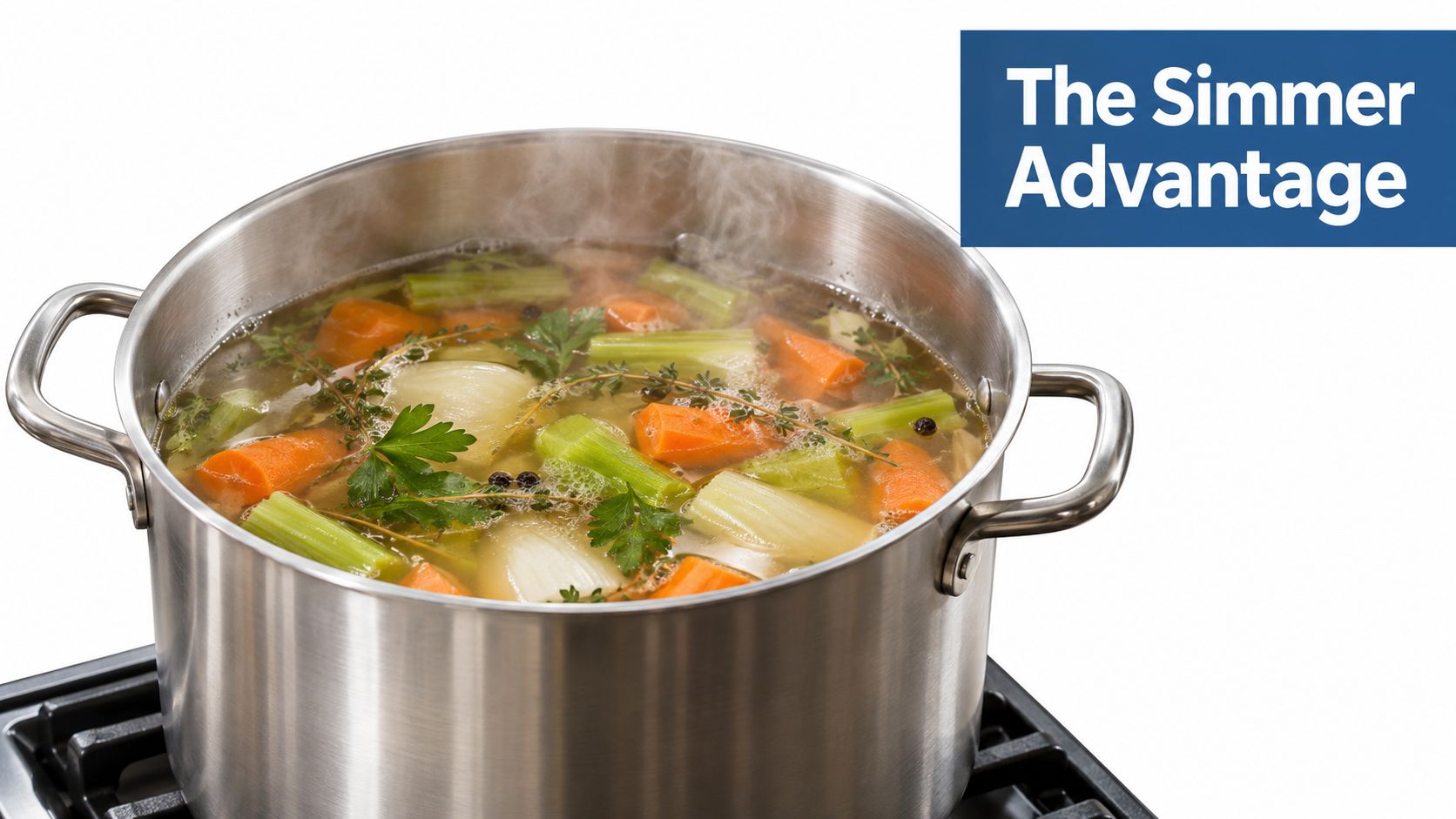
A deep pot solves a specific problem. It gives bubbling liquid more vertical room, which helps with boil-over control and makes long simmers feel less cramped. That's especially helpful when you cook broths, soups, stews, boiled vegetables, grains, or anything that starts with plenty of water and keeps moving as it heats.
Where people often get confused
Many shoppers look only at capacity. That's understandable, but capacity and depth are not the same decision. Two pots can hold a similar amount, yet cook quite differently if one is taller and narrower while the other is wider and lower.
A taller pot usually slows evaporation and contains splatter better. A wider pot can make stirring easier and may heat more directly across the base. Neither shape is automatically better. The right choice depends on what you cook most often, how strong your cooktop is, and how much cupboard space you can spare.
If your kitchen already feels crowded, practical setup matters too. Good workflow around the stove, sink, and prep area makes a heavy liquid-filled pot much easier to manage. If you're rethinking your kitchen habits, these Norwich kitchen efficiency tips from Gorins offer useful ideas for organising movement and storage in a busy cooking space.
A deep pot should make cooking calmer, not clumsier.
Why depth deserves more attention
Most buying guides tell you what a stockpot is. Fewer explain what depth changes in daily use. That's the part that matters once you own it. Tall walls affect heating up the contents, stirring from the bottom, reducing liquids, and carrying the pot to the sink.
Deep pots for cooking are most useful when you regularly make food that benefits from volume and time. If you mainly cook quick sauces, shallow braises, or foods that need fast reduction, more depth can become a burden instead of a benefit.
What Makes a Deep Pot Different From Other Cookware
A deep pot is different because of shape, not just size. The easiest way to picture it is to compare a tall glass with a wide bowl. They might hold a similar amount, but the liquid behaves differently in each one. Heat travels differently. Steam escapes differently. Even stirring feels different.
Shape changes the cooking job
A saucepan is often built for smaller quantities and quicker control. A braiser is wide and shallow, so moisture reduces faster and stirring across the bottom is easy. A Dutch oven can be deep, but many are broader and heavier, built for both stove and oven cooking.
A deep pot leans into vertical space. That shape is helpful for:
- Soups and stocks because ingredients can sit under liquid with less splashing
- Pasta and boiled vegetables because water has room to roll without immediately climbing over the rim
- Steaming and blanching because height helps contain rising steam
- Batch cooking because tall walls hold volume without demanding as much burner width
One practical way to compare shapes is to browse examples of different cooking pot types and notice how each form supports a different cooking style.
Tall walls do more than contain food
The walls of a deep pot are active parts of the cooking environment. They hold heat, reflect steam back down, and influence how hot liquid circulates inside the pot. As depth increases, the wall area matters more.
That's why deep pots can be excellent for long simmering foods, but also why poor construction shows up quickly. If the base gets very hot while the walls stay cooler, you can end up with too much heat concentrated at the bottom and not enough even movement through the rest of the pot.
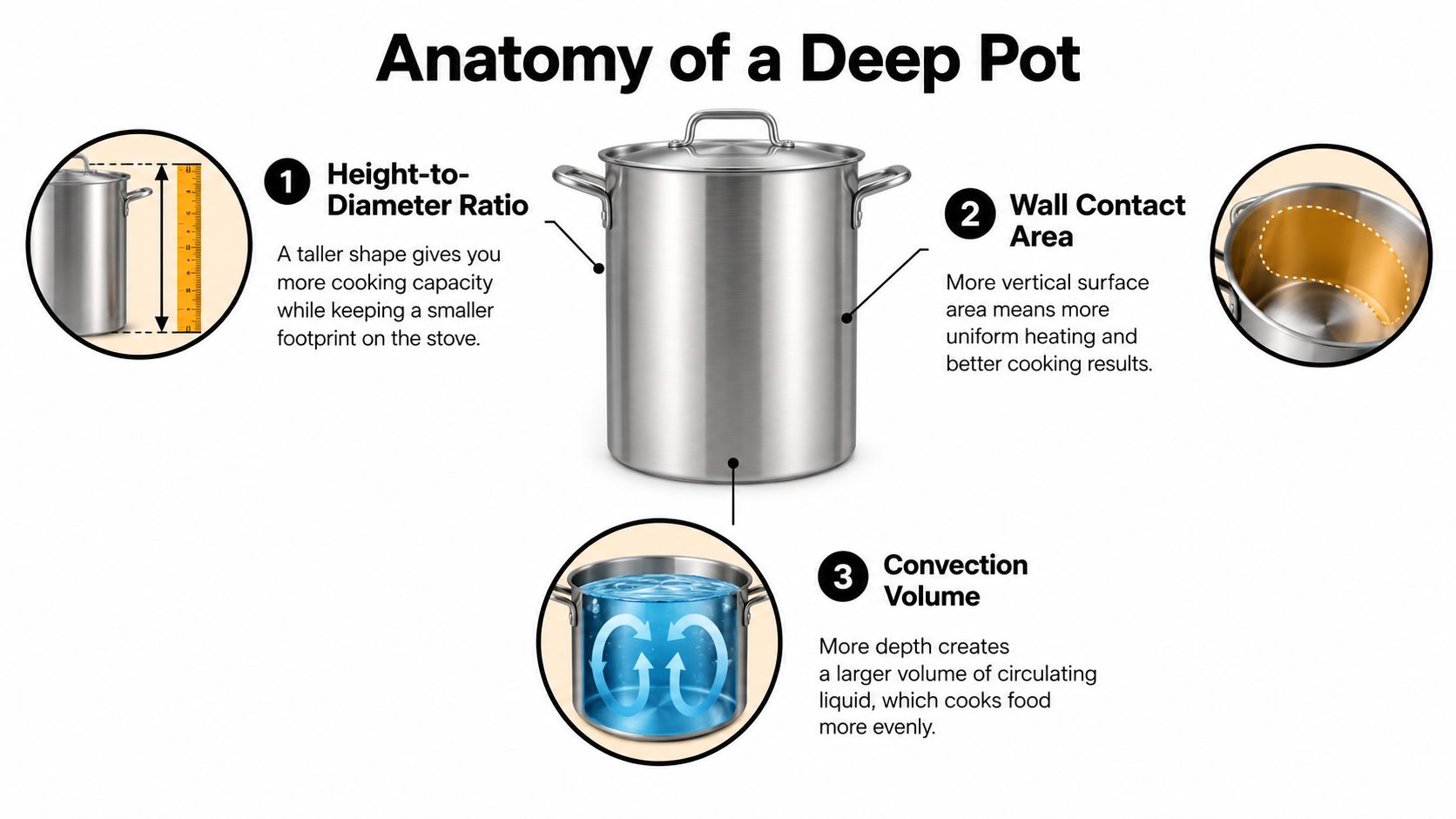
A short visual makes this easier to grasp:
Three functional differences to notice
-
Height-to-diameter ratio
A taller, narrower pot gives you more depth for the same footprint. That can help on smaller cooktops, but it also means heat has farther to travel through the contents. -
Wall contact area
The deeper the pot, the more interior wall space interacts with hot liquid and steam. That affects heat retention and how steadily a simmer behaves. -
Convection volume
In a deep pot, heated liquid rises from the lower area and cooler liquid drops back down. That movement can work well for soups and stocks, but only if the pot heats evenly enough to support it.
The deeper the vessel, the less useful it is to think only about the base. The walls start shaping the result too.
Comparing Deep Pot Materials and How They Handle Heat
Material matters more in a deep pot than many people expect. In a frying pan, you're mostly worried about the cooking surface. In a tall pot, you also need to think about how heat spreads upward and outward through a larger body of liquid.
The biggest confusion usually starts with stainless steel. People know it's durable and easy to maintain, so they assume all stainless pots perform similarly. They don't.
Why stainless alone can struggle in tall pots
In cookware analysis, 304 stainless steel is cited at about 16.2 W/m·K at room temperature, while aluminium is around 237 W/m·K and copper around 401 W/m·K. That's why fully clad or multi-ply deep pots tend to heat more evenly than single-layer stainless steel designs, according to this heat distribution analysis of stainless steel cookware.
In plain language, stainless steel is strong and practical, but it doesn't move heat very well on its own. In a deep pot, that weakness matters because heat doesn't just need to spread across the bottom. It also needs to support even cooking through a taller column of food or liquid.
Why cores and cladding matter
When a deep pot has an aluminium or copper core, that inner layer helps spread heat laterally from the burner. The result is steadier temperature across the base and better support for the liquid above it. The same source notes a trade-off. Thicker hybrid constructions in roughly 2–5 mm builds add weight and cost.
That trade-off is worth understanding before you buy. A tall pot full of stock is already heavy. Add a thick clad body and the handling changes. You gain cooking performance, but you also need comfortable handles and a realistic plan for lifting it.
Here's a practical comparison:
Deep Pot Material Comparison for Everyday Cooking
| Material | Heat Distribution | Weight and Care | Best For |
|---|---|---|---|
| Stainless steel, single layer | Durable, but can create hotter zones near the base in deep-pot cooking | Usually straightforward to clean, often lighter than thick clad builds | Boiling water, simple cooking where perfect evenness matters less |
| Stainless steel with aluminium or copper core | More even heat spread, better suited to soups, stocks, braises, and long simmers | Heavier and often dearer, but strong for regular use | Home cooks who want all-round performance |
| Titanium | Often chosen for light weight, corrosion resistance, and clean-surface appeal rather than heavy heat retention | Light to handle, generally low-fuss, useful where portability matters | Minimalist kitchens, outdoor use, cooks who value lightness and durability |
| Nonstick | Convenient for easy release, though less common as the first choice for very large stock-style jobs | Needs gentler utensils and cleaning habits | Reheating, gentle foods, lower-stick cooking |
| Cast iron | Holds heat well once hot, but can be slow and very heavy in deeper forms | Demands more effort to lift and maintain, especially when full | Slow cooking, oven-to-table use, hearty stews |
How to compare listings without guessing
Australian cookware pages often focus on brand, capacity, and cooktop icons, but they don't always explain how construction changes the experience of a tall pot. When you compare listings, pay attention to:
- Body construction if the pot is described as clad, multi-ply, or layered
- Weight expectations if you batch cook often
- Cooking style because a pasta pot and a stock pot don't stress materials in the same way
- Maintenance reality rather than what looks best in a product photo
If you want a broader material mindset before narrowing down a pot, this guide to good quality pots and pans is a useful companion.
One more material note belongs here. Everti offers pure titanium cookware as one option for cooks who want a lightweight, corrosion-resistant pot material with an uncoated surface. That won't suit every cooking style, but it can make sense when lower weight and straightforward cleaning matter more than heavy heat retention.
Choosing the Right Size and Depth for Your Kitchen
The most overlooked deep-pot question isn't “How many litres?” It's “How deep can I use comfortably on my cooktop, in my sink, and in my cupboards?”
That's the practical gap many Australian shoppers run into. Retail pages often highlight capacity ranges and cooktop compatibility, but they rarely explain the depth trade-offs that affect daily cooking, as seen in Australian stockpot retail listings.
Capacity isn't the whole story
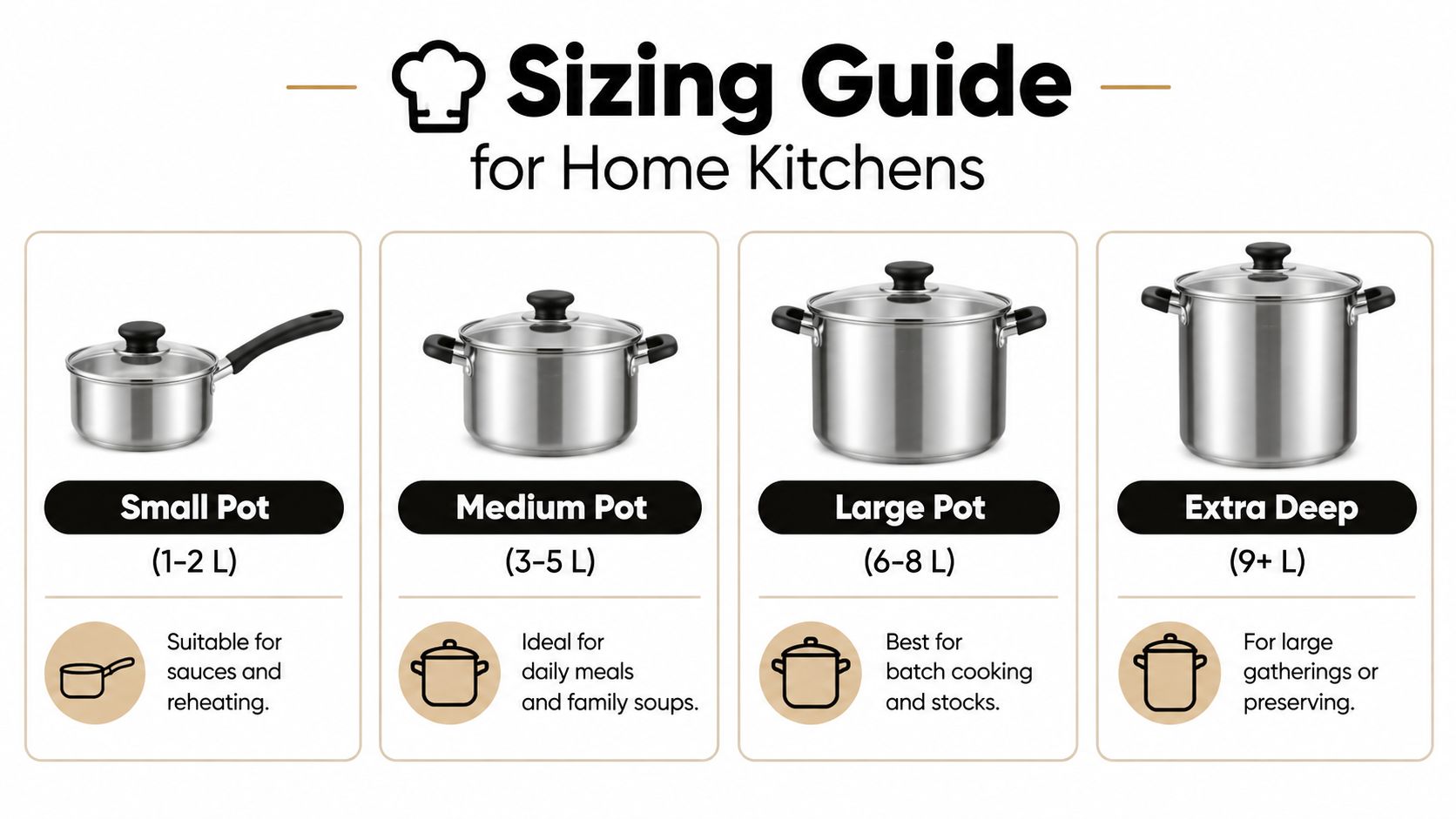
A compact household may not need an extra-deep vessel, even if big-batch cooking sounds appealing. Tall pots can be awkward to stir, slower to heat, and annoying to store if your kitchen is short on vertical space. This matters even more on modest home burners, where a very tall pot may keep the base hot while the upper volume takes longer to settle into a steady simmer.
At the other end of the scale, commercial gear shows how important vertical geometry becomes in high-capacity cooking. An Australian commercial boiling pan listing specifies a vessel depth of 589 mm and diameter of 892 mm, showing that deep-vessel design is deliberate in large-volume boiling and braising contexts, according to this commercial boiling pan specification.
Most home kitchens, of course, don't need anything close to that style of scale. The lesson is simpler: once depth increases, geometry starts driving performance.
A practical way to choose
Use your cooking habits first, then your storage limits, then the product description.
-
For one or two people
A medium pot often handles soups, pasta, grains, and small batch broths without dominating the cupboard. -
For families
A deeper pot makes sense when you often cook one-pot meals, boil pasta for several people, or want leftovers ready for the next day. -
For batch cooks and preservers
Extra depth helps when you're making stock, cooking bones, boiling corn, or preparing food in larger rounds. -
For small kitchens
There's a point where extra depth becomes friction. If stirring feels awkward and washing the pot feels like wrestling a bucket in the sink, it's too much pot for the space.
When a deep pot becomes too deep
Australian product listings often separate home and catering stockpots by size, but they don't always explain when the jump becomes unhelpful for households. Listings geared to hospitality push 19L–50L+ stockpots, while consumer pages still present 7.6L–11L pots as typical home options, a gap visible in Australian stockpot listings across home and hospitality use.
That mismatch explains why some people buy a huge pot and then barely use it. It's not that the pot is bad. It's that the pot belongs to a different cooking environment.
Practical rule: Buy for your real burner size, your real sink, and your real shelf space. Not for the one weekend each year when you cook for a crowd.
Lids Handles and Features That Improve Everyday Use
A deep pot can have the right material and the right size and still feel wrong in daily use. The difference often comes down to the details you touch every time you cook: the lid, the handles, the rim, and the base.
Lid fit changes the cooking outcome
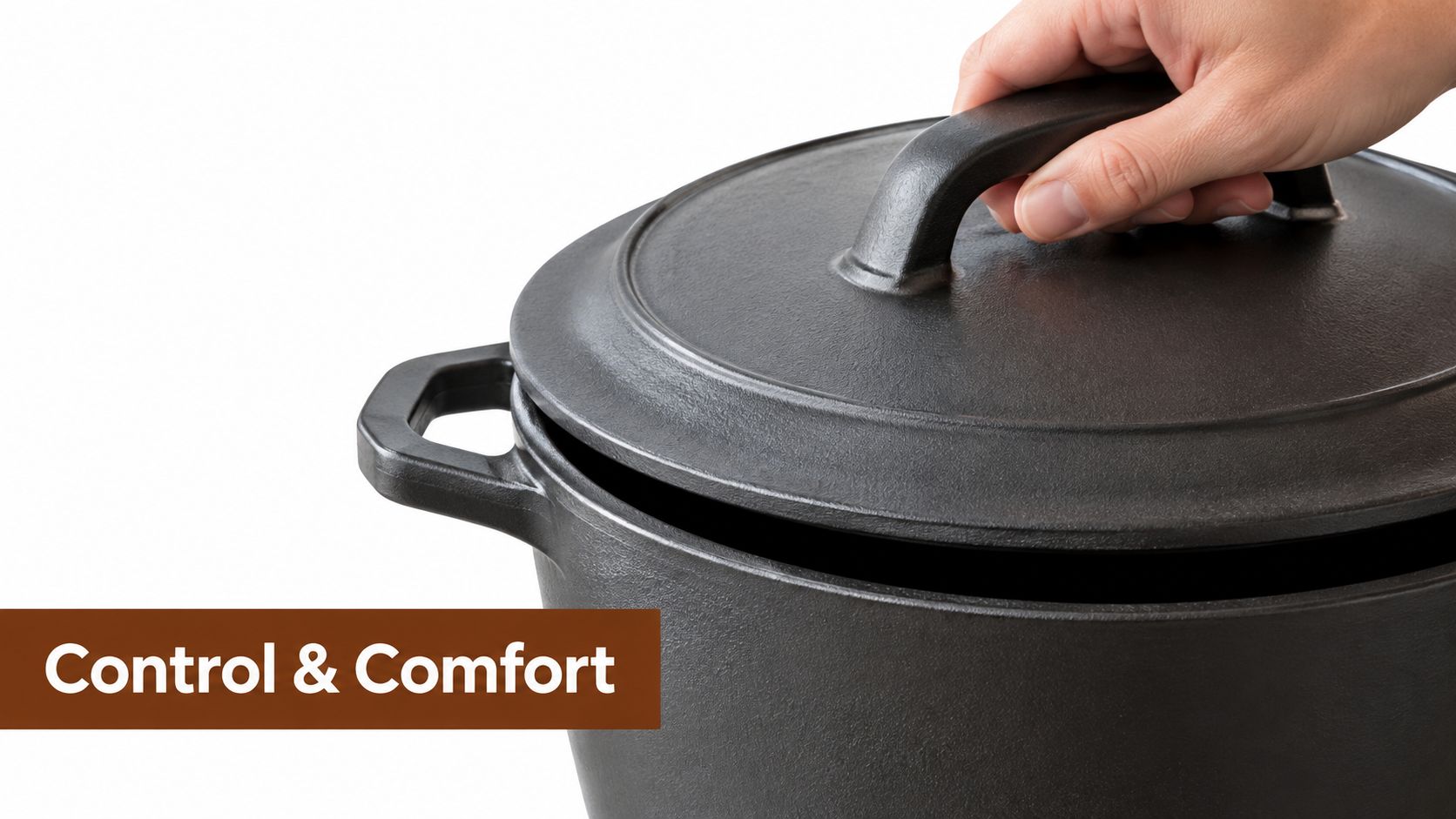
A tighter lid helps hold moisture and heat. That's useful for stocks, stews, and long simmers where you don't want the liquid level dropping too quickly. A looser or vented lid can be handy when you want more evaporation or less rattling during a lively boil.
If you make soup every week, a secure lid matters more than a flashy finish. If you boil pasta and vegetables more often, you might prefer a lid that's easy to lift and set aside quickly without feeling slippery or unstable.
Handles need to match the weight of the job
Deep pots become heavy fast because liquid is heavy. Ingredients add more. A pot that feels manageable empty can become awkward once full.
Look for:
- Wide side handles that leave enough room for oven mitts
- Secure attachment points so the pot doesn't twist when lifted
- Balanced proportions so the body doesn't feel top-heavy
If the pot may go from hob to oven, handle material and heat tolerance matter too. This guide to oven-safe cookware basics helps when you're deciding whether one vessel can cover both jobs.
Features that are worth paying for
Some extras are useful. Others are mostly noise in a product listing. The best way to judge them is by matching them to your habits.
- Rolled or shaped rims help when pouring stock or draining water.
- Interior measurement markings are handy for soups and grains.
- Induction-compatible bases matter if your cooktop uses induction, but they don't tell you much about how the pot will behave at full depth.
- Straining lids or insert systems can simplify pasta, blanching, or preserving setups.
A feature is only valuable if it removes a repeated annoyance.
If you dread lifting the lid, draining the water, or finding cupboard space, the pot won't become a favourite no matter how good the material is.
Caring for Deep Pots to Keep Them Performing for Years
A deep pot lasts longer when care matches the way the pot works. Tall walls catch splashes, starch, fat, and stock residue higher up the sides than many people expect. If you clean only the base well and rush the walls, performance and appearance both suffer over time.
Clean for depth, not just surface shine
After simmering soup or stock, check the inside walls for a ring line. That mark usually tells you where starch, minerals, or proteins settled during cooking. If you leave it there repeatedly, the pot can become harder to clean and less pleasant to use.
A few habits help:
- Wash soon after cooling so residue doesn't set hard on the upper walls
- Use non-abrasive tools on finishes that scratch easily
- Dry thoroughly around rims, rivets, and handle joins
- Avoid sudden temperature shocks when the pot is very hot
Match the routine to the material
Stainless steel often tolerates thorough scrubbing better than coated surfaces, but it still benefits from gentle cleaning before residue bakes on. Nonstick surfaces need softer utensils and lighter washing methods. Titanium appeals to many cooks because it's corrosion-resistant and straightforward to clean in everyday use.
Historical cookware choices in Australia also reflect this practical side. A historical overview notes a shift from early cast iron and Dutch ovens to aluminium cookware in the twentieth century because aluminium was lightweight and corrosion-resistant, within the broader story of Australian cookware development documented in this Australia cookware history overview.
Deep pots don't fail all at once. People usually wear them down through small repeated habits.
Storage matters more than people think
A tall pot shoved onto a high shelf becomes annoying fast. If it's hard to reach, you'll use it less. Store it where you can lift it safely with two hands, and avoid stacking rough lids or heavy cookware inside if the interior finish marks easily.
Good care isn't fussy. It's just consistent. A pot that's cleaned well, dried properly, and stored sensibly tends to stay useful for a long time.
Finding the Best Deep Pot for Your Cooking Style
The right deep pot is the one that fits your actual meals, not the one with the biggest number on the label.
Match the pot to the cook
If you cook family soups, pasta, curries, and weeknight stews, a medium-to-large deep pot with even heat and comfortable handles is usually the most sensible choice. If you batch cook stock, legumes, or freezer meals, a taller pot with better wall-supported heat performance makes more sense.
For a health-focused minimalist, material may drive the decision more than capacity. You might care most about an uncoated interior, easy cleaning, and low-fuss durability. For outdoor cooks or small-space users, lighter materials can be more practical than very thick, very heavy constructions.
Think in trade-offs, not labels
A deeper pot gives you headroom, but asks more from heat distribution and storage. A lighter pot is easier to carry, but may not hold heat the same way as a heavier build. A large catering-style pot sounds flexible, but can become dead cupboard weight in a normal home kitchen.
The strongest buying decision usually comes from three questions:
- What do I cook most often?
- How much weight do I want to lift when it's full?
- Will this depth work on my cooktop and in my kitchen every week?
Pots remain a major cookware category in Australia. The country's cookware market was estimated at USD 255.75 million in 2024, with residential cookware at USD 157.18 million in 2024, and the market is projected to reach USD 378.3 million by 2033 at a projected 4.46% CAGR for 2025 to 2033, according to Australian cookware market sizing and projections. That doesn't tell you which pot to buy by itself, but it does show that durable pot-based cookware remains central in home kitchens.
Choose depth because it solves a recurring cooking problem. If it gives your food more room, your simmer more control, and your kitchen less mess, it's doing its job well.
If you're comparing materials for a deep pot and want something lightweight, uncoated, and built around long-term daily use, Everti offers pure titanium cookware alongside other kitchen essentials designed for clean, durable performance. To see how that approach fits into your own cooking setup, visit Everti.