

The safest dinner set with glasses for health-conscious Australian households is an uncoated, tested titanium set or a fully vitrified ceramic and clear-glass set with documented lead and cadmium migration results, dishwasher-compatible design, and clear disposal guidance. For ceramic tableware, useful benchmark limits are 20.0 mg/L lead and 2.0 mg/L cadmium for plates, and 7.0 mg/L lead and 0.7 mg/L cadmium for cups, mugs, jugs, and similar vessels up to 1,100 mL.
What matters more at dinner, the colour of the glaze or what happens when the rim chips, the dishwasher is loaded, and the glass reaches the recycling bin? Most buying guides begin with shape, price, and Instagram appeal. A safer approach begins with the complete life of the set, from food contact and cleaning to breakage and disposal.
Why Dinner Set Choice Matters Beyond Appearance
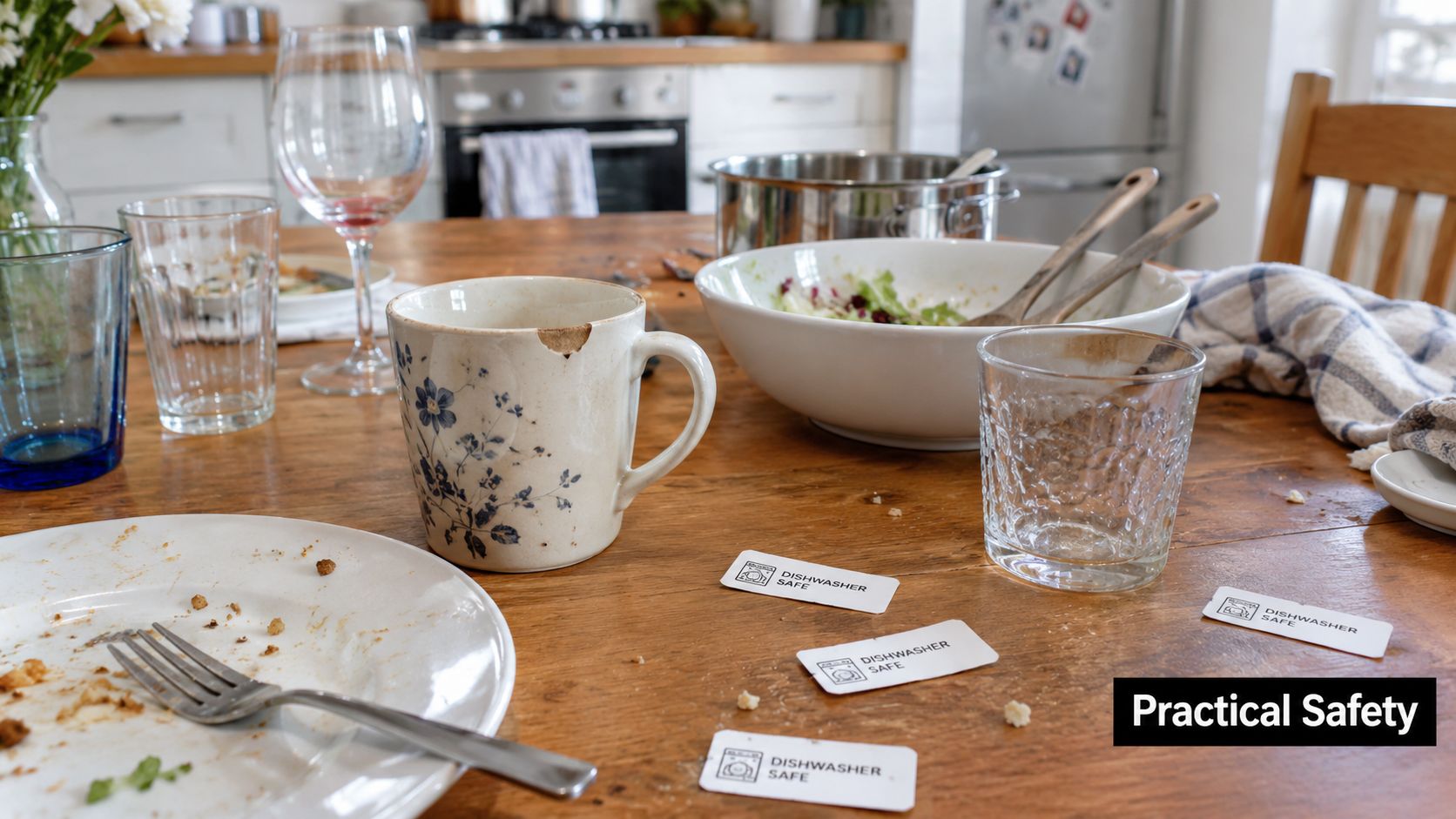
A weekend dinner can expose every weakness in a dinner set. One guest reaches for a glass with a cloudy mark that won't wash off. Someone notices a small chip on a plate rim. The bowls don't stack properly, two glasses can't fit securely in the dishwasher rack, and nobody knows whether the metallic decoration can go through a hot cycle.
The meal may have looked carefully planned, but the cleanup becomes a process of sorting exceptions. One piece needs hand washing, another needs inspection, and a third has to be removed from service. The problem isn't a lack of style. It's that the plates, bowls, and glasses were chosen as separate objects rather than as one working system.
Australian households have long used table settings to express hospitality, organisation, and changing ideas about domestic life. Museums of History New South Wales documents formal settings from the colonial period through the twentieth century, including Governor Philip's table in 1788, Victorian banquets, and highly designed interiors of the 1950s. The same historical record shows that coordinated tableware was tied to entertaining, gifting, and household identity, not just basic function. Australian table-setting history provides useful context for why a dinner set still carries meaning beyond its individual pieces.
The real cost is the maintenance burden
The sticker price tells you what you pay at checkout. It doesn't tell you how often a fragile glass will need replacing, whether a worn decoration needs special handling, or how much storage space an awkward set will consume. A set that looks excellent in a product photograph can become frustrating if it resists efficient loading or has unclear food-contact documentation.
A more useful evaluation asks:
- Food contact: Can the seller identify the materials, glaze, decoration, and relevant migration testing?
- Daily cleaning: Are the pieces suited to the way your household washes them?
- Physical condition: Are rims, bases, and surfaces likely to remain smooth and easy to inspect?
- End of life: Does the seller explain what to do with broken or mixed components?
Glasses deserve the same attention as plates. Their shape affects stability, storage, dishwasher loading, and the way drinks are served. If you're choosing different vessels for different drinks, a practical guide to picking glasses for red and white can help you consider use before appearance.
Practical rule: Choose a dinner set that makes the safe, efficient choice the easy choice every day.
Core Materials Compared for Safety and Durability
Material names are useful starting points, but they don't prove that a finished product is safe. A hard surface can still have a vulnerable glaze, decorative coating, damaged rim, or poorly documented composition. Physical durability and chemical safety are separate questions.
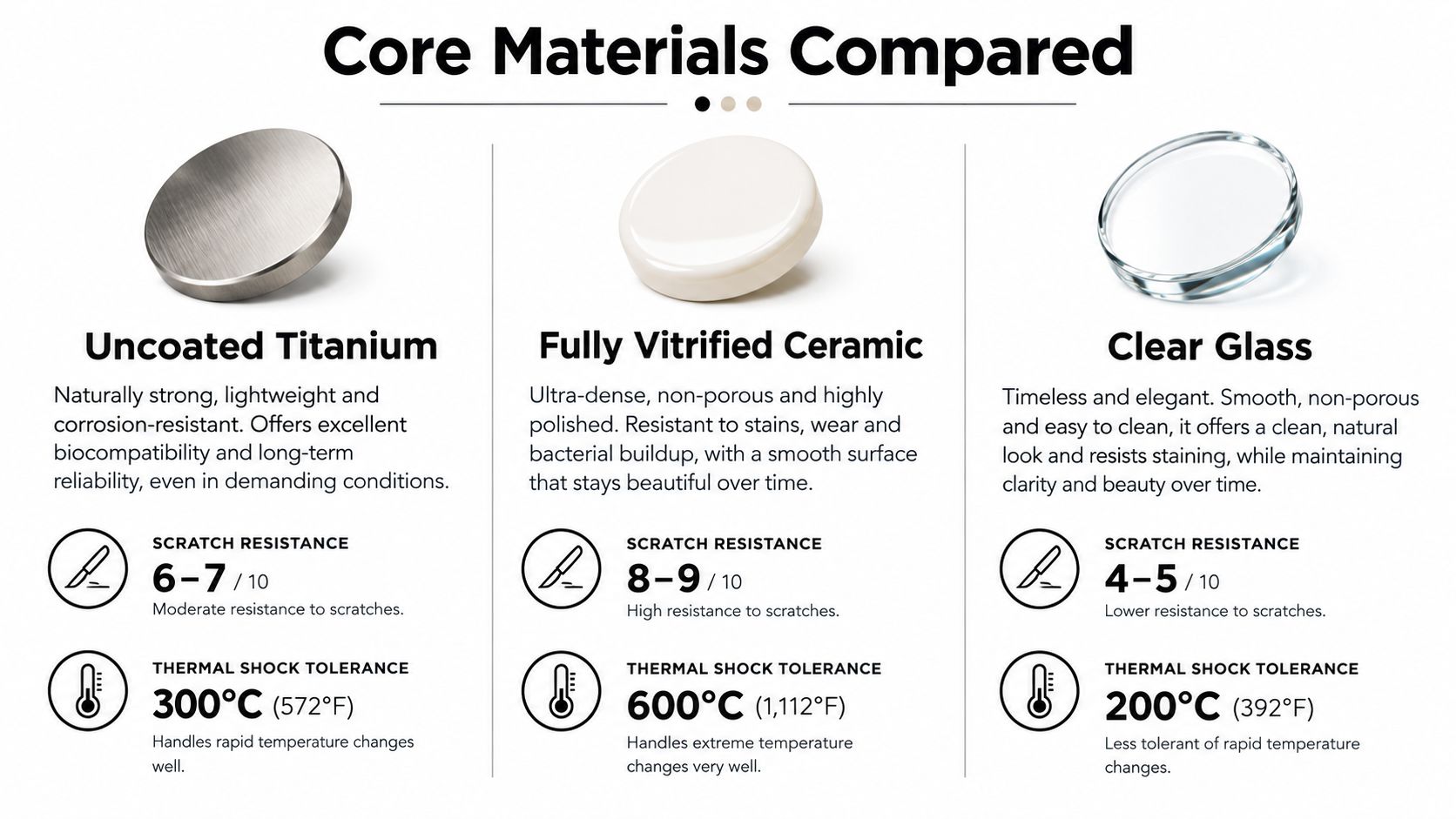
Uncoated titanium is an appealing option when a supplier can document its composition and intended food-contact use. With no decorative coating to wear away, the surface is straightforward to inspect. It may also suit buyers who want a restrained, lightweight-looking table setting, although the feel, sound, weight, and visual character won't be the same as ceramic or glass. Ask for material specifications rather than accepting a broad phrase such as “premium titanium”.
Fully vitrified ceramic is dense and practical when it has been properly manufactured and tested. Its strength lies in a well-formed, stable body and a surface that remains smooth and cleanable during normal use. The risk increases when a buyer treats every ceramic finish as equivalent. Glazes, printed decorations, metallic details, and exposed edges need separate consideration, especially if the supplier doesn't provide food-contact documentation.
Clear glass is visually simple and makes surface wear easier to notice. It still needs careful assessment, because a drinking glass has different geometry and use conditions from a plate. Look for information about composition, intended temperature range, decoration, and cleaning instructions. A clear appearance isn't evidence that migration testing has been completed.
Where coatings and mixed materials complicate the decision
Decorated ceramic may be perfectly suitable, but the decoration deserves its own review. A printed pattern on the food-contact surface, a metallic rim, or a glaze that develops crazing creates more questions than an undecorated finish. Enamelware can also be durable in some settings while presenting a different inspection task when the enamel chips or exposes the underlying material.
Mixed-metal sets require similar caution. Plated surfaces and coloured finishes can change how a piece should be cleaned and whether it belongs in a microwave or dishwasher. A manufacturer should state which surfaces contact food and which cleaning methods are allowed.
This guide to non-toxic dinnerware materials can be a useful starting point for comparing material choices, but don't let the title of a product category replace evidence for the particular set you're considering.
| Material choice | What to inspect | Main practical question |
|---|---|---|
| Uncoated titanium | Composition, purity documentation, intended use | Does the supplier identify the material clearly? |
| Fully vitrified ceramic | Body, glaze, decoration, rim condition | Is the whole surface smooth and tested? |
| Clear glass | Composition, thermal guidance, bases and rims | Can it handle the household's cleaning routine? |
| Decorated or plated pieces | Decoration location, wear limits, care instructions | What happens when the finish is damaged? |
The safest comparison is not “Which material is best?” It is “Which finished product has the clearest evidence, the fewest vulnerable surfaces, and care instructions that match my home?”
How to Verify Food-Contact Chemical Safety
Australian food-contact equipment and containers must be suitable for their intended use and must not contaminate food. That requirement doesn't mean a shopper can confirm safety by looking at a polished surface. A responsible retailer should be able to explain the material, the surface treatment, the intended uses, and the testing that supports those claims.
For ceramic tableware, the relevant migration limits differ between flat dishes and drinking vessels. Export guidance summarising Australian requirements identifies 20.0 mg/L for lead and 2.0 mg/L for cadmium in plates and similar dishes. For cups, mugs, jugs, and comparable vessels of 1,100 mL or less, the cited limits are 7.0 mg/L for lead and 0.7 mg/L for cadmium. These figures are described in the Australian food-contact requirements overview.
That difference matters in a dinner set with glasses. A supplier may provide a test document for the plates but not the drinking vessels, or may refer generally to “ceramic testing” without identifying the sample type. Ask whether the report covers the actual plate, bowl, cup, or glass you intend to use.
A document-first buying check
Before buying, request or locate documentation that answers these questions:
- What is the exact composition? The listing should identify whether the piece is glass, ceramic, titanium, enamelled metal, plated metal, or a combination.
- Where is the decoration? A pattern on the outside isn't the same as decoration on the food-contact surface.
- What did the testing examine? Look for lead and cadmium migration results where ceramic components are involved, and check that the tested product matches the retail item.
- What uses are allowed? The instructions should address acidic and oily foods, hot and chilled contents, microwaving, and dishwasher cleaning.
- What happens after damage? The care guidance should explain when a chipped, cracked, crazed, or heavily worn piece must be removed.
NSW Food Authority guidance says reusable food-contact surfaces should be smooth, easy to clean, and resistant to absorbing grease, food particles, and water. Its advice also reinforces the need to check suitability for acidic or oily foods, hot and chilled use, microwaving, and dishwashing in the food packaging guidance.
Inspect the surface, not just the label
A smooth glaze can become a different surface after repeated abrasion or a hard impact. Run a clean finger around the rim and inspect it under good light. Look for hairline cracks, rough spots, pinholes, crazing, worn print, and metallic detailing that has started to lift. A glass should have a stable base and a rim without nicks.
Acidic foods and repeated dishwasher cycles are relevant because use conditions can affect the interaction between food and a surface. That doesn't mean every dishwasher cycle makes a product unsafe. It means the care instructions and test conditions should match the way you'll use the set.
A certification mark may support confidence, but it is not a substitute for knowing what was tested. Learn what certification documents demonstrate with this explanation of what SGS certification means. If a seller relies only on “non-toxic”, “BPA-free”, or “dishwasher safe” without identifying the product, surface, and intended use, treat the claim as incomplete.
Dishwasher Compatibility and Water Efficiency
A dinner set can be dishwasher safe as individual pieces and still be a poor dishwasher design. The appliance must hold the complete load securely, allow water to reach the surfaces, and avoid collisions between glasses. A set that forces partial loads or causes repeated rewashing wastes the efficiency promised by the appliance.
Under Australia's Water Efficiency Labelling and Standards scheme, dishwasher water consumption is measured per complete wash cycle and shown on the mandatory label. A modern 5-star dishwasher can wash a full 12-place setting using less than 10 L of water, while a 14-place-setting, 6-star model using 9.5 L per cycle can save approximately 3.5 kL of water annually compared with a 3-star model using 17 L, assuming comparable use. These figures are provided in YourHome's appliance guidance.
The comparison only helps if the dinner set fits the machine properly. If tall glasses prevent the spray arm from turning, or broad plates block the rack, the household may need another cycle. That can erase the practical benefit of choosing a water-efficient appliance.
Design for a complete load
Look for stackable plates and bowls with profiles that don't trap food or nest so tightly that water can't reach the surfaces. Drinking glasses should have stable bases and enough clearance to sit securely without touching neighbouring pieces. Their dimensions should suit standard Australian dishwasher racks, rather than requiring a specialised arrangement.
A useful showroom or pre-purchase test is to compare the set's largest plate, deepest bowl, and tallest glass with your dishwasher's rack layout. Check whether the glasses sit between the tines without leaning, whether bowls leave room for spray coverage, and whether plates can be loaded without forcing them together.
Loading is part of product safety. A stable arrangement reduces knocks, improves cleaning access, and lowers the chance that a damaged piece returns to service unnoticed.
Australian dishwasher performance is tested under AS/NZS 2007.1:2021, which measures energy use, water consumption, washing performance, and drying performance. A “dishwasher safe” label doesn't guarantee that every rack position is suitable or that a crowded load will clean well. Pair the claim with clear loading guidance, and remove any piece that develops a chip or crack.
Styling, Size Configuration, and Everyday Use
A good dinner set with glasses should look intentional on an ordinary weeknight, not only when a table is dressed for guests. That depends less on matching every colour than on coordinating the scale and proportions of the pieces. A broad dinner plate, a bowl with a usable depth, and a glass that sits securely should work together at the table and in the cupboard.
Start with your household's actual routine. Do you serve one-pot meals, large salads, soups, or small shared plates? Choose shapes that support those meals without forcing every piece into a decorative role. Storage matters just as much. Plates that stack neatly and bowls with consistent profiles reduce friction, while glasses with unstable stems or irregular bases consume attention every time they are put away.
Minimalist titanium can suit a pared-back setting with its plain, utilitarian character. Neutral ceramic can provide visual warmth without relying on heavy decoration, and clear glass keeps the table open and makes residue easy to spot. If you want colour, prefer a finish with clear care instructions and documented construction rather than assuming that a striking surface is equally durable.
Match the set to the way people drink and eat
Glass selection deserves a practical check. A water glass needs stability and comfortable handling. Wine glasses may need more careful storage and may occupy a different dishwasher position. If you also serve whisky, guidance on how to pick scotch glass sets can help clarify how shape and purpose affect the choice.
Don't buy a large collection just because a listing groups many pieces together. A smaller, coherent set that gets used regularly is easier to store, inspect, clean, and replace with a matching component if one piece fails. Before ordering, check whether the seller offers individual replacements, publishes dimensions, and identifies which parts belong to the same care instructions.
This guide to choosing plates, bowls, and cups as a set is useful when comparing configurations. Treat the glasses as part of that same decision, not as an afterthought added to make the bundle appear complete.
A calm table setting comes from consistency. Similar rims, compatible heights, and restrained surface treatments create a polished result without requiring fragile embellishment. The best design is the one that continues to look considered after ordinary washing, storage, and use.
Sustainability, Longevity, and Responsible Disposal
“Recyclable glass” can be a misleading description for a drinking glass. Australian waste systems distinguish packaging glass from other glass products, and recovery outcomes differ sharply between those categories. Victoria's circular-economy reporting recorded an overall glass recovery rate of 64% in 2022–23, with 75% recovery for packaging glass and 17% for other glass. The report also states that households generated 62% of glass waste, and projects that glass waste will grow by more than 50% over the next 30 years. See the Victorian material performance report for the source data.
That distinction means a broken drinking glass may not belong in the same recycling stream as a bottle or jar. Decorated glassware, tempered items, ceramics, and mixed dinner-set components can have different processing requirements. Broken tableware may contaminate a recovery stream, particularly when food residue, bottle caps, or ceramic fragments are present.
Longevity comes before the recycling label
A set that survives regular use, remains easy to clean, and has clear replacement or disposal guidance may create less waste than a fashionable set that breaks or becomes unusable quickly. Material alone can't answer that question. Consider the complete chain:
- Buy well: Prefer documented food-contact suitability and surfaces that are easy to inspect.
- Use correctly: Follow temperature, microwave, and dishwasher instructions.
- Remove damage: Don't keep chipped rims, cracked ceramics, crazed glaze, or damaged decoration in active service.
- Dispose locally: Check your council's instructions before placing glassware or broken tableware in a recycling bin.
A product's environmental value depends on how long it remains useful and where it goes when that usefulness ends.
For an Australian household, the responsible choice isn't automatically the material with the most convenient eco-label. It is the dinner set that combines verified safety, durable construction, efficient cleaning, repair awareness, and correct disposal behaviour. Those criteria give high-quality titanium, tested ceramic, and suitable clear glass a fair comparison without pretending that every glass product follows the same recycling pathway.
Everti creates lifetime titanium essentials for Australian kitchens and tables, including uncoated drinkware and tableware designed around material clarity, easy care, and long-term use. Visit Everti to explore its titanium range and choose pieces that put documented construction and lasting everyday performance ahead of disposable trends.