

A dinner set can look ideal online, then arrive with cups that feel too small for your morning tea, plates that won't stack in your cupboard or too many pieces for your household to store. The useful question isn't how many items come in the box. It's whether the set suits the way you eat, drink, host and care for your tableware.
Choosing dinner sets with cups means checking more than colour and piece count. Cup capacity, storage fit, replacement options and safety documentation all affect how practical a set will be after the first meal. A coordinated collection can be a pleasure to use, but buying the largest bundle isn't automatically the best value.
Why Dinner Sets With Cups Deserve a Closer Look
A couple shopping for a single coordinated set might picture easy weekday dinners and a tidy cupboard. Then they find that the advertised set includes plates and bowls but no cups, or that its mugs have handles that take up more shelf space than expected. A visiting relative may need another place setting, while a small kitchen has no room for extras that rarely leave the box.
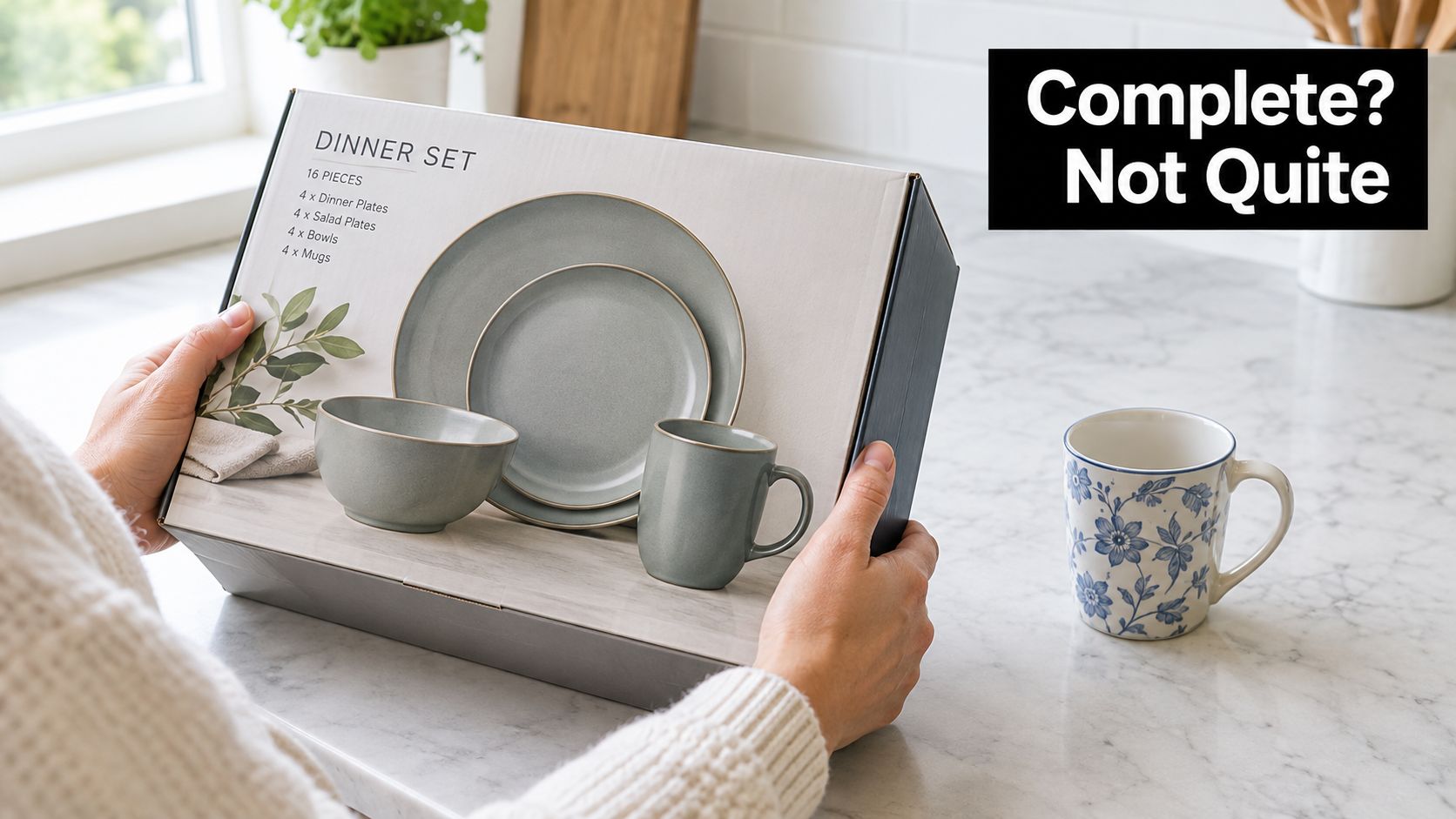
Coordinated doesn't always mean complete. One listing may bundle cups and saucers, another may include only plates and bowls, and a third may use its piece count to include serving ware. Even within a coordinated range, cups, bowls and serving pieces can have different shapes or sizes. A set can look unified in a product photograph yet leave a practical gap at home.
There's a reason tableware can feel more meaningful than everyday equipment. A blue-and-gold ceramic dinner and tea service in the City of Armadale History House collection was given to Laura Jane Dumsday around her first marriage, travelled with her family from England to Victoria and then Western Australia, and became part of household life in Forrestdale. The collection describes how coordinated tableware could carry associations with family continuity, hospitality and migration across generations (City of Armadale History House collection).
That history helps explain the appeal, but it doesn't mean every household needs a full formal service. A family might value easy-to-replace everyday pieces; an apartment dweller may favour compact stacking; occasional hosts may want extra cups without doubling their dinnerware. Gift buyers have a different task: choosing something the recipient can store and use, not just something that looks impressive in a box. For ideas on coordinating the wider dining space, browse dining table accessories for your home.
Understanding Dinner Set Configurations
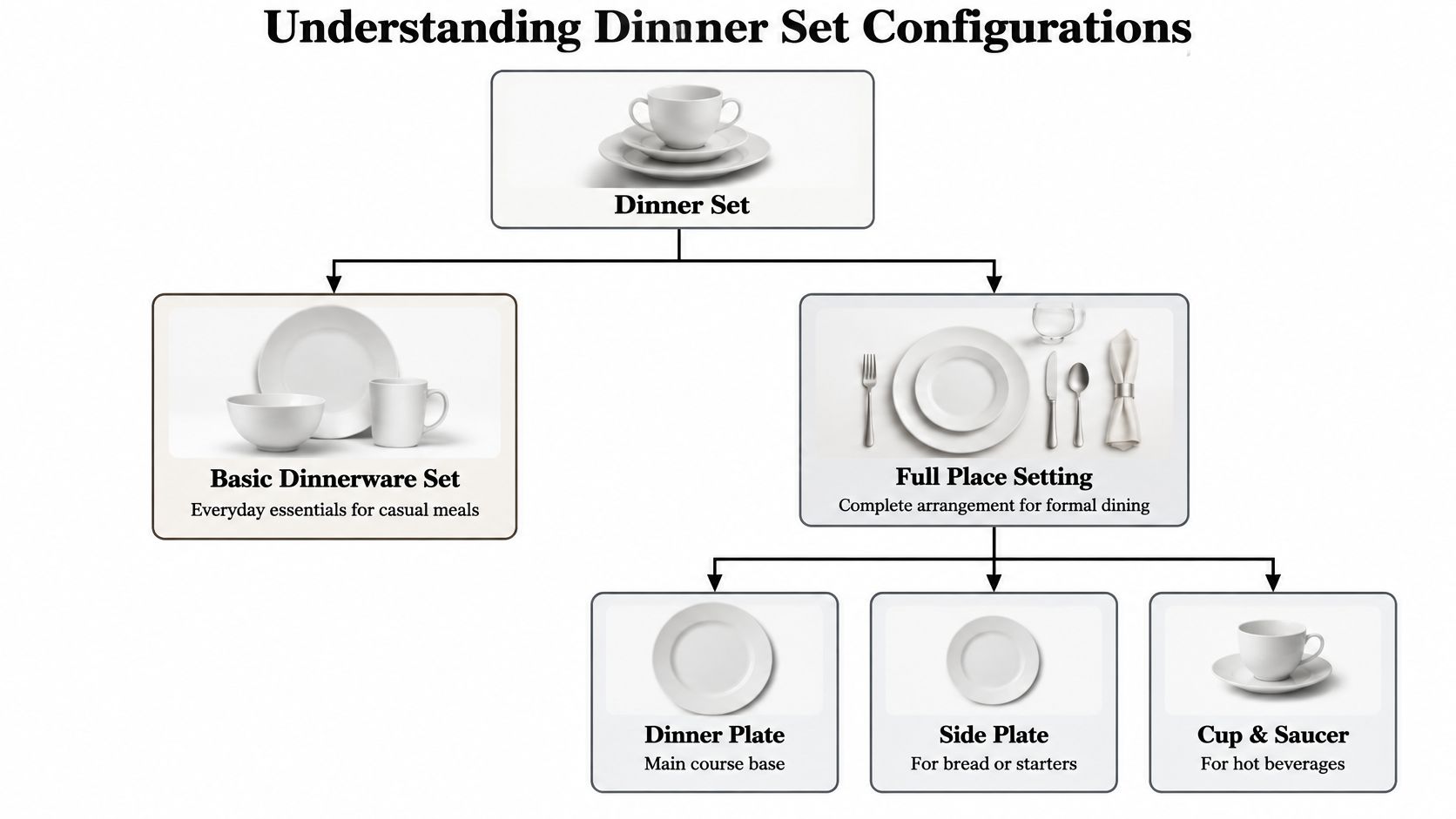
Think of setting a table as filling distinct jobs, not just arranging matching pieces. A dinner plate carries the main meal; a side plate can hold bread or a starter; and a bowl might suit cereal, soup or a shared side. A cup is for a hot drink, while a saucer catches drips and gives the cup a stable resting place.
A basic dinnerware set usually focuses on everyday eating pieces. A full place setting is a more complete arrangement, but the exact meaning varies by seller. Cutlery, drinking glasses and serving pieces may be sold separately, even when a styled product photo shows them alongside the dinnerware.
The National Gallery of Victoria's exhibition A Modern Life: Tablewares 1930s–1980s presented more than 140 objects and traced a shift from formal coordinated services towards more versatile, informal dining. It highlighted mix-and-match tableware as well as the influence of changing lifestyles and new materials on how Australian households used their tables (NGV exhibition overview). That context is useful when you're deciding whether every item must match exactly or work together.
Dinner Set Terms at a Glance
| Set component | What it covers | Key question to check |
|---|---|---|
| Dinner plate | Main meal | Does the size suit your usual portions and cupboard? |
| Side plate | Bread, starters or smaller servings | Is it included for each intended place setting? |
| Bowl | Cereal, soup or other serving needs | What shape and capacity does the listing specify? |
| Cup | Tea, coffee or another hot drink | Is its capacity comfortable for your routine? |
| Saucer | Resting surface for a cup | Is it included, and does it stack with the cup? |
| Serving piece | Shared dishes or table service | Is it part of the bundle or shown for styling? |
| Full place setting | A group of pieces arranged for one diner | Which exact items make up that setting? |
A label such as “service for six” or “36-piece set” describes intended coverage or a total count, not one universal inventory. One set's total may include saucers and serving pieces, while another allocates more pieces to plates and bowls. Check the itemised contents, then compare three separate things: appearance, coverage and configuration.
Compare Common Dinner Set Materials
A set travels from cupboard to table to sink, and each material brings different handling considerations. The material name alone can't tell you how a particular item will feel in your hand, stack on a shelf or respond to daily care. Construction, finish and the maker's instructions matter too.
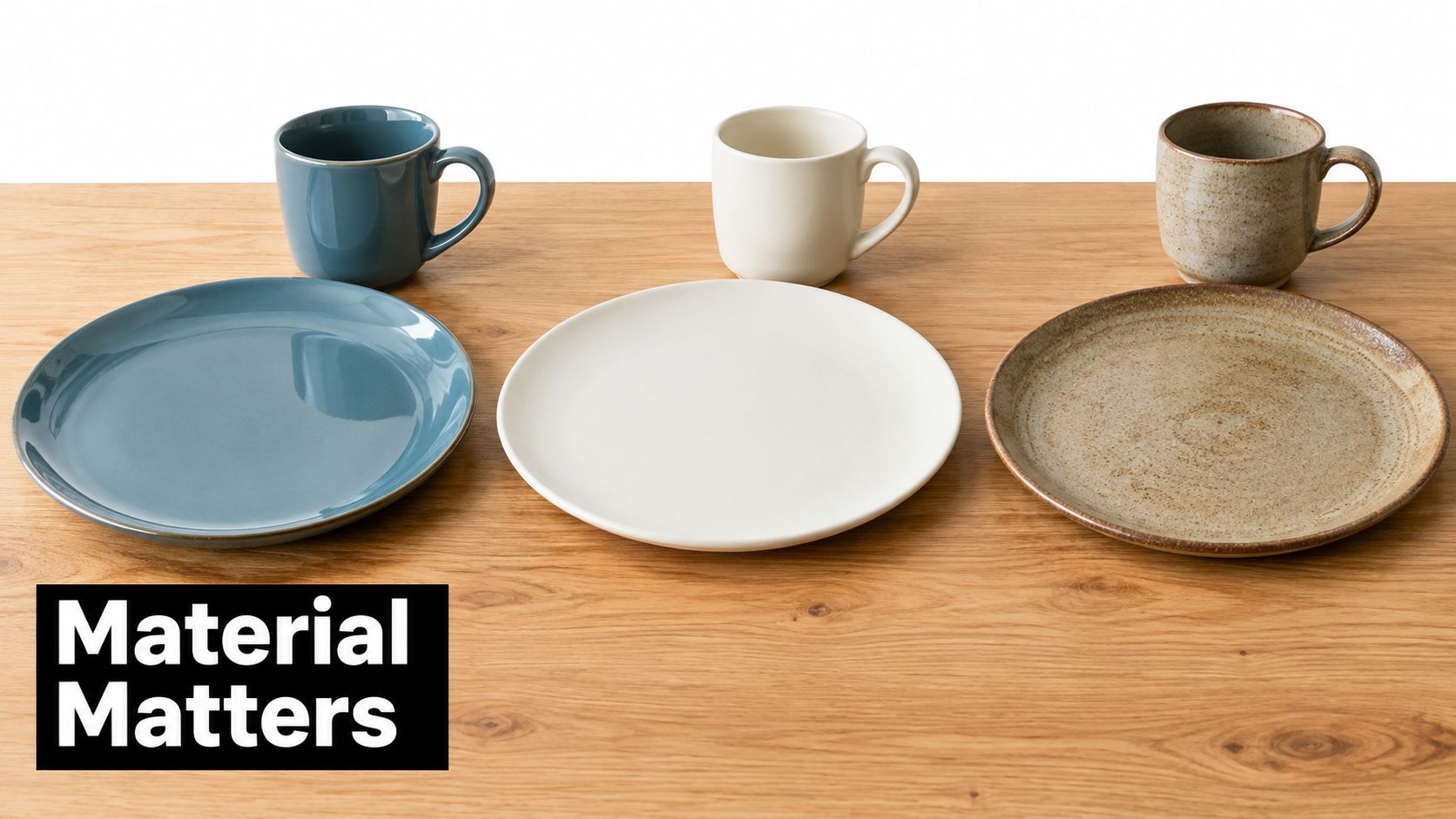
Ceramic is a broad category rather than a single feel or performance. Glazes and forms vary, so one ceramic set may feel delicate and refined while another feels substantial. Porcelain often appeals to buyers who want a lighter, more refined appearance, while stoneware is a ceramic option that may feel heavier in daily handling. Neither label, by itself, guarantees that a piece won't chip or that it suits every routine.
Think beyond the material label
Glass changes the practical questions: consider where it will be stored, how carefully it must be handled and whether its temperature guidance suits your use. Metal tableware has different weight, finish and care considerations from glazed ceramics. It may also create a noticeably different look at the table, so check how the material works with the rest of your dishes.
Practical rule: Choose a material by handling the actual piece, if possible, and reading its care guidance. A category name won't tell you everything about the item in front of you.
The same whole-product approach helps when you're comparing ceramic options. This guide to ceramic dinner sets can help you focus on the product details rather than relying on a broad material label. For a separate serving need, such as keeping a hot drink ready for guests, consider the handling and care questions involved in choosing a durable hot drink carafe.
Here's a useful comparison prompt for the shop or product listing: how does the piece feel when full, how does it sit against other items, and what cleaning or heating instructions apply? A set that looks elegant but is awkward to lift or stack may become less convenient than a simpler alternative. Think through the set's complete life, from storage to washing-up, before treating appearance as the deciding factor.
Before you decide, write down your priorities: look, hand feel, heat exposure, stackability, maintenance and the chance to buy matching replacements. If a product's details don't answer those questions, ask the seller rather than assuming all pieces in a material category behave alike.
Read Sizes, Capacities and Piece Counts Clearly
Product photos can make a set look roomier or more compact than it is. Read the written specifications and compare them with the shelves, drawers and drinks you use. A plate's diameter is only one part of the fit: rim depth and shape influence how pieces stack, while cup handles can make a neat-looking row wider than expected.
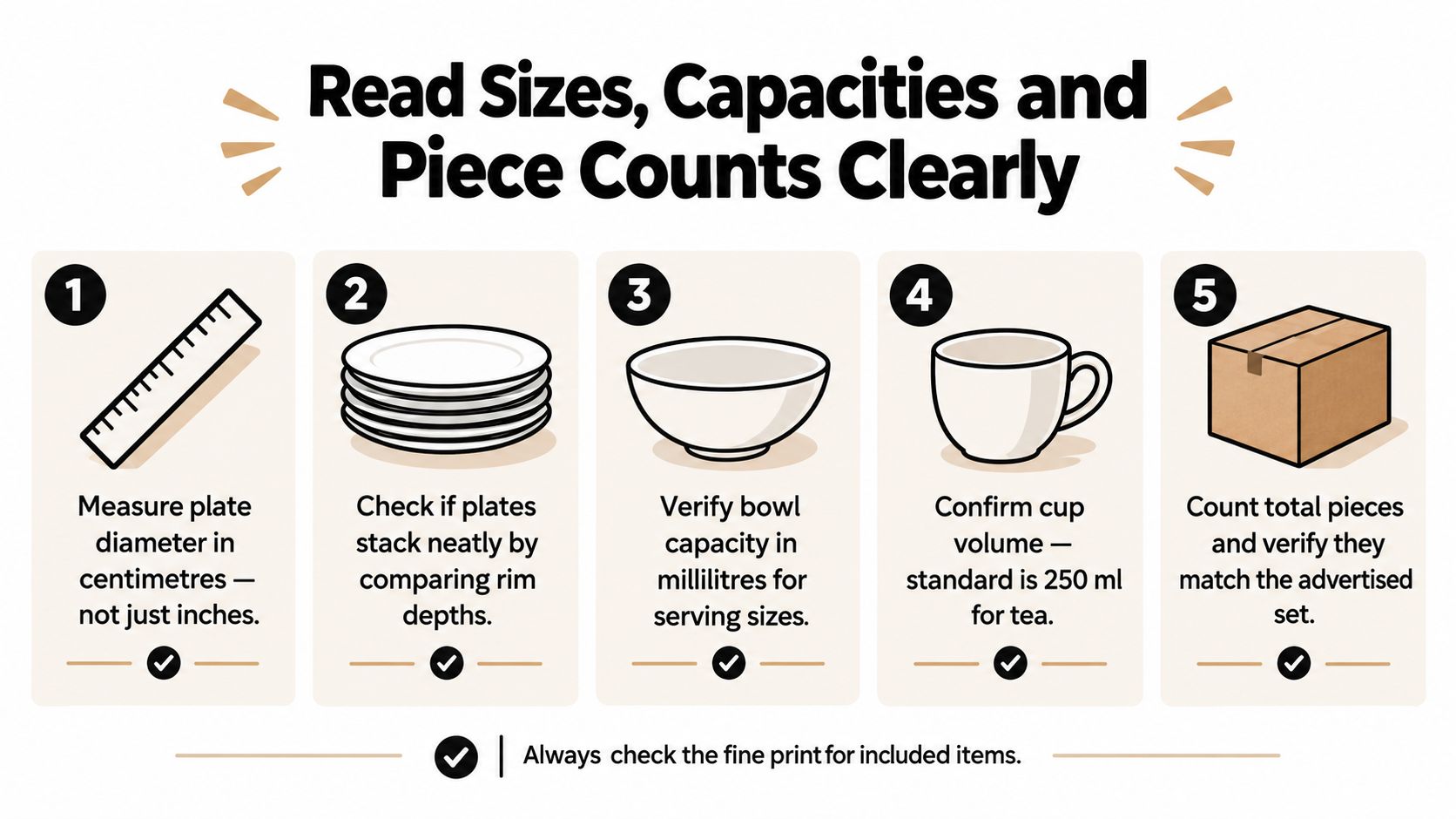
Start with the listing itself. Find the itemised contents, then note the cup capacity, plate and bowl dimensions, total weight if provided, and any included accessories. A total piece count won't tell you whether every diner gets the same combination of items, so check the allocation rather than using the headline number as a shortcut.
Measure where the set will live
Before ordering, measure the cupboard shelf height and depth, the space available for stacked plates and the clearance around cup handles. If you use a drawer for smaller pieces, check its width and how high the drawer sits. Think about the weight of a full stack too, especially if you'll lift it down often or carry it between the kitchen and dining area.
For serving comfort, consider what you drink. A cup suited to a small coffee may not suit someone who pours a generous tea, so compare the listed capacity with your usual serving. Check whether the shape and handle feel comfortable to hold, and whether the saucer, if included, stores with the cup without wasting shelf space.
Take a moment to compare the set's dimensions with the shelf and the cup you reach for most. A good fit is easier to judge with a tape measure than with a styled photograph.
If you're unsure what plate diameter will work for your table and cupboard, this reference on perfect dinner plate sizes offers another way to think through the fit. Then make a simple shopping list: the pieces included, the pieces you already own and any gaps you'd need to fill. That keeps you from paying for duplicates while still leaving you with enough of the items you use regularly.
Check Safety, Strength and Care Claims
A broad “food safe” label doesn't tell you what testing supports the claim or whether the test applies to the particular cup you're buying. For ceramic tableware, ask for food-contact test information that identifies the vessel's capacity, glaze, test method and measured migration values. This detail matters because ceramic glaze can release lead or cadmium into food or acidic drinks.
Australia's Customs (Prohibited Imports) Regulations set different maximum release limits by vessel category and size. For cups, mugs, jugs, bowls and similar vessels under 1,100 mL, the stated limits are 7.0 mg/L for lead and 0.7 mg/L for cadmium; at or above that capacity, the limits are 2.0 mg/L and 0.2 mg/L. Plates and saucers have separate limits of 20.0 mg/L for lead and 2.0 mg/L for cadmium. You can review the regulatory information and tableware testing context in this overview of Australia's ceramic tableware requirements.
Ask for specific documentation
AS 4371:2012 covers permissible lead and cadmium release, marking, impact resistance and thermal-shock performance for ceramic tableware, including cups and other hollow ware. Its standard information page identifies thermal shock as a test consideration. Ask the seller which care and performance claims apply to the actual product, not just to the broader collection.
Thermal shock is the strain created when parts of a cup heat or cool at different rates. A cold cup filled with a very hot drink, or a hot cup rinsed under cool water, can develop a temperature gradient that contributes to glaze crazing, cracks or breakage. Dishwasher suitability is a separate question from thermal-shock performance; AS/NZS 2007.1:2021 concerns household dishwasher performance and doesn't replace product-specific tableware durability testing.
Inspect before regular use
When the set arrives, look over each rim, handle, glaze surface and base. Check for chips, cracks, an unstable foot or a handle that feels insecure, while remembering that a visible variation in a glaze doesn't automatically prove the item is unsafe. Follow the supplied care instructions and don't assume a cup is suitable for a dishwasher, microwave or other heating method unless the product information says so.
The same careful approach applies when comparing food-contact claims across dinnerware materials. For everyday use, avoid sudden temperature changes: don't move a cold cup straight to very hot liquid or put hot ceramics under cold water. Read the maker's maximum service temperature and heating or cooling guidance, and ask for clarification if those instructions are missing.
Choose Between Bundled and Modular Sets
A bundle can be convenient when you want a coordinated table right away. A starter set can be a better fit if you're furnishing a compact kitchen or keeping pieces you already like. Modular buying lets you select the shapes and quantities you want, and can make it easier to replace an individual item if the seller offers pieces separately.
For a family, the everyday pattern may matter more than an occasional guest count. Ask whether the bundle provides enough of the pieces that get used and washed most often, and whether you have space for the whole collection. If one cup breaks, can you replace it without buying another full set? The answer can shape the ownership experience.
An apartment dweller might prefer a smaller core that stacks neatly and leaves room for other kitchen essentials. A regular host may value matching coverage and the option to add extra cups or serving pieces over time. Someone who entertains only occasionally may find that a smaller set plus a few separately purchased pieces is easier to store than a bundle built for rare gatherings.
Estimate what you'll use first
Before comparing prices, note the number of people who eat at home, how often guests join, which hot drinks you serve and how much cupboard space you can spare. Then list the pieces you need most often, followed by optional items for hosting. Compare the cost and replacement availability of those pieces with the bundle, rather than assuming a larger box automatically offers better value.
Australian market commentary discusses interest in customisable and eco-conscious tableware alongside casual and disposable options, but it doesn't quantify the storage or replacement costs that households face. That leaves a practical question for buyers: will a fixed bundle serve your actual routine, or would a durable core with additional pieces bought as needed be more useful? Consider cupboard volume, transport weight and how easily you can replace a broken item before deciding.
Match Dinner Sets to Common Buying Needs
A family replacing a mixed collection may start with the pieces that handle breakfast, lunch and dinner. Their shortlist could favour stackable plates and bowls, cups that suit regular drinks, straightforward care instructions and a seller who can replace an individual item. Before buying, they should check that the itemised contents match the household's routine, not just the number highlighted in the listing. A warning sign is a set that looks complete but leaves unclear which pieces are included.
An entertainer has a different table to plan. They might choose a coordinated everyday core, then add pieces that make hosting easier when friends visit. Serving dishes, extra cups and the availability of companion pieces may matter more than filling every cupboard with formal settings. For presentation ideas that can work with pieces collected over time, explore these table-setting ideas. Ask whether the range can be expanded and how closely later pieces will match.
A gift buyer's checks
If you're buying a dinner set as a present, start with the recipient's home and habits. Do they have room to store a large bundle? Do they prefer tea cups, larger mugs or a mix of styles? Clear product information and care guidance can help you choose something they'll use rather than a set that looks impressive only when unboxed.
Packaging also deserves attention. Ask how the seller protects ceramic pieces in transit, what to do if something arrives damaged and whether replacements are available. For any of these shoppers, the shortlist should reflect real use: family buyers check daily practicality, hosts consider serving and expansion, and gift buyers prioritise fit, presentation and dependable product details.
Make Your Final Dinner Set Decision
Start with who'll use the set most days, then check whether it fits your cupboards and suits your drinking habits. Add hosting needs, cleaning routines and replacement availability before treating colour or a large piece count as deciding factors. Mark each requirement as a must-have, a preference or a visual wish-list item.
Before you buy, confirm the dimensions, capacity, exact pieces included and how the pieces stack. Check the condition and safety documentation, read the care instructions and compare the final cost with any extra items you'll need. If a listing leaves a key question unanswered, ask the seller before ordering.
The best set isn't the one with the most pieces. It's the one you can use comfortably, store without frustration, care for consistently and replace without having to start again.
Everti creates titanium kitchen and table essentials for people who value durable, easy-care design, including tableware made for everyday routines. Explore the range and find pieces to complement your table at Everti.