

You've cooked a generous pot of spaghetti bolognese, ladled out the sauce, and reached for the usual dinner plate. The noodles spread, the sauce runs towards the edge, and every forkful becomes a small balancing act. A standard soup bowl isn't much better. It's deep enough to hide the pasta and narrow enough to make twirling awkward.
A dinnerware set with pasta bowls solves that problem only if the bowls are designed for real meals, not just photographed attractively. For Australian kitchens, the important questions are practical: will the bowl hold sauced pasta, laksa, risotto or curry without splashing? Does it fit your dishwasher and cupboard? Can it handle microwave reheating and repeated washing? And is it comfortable to lift when full?
The Australian market is well established rather than niche. Australia imported US$80.7 million of ceramic tableware, kitchenware and other household goods in 2024, representing 20.23 million kilograms, while China supplied about US$66.8 million and 16.74 million kilograms of that total, according to the World Integrated Trade Solution ceramic household imports data. The same dataset records US$157 million in ceramic household article imports in 2024, while the broader ceramic-products import category reached US$814 million in 2023. There's plenty of choice. The challenge is choosing a set that earns its cupboard space.
What Makes a Pasta-Bowl Dinnerware Set Different
Most standard dinnerware sets include dinner plates, side plates and a small bowl. That bowl might suit cereal, yoghurt or a modest soup, but it often has the wrong proportions for a full serve of spaghetti, penne or pumpkin risotto. A pasta bowl is wider and shallower, with a broad interior that keeps noodles in a manageable pile while leaving room for sauce.
The difference comes down to four details:
- Capacity: Measured in millilitres, this tells you how much food and sauce the bowl can hold before it feels crowded.
- Depth: A deeper bowl contains broth and curry, while a shallower one makes twirling long pasta easier.
- Rim diameter: A broad opening gives your fork room to work and lets you see the food clearly.
- Table footprint: The bowl should sit comfortably at a place setting without competing with the dinner plate, cutlery or serving dishes.
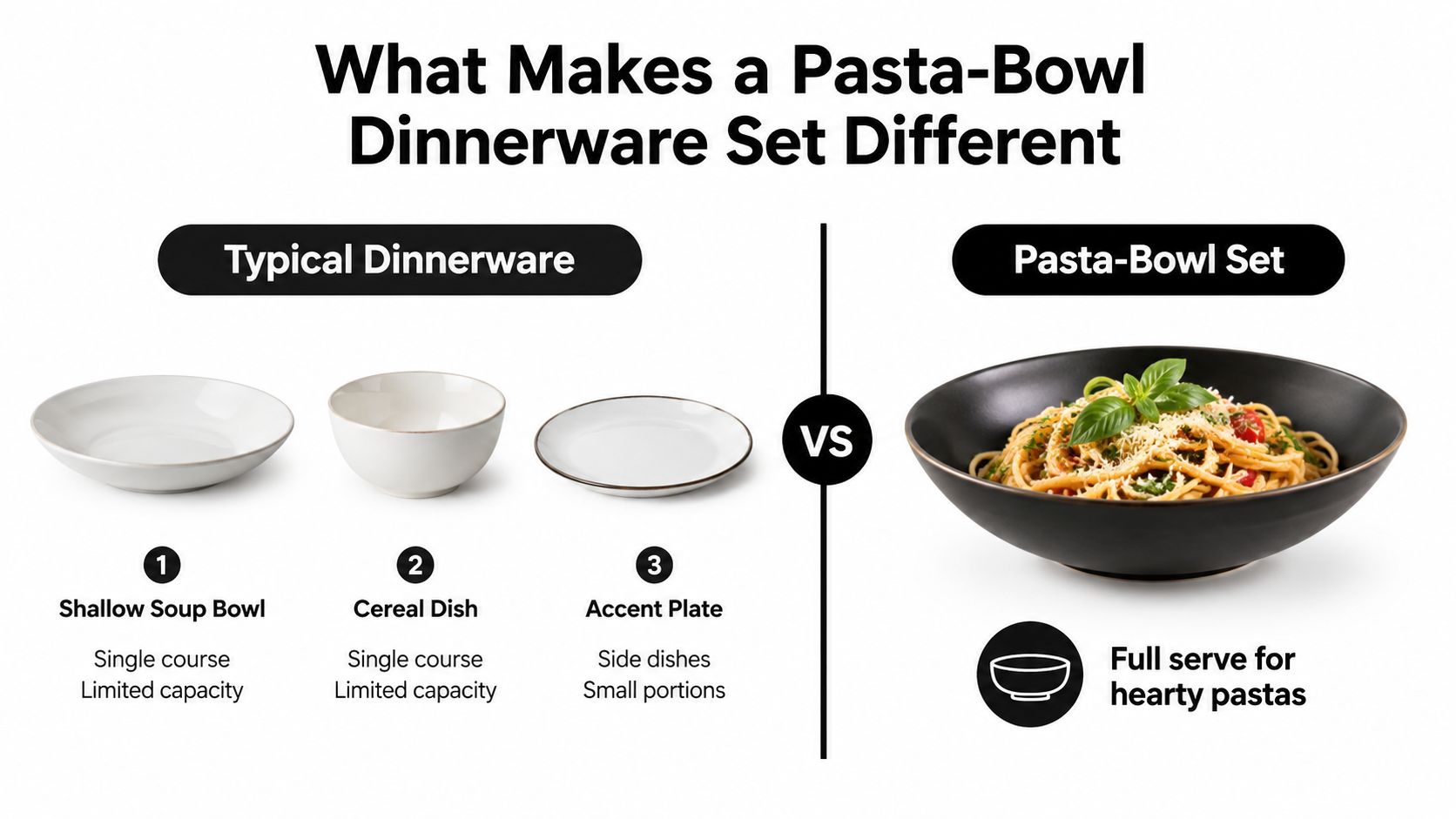
A pasta-bowl-inclusive set also changes how you serve the rest of the week. The same bowl can handle saucy pasta, a dry noodle dish, laksa, risotto, chilli or a family-style grain bowl. That versatility matters more than whether the glaze matches the latest colour trend.
Australian hospitality examples show pasta bowls commonly sit between 200 mL and 800 mL, with a 230 mm bowl listed at 210 mL and wide-rim formats available in 200 mL, 400 mL and 600 mL capacities, as shown by Bunzl Australia's pasta and soup bowl listing. Those figures demonstrate why diameter alone is a poor buying guide. Two bowls with a similar footprint can have dramatically different usable volume.
For an additional visual reference, the bronze-die pasta selection shows the kind of pasta shapes and sauces that expose a bowl's practical strengths. Long strands need a comfortable twirling area. Short pasta, thick sauces and baked dishes need enough room for a fork to move without pushing food over the rim.

How Pasta-Bowl Sets Are Configured
Start by checking the place-setting count, not the headline piece count. A set can contain mugs, serving pieces or small bowls that add to the total while leaving you with fewer pasta bowls than expected. The useful question is simple: how many people can sit down with a dinner plate, side plate and pasta bowl at the same time?
Common configurations include:
| Set Size | Dinner Plates | Pasta Bowls | Other Pieces | Best For |
|---|---|---|---|---|
| Four-piece setting | 1 per setting | 1 per setting | Usually side plate or bowl | A compact household |
| Six-piece setting | 1 per setting | 1 per setting | Side plates and breakfast pieces | Regular family meals |
| Eight-piece setting | 1 per setting | 1 per setting | Mixed everyday tableware | Larger households |
| Twelve-piece setting | 1 per setting | 1 per setting | Side plates, bowls or mugs | Entertaining and replacements |
| Sixteen-piece set | 4 total | 4 total | Often 4 side plates and 4 mugs or bowls | A complete four-person table |
These labels describe common retail structures rather than a universal industry standard. Always open the product details and count each item. Some brands place a pasta bowl in the same line as a dinner plate and sell it separately, while others include it as one item per setting. Australian ranges from names such as Maxwell & Williams, Ecology and Baccarat can be packaged differently from generic imports, so the product title isn't enough.
Check the measurements before the styling
Dinner plates commonly sit around 26 to 28 cm, while pasta bowls are often around 21 to 23 cm wide and approximately 5 to 6 cm deep in the configurations described for this guide. Those dimensions give the bowl a broad serving surface without turning it into a platter, but the profile matters just as much as the diameter.
A shallow bowl with a wide rim may be ideal for spaghetti. A deeper bowl may suit laksa and noodle soups, but feel cumbersome for a neat risotto presentation. Read the capacity, height and diameter together.
Before buying a mixed plate-and-bowl collection, use the plate and bowl set guide to compare how the components are intended to work together. The useful measure is the number of complete, usable settings you'll receive, not the number printed in large type on the packaging.
Know what the extra pieces are doing
A 16-piece set may include four dinner plates, four side plates, four pasta bowls and four mugs or cereal bowls. A 20-piece set might replace the mugs with smaller bowls or add serving platters. Neither option is automatically better. Choose the arrangement that reflects how you eat.
If you already own mugs and cereal bowls, buy the set with more useful serving pieces. If your household eats pasta, curry and rice dishes regularly, four well-sized pasta bowls will be more valuable than decorative extras that stay in the cupboard.
Materials and Finishes That Actually Hold Up
Pasta bowls work harder than side plates. They carry hot, oily food, take direct contact from forks, pass through dishwashers and often sit underneath other dishes in a crowded cupboard. For daily use, mid-weight stoneware with a properly glazed foot is the safest all-round choice.
| Material | Weight | Heat Retention | Chip Resistance | Dishwasher Safe | Price Tier |
|---|---|---|---|---|---|
| Stoneware | Medium to heavy | Strong | Generally good | Often, if labelled | Mid-range |
| Porcelain | Light to medium | Moderate | Good, though edges can feel sharper | Often, if labelled | Mid to premium |
| Bone china | Light | Lower | Suitable for careful use | Often, if labelled | Premium |
Stoneware feels substantial and keeps food warm well. That heft can be reassuring at the table, but it becomes a drawback if children are clearing dishes or someone regularly eats from the sofa. Look for a smooth, fully glazed underside and a rim that doesn't feel fragile.
Porcelain gives a lighter, cleaner feel and often suits a more formal table. It's a sensible option when you want bowls that are easier to lift, but you still need clear microwave and dishwasher instructions. Bone china is elegant and thin, yet it's the least convincing choice for a pasta-bowl-heavy everyday set unless you value lightness and refinement above rugged handling.
Finish matters more than the colour name
Glossy glaze is usually easier to wipe clean and tends to disguise everyday marks. Matte finishes have a softer appearance and more tactile grip, but decorative surfaces can show utensil marks sooner. Reactive glazes and hand-dipped edges bring visual variation, though that variation also makes replacement matching harder.
Buyer's rule: Pick the body first, then the glaze. A fashionable finish can't compensate for a bowl that's too heavy, too narrow or poorly rated for thermal use.
For a deeper comparison of food-contact materials and care considerations, consult this guide to non-toxic dinnerware material choices. Keep the decision grounded in the manufacturer's care labels. “Ceramic” describes a broad family of products, not a guarantee of dishwasher, microwave or oven performance.
Sizing Pasta Bowls to Real Australian Meals
Choose the bowl for the food your household serves. Australian hospitality ranges put pasta bowls anywhere from a 200 mL to 800 mL capacity, showing how much these formats can vary. Smaller bowls suit side portions or a first course. Larger bowls leave room for sauce, broth and movement.
For a home dinnerware set, I recommend the middle to upper end of that range for everyday mains. Spaghetti bolognese needs enough room to toss without crowding, while a normal serve should not disappear across an oversized base. Risotto benefits from surface area for spreading and eating. Laksa needs both capacity and containment for broth, noodles and toppings.
| Dish Type | Capacity | Depth | Diameter |
|---|---|---|---|
| Side pasta or first course | 200 to 400 mL | Lower profile | Compact |
| Everyday sauced pasta | 600 to 800 mL | Moderate | Broad |
| Risotto or curry | 600 to 800 mL | Moderate | Broad |
| Laksa or noodle soup | 600 to 800 mL | Deeper profile | Broad enough for toppings |
Use those capacities as a practical guide, not a fixed serving rule. Shape changes usable space. A wide, low bowl can feel roomier for pasta than a narrow bowl with the same stated volume.
Match depth to the fork, spoon and sauce
Shallow sides make long noodles easier to twirl and food easier to reach with a fork. Taller sides contain broth and saucy curry more effectively as you lift noodles or use a spoon. For a mixed Australian menu, a gently sloped interior handles more dishes than a sharply vertical wall.
Check storage before buying. A broad bowl may serve beautifully yet block a dishwasher rack or fail to nest with your cereal bowls. Measure the cupboard and dishwasher, especially when replacing a mixed collection.
Don't ignore the full-bowl weight
An easy-to-lift empty bowl can feel awkward once it holds hot food and liquid. Lift a sample with one hand if possible. A rim that digs into your fingers or an unstable base will be more irritating during a long family meal.
Australian retail examples include an 800 mL, 26.5 cm stoneware pasta bowl. Another 23.5 cm bowl is rated dishwasher, freezer, microwave and oven safe up to 170 to 200°C, according to Noritake Australia's Colorwave Raspberry pasta bowl specifications. Put capacity, thermal-care ratings and diameter on the same shortlist. A bowl that fits the meal but fails your microwave, oven or storage routine is the wrong choice for an everyday set.
Mixing Pasta Bowls With the Rest of Your Set
A new pasta bowl doesn't need to be an exact match for your dinner plates. It needs to look intentional and behave well in the cupboard. Matching glaze family is usually easier than matching colour perfectly. A satin bowl beside a satin plate looks coherent even when the shades differ slightly, while a high-gloss bowl can look disconnected from a heavily textured matte set.
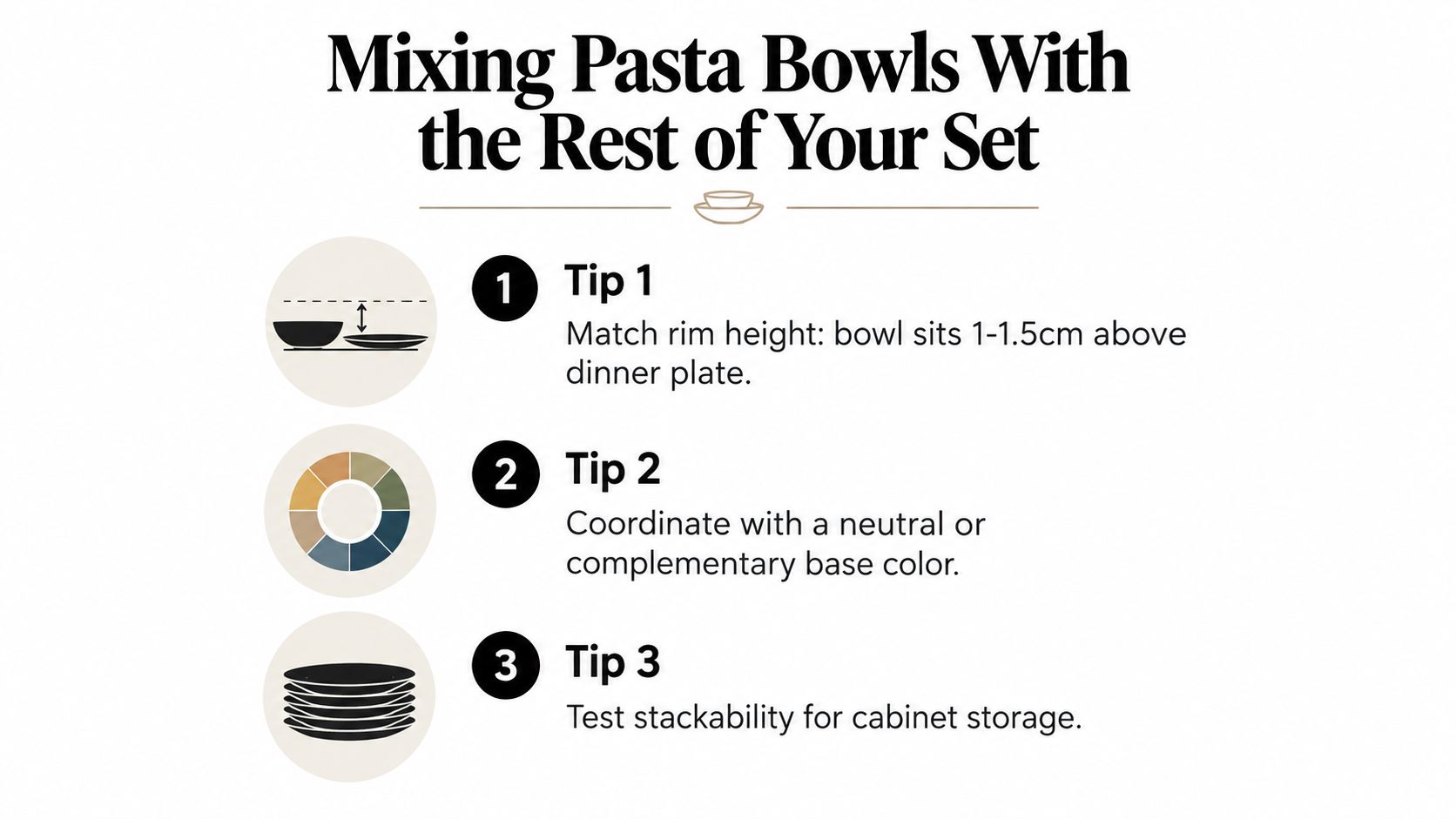
Start with the rim relationship. Aim for the pasta bowl to sit no more than 1 to 1.5 cm above the dinner plate rim. That keeps the place setting visually balanced and prevents the bowl from dominating the table.
Build around the difficult piece
Pasta bowls are harder to replace than plain dinner plates, especially when you want a particular depth, capacity and foot shape. If you're building a mixed collection, buy the pasta bowls first and then find plates that support them.
Solid colours and restrained textures are the most forgiving choices. A bold geometric bowl beside a patterned dinner plate creates competing focal points, particularly under strong kitchen lighting. Neutral stoneware, soft white porcelain or a restrained reactive glaze gives you more freedom to replace individual pieces later.
Storage should decide the purchase as much as appearance. Stack the bowl with your cereal bowls and side plates, or compare the manufacturer's nesting profile with the dimensions of your shelves. A beautiful bowl that needs its own cupboard is not a practical upgrade.
The ceramic dinner set guide can help you assess how a complete ceramic collection is organised before you add pasta bowls to an existing table.
A short demonstration can also help you judge the proportions of a bowl-inclusive setting:
Look for a bowl that leaves enough room around the food, but doesn't swallow the plate beneath it. That visual balance matters during everyday meals, not only when guests arrive.
Care, Cleaning, and Long-Term Storage
Good pasta bowls fail through careless handling more often than dramatic accidents. Hot sauce, standing water, abrasive detergents and crowded dishwasher racks place repeated stress on the glaze and edges. Follow the manufacturer's care label first, then load the bowls so they can drain and avoid contact with hard surfaces.
Use these habits:
- Load with clearance: Keep bowls away from tines and neighbouring dishes that can knock the rims.
- Angle them for drainage: Water shouldn't pool inside the bowl after a cycle.
- Use a mild detergent: Strong citrus or bleach-heavy products can dull some coloured and reactive finishes.
- Dry before stacking: Residual moisture encourages mineral marks and keeps the rim in contact with water.
- Protect the rims: Felt or cork separators are preferable to direct rim-on-rim stacking.
Don't treat microwave and oven safety as interchangeable. A bowl can tolerate microwave reheating yet lack an oven rating, or carry an oven rating with a stated temperature limit. The Noritake Australia listing mentioned earlier demonstrates the level of detail worth checking, including dishwasher, freezer, microwave and oven compatibility.
Retire damaged bowls promptly
A hairline crack or deep chip isn't just an aesthetic annoyance. It makes the surface harder to clean and creates a weak point during handling, especially with hot and acidic foods such as tomato-based pasta sauce. Set damaged pieces aside rather than returning them to daily service.
Reactive and matte finishes deserve closer inspection because marks can be more visible. If the manufacturer specifies hand washing, don't override that instruction because another ceramic set survives the dishwasher. Care requirements are part of the product, not a footnote.
Common Buying Mistakes to Avoid
The most common mistake is choosing the largest bowl available. Bigger capacity sounds useful, but an oversized bowl can make an ordinary serve look sparse, leave long pasta spread too widely and create storage problems. It may also be awkward to hold when full.
A pasta bowl should give food room to move, not turn dinner into platter service. For most homes, a broad, moderate-capacity bowl is more useful than a deep vessel designed for unusually large serves. Use capacity alongside depth and diameter rather than treating one number as the complete answer.
Buying for the photograph
Styled product images hide the details that affect daily use. They rarely show whether the inner wall is easy to approach with a fork, whether the foot is glazed, or how much cabinet space the bowl consumes.
Ask for the full specification sheet. If the listing gives only a diameter and colour, keep looking until you can verify the capacity, construction and care ratings.
Ignoring the existing table
A bowl that clashes with your dinner plates can still work, but a bowl that doesn't stack with them becomes an everyday nuisance. Check rim height, foot diameter and the way the pieces nest. This is especially important when adding individual pasta bowls to a set bought years earlier.
Forgetting the handling test
Heavy stoneware feels durable, but weight becomes significant when the bowl is full of hot laksa or broth. Pick it up from the shelf and imagine carrying it to the table with one hand. If the curve presses into your fingers or the base feels unstable, the design isn't serving the meal properly.
Finally, don't buy a decorative finish you're unwilling to use. Pasta bowls belong in regular rotation. The right set should tolerate ordinary meals, ordinary washing and the occasional knock without making you nervous every time someone reaches for one.
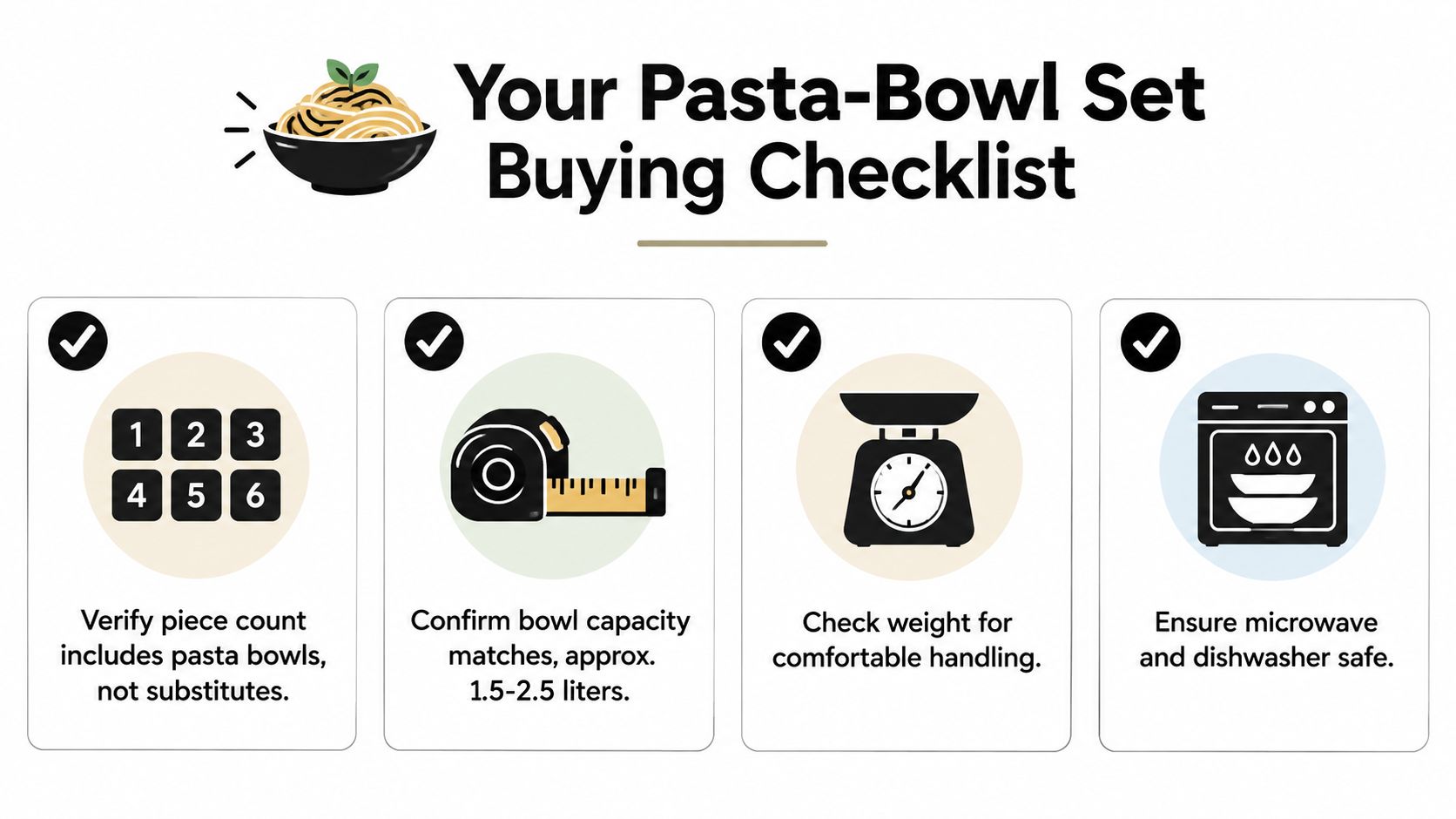
Your Pasta-Bowl Set Buying Checklist
Use this checklist before buying, whether you are in a shop or comparing product pages. Capacity and thermal-care details come first. Colour should decide only after the bowl fits the meals and washing routine you have.
- Confirm the configuration. Count dinner plates, side plates, pasta bowls and other pieces separately. Check that the set includes proper pasta bowls, not shallow soup bowls or small cereal dishes.
- Match capacity to Australian meals. Compare the stated volume with your usual spaghetti, risotto, laksa and curry servings. Australian hospitality ranges cover everything from modest portions to large, liquid-heavy meals, so the label “pasta bowl” does not guarantee the same performance.
- Check shape as well as volume. A wide interior with gently sloped sides makes spaghetti easier to twirl and gives risotto room to spread. A taller profile contains laksa and other broth-based meals more effectively.
- Choose the body for your routine. Stoneware suits frequent family use and feels substantial. Porcelain is lighter and more refined. Bone china belongs in a set only when its lighter, more delicate feel suits the way you handle tableware.
- Read the thermal-care labels. Verify dishwasher and microwave compatibility, then check oven and freezer ratings separately. Do not assume a bowl that tolerates one temperature change is suitable for every appliance. The Noritake Australia pasta bowl specifications show the level of care and temperature information a product page should provide.
- Test the storage footprint. Compare the bowl's diameter and height with your dinner plates, cereal bowls, dishwasher rack and cupboard shelves. Good nesting saves more daily frustration than an elaborate pattern.
- Assess the rim and glaze. Choose a smooth, fully glazed food surface and a sturdy edge. Matte and reactive finishes can work well, but read their care instructions before putting them into heavy rotation.
- Lift a full-size sample. If only an empty sample is available, check the grip, base stability and rim comfort. A bowl that strains your wrist when full of hot laksa will stay in the cupboard.
Buy enough pieces for the people who regularly eat together, with spare bowls if breakage or visitors are common. If you already own plates, separate pasta bowls may give you a better result than accepting a poorly configured bundle.
Prioritise working shape, usable capacity and thermal-care ratings over decorative styling. The right bowl makes spaghetti easy to twirl, keeps laksa contained, gives risotto room to spread and survives ordinary cleaning.
Everti offers titanium tableware and kitchen essentials for buyers who want lightweight handling, corrosion resistance and easy cleaning alongside ceramic dinnerware. Visit Everti to explore options that can complement a practical pasta-bowl set in an Australian kitchen.