

You've got a pot full of sauce simmering, a tray of rice waiting on the side, and half the family asking when dinner's ready. A standard frypan starts to look like the wrong tool fast, especially when you're trying to brown, stir, and hold heat without crowding the surface. That's where an extra large cooking pan earns its place, but only if it fits your cooktop, your storage, and your cleaning routine.
The hard part isn't finding something big. It's finding a pan that works at that size, heats evenly, and won't turn every meal into a lifting and washing problem. For Australian buyers, that means looking past the headline size and checking the base, the material, and the way the pan behaves in a real kitchen.
Why Pan Size Changes Everything
A big pan changes how you cook, not just how much you cook. If you've ever tried to make pasta sauce for a crowd in a pan that's too small, you know the pattern, ingredients pile up, steam traps under the food, and browning disappears. The result is often more batches, more stirring, and more time standing at the stove.
That's why Australian commercial-kitchen guidance treats cookware as a service-volume tool, not a decorative purchase. Larger venues need high-capacity cookware to keep pace with batch production, and cookware sets commonly include stockpots for stocks, soups, and large-batch cooking alongside frypans and saucepans, as noted in Australian cookware guidance from Reward Hospitality. Reward Hospitality cookware guidance
Size is not the same as usefulness
A pan can be physically large and still be awkward to use. If the base doesn't sit well on the heat source, or if the food spreads too thin, the extra surface area can help browning. If the food crowds into a deep layer, the bigger pan doesn't really solve the problem.
Practical rule: buy for the food you actually make, not for the biggest vessel you can store.
That means a cook who regularly makes shallow sautés, stir-fries, or batch sauces needs a different shape from someone who mostly simmers or braises. In a family kitchen, an oversized pan can reduce the number of batches. In a compact kitchen, it can also become the thing that's hardest to lift, wash, and dry.
The safest way to think about size is simple. First, decide what you're cooking most often. Then check whether a larger pan will make the job easier, or just make the pan itself harder to manage.
What Extra Large Actually Means on Your Cooktop
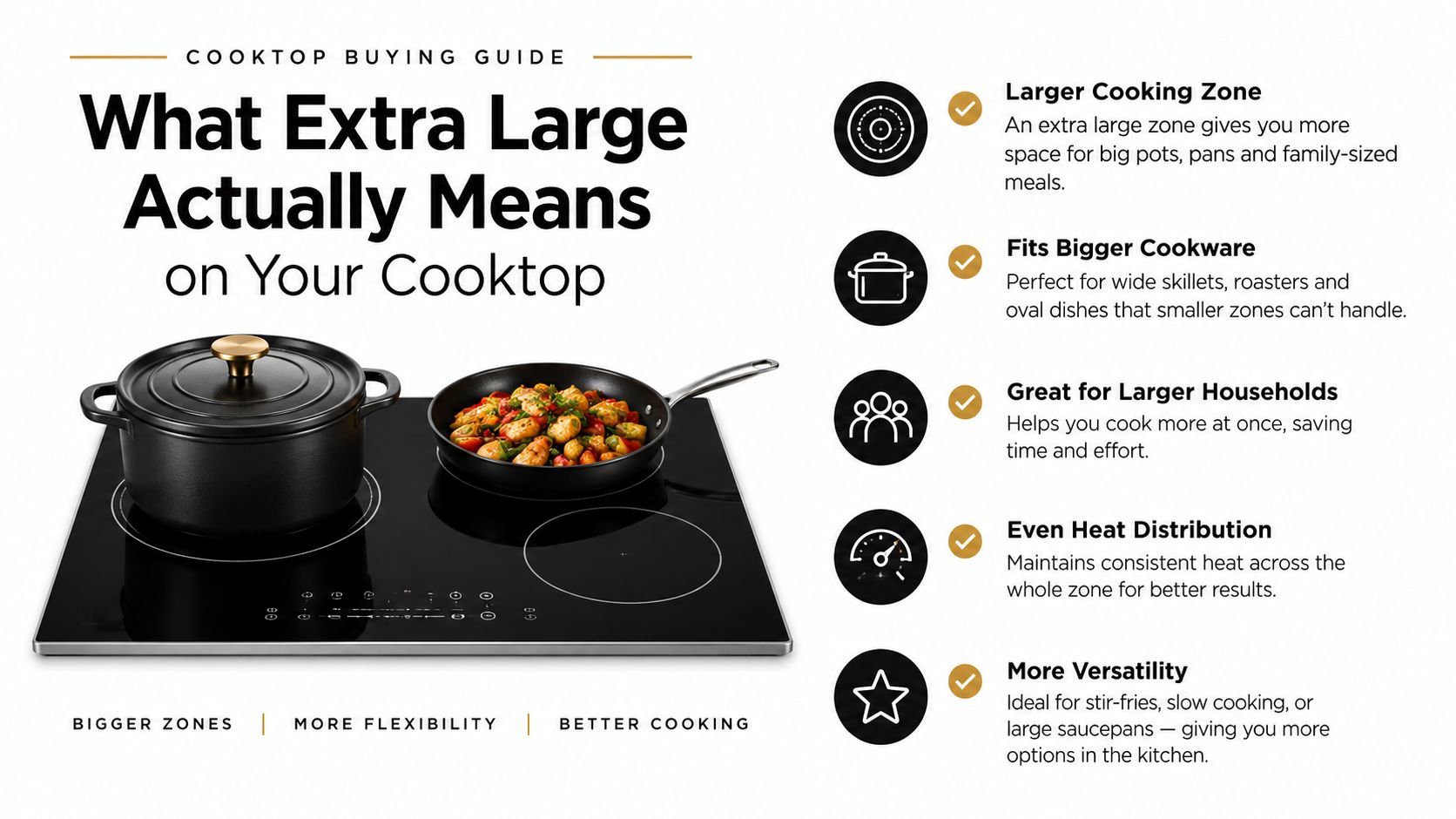
The phrase extra large cooking pan sounds precise, but in practice it isn't. On a cooktop, the useful measure isn't just the outside diameter. You need to think about the flat cooking surface, the base diameter, the usable capacity, and the handle clearance around the pan.
Measure the stove before you shop
Start with the cooking zone. On a compact apartment cooktop or a 60 cm domestic stove, a pan that looks ideal in a product photo may overhang the active zone and heat poorly. The same issue shows up on outdoor burners and barbecue side burners, where the base may be larger than the hot area underneath it.
Australian cookware guidance often recommends a large frypan or sauté pan as a core household vessel, but it doesn't solve the fit, heat-distribution, or storage trade-offs of oversized cookware, so buyers need to compare the pan's flat base with the cooktop or induction zone and choose realistic servings by food type. Australian cookware guidance on cookware fit
A simple buying test
Use this order when you measure:
- Check the active zone first. If the heat source is smaller than the pan base, expect uneven heating at the edges.
- Measure storage next. A pan that fits the stove but not the cupboard is still a bad fit.
- Compare food type to surface area. Shallow, even layers suit browning. Tall piles don't.
- Leave room for handles. A pan that clips the splashback or another burner is clumsy and unsafe.
A useful rule of thumb is that one oversized pan is not always better than two medium pans. If you're searing in batches, two smaller pans can preserve spacing and browning better than one huge vessel packed too full. That matters more than the label on the box.
Comparing Pan Materials From Cast Iron to Titanium
Material matters more as pan size grows. A bigger pan carries more mass, spreads heat across a wider surface, and makes weak handling or poor heat control easier to notice.
The main options side by side
The main choices are stainless steel, cast iron, aluminium, and titanium. Each one solves a different problem, and each one asks for a different kind of care.
| Material | Heat Distribution | Weight | Maintenance | Typical Lifespan |
|---|---|---|---|---|
| Stainless steel | Even enough when it has a good encapsulated or reinforced base, but it can still form hot spots in oversized pans | Moderate to heavy | Easy to maintain, but food can stick if the pan is poorly preheated | Long, especially with solid construction |
| Cast iron | Holds heat very well once hot | Very heavy at large sizes | Needs careful drying and seasoning upkeep | Very long if maintained well |
| Aluminium | Heats quickly and spreads heat well when built properly | Light to moderate | Usually easy to handle, but surface finish matters | Long when the construction is well engineered |
| Titanium | Depends on design, but offers strong structure with a light feel | Very light for its strength | Low-fuss cleaning and strong corrosion resistance | Very long when uncoated and well made |
A large commercial reference point helps explain the scale issue, even though home cookware is a different category. Commercial bratt pans commonly range from 30–60 L for medium restaurants and can exceed 150 L for central production kitchens, with cabinet widths of approximately 800–1,200 mm. Home pans never reach that scale, but the same principle applies, capacity, not diameter alone, defines the extra-large category. Commercial bratt pan sizing
How to read the table
Cast iron is the clear choice when thermal stability matters most, but its weight becomes a real issue once the pan is very large. Lifting it, washing it, and storing it can feel like handling gym equipment after a long meal.
Aluminium is easier to move and responds quickly to heat, which helps at scale, but the build quality has to be sound. Stainless steel is the everyday workhorse for many kitchens, especially when the base is engineered properly. Titanium stands apart when low weight, corrosion resistance, and long service life matter most.
For a busy home kitchen, the best material is the one you will use every week without dreading the lift or the clean-up. If the pan becomes awkward in the sink or too heavy for the cupboard, the material has already failed the test.
Heat Distribution and Stovetop Compatibility
Large pans live or die by their base. As the footprint grows, heat from the burner can stay concentrated in the centre while the edges lag behind, so the pan doesn't behave like a single evenly heated surface. That's why a large pan can brown beautifully in one spot and scorch or steam in another.
What the base needs to do
Australian commercial cookware guidance notes that gas burners commonly operate around 20–30 MJ/h, while thin bases can flex or dome under high-output heating, reducing flat contact and causing localised scorching. For induction, the base must be magnetic and explicitly induction-compatible, and domestic electric coil cooktops commonly use approximately 150 mm and 200 mm elements. Commercial cookware heat guidance
That puts the focus on construction, not just size. A medium-to-heavy reinforced or encapsulated base helps spread heat more evenly. A stainless steel shell around an aluminium heat-spreading core is a common way to reduce hot spots and improve stability. The trade-off is simple, more thickness can improve heat spread, but it can also slow the warm-up.
The bigger the pan, the more the base design matters.
What to check before you buy
Use the following checks before you commit:
- Flatness on contact. Make sure the base sits properly on your cooktop.
- Heat-source match. Confirm gas, electric, or induction compatibility before ordering.
- Handle spacing. Check whether the handles stay clear of adjacent burners and splashbacks.
- Filled weight. Lift the pan as if it were full, because that's how you'll use it.
For induction buyers, a dedicated compatibility guide can help you compare base types and element behaviour, especially when the pan is much wider than the active zone. Induction cookware compatibility guide
Weight, Cleaning and Everyday Care
A pan can be technically excellent and still be a poor fit for daily life. Once it's full of sauce, stock, or braised food, an extra-large vessel can become awkward to move from stove to sink, and even harder to store while drying. The question isn't just whether you can cook in it, but whether you can live with it.
Hygiene matters more as size grows
Food Standards Australia New Zealand's Standard 3.2.3 applies to all Australian food businesses and requires food-contact materials to be suitable for their intended purpose and not contaminate food, with equipment required to support effective cleaning and, where necessary, sanitising. FSANZ Standard 3.2.3
That matters even in a home kitchen. The larger the pan, the more food residue it can hold if corners, rivets, seams, or surface damage trap leftovers. A pan that's hard to clean becomes a hygiene headache faster when it handles batch cooking rather than one small meal.
Care by material
- Stainless steel: Preheat properly, avoid flooding a cold pan with cold food, and clean off residue before it hardens.
- Cast iron: Dry it thoroughly after washing, then protect the surface from moisture so rust doesn't start.
- Aluminium: Wash gently and avoid abrasive treatment that damages the surface.
- Titanium: Keep the cleaning routine simple, because the material's corrosion resistance and uncoated surface reduce fuss.
Good care starts before cooking, not after. A correctly preheated pan is easier to clean than one that's been overheated or used with residue baked onto the base.
The buying decision should include the sink, not just the stove. If the pan is too large for easy washing or too heavy to lift when full, the convenience of extra capacity disappears quickly. A good extra-large pan should fit your kitchen habits as well as your recipe list.
When Titanium Is the Right Choice
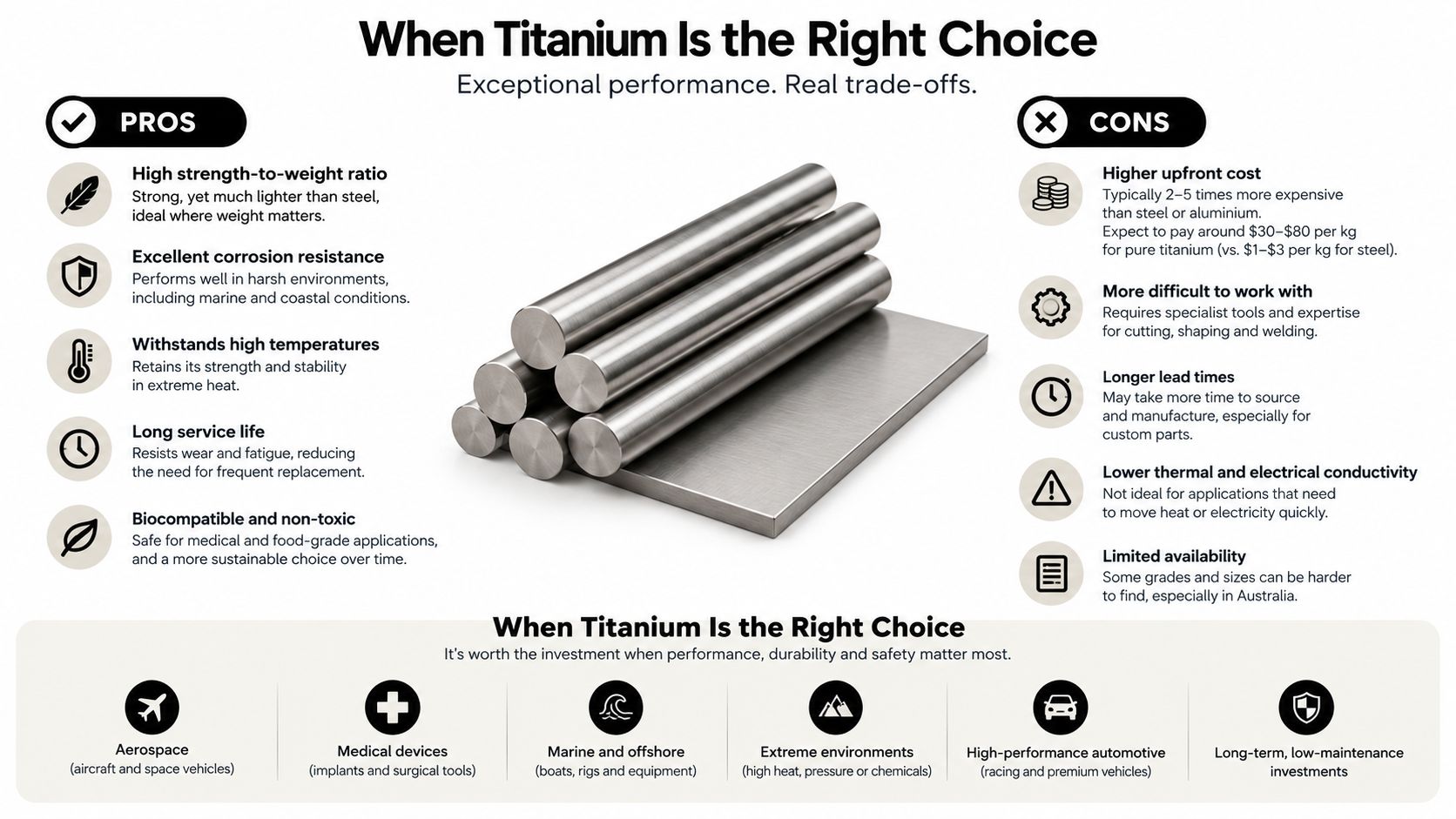
Titanium makes the strongest case when an oversized pan needs to stay light, durable, and easy to keep clean. In a large format, weight becomes more than a comfort issue. It affects how safely you lift, tip, rinse, and store the pan after cooking.
Why uncoated titanium stands out
An uncoated surface removes dependence on a coating layer, which means there's no coating to wear away over time. That's different from relying on a surface treatment to do all the work. Titanium also brings corrosion resistance and a strong strength-to-weight ratio, which suits kitchens where the pan will be moved often or used in demanding conditions.
Australian food-safety discussion should stay grounded here. FSANZ reports that PFAS were detected in fewer than 2% of tested Australian food samples and that dietary exposure is very low, while Australian authorities have banned PFOA, PFOS and PFHxS from import, export and manufacture from 1 July 2025. PFAS and the general food supply
That's why credible guidance should avoid fear-based non-stick messaging. The decision itself is about material behaviour, maintenance, and how the pan will be used. If you want to explore the product type further, this overview of best titanium pans is a useful starting point.
Who titanium suits
Titanium works well for people who want a pan that feels easy to handle despite its size. It also suits buyers who value a clean, uncoated food surface and a material that resists corrosion over long use. It's less compelling if you want the heavy, slow, heat-retentive feel of cast iron.
The right call is practical, not ideological. If your main frustration is weight, cleaning, and long-term material stability, titanium has a strong case. If your main need is slow heat storage for long simmering, another material may fit better.
Lifespan, Warranties and Your Pre-Purchase Checklist
An extra-large pan should be judged on how it will behave after months of use, not just how it looks on day one. The true test is whether the base stays flat, the handles stay tight, and the cooking surface still releases food after repeated batch work. That is why warranty terms matter as much as the sales copy.
What a good warranty really signals
A warranty is a window into how the maker thinks about wear. It can point to the parts most likely to fail first, whether that is a coating, a handle joint, or the pan body itself. A coated pan usually depends on the life of that surface layer, while an uncoated pan shifts the focus to the metal and build quality.
For a closer look at how warranty promises are framed, the discussion on lifetime warranty cookware is a useful reference.
Your final checklist
Before you buy, check these points:
- Cooktop fit. Measure the active zone and compare it with the pan's flat base.
- Storage clearance. Check cupboard height, shelf width, and handle length.
- Heat compatibility. Match the pan to gas, electric, or induction.
- Filled weight. Make sure you can lift and pour it safely.
- Cleaning ease. Look for a design that won't trap residue.
- Material claim. Verify what the pan is made from, not just how it is marketed.
The best extra-large pan is the one that still makes sense after the novelty wears off. If it fits the stove, the sink, and the cupboard, and the warranty matches the material claims, you have a pan that should keep earning its place as your recipes change.