

At its heart, preventing cross-contamination is all about one simple rule: keep raw foods completely separate from ready-to-eat foods. This isn't just a suggestion; it's a fundamental principle for every step of your cooking process. Think of it as creating deliberate, non-negotiable barriers in your kitchen workflow, using different utensils, cutting boards, and containers to stop harmful bacteria from migrating from raw chicken to a fresh salad.
What is Cross-Contamination, Really?
Cross-contamination is the silent threat that can quickly turn a beautiful home-cooked meal into a source of food poisoning. It's the accidental transfer of nasty pathogens from one surface or food to another. Imagine it as an invisible superhighway for bacteria like Salmonella and Campylobacter right on your countertop.
We’ve all seen it happen, especially at a classic family barbecue. Someone uses a pair of tongs to place raw chicken onto the grill, then a few minutes later, uses those same tongs to plate the cooked chicken or serve a salad. That’s it. In that one small move, any bacteria from the raw meat juices have hitched a ride onto food that's ready to be eaten, creating a serious health risk.
The Real-World Health Impact
This isn't just some minor kitchen slip-up. The consequences can be serious and, unfortunately, are quite common. According to NSW Health, a shocking 4.68 million Australians get sick from foodborne illnesses every single year. Cross-contamination, right alongside undercooking, is a leading cause. This number really drives home how easily bacteria can spread when raw meat juices splash onto a utensil or a nearby bunch of parsley.
This is exactly why getting a handle on cross-contamination is non-negotiable. It’s not about memorising a long list of rigid rules, but about building smart, safe kitchen habits that eventually become second nature.
The goal is to make your kitchen a 'no-fly zone' for harmful bacteria. Every tool, from your hands to your cutting board, can either be a barrier against contamination or a bridge for it.
Your Kitchen’s First Line of Defence
The tools you use every day are your most powerful defence. Clean hands and separate utensils are obvious must-haves, but the surface where you do the bulk of your prep work—your cutting board—plays a massive role. A plastic or wooden board covered in deep knife grooves can become a permanent home for bacteria, making it almost impossible to truly sanitise. To see why your choice of material is so important, check out our deep dive on cutting board health risks.
Ultimately, stopping the spread of germs is a foundational kitchen skill. For a fantastic overview of the core principles, this guide on how to prevent food contamination in your kitchen is a great place to start. By mastering these simple concepts, you take full control over the safety of the food you serve your family, making sure every meal is as healthy as it is delicious.
Designing a Safer Food Preparation Workflow
Creating a kitchen that's genuinely safe is about more than just wiping down the counters after you cook. It’s about building a deliberate workflow—a system designed to keep potential hazards far away from clean, ready-to-eat foods. This is where we go beyond the basic 'Clean, Separate, Cook, Chill' mantra and dive into the practical steps that prevent cross-contamination from ever happening.
Think of a good workflow as a one-way street for bacteria. It ensures they never get a chance to double back and contaminate fresh ingredients. The golden rule here is simple but absolutely critical: prepare all your ready-to-eat items first.
Let's say you're making a chicken stir-fry with a fresh side salad. Before that raw chicken even leaves the fridge, you should be washing and chopping all your salad veggies. This simple act of sequencing means the board, knives, and surfaces your salad touches are completely clean. The primary path for contamination is cut off right from the start. Only when the veggies are done and safely set aside should you move on to handling the raw meat.
This diagram shows just how easily one small mistake can create a big problem.
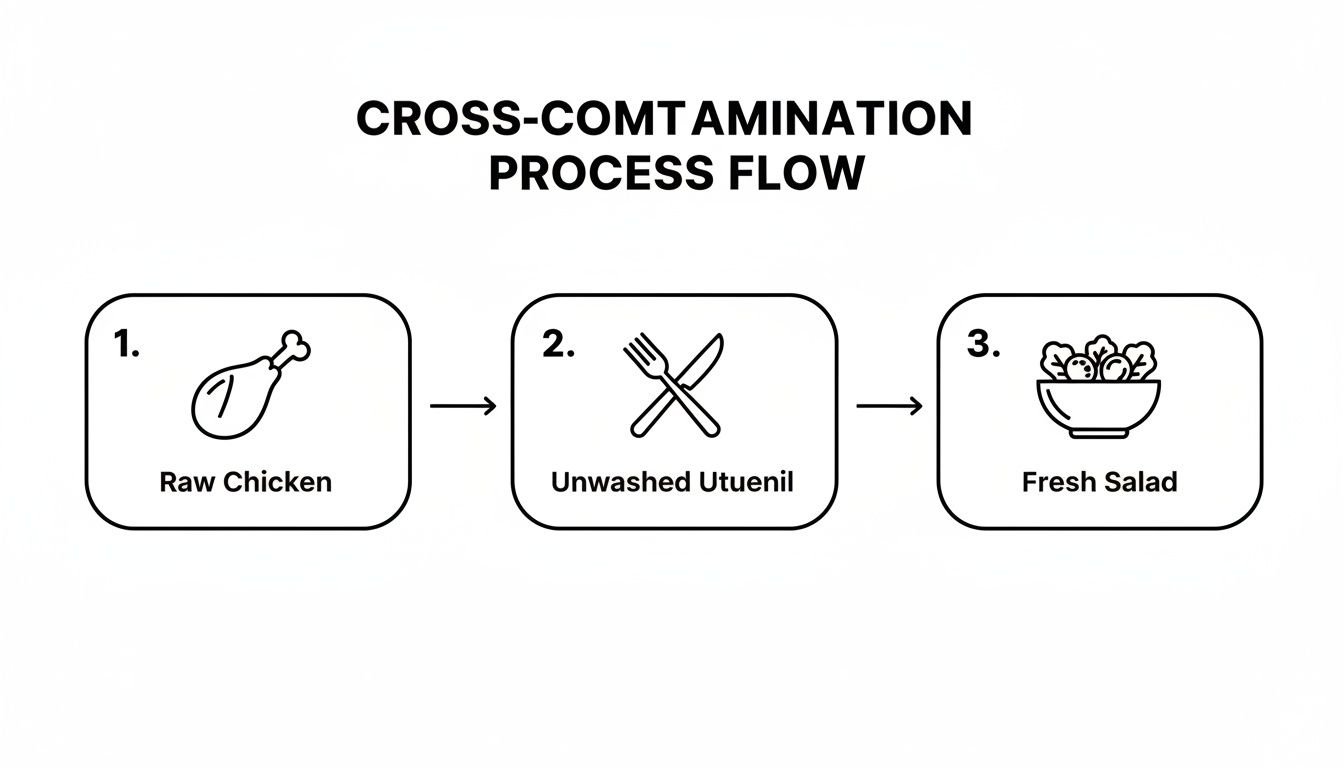
As you can see, that unwashed utensil becomes a bridge, allowing bacteria to travel directly from the raw chicken to the fresh, uncooked salad. It’s a classic, and entirely preventable, mistake.
The Myth of Washing Raw Chicken
One of the most stubborn—and dangerous—kitchen habits is washing raw chicken in the sink before cooking it. A lot of people think they’re rinsing off germs, but they’re actually helping them spread. The practice causes what’s known as aerosolisation, where tiny water droplets loaded with bacteria like Salmonella and Campylobacter get sprayed all over your kitchen.
These microscopic droplets can fly up to a metre, contaminating your sink, benchtops, dish rack, and any nearby utensils or clean food. The Food Safety Information Council recently revealed that nearly 50% of Aussies still wash whole raw chickens. While that's a slight improvement on a decade ago, it’s still a massive food safety risk.
The only thing that reliably kills these pathogens is cooking the chicken to an internal temperature of 75°C. That pre-wash is not just pointless; it's actively hazardous.
The safest way to handle raw chicken is to move it directly from the packet to the cutting board or pan. If you need to, pat it dry with a paper towel and then throw the towel straight in the bin. This keeps the bacteria contained.
Of course, a safe workflow relies on impeccable hand hygiene. To really lock down your kitchen's safety, it's worth getting familiar with proper hand washing station rules. This ensures you have everything you need to effectively scrub away pathogens after touching raw foods.
Choosing Your Tools Wisely
The gear you use, especially your cutting board, plays a massive role in the fight against cross-contamination. Not all materials are created equal. Some can accidentally become a perfect breeding ground for the very bacteria you're trying to eliminate.
For years, the big debate was wood versus plastic. Wood is naturally porous, so it can soak up moisture and bacteria. Plastic, on the other hand, might seem non-porous at first, but it quickly gets covered in deep knife grooves. These little cuts and scores become microscopic safe houses for bacteria, making the board almost impossible to sanitise completely, even in a hot dishwasher.
This is where modern, non-porous materials really shine. A cutting board made from pure titanium, for example, offers a fundamentally safer surface. Its advantages are clear:
- A Non-Porous Surface: Titanium doesn't absorb liquids, smells, or germs. Anything on the board stays on the surface, ready to be washed away easily.
- Built to Last: It's incredibly tough and resists the deep scratches that plague plastic boards, leaving bacteria with nowhere to hide.
- Naturally Antibacterial: As a biocompatible material, titanium naturally discourages bacteria from growing on its surface, giving you an extra layer of protection.
Have a look at this breakdown of common cutting board materials. It really highlights why your choice of prep surface is so important.
Cutting Board Hygiene Comparison
| Material | Porosity | Bacterial Risk | Knife Friendliness | Ease of Cleaning |
|---|---|---|---|---|
| Wood | High (Porous) | High (absorbs bacteria) | Excellent (gentle on knives) | Difficult (hand wash only) |
| Plastic | Low (becomes high with use) | Very High (scratches trap germs) | Good (but can dull knives) | Moderate (dishwasher safe) |
| Titanium | Zero (Non-Porous) | Very Low (naturally antibacterial) | Excellent (gentler than steel) | Excellent (dishwasher safe) |
Ultimately, a safer kitchen comes down to a system of smart habits backed by the right tools. By prepping your produce first, handling raw meat with care, and choosing a truly non-porous cutting surface like titanium, you build a powerful defence against cross-contamination. It’s how you make sure every meal you create is as safe as it is delicious.
Smart Storage and Handling: Your Next Line of Defence
Preventing cross-contamination goes way beyond what happens on your cutting board. Your refrigerator and pantry are the next critical frontiers in the battle for food safety. A messy, disorganised fridge isn't just an eyesore; it's a high-risk zone where harmful bacteria from raw foods can easily find their way onto things you’re about to eat.
Effective storage is a system, not an accident. It’s all about creating a deliberate, logical layout inside your fridge that physically separates high-risk items from low-risk ones. Honestly, this simple act of organisation is one of the most powerful things you can do to keep your food safe.
The golden rule, the one you absolutely cannot break, is to always store raw meat, poultry, and seafood on the bottom shelf. This isn't just a friendly tip—it's a non-negotiable principle of food safety. Raw meats can leak juices, and if they're sitting up high, those bacteria-laden drips can contaminate everything below, from fresh veggies to last night's pasta.
Organising Your Refrigerator for Maximum Safety
It helps to think of your fridge as having different temperature and risk zones. When you store food in the right spot, you don't just improve safety; you also keep it fresher for longer. A well-organised fridge is really the cornerstone of any solid plan for preventing cross-contamination.
Here’s a simple and effective layout to follow:
- Top and Middle Shelves: This is prime real estate for ready-to-eat foods. Think leftovers, dairy products like yoghurt and cheese, and cooked meats. These items won't be cooked again, so keeping them far away from raw contaminants is vital.
- Bottom Shelf: This is the dedicated zone for raw meat, poultry, and fish. No exceptions. Always keep them in sealed, leak-proof containers or on a tray with a lip to catch any potential drips.
- Crisper Drawers: These are designed to hold humidity, making them perfect for your fruits and vegetables. It's a good idea to keep them separate, as some fruits release ethylene gas that can make your veggies spoil faster.
- Door Shelves: As the warmest part of the fridge, the door is best for condiments, sauces, and juices—things that are naturally more resistant to spoilage. Try to avoid storing milk or eggs here.
This structured approach transforms your fridge from a potential hazard into a secure storage unit, actively working to keep your family safe.
Handling Leftovers and Ready-to-Eat Foods
Just because food is cooked doesn't mean it's automatically immune to contamination. How you handle leftovers and other ready-to-eat items is just as important. Never, ever use a utensil that has touched raw meat to serve a cooked dish or scoop out a portion of leftovers.
Think about it: you use a fork to turn raw chicken in a pan, and then, without washing it, you use that same fork to taste the finished sauce. That single action can reintroduce harmful bacteria to a perfectly cooked meal. It's a small habit to change—just grab a clean utensil—but it makes a massive difference.
When you're packing away leftovers, use clean, airtight containers and pop a label on them with the date. Aim to eat them within three to four days to make sure they're still safe and delicious. This stops microbes from growing and prevents any accidental contamination from other items in the fridge.
Expanding the Focus to Allergen Management
The principles of preventing cross-contamination extend beyond just bacteria. For many families, cross-contact with allergens like peanuts, gluten, or dairy is an equally serious health threat. The unintentional transfer of an allergen from one food to another can trigger severe, even life-threatening, reactions.
This is where your kitchen tools, especially your cutting board, play a critical role. A porous old wooden board or a heavily scratched plastic one can hang onto microscopic traces of allergens even after a good wash. For a household managing a peanut allergy, for example, residue from making a satay sauce could easily transfer to a fresh salad prepared on the same board later on.
The seriousness of this issue is clear in national food recall data. Between 2013 and 2022, there were a staggering 346 allergen-related food recalls in Australia, many caused by cross-contact during storage or processing. For perspective, microbial issues triggered 194 recalls in the same period, which really highlights how significant allergen management is. To get a better sense of these findings, you can explore the full data on Australia's food recalls.
Using a truly non-porous cutting board, like one made from pure titanium, is a game-changer for allergen-sensitive kitchens. Since titanium doesn’t absorb particles and resists the deep scratches where residues love to hide, it can be washed completely clean. This ensures no allergenic traces are left behind, offering essential peace of mind and making your kitchen a safer space for everyone.
Mastering Your Kitchen Cleaning and Sanitising Routine
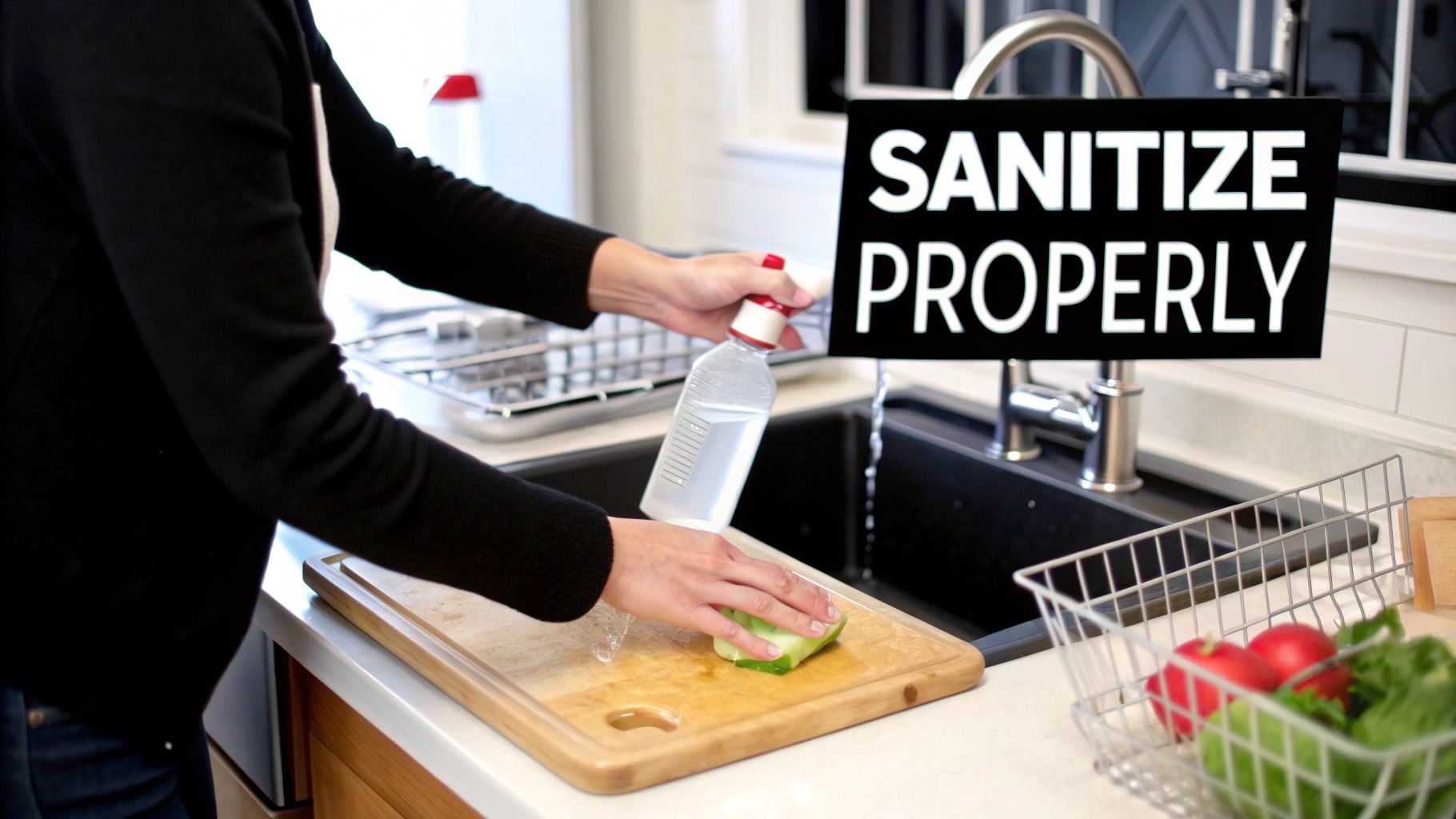
A truly safe kitchen goes beyond clever workflows and organised storage. At its heart is a non-negotiable cleaning and sanitising protocol. It’s easy to think these words mean the same thing, but they’re two very different, equally vital steps in stopping cross-contamination.
Cleaning is the physical part—wiping away food scraps, dirt, and grime. Think of it as clearing the decks. Sanitising, on the other hand, is the chemical step that reduces nasty microorganisms like bacteria and viruses down to a safe level. You must always clean before you sanitise. Why? Because leftover food bits can act like a shield for germs, making your sanitiser completely useless.
The Foundation of Kitchen Hygiene: Handwashing
Before you even think about touching an ingredient, your most important cleaning routine starts at the sink. Your hands are the number one way germs get ferried around the kitchen, so proper handwashing is a must, especially after handling raw meat, poultry, or seafood.
A quick splash under the tap just won’t do. Here’s the proper, science-backed way to do it:
- Wet your hands with clean, running water.
- Apply soap and lather up. Get right in there—scrub the backs of your hands, between your fingers, and under your nails.
- Scrub for at least 20 seconds. An easy trick is to hum the "Happy Birthday" song twice from start to finish.
- Rinse well under clean, running water.
- Dry your hands with a clean towel or let them air dry.
This simple 20-second habit is one of the single most powerful things you can do to prevent foodborne illness at home.
Choosing and Using Food-Safe Sanitisers
Once a surface is clean, it's time to sanitise. This is crucial for high-touch spots and any surface that’s been in contact with raw food. While there are plenty of commercial sanitisers, you can easily make your own food-safe solution.
A simple bleach solution is a classic for a reason. Just mix one teaspoon of unscented household bleach into one litre of water. Apply it, let it sit for at least one minute to work its magic, and then let it air dry. If you're looking for other options, you can explore our guide on using food-grade hydrogen peroxide as another safe and effective sanitising agent for your kitchen.
Don't forget the golden rule: clean first, then sanitise. Always wash surfaces with hot, soapy water to get rid of visible grime. Sanitiser only works on an already clean surface. This two-step process is fundamental to kitchen safety.
Your Kitchen Tools Can Make or Break Your Routine
Your cleaning and sanitising efforts are only as good as the tools you're using. This is where the material of your cutting board becomes a huge factor in how well you can actually prevent cross-contamination.
Think about that old, well-used plastic cutting board. It's probably covered in a web of deep knife grooves and fuzzy scratches. When you try to wash it, bacteria can hide deep inside those cuts, safe from both soap and sanitiser. Even a hot cycle in the dishwasher might not be enough to get to them.
This is exactly why a non-porous surface is such a game-changer for kitchen hygiene. A board made from pure titanium, for example, offers a completely different experience.
- No Place for Germs to Hide: Titanium is incredibly tough and resists the deep scoring that plagues plastic boards. This leaves a smooth, non-porous surface where bacteria have nowhere to camp out.
- Effortless to Clean: Germs, food bits, and smells can't soak into the surface. A simple wash with soap and water or a run through the dishwasher is all it takes to get the board perfectly clean and sanitised.
- Naturally Hygienic: The material itself is naturally antibacterial, which gives you an extra layer of defence against germs growing between uses.
When you choose tools that are genuinely easy to clean and sanitise, you make your entire food safety system stronger. A board like titanium becomes the cornerstone of a safe and efficient routine, ensuring all your hard work to prevent cross-contamination actually pays off.
Why Your Cutting Board Is Your Best Defence
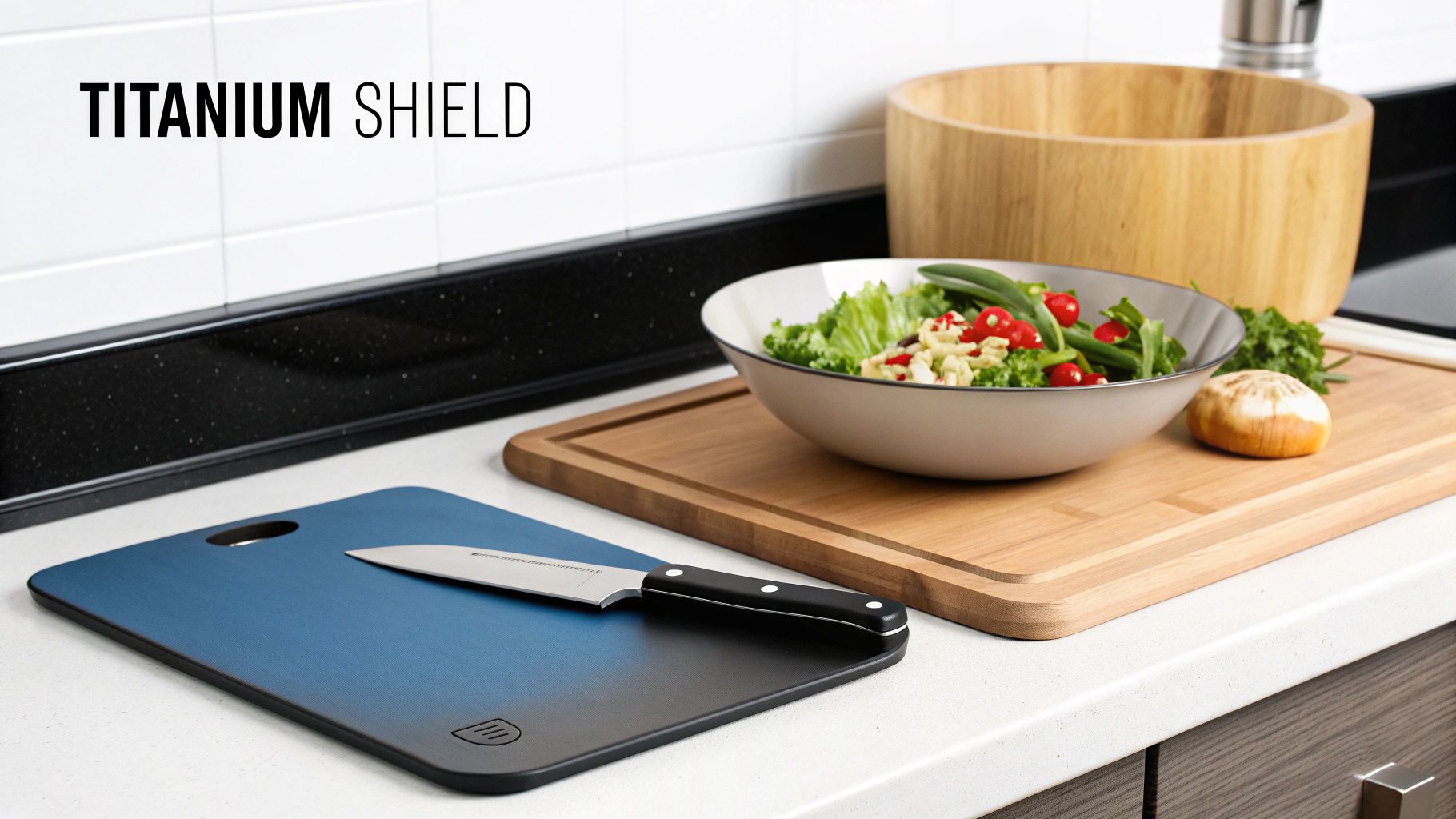
When you strip it all back, every strategy for preventing cross-contamination—from smart prep workflows to organised storage and diligent cleaning—is about one thing: creating physical barriers to stop harmful bacteria from spreading.
Once you start seeing your kitchen through that lens, you quickly realise your cutting board isn't just another accessory. It’s the central arena where this battle is won or lost. Every single slice, dice, and chop happens right there. It’s the meeting point for raw chicken and fresh parsley, and a single contaminated surface can undermine all your other safety efforts.
This is precisely why your board's material is so incredibly important. It can either be a weak link in your food safety chain or your strongest, most reliable defence. A good cutting board should actively work with you, not against you.
The Problem with Traditional Materials
For years, we’ve all relied on wood and plastic boards, but they both have some serious drawbacks that can increase the risk of cross-contamination.
Wooden boards, for all their rustic charm, are naturally porous. This means they soak up moisture, food juices, and, you guessed it, bacteria. Over time, they become almost impossible to truly sanitise because germs get trapped deep within the fibres.
Plastic boards seem like a more hygienic choice at first, but they quickly develop a network of deep scratches and knife grooves. These tiny crevices are the perfect hiding spots for nasties like Salmonella and Campylobacter. A thorough wash or even a spin in the dishwasher often isn't enough to dislodge pathogens from these microscopic hideouts.
How Titanium Directly Solves the Core Challenges
This is where a material like pure titanium completely changes the game. It’s not just an upgrade; it’s a strategic choice that gets right to the heart of hygiene and cross-contamination. Its unique properties create a powerful, multi-layered defence.
Here’s how it works:
- A Truly Non-Porous Surface: Titanium is completely non-absorbent. Raw meat juices, liquids, and odours can't penetrate the material, so they stay on the surface. When you wash the board, you remove 100% of the contaminants. Every. Single. Time.
- Resists Scratches and Grooves: Its incredible durability means it doesn’t suffer from the deep scoring that plagues plastic boards. Without those nooks and crannies for bacteria to hide in, the surface stays smooth and simple to sanitise.
- Naturally Antibacterial: As a biocompatible material, pure titanium naturally inhibits bacterial growth on its surface. This acts as an extra layer of passive protection, keeping your prep area more hygienic between cleanings.
Choosing a titanium cutting board is about more than just durability. It’s an investment in a surface that is fundamentally designed to prevent cross-contamination, offering peace of mind every time you prepare a meal.
More Than Just a Hygienic Surface
The benefits don't stop at microbial safety. A superior cutting board material enhances your whole cooking experience and supports a healthier home. For families who are conscious of plastics in the kitchen, titanium is a welcome solution.
Because it’s pure, uncoated metal, a titanium board is completely free of microplastics and BPA. There’s zero risk of tiny plastic particles flaking off into your food over time. And despite its strength, it's engineered to be gentler on your high-quality knife edges than other hard surfaces like glass or stone.
Ultimately, knowing how to prevent cross contamination means making smart, informed choices about your kitchen tools. If you’re ready to explore a cutting board that aligns with a modern, health-first approach, you can learn more about what makes the best cutting board material for health in our detailed guide. It connects all the dots, showing why the right board isn’t just an accessory, but a foundational investment in a safer, cleaner kitchen.
Your Cross-Contamination Questions, Answered
Even when you’re trying your best to follow the rules, it’s easy to get stuck on a few common kitchen questions. Getting the right answers is what turns good intentions into rock-solid, safe habits. Let's tackle some of the most frequent queries that come up during meal prep.
Can I Just Wash My Cutting Board Between Meat and Veggies?
Technically, yes, but it’s a risky move. While a good scrub is essential, it’s not always foolproof, especially when you're dealing with older, worn-out boards.
Porous materials like wood, or plastic boards covered in deep knife grooves, can trap bacteria in places that are almost impossible to clean properly. This is exactly why food safety pros will always tell you that using separate boards is the gold standard for a reason.
If you’re ever in a pinch and only have one board, stick to this order of operations:
- Prep all your vegetables and other ready-to-eat foods first. Set them aside.
- Next, give the board a serious clean with hot, soapy water, followed by a proper food-safe sanitiser.
- Only after it's been thoroughly cleaned and sanitised should you let raw meat touch it.
This is where a non-porous board, like one made from pure titanium, really shines. It doesn’t give bacteria anywhere to hide, making it far easier to get truly clean and significantly lowering your risk.
What’s the Best Way to Defrost Frozen Meat?
Slow and steady wins the race here. The safest way, without a doubt, is to let it thaw in the fridge on the bottom shelf. Pop it in a sealed container or on a lipped plate to make sure any juices are contained. This simple step prevents any accidental drips from contaminating the food stored below.
Whatever you do, never leave meat to thaw on the kitchen bench. The outside of the meat can quickly warm up to the 'danger zone' (between 5°C and 60°C), where bacteria thrive, while the inside is still frozen solid.
If you're short on time, you can use the defrost setting on your microwave. Another option is to put the meat in a leak-proof bag and submerge it in a sink of cold water, making sure to change the water every half hour.
When Should I Throw Out My Old Cutting Boards?
It’s time for a new board as soon as your current one has deep scratches, stubborn stains, or grooves you can't get clean. Those little imperfections are a paradise for nasty bacteria, and even the most vigorous scrubbing might not be enough to get them out.
There's no set "use by" date for a cutting board; it all comes down to its condition. Get in the habit of giving your boards a quick inspection every now and then.
This constant need for replacement is a huge argument for investing in a more durable, non-porous material. A board crafted from pure titanium, for example, is built to resist deep scoring and will likely be the last one you ever need to buy.
Ready to make your kitchen the safest it can be? The flagship Titanium Cutting Board from Everti is your ultimate defence against cross contamination. Its non-porous, naturally antibacterial surface offers peace of mind with every meal. Explore the future of food prep at https://everti.com.au.