

Selling on eBay in Australia is a fantastic way to reach millions of potential buyers, whether you're clearing out spare items from around the house or running a full-fledged business. The whole game is about setting up your seller account properly, creating listings that grab attention, pricing your items smartly, and sorting out your shipping. Nail these basics, and you'll be well on your way.
Why eBay Is a Smart Choice for Australian Sellers
Before we get into the nitty-gritty, let's talk about why eBay is still such a powerhouse for sellers down under. It’s not just another marketplace; it’s a massive, ready-made audience of active shoppers who are literally searching for what you have. That immediate access to a hungry market is a huge leg-up compared to building your own website from scratch and trying to find customers.

Think about brands selling premium gear, like Everti with their durable titanium kitchenware. For them, eBay isn't a second-hand shop; it's a direct line to customers who get what quality is all about. Instead of burning through a massive marketing budget just to get eyeballs on their site, they can put their products right where people who value craftsmanship are already looking.
Get In Front of a Massive, Ready-Made Audience
The biggest drawcard for selling on eBay in Australia is the sheer number of people using it. We're talking about 12 million monthly active users, making it the country's go-to online shopping destination. This gives you an incredible opportunity to connect with all sorts of buyers, from health nuts to design lovers, all in one spot. You can dig deeper into these impressive eBay statistics to see what they mean for your potential.
This screenshot from SimilarWeb really puts into perspective just how much traffic eBay.com.au gets.
The numbers don't lie. Its high ranking and massive, consistent visitor count highlight just how much trust Aussies have in the platform.
A Platform Built on Trust and Familiarity
After decades in the game, eBay has earned some serious trust. Australian shoppers know the drill—they understand how bidding works, what 'Buy It Now' means, and they rely on the buyer protection policies. This built-in familiarity removes one of the biggest hurdles that new, independent online stores struggle with: getting people to trust you with their money.
When you list an item, you're not just selling a product; you're borrowing eBay's credibility. This established trust helps convert browsers into buyers more effectively, especially for higher-value items where customer confidence is crucial.
This trust makes the whole sales process smoother. Buyers feel safe punching in their credit card details because they know there's a system in place to protect them if things go sideways. That security makes them far more likely to click 'buy' on your listing.
Getting Your Seller Account Set Up for Success
Before you even think about your first listing, it’s worth spending a bit of time getting your eBay seller account set up properly. Trust me, getting this right from the start saves a world of headaches later on. Think of it as laying the foundations for your new online venture—it determines how buyers perceive you and how smoothly everything runs behind the scenes.
The first choice you’ll make is between a personal and a business account. If you’re just clearing out the garage and selling some pre-loved items, a personal account is all you need. Simple.
But if you’re planning to sell regularly, buy goods specifically to resell, or list products you've made yourself, you absolutely need a business account. It unlocks more professional tools, makes tracking your income and expenses for tax time much cleaner, and instantly signals to buyers that you’re a serious, professional seller.
Navigating the Essential Admin Tasks
Once you've picked your account type, eBay needs to confirm you are who you say you are. This just involves providing some basic identification and linking your Australian bank account to eBay's Managed Payments system. This is how you’ll receive your money, so it’s a critical step.
You'll also run into initial seller limits. Almost every new seller starts with restrictions on how many items they can list or their total value. For example, a common starting limit is 10 items or $500 per month.
Don't let these limits put you off. They’re designed to protect everyone on the platform. As you start selling, shipping on time, and building up positive feedback, you can request increases and get those limits lifted pretty quickly.
Think of them as training wheels while you get the hang of selling on eBay.
Establishing Your Store Policies
Before diving into creating listings, take a moment to set up your business policies. These are basically the rules of engagement for your customers and cover three main areas:
- Payment Policy: This just confirms how you get paid. With eBay managing all payments now, it's pretty straightforward, but it’s still a required step you need to complete.
- Postage Policy: Here’s where you detail your shipping methods, costs, and handling times. Will you offer express postage? Are you open to shipping internationally? Be crystal clear to avoid confusion.
- Return Policy: Define your rules for returns. Remember, Australian Consumer Law will always apply, but you can specify your own terms, like the return window (e.g., 30 days) and who is responsible for return postage costs.
Finally, give some thought to your username. It’s a small part of your brand. A name like "Dans_Great_Deals" feels much more established and trustworthy than a random jumble of letters and numbers. Taking care of these details from day one means you can start selling with confidence and clarity.
Crafting Product Listings That Actually Convert
A fantastic product can completely vanish on eBay if the listing doesn’t do its job. It’s a crowded marketplace, so your goal is to create a listing that grabs attention, builds trust, and convinces a shopper to hit that "Add to basket" button. The secret is to think like an Australian buyer searching for exactly what you're selling.
Nail the Title and Photos First
Your product title is everything when it comes to getting found. Forget about being clever or creative here; you need to be descriptive and practical. Pack it with the exact keywords a potential buyer would type into the search bar.
Let's say you're selling a premium item like an Everti titanium cutting board. A weak title would be "Nice Cutting Board." A title that actually sells would look something like this: "Everti Pure Titanium Cutting Board Large 38cm SGS-Verified Hygienic & Blade-Safe." See the difference? It has the brand, material, size, and key selling points right there. It’s a mini-advertisement in itself.
Once they click, it's all about the photos. In online selling, high-quality images are non-negotiable. You don't need a fancy studio, but you absolutely need clear, well-lit shots from every important angle.
- Keep it clean: A simple white or neutral background always works best. It makes your product the star.
- Show the scale: If the size isn't obvious, place a familiar object like a coin or a phone next to it.
- Zoom in: Get close-ups of important details, textures, or unique features.
- Be upfront about flaws: If you're selling something pre-owned, take clear photos of any scratches or wear. Honesty builds trust and prevents headaches later.
Write a Description That Sells
After the photos, your description is your chance to seal the deal. This is where you answer a buyer's questions before they even have to ask. Keep your paragraphs short and use bullet points to make the information easy to scan.
Don't just list features—explain the benefits. Instead of saying "SGS-verified titanium," tell them what that actually means: it's guaranteed 99.9% pure, it’s naturally antibacterial, and it will never rust or stain.
This simple shift from what it is to what it does for them helps justify your price and builds a buyer's confidence.
Use Item Specifics to Get Seen
This is a step too many sellers skip, and it's a huge mistake. Item Specifics—those little drop-down fields for brand, colour, material, and size—are incredibly powerful. Filling these out is how your product shows up when buyers use the filters on the left side of the search results. If you leave these blank, your listing is invisible to a huge chunk of serious buyers.
If you sell items with different options, like T-shirts in various sizes or colours, the Variations feature is your best friend. It lets you put all those options into one clean listing instead of cluttering up your store with dozens of separate ones. This is way better for the buyer and helps consolidate all your sales history and positive feedback onto a single, powerful listing.
Finally, every good listing is backed by clear and fair policies. If you need a solid starting point for your own terms, feel free to review our return policy to see how we structure ours.
Pricing Your Products and Understanding eBay Fees
Figuring out the money side of eBay is where the rubber really meets the road. If you get this part wrong, you could end up doing a lot of work for very little profit. It’s all about finding that sweet spot between a competitive price and actually making a decent margin after eBay takes its cut.
So, let's talk about the fees. For most of us selling from Australia, it boils down to two main costs you need to have front of mind.
-
Insertion Fees: Think of this as the fee to put your item on the shelf. The good news? eBay gives you a bunch of free listings every month—often over 250—so unless you’re a high-volume seller, you probably won’t even notice this one.
-
Final Value Fees: This is the big one. It’s a percentage of the total amount the buyer pays, which includes the item price and whatever you charge for postage. It changes depending on the category, but you should budget for something in the ballpark of 10% to 15%.
These fees come directly out of your sale, so you absolutely have to build them into your asking price from the get-go.
Choosing Your Pricing Strategy
How you price your item really depends on what you're selling. On eBay Australia, you’ve got two main plays: the straightforward 'Buy It Now' or the classic auction.
A ‘Buy It Now’ listing is your best bet for common items with a pretty clear market value, like a new electronic gadget or a specific brand of clothing. It’s simple, direct, and what most online shoppers expect. You can also add a ‘Best Offer’ option, which I highly recommend. It opens the door to negotiation and can help you shift stock a bit quicker without having to slash your public price.
Auction-style listings are perfect for those one-of-a-kind, rare, or collectible items where it’s hard to pin down a value. Starting the bidding low can create a real buzz and pull in multiple interested buyers, sometimes pushing the final price well beyond what you would have asked for in a fixed-price sale.
Setting a realistic price is part art, part science. My best tip is to search for your item on eBay and then filter the results by 'Sold Items'. This shows you what people are actually paying for things, which is far more valuable than just seeing what other sellers are asking.
Factoring in All Costs
The biggest mistake new sellers make? Underestimating postage. You have to be precise here. Guess too low, and you're paying out of your own pocket. Guess too high, and you'll put buyers off. The only way to get it right is to pack your item, weigh it, and measure it before you list it.
This quick diagram shows how the different parts of your listing come together to justify your price.
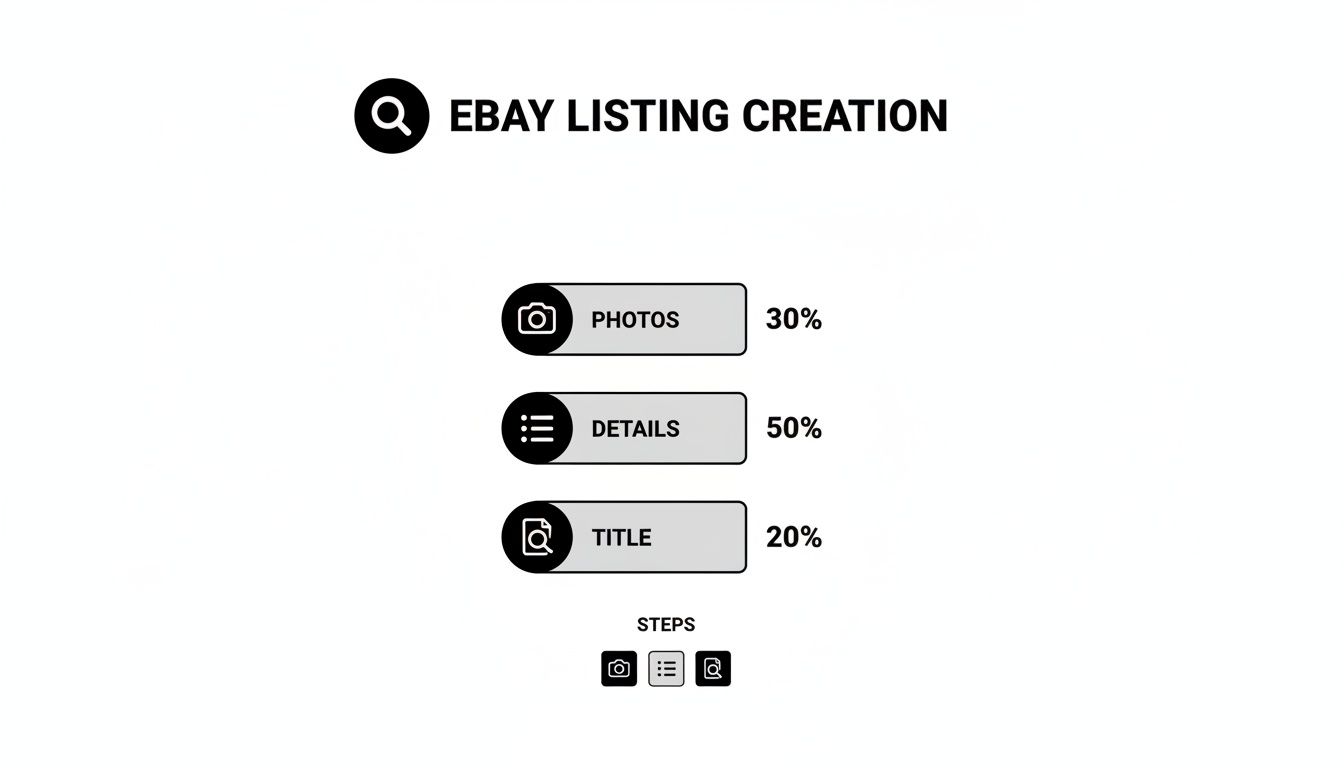
While the title and photos pull people in, it's the details—including a well-researched price—that seal the deal.
To give you a clearer picture of what to expect, here's a simplified breakdown of the fees you'll encounter.
eBay Australia Seller Fee Breakdown (Example)
| Fee Type | Description | Typical Cost (Variable) |
|---|---|---|
| Insertion Fee | The cost to create a listing. | Often $0 for the first 250+ listings per month. |
| Final Value Fee | A percentage of the total sale amount (item + postage). | 13.25% on most of the sale amount up to $4,000. |
| Fixed Order Fee | A small, flat fee charged on every sale transaction. | $0.30 per order. |
| Optional Listing Upgrades | Fees for extra features like subtitles or scheduling. | Varies (e.g., $2.50 for a subtitle). |
This table is just an example for a common category, so always check the specific fee structure for what you're selling. The numbers can and do change.
The potential for serious sellers is massive; we're talking over 8,500 professional sellers in Australia who treat eBay as a primary or secondary income stream. With reports showing that profits for things like collectibles are on the rise, it’s clear buyers are willing to pay for good items. You can read more about eBay's Australian seller community to see the scale of the opportunity.
Mastering Shipping and Logistics Across Australia
Shipping can feel like the final, complicated hurdle when you're just starting out on eBay Australia. But let's be honest, getting it right is a massive part of keeping your customers happy and coming back for more. Your approach to postage isn't just a backend task; it's a powerful tool that directly impacts your sales, reviews, and overall efficiency.
The first choice you'll make is your courier. For most of us selling here in Australia, it really comes down to two main players: Australia Post or a service like Sendle.
Australia Post has an unbeatable reach, especially if you're sending items to rural or remote areas. Plus, their huge network of post offices makes drop-offs incredibly convenient. On the other hand, Sendle often comes in with more competitive pricing for metro deliveries and offers a door-to-door pickup service, which can be a real time-saver.
Choosing Your Postage Strategy
Once you've got a carrier in mind, you need to decide how you'll charge your customers for postage. There are really two ways to go about this.
- Flat Rate Shipping: This is the simple option. You set one standard postage cost for all buyers across Australia. It works best if you sell items of a similar size and weight, where the actual shipping cost doesn't fluctuate too much from one city to another.
- Calculated Shipping: This is the fairest method for both you and the buyer. You enter your parcel's weight and dimensions when you create the listing, and eBay automatically calculates the exact postage cost based on the buyer's postcode. This ensures you never overcharge or, more importantly, undercharge.
It’s crucial to know how to calculate shipping charges accurately in Australia from the get-go. A small miscalculation can quickly chew through your profit margin on a sale.
The Power of Free Shipping and Clear Policies
Thinking about offering free shipping? Do it. It’s one of the most effective ways to make your listing stand out and can seriously boost your sales. It just removes that final moment of hesitation for a potential buyer. The trick is to simply factor the average postage cost into your item's list price.
A well-defined shipping policy is all about building trust and managing expectations. Be totally upfront about your handling time—that's how long it takes you to pack and post the item after payment clears. Aiming for a one-day handling time is a fantastic goal that buyers really notice and appreciate.
Your policy should also clearly state if you offer combined shipping for multiple items or if you ship internationally. To get an idea of a clear and comprehensive layout, feel free to check out our own detailed shipping policy and see how we set out the terms for our customers.
Finally, don't forget to use eBay’s own tools. You can print your postage labels directly through the platform, which saves a heap of time and automatically uploads the tracking information for both you and your buyer. It’s a simple step that cuts down on all those "Where's my order?" messages. It's these kinds of streamlined tools that make it possible to grow—in fact, over three-quarters of eBay sellers say the platform has helped them reach new customers all over the world.
Got Questions About Selling on eBay Australia?
Jumping into eBay can feel like learning a new language, and it's natural to have a few questions as you find your feet. Getting your head around the common sticking points early on will give you the confidence to run your store smoothly and handle whatever comes your way.
One of the first hurdles for many new sellers is returns. The thought of it can be a bit intimidating, but it's just part of the e-commerce game. The trick is to have a clear, fair return policy in place from day one. It sets expectations for your buyers and, just as importantly, protects you.
Keep in mind, Australian Consumer Law is the baseline. Buyers are always covered if an item is faulty or not as described. But for simple "change-of-mind" returns, your policy is king. You get to decide the rules, like the return window (30 days is pretty standard) and who foots the bill for return postage.
How Do I Keep My Seller Performance in Good Shape?
Think of your seller performance as your reputation on eBay. It has a direct impact on how many people see your listings and whether they trust you enough to buy. eBay keeps an eye on a few key metrics to assign your seller level: Below Standard, Above Standard, or the coveted Top Rated.
These are the big ones to watch:
- Transaction Defect Rate: This flags any sales you had to cancel or disputes that were closed without a resolution. You need to keep this number as low as humanly possible.
- Late Shipment Rate: This one’s simple – it tracks how often you post items after your stated handling time. Ship on time, every time.
- Cases Closed Without Seller Resolution: This happens when a buyer has a problem and you don't sort it out, forcing eBay to step in and find in their favour.
Meeting these standards consistently doesn't just earn you a pat on the back. It can lead to real perks, like fee discounts and better visibility in search results.
Your seller dashboard is your best friend. Make it a habit to check it at least once a week. If you spot a metric starting to dip, you can jump on the cause—maybe your dispatch times are slipping or your item descriptions aren't clear enough—before it spirals into a serious issue.
What’s the Best Way to Handle Buyer Disputes?
Sooner or later, you’ll run into a buyer who isn't completely happy. It happens. The absolute best way to handle this is with quick, professional, and empathetic communication. You’d be surprised how many problems can be solved with just a simple, polite message.
If a buyer opens a formal 'request' or 'case' through eBay's Resolution Centre, don't sweat it. Just make sure you respond within the timeframe eBay gives you. Often, the easiest path is to offer a partial refund for a minor issue or simply accept the return to keep your customer happy and move on. The worst thing you can possibly do is ignore it. That’s a surefire way to get a defect slapped on your account.
Getting comfortable with these practical bits and pieces is what separates the successful sellers from the rest. If you're looking for more detailed answers, we've compiled a ton of information in our comprehensive FAQs, covering almost every situation a new seller might face.
Can I Sell to Customers Outside of Australia?
You sure can! In fact, eBay makes it surprisingly easy to reach a global audience. All you need to do is enable international shipping in your postage policies and select the countries you’re happy to post to.
When you start selling overseas, there are just a couple of extra things to keep on your radar. You’ll need to fill out customs declarations accurately, and remember that international postage costs can be quite a bit higher. I'd also strongly recommend using a tracked shipping service. It provides peace of mind for both you and your buyer, protecting everyone from the headache of lost parcels. Once you've mastered the local market, selling internationally is a brilliant way to grow your business.
Ready to elevate your everyday essentials? Discover the unmatched purity and durability of titanium with Everti. Explore our lifetime collection of kitchenware and tableware at https://everti.com.au.