

Under Australian Consumer Law, both terms can offer protection, but a lifetime warranty is a voluntary promise, while consumer guarantees are automatic legal rights that can continue beyond any warranty period. A “lifetime guarantee” is not automatically a stronger right, because its meaning depends on the wording and the legal obligations that sit underneath it.
You buy an expensive titanium cookware set because you expect it to become part of your kitchen for years. Then a crack appears, a handle loosens, or the surface behaves differently from the product description. You find the certificate, see the words “lifetime”, and assume the answer is simple. Instead, the document asks whether you're the original owner, whether the damage counts as a defect, and whether ordinary use has excluded the claim.
That confusion is common because manufacturers use guarantee and warranty as reassuring marketing language, even though the practical coverage can differ sharply. In Australia, the more important question isn't which word sounds stronger. It's whether the promise is clear, what it covers, and how it relates to your separate rights under the Australian Consumer Law.
The Lifetime Promise in Your Kitchen
You unpack the cookware, wash each piece, and place it carefully in the cupboard. The product page described durable materials, reliable construction, and a lifetime promise. You reasonably expect the promise to matter if something fails through ordinary use.
Two years later, a crack appears near the rim of one pan. You haven't dropped it or used it in an unusual way. The warranty certificate is still in a drawer, but its wording introduces several conditions. It may cover manufacturing defects, exclude accidental damage, require proof of purchase, and limit the promise to the original purchaser. “Lifetime” suddenly looks less like an answer and more like a question.
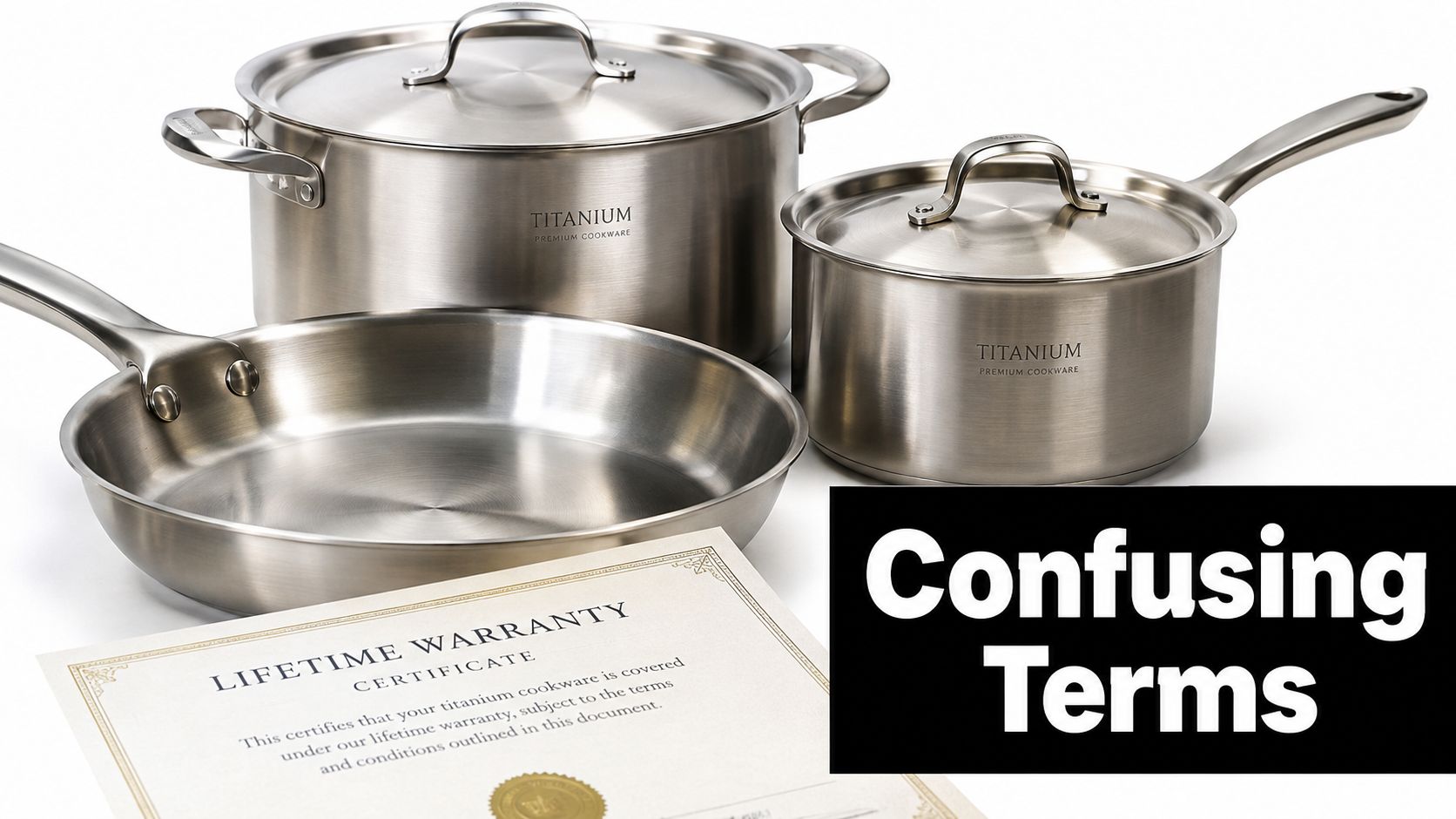
The first practical lesson is to read the claim before buying, not after a failure. Ask what “lifetime” refers to, whether the protection follows the product or the first buyer, and whether the business promises repair, replacement, refund, or only a decision at its discretion.
What the certificate may leave unclear
A product page can make a lifetime claim prominent while placing the important limits elsewhere. Look for:
- Coverage scope: Does the promise address manufacturing defects, all failures, or only selected components?
- Ownership rules: Can a later owner claim, or must you have bought the item directly?
- Excluded conduct: Are misuse, accidental damage, scratching, staining, and normal wear excluded?
- Claim process: Do you need a receipt, registration record, photographs, or an inspection?
- Available remedy: Will the business repair the item, replace it, refund it, or offer another remedy?
Keep your receipt, order confirmation, warranty document, and product photographs together. Those records won't create rights that don't exist, but they can make it easier to show what was promised and when you bought the item.
Practical rule: Treat “lifetime” as a prompt to inspect the terms, not as proof that every future problem will be covered.
A durable kitchen should also be designed around how people cook, clean, store, and move through the space. For broader ideas about creating a kitchen that remains practical over time, these DC area kitchen design tips provide useful context. Good design and clear product terms solve different problems, but both help prevent expensive assumptions.
Defining the Two Terms Clearly
A guarantee is a business's assurance about a product or the customer's experience. It might promise repair or replacement if an item fails, or state that the product will perform in a particular way. The word sounds broad, but its legal and practical effect depends on the written promise and its conditions.
A warranty is usually a more structured voluntary promise. It explains when the business will provide a remedy, often for defects in materials or workmanship. Its terms may identify exclusions, proof requirements, ownership restrictions, and the steps for making a claim.
| Feature | Lifetime guarantee | Lifetime warranty |
|---|---|---|
| Typical function | A broad-sounding assurance about performance or satisfaction | A written promise with defined coverage and conditions |
| Main question | What exactly has the business promised? | What defect, person, product, and remedy does the document cover? |
| Meaning of “lifetime” | Must be interpreted from the wording and context | Must be defined in the warranty terms |
| Relationship with Australian law | Doesn't replace statutory consumer guarantees | Doesn't replace statutory consumer guarantees |
The legal hierarchy sits above both voluntary promises. The ACCC explains the difference between warranties and consumer guarantees: a warranty is an additional promise, while consumer guarantees arise automatically under the Australian Consumer Law. A retailer or manufacturer cannot use warranty wording to remove those statutory protections.
A simple way to remember the hierarchy
The voluntary promise sits on top of the law as an extra layer. It can give you a clear process for seeking repair or replacement, but it never replaces the statutory consumer guarantees underneath it. For example, a company may offer to replace a defective cutting board under a lifetime warranty. If that warranty later expires, the expiry does not automatically answer every legal question. The product may still need to meet the consumer guarantees that apply to its type, price, description, and circumstances.
The word guarantee is not a magic legal upgrade, and warranty is not a legal waiver. Read either promise as a set of conditions, then assess it alongside the separate statutory framework. This distinction matters because “lifetime” can describe a voluntary claim without defining the full legal rights available when the product fails.
What Australian Consumer Law Protects
A chopping board advertised with a lifetime promise can still fail soon after purchase. Australian Consumer Law gives the buyer a separate legal baseline, independent of any business warranty. Consumer guarantees are automatic, cannot be removed by contract wording, and do not operate on a single fixed expiry date. The relevant question is whether the product lasted for a reasonable time, considering its type and circumstances. The ACCC explains consumer rights and guarantees.
For a longer treatment of how these rights interact with product promises, see our guide to lifetime warranty products.
A statutory guarantee does not mean every utensil must last forever. A product's expected useful life depends on its nature, price, description, and the performance a reasonable buyer would expect. A basic utensil and a premium cookware set may create different expectations. The legal assessment follows the item and its circumstances, rather than the word “lifetime” on a sales page.
What happens when a product fails
Consumer guarantees can cover acceptable quality, fitness for a purpose disclosed to the seller, and consistency with the product description. If an item fails to meet the relevant guarantee, the appropriate response depends on the seriousness of the problem and the surrounding facts. The business may need to repair, replace, or refund it. Pointing to the end of a voluntary warranty does not settle that separate legal question.
The ACCC's guidance on consumer guarantees after a warranty expires addresses a common misunderstanding: an expired warranty document does not automatically end every possible remedy. A warranty can give buyers a clear claims process, while the statutory assessment continues to depend on the product's condition, use, and expected lifespan.
A warranty can end while a consumer guarantee question remains open.
This hierarchy changes how a lifetime claim should be assessed. A generous warranty may make a claim easier to process, but it does not decide whether the product met the legal standard. A narrow warranty does not automatically remove rights supplied by law.
The practical questions are straightforward: What did the product promise? How was it used? What would a reasonable buyer expect from that kind of item? Those answers matter more than whether the seller chose the word “guarantee” or “warranty.”
When Lifetime Claims Face Regulatory Scrutiny
Regulatory action shows why the word “lifetime” needs a precise definition. In 2017, the ACCC accepted a court-enforceable undertaking from Belkin concerning lifetime warranty claims. The action required Belkin to honour the claims for the lifetime of the original purchaser, illustrating that an ambiguous promise can be interpreted more narrowly than a shopper might assume. The ACCC's consumer buying guidance provides the broader context that warranties are voluntary promises and consumer guarantees remain separate.
The important point isn't that every lifetime warranty will follow the same wording. It's that the word has legal weight when a business uses it to shape a buyer's expectations. If the advertisement suggests coverage that the written terms don't support, the business may face pressure to clarify or honour the broader impression.

Why Belkin matters to everyday shoppers
Suppose a product page says “lifetime warranty” without explaining whose lifetime applies. A buyer may read that as protection for the item for as long as it remains in use. The business may intend something narrower, such as protection for the original purchaser. The gap between those interpretations creates the dispute.
The Belkin action is a practical warning to both sides:
- For buyers: Don't assume the product's life, the owner's life, and the warranty period mean the same thing.
- For businesses: Define ownership, duration, exclusions, and remedies in language customers can understand.
- For both: Marketing copy and warranty documents need to communicate the same promise.
The ACCC also renewed attention in 2024 to the possibility of repairs, refunds, or replacements after a warranty expires, as reflected in its reminder about post-warranty consumer rights. That message weakens the common assumption that “out of warranty” automatically means “no rights”.
The risk of vague wording
A long promise can create false confidence if the claim process is difficult or the exclusions swallow most ordinary problems. Clear terms don't guarantee that a claim will succeed, but they let a buyer understand the bargain before paying.
For kitchenware, ask whether the lifetime wording covers a defect in material or workmanship, damage caused by ordinary use, or only a narrow category of failures. The answer matters more than the size of the lettering on the product page.
How to Evaluate Kitchenware Lifetime Claims
Use the written terms as a buying checklist. Don't rely on a badge, a product title, or a salesperson's shorthand explanation. A credible claim should make the important boundaries visible before checkout.
| Check item | What to look for |
|---|---|
| Meaning of lifetime | A clear statement about the product's life, the original owner's life, or another defined period |
| Covered problems | Specific defects or failures, rather than an undefined promise to cover “everything” |
| Exclusions | Ordinary wear, misuse, accidental damage, scratches, stains, and alterations |
| Ownership | Whether the promise is transferable or limited to the original purchaser |
| Proof | Receipt, order record, registration, photographs, or other claim evidence |
| Remedy | Repair, replacement, refund, credit, or another stated outcome |
| Claim route | Contact details, inspection steps, shipping arrangements, and response process |
| Materials | Technical documentation or independent verification supporting the product description |
Ask these questions before paying
- What does lifetime mean here? Ask the seller to identify the person, product, or period that defines it.
- What would void the promise? Separate misuse from normal cooking, cleaning, storage, and transport.
- Do I need to register? If registration is required, complete it and save confirmation with your receipt.
- Who pays for return shipping? A warranty may cover the product while leaving logistics unclear.
- What happens if the model is discontinued? Look for the stated replacement or refund approach.
- Does the claim cover accessories and components? A set may have different treatment for different parts.
Independent material evidence can strengthen a product claim, but it doesn't automatically determine your legal remedy. If a brand refers to SGS verification, learn what was tested and what the certification confirms. Everti's explanation of what SGS certification means is a useful starting point for understanding why the scope of a certificate matters.
Care also affects the factual question of whether damage arose from ordinary use or misuse. For outdoor serving, practical food-safety habits such as how to keep flies away from food can help you protect food and reduce avoidable contamination risks, although no care routine changes the written warranty terms.
Save screenshots of the product page when you order. Marketing copy can change, while your records help establish what representation you relied on at the time of purchase.
Choosing Durable Titanium Kitchen Essentials
A lifetime claim deserves evidence that relates to the material, not just the slogan. Titanium kitchenware can appeal to buyers who want a lightweight, corrosion-resistant material with a clean, uncoated surface. Those attributes may support a durability proposition, but the product still needs clear specifications and realistic care instructions.
For health-conscious cooks, the relevant questions include whether the surface is coated, how colour is produced, and whether the maker provides material information. For chefs and frequent home cooks, strength, cleaning, knife interaction, handling, and storage may matter more than the word “lifetime” on the packaging.
Evidence should come before enthusiasm
Prioritise documentation that lets you test the claim:
- Material identity: Look for a clear statement about the titanium used and whether the product contains coatings or added layers.
- Independent verification: Check whether a named testing organisation verified a stated property, and read the scope rather than treating the logo as a blanket endorsement.
- Construction details: Examine joins, handles, edges, surface finishing, and any parts made from different materials.
- Colour method: If the product has an iridescent finish, determine whether the colour comes from controlled heat treatment, coating, or dye.
- Care guidance: A durable product still needs instructions for cleaning, heat exposure, stacking, and impact.
Everti is one example of a brand presenting titanium kitchen and table products with SGS verification and material information. Its range includes cookware, drinkware, tableware, cutting boards, and the Aura collection. Evaluate those statements against the product documentation and the written warranty rather than treating the brand name as a substitute for your own review.
Match the material to the way you cook
A lightweight titanium board may suit a compact kitchen, outdoor cooking, or a buyer who wants an easy-to-clean prep surface. A professional chef may instead prioritise board dimensions, stability, knife feel, and the replacement process if a defect appears. A family may value simple cleaning and resistance to corrosion more than colour or portability.
You can also compare the construction approach with broader guidance on house cookware sets, then return to the warranty document and ask whether the promise covers the exact item and use case you're considering. Product performance and legal coverage are related, but they aren't interchangeable.
The sound decision is conditional: choose titanium when its properties fit your routine, and choose a lifetime promise only when its scope is clear enough to evaluate.
Why Marketing Language Often Misleads Buyers
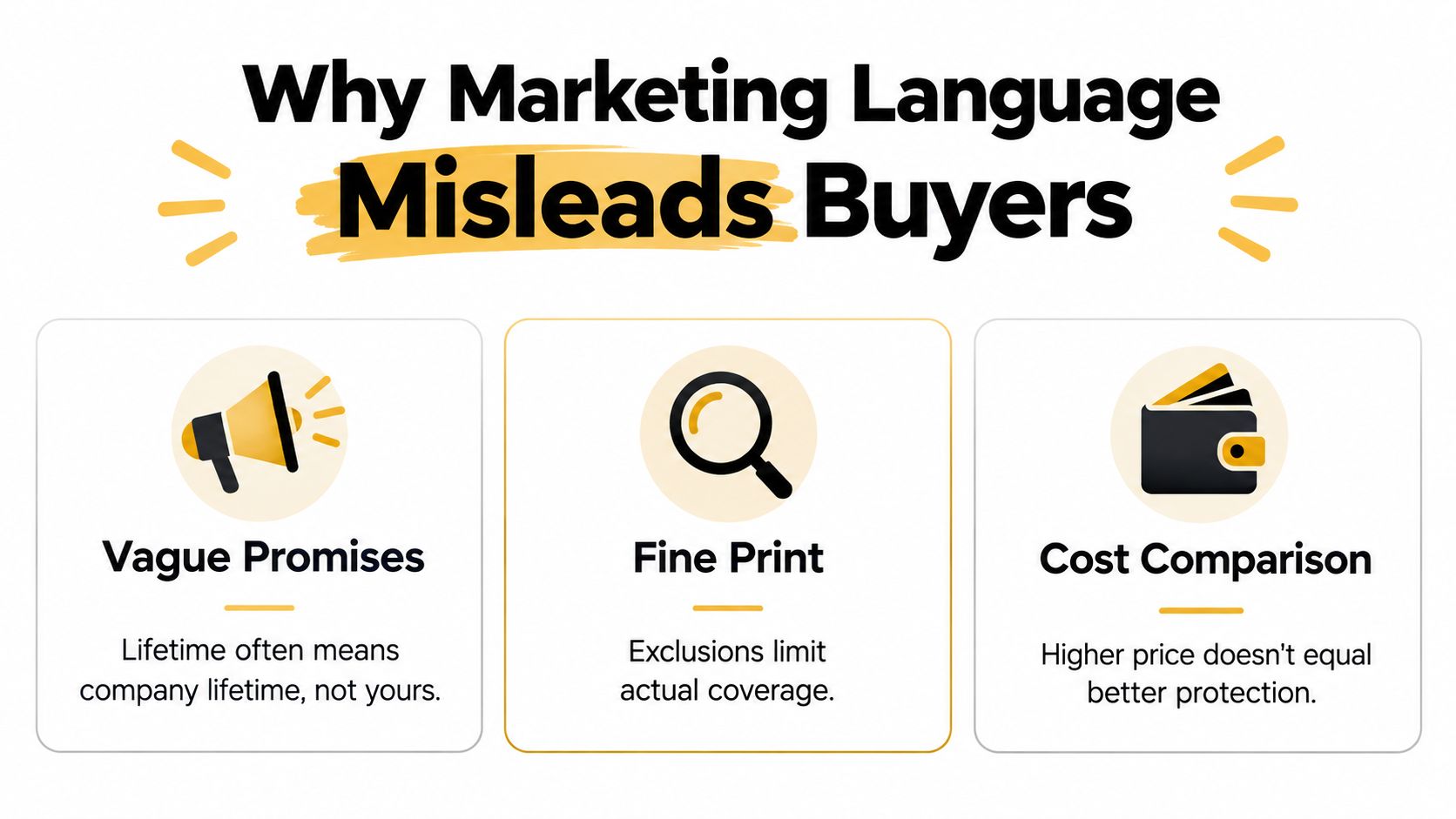
The most prominent promise isn't always the most valuable protection. “Lifetime” can suggest permanence, yet actual coverage may depend on ownership, exclusions, proof, inspection, and the difference between a defect and ordinary wear.
A buyer may also assume that a higher-priced item must offer stronger protection. That doesn't follow. Price can reflect materials, design, distribution, branding, or other features. It doesn't turn an unclear warranty into a clear one.
Replace the slogan with an evidence test
Challenge the promise with three questions:
- What exactly is covered? A broad headline may sit above narrow defect language.
- What must I do to claim? Registration, receipts, photographs, inspections, and return procedures can determine how practical the promise is.
- What does the law add? The warranty is only one part of the buyer's position under Australian Consumer Law.
A company that explains limitations openly may be more useful than one that repeats “lifetime” without defining it. Transparency helps you compare products on enforceability, documentation, and expected performance rather than emotional reassurance.
The strongest buying decision isn't the one with the longest promise. It's the one with the clearest promise and the evidence to support it.
The distinction between lifetime guarantee vs lifetime warranty therefore matters, but it isn't the whole decision. In Australia, statutory consumer guarantees provide the legal foundation. The voluntary promise can add a clearer remedy, a convenient claims pathway, or extra coverage, but only if the terms are properly stated and the business can apply them consistently.
Keep your records, read the exclusions, and ask what “lifetime” means before you buy. If a seller can't answer those questions plainly, treat the uncertainty as part of the product's risk.
Everti offers titanium cookware, cutting boards, drinkware, and tableware supported by material information, including SGS verification for its titanium cutting boards. Visit Everti to compare the products and read the warranty terms before choosing the kitchen essentials that fit your routine.