

Picture this: perfectly golden pancakes that glide onto the plate, or a delicate piece of fish that sears beautifully without a hint of sticking. This is the promise of a great non stick skillet pan, and for many of us, it’s the quiet workhorse of our kitchen, making daily cooking smoother and clean-up a breeze.
Why Your Choice of Skillet Matters
It's easy to think of a skillet as just another pan, but the right one can genuinely change how you cook. It’s the difference between a frustrating meal and a joyful one, and it impacts everything from the health of your food to the time you spend scrubbing sinks. We're here to break down what separates a pan destined for the bin after a year from a true, long-lasting kitchen partner.
A quality skillet isn't just about convenience. It’s about getting better results with less effort.
- Healthier Cooking: An effective non-stick surface means you can dramatically cut down on the oils and butters you use, letting the flavour of the food shine through without adding unnecessary fats.
- Effortless Results: Consistency is key. A good pan heats evenly and releases food reliably, so whether you're making a simple omelette or tricky crepes, you can trust it to perform.
- A Smarter Investment: It might be tempting to grab a cheap pan, but they often scratch, warp, and lose their non-stick power quickly. Investing in a durable skillet saves you money and hassle in the long run.
The Growing Demand for Quality
It’s clear that home cooks are realising the value of reliable cookware. Here in Australia, the non-stick market hit a revenue of USD 338.3 million in 2024. Pans and woks—including the humble non stick skillet pan—are the biggest players, accounting for a 52.68% share of that market. It’s a statistic that really shows how much we depend on these tools for quick, healthy meals. You can explore more data on these Australian market trends to see the full picture.
Ultimately, choosing the right skillet is an investment in your own confidence. When your tools just work, cooking becomes less of a chore and more of a creative outlet.
The real value of a great non stick skillet pan isn’t just in the food it helps you create, but in the time and frustration it saves you every single day. It simplifies the entire cooking process from start to finish.
In this guide, we’ll walk you through everything that matters. We'll look at the different types of coatings, the materials that make up the pan's core, and the important health and safety factors you need to know. By the end, you'll have the confidence to choose a skillet that's safe, durable, and a perfect fit for the way you cook.
Understanding Different Non-Stick Coatings
Ever wondered what gives a non-stick skillet its magical, food-releasing powers? It all comes down to the coating. Think of an uncoated pan as a microscopic mountain range, full of tiny peaks and valleys where food loves to get stuck. A non-stick coating smooths over that entire landscape, creating an ultra-slick surface where your ingredients simply glide.
But not all coatings are made the same. They differ in how they're made, how they perform, and how long they last. Getting your head around these differences is the key to picking the right pan for your kitchen. Let's break down the most common types you'll find on the shelf.
PTFE: The Original Non-Stick
The most famous coating is polytetrafluoroethylene (PTFE), which most of us know by its brand name, Teflon. It’s a synthetic polymer that’s exceptionally slippery, making it the champion for delicate foods like eggs, fish, and pancakes. For decades, this was the surface that defined what a non-stick pan could do.
Modern PTFE pans are perfectly safe for home cooking. In the past, there were legitimate concerns about PFOA (perfluorooctanoic acid), a chemical once used to manufacture the pans. Today, PFOA has been completely phased out of cookware from reputable brands, so you can cook with total peace of mind—as long as you treat it right.
The golden rule for any non-stick pan is to keep the heat in check. Pan manufacturers agree that temperatures above 260°C (500°F) can cause coatings to degrade. Always stick to low-to-medium heat to protect your pan's surface and ensure its safety.
Ceramic: A Natural Alternative
"Ceramic" non-stick coatings have become a popular alternative. Don't picture traditional pottery, though. These coatings are actually made from a sand-like mineral using a process called sol-gel. The end result is a hard, glossy surface that’s naturally free from both PTFE and PFOA.
Straight out of the box, ceramic pans offer fantastic non-stick performance and can often handle slightly higher temperatures than their PTFE cousins. Their main weakness is durability. The non-stick properties tend to wear out faster than high-quality PTFE, sometimes in less than a year with regular use.
The concept map below shows the key things you'll want to balance when choosing a skillet, from cooking results to health and cost.
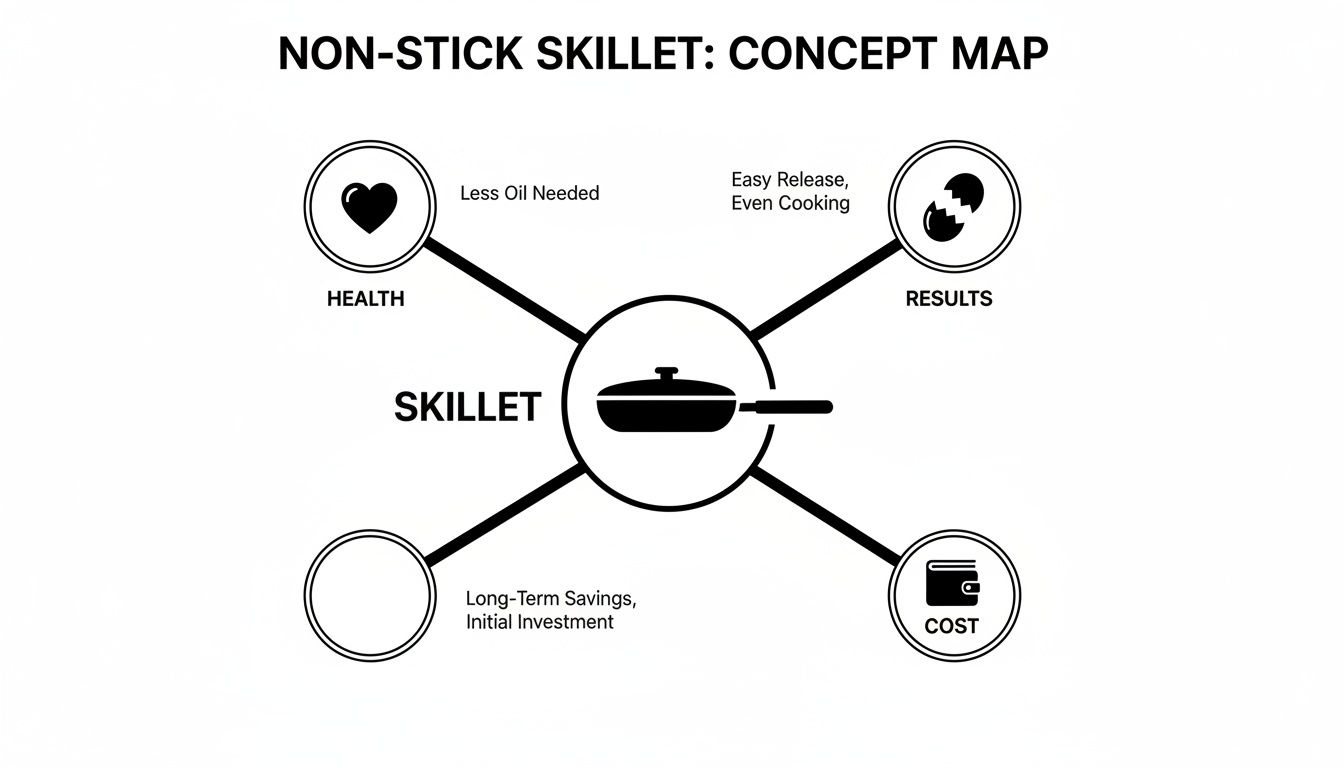
As you can see, the perfect pan is one that delivers long-term value, is made from materials you trust, and gives you reliable cooking performance every time.
Proprietary and Reinforced Coatings
To get the best of both worlds, many brands now offer their own unique coatings. These are usually PTFE-based but are strengthened with other materials to make them tougher and longer-lasting. You’ll often see terms like:
- Diamond-infused: Tiny diamond particles are mixed into the coating to create a harder, more scratch-resistant surface.
- Titanium-reinforced: A titanium base layer is used to help the coating stick more strongly to the pan's core, giving it a much longer life.
- Granite or stone-derived: These coatings include mineral particles to add texture and toughness, aiming to mimic the rugged feel of stone cookware.
These reinforced surfaces are all about combining the easy release of PTFE with better, long-term durability. Brands are always experimenting with new ideas as home cooks look for versatile pans that can do everything from searing on the stovetop to finishing a dish on the barbecue.
New surface technologies are constantly emerging as well. If you're curious about the science behind these advancements, you can explore a comparison of Graphene Coatings vs Ceramic Coatings to see how different materials are engineered for durability.
Ultimately, the right choice comes down to what you value most—be it maximum slickness, material purity, or a pan that will last for years. To dive deeper, you can also check out our guide on the best non-stick surface for a frying pan.
How Core Materials Impact Skillet Performance
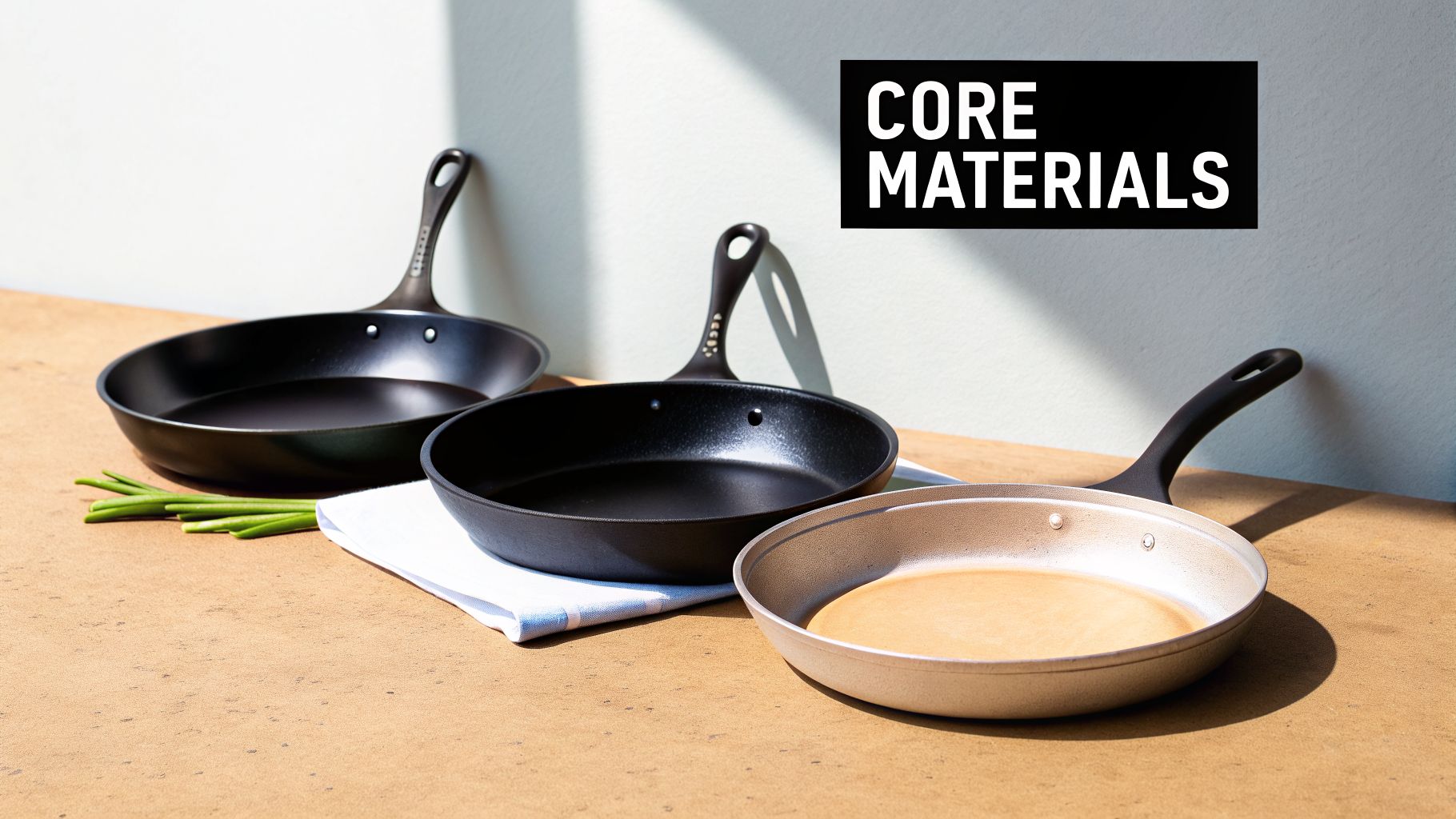
That slick non-stick coating is fantastic, but it's really only one part of the equation. The real heart and soul of a non stick skillet pan is what’s underneath—its core material. Think of the pan's body like the engine of a car. It determines how fast the pan heats up, how evenly it cooks your food, and how well it holds onto that heat. The non-stick coating? That’s more like the shiny paint job. It provides the flawless surface, but it's the engine underneath doing all the heavy lifting.
Every core material comes with its own set of strengths and weaknesses, mostly centred around heat conductivity, heat retention, and durability. Some materials get hot in a flash but lose that heat just as quickly, which can make getting a decent sear on a steak a real challenge. Getting your head around these trade-offs is the key to finding a pan that actually suits the way you cook.
Aluminium: The Speedy Conductor
There's a reason most non-stick cookware is made from aluminium. It's incredibly lightweight and a brilliant conductor of heat, which means it gets hot almost instantly and responds to temperature changes on a dime. This makes it perfect for those quick, everyday jobs like frying an egg or wilting down some spinach where you just need the heat now.
Of course, that speed can also be a drawback. Cheaper, thinner aluminium pans are notorious for developing hot spots that cook food unevenly. They’re also prone to warping, especially if you get them scorching hot or make the classic mistake of rinsing a hot pan under cold water. To get around this, look for pans made from hard-anodised aluminium. It’s a much tougher, more durable version that holds its shape and resists scratches far better.
People often assume all aluminium pans are flimsy, but that's just not true. A well-made, heavy-gauge or anodised aluminium skillet strikes a great balance between speed and stability, giving you much better results than the cheap ones.
Stainless Steel: The Durable Workhorse
Walk into any professional kitchen and you'll see stainless steel everywhere. Chefs love it for its incredible durability and because it doesn't react with acidic foods. When it's used as the core of a non-stick pan, you get a seriously strong bit of kit that won’t warp, dent, or corrode. The catch is that stainless steel on its own is a pretty poor heat conductor, which can lead to uneven cooking.
Manufacturers solve this by "cladding" the pan. They sandwich a highly conductive metal, usually aluminium or copper, between layers of tough stainless steel. This multi-ply construction gives you the best of both worlds: the quick, even heating of aluminium with the bombproof structure of steel.
- Even Browning: The conductive core gets rid of hot spots, so your food browns perfectly from edge to edge.
- Excellent Heat Retention: Once it's hot, a clad pan stays hot, making it ideal for getting a great sear on meat.
- Unmatched Durability: This layered construction creates an incredibly rigid pan that will resist warping for years.
Cast Iron: The Heat Retention Champion
Nothing gets hot and stays hot quite like cast iron. It’s legendary. That incredible heat retention is what lets you create that deep, beautiful crust on a steak or a burger that other pans just can't replicate. When you add a non-stick coating to a cast iron base, you get that amazing searing power combined with an easy-release surface.
The trade-offs are weight and responsiveness. Cast iron pans are heavy, and they take their sweet time to heat up. Once they’re hot, they’re slow to cool down, so you don’t have the same pinpoint temperature control. Still, if a perfect sear is your top priority, a non-stick cast iron skillet is a fantastic choice. This combination is particularly popular here in Australia, where home cooks and chefs alike are always looking for versatile, healthier cooking methods. With around 70% of households actively trying to cook healthier, a good non-stick skillet can slash oil usage by up to 30%. If you’re interested in the local market, you can discover further insights into the ANZ non-stick market.
Navigating Health and Safety in Non-Stick Cookware
Let's be honest, the first question on everyone's mind when they pick up a non-stick skillet is simple: "Is this actually safe?" It’s a great question, and with so much conflicting advice out there, it’s easy to get confused. We're going to cut through the noise and look at the real risks involved with traditional non-stick coatings.
The safety concerns really boil down to two specific situations: when a pan gets seriously overheated, and when the non-stick surface is badly scratched and starts to flake off. If you understand these two scenarios, you can cook with complete confidence.
The Problem with High Heat
Most common non-stick coatings, particularly those using PTFE, are completely stable and inert at normal cooking temperatures. The trouble starts when they get pushed to extremes—we're talking temperatures far beyond what you'd ever need to fry an egg or sear a piece of fish.
The golden rule from manufacturers is to never let your non-stick skillet get hotter than 260°C (500°F). If you heat a pan beyond this point, especially when it's empty, the coating can start to break down and release fumes. Breathing these in can cause a temporary, flu-like reaction known as polymer fume fever. While it's not common and usually passes on its own, it’s a clear warning sign about the importance of managing your heat.
The easiest way to prevent this? Stick to low and medium heat settings. A cheap, flimsy pan can skyrocket to unsafe temperatures in less than three minutes, so investing in a well-made pan and keeping the flame moderate is your best defence.
Scratches, Flakes, and Why They Matter
The other big worry is physical damage to the pan's surface. Once your pan has deep scratches or the coating is visibly peeling, its non-stick days are numbered. But that’s not the only problem.
A damaged coating means your food will stick, which is frustrating enough. More importantly, it opens the door for tiny particles of the coating to chip off and end up in your meal.
Once a non-stick pan has a single deep scratch, it's time to stop using it for cooking. This isn't just about performance; it's a clear sign that the protective surface is no longer intact and could potentially break down further.
This brings up the very valid concern of microplastic ingestion. Although the inert particles from modern PFOA-free coatings are generally thought to pass through the body without being absorbed, the idea of eating bits of a synthetic coating is unsettling for many people. It’s a major reason why so many health-conscious cooks are exploring other materials. If you're looking for alternatives that offer greater peace of mind, you can learn more about non-toxic pans available in Australia and what makes them a safer choice.
Practical Guidelines for Safe Use
So, how do you make sure your cooking is always safe? It all comes down to a few straightforward, non-negotiable habits in the kitchen.
To make things simple, here’s a quick-reference guide comparing the most popular coatings and how to care for them.
Coating Safety and Care Comparison
| Coating Type | Max Safe Temperature | Best Utensil Type | Signs of Degradation |
|---|---|---|---|
| PTFE (Teflon) | ~260°C (500°F) | Silicone, Wood, Nylon | Deep scratches, flaking, peeling |
| Ceramic | ~230°C (450°F) | Silicone, Wood, Nylon | Loss of slickness, staining |
| Uncoated Titanium | Extremely High | Any (metal-safe) | None (no coating to degrade) |
Ultimately, keeping your cookware safe is about treating it with a little respect. By sticking to moderate heat, using the right utensils, and keeping an eye out for wear and tear, you can avoid any potential risks. When you see deep gouges or peeling, it's a clear signal the pan has done its job and it's time for a replacement. This simple, proactive approach lets you enjoy all the convenience of a great non-stick pan, worry-free.
Why Titanium Is the Future of Healthy Skillets
After weighing up all the health and safety issues tied to traditional coated cookware, it’s only natural to ask: is there a better way? What if you could get incredible performance from a skillet without worrying about fragile coatings, leaching chemicals, or the dangers of overheating?
This is where titanium steps into the kitchen.
Often linked with high-tech fields like aerospace engineering and medical implants, titanium is an amazing material that offers a real solution to the problems that come with coated pans. Unlike a typical non-stick skillet, which depends on a synthetic layer to do its job, a pure titanium skillet is inherently safe and built to last a lifetime.
Imagine a pan with no coating to scratch, peel, or break down over time. That’s exactly what 100% titanium delivers. Its surface is naturally tough and corrosion-resistant, which means it will never rust or have a bad reaction to acidic foods like tomatoes or lemons.
The Power of an Inert Material
The single most important thing to know about pure titanium is that it's completely inert. That’s the scientific way of saying it will never, ever leach anything into your food. It doesn't matter how high you crank the heat or what ingredients you're using; the metal itself is non-reactive, giving you total peace of mind.
This simple fact gets rid of all the usual worries about coated cookware:
- No Chemical Leaching: Because there are no synthetic compounds like PTFE, there's zero risk of chemicals breaking down at high temperatures.
- No Microplastics: With no coating to flake away, you can be sure no unwanted particles are making their way into your family's dinner.
- No Polymer Fumes: You can sear a steak on high heat in a pure titanium pan without any concern about releasing toxic fumes.
A pure titanium skillet isn't just a pan without a non-stick coating; it's a fundamental shift in how we think about cookware. It moves away from disposable, temporary surfaces and towards a permanent, safe, and reliable kitchen tool.
This makes it a smart, one-time investment for any health-conscious cook. Instead of replacing a worn-out non-stick pan every couple of years, you get one piece of cookware designed to perform indefinitely.
Performance Meets Durability
Beyond its unmatched safety, titanium is a serious performer in the kitchen. It has one of the highest strength-to-weight ratios of any metal, so it's incredibly durable yet surprisingly light and easy to manage. While it might not heat up as quickly as aluminium, its ability to hold a steady, even temperature makes it fantastic for getting that perfect sear on a steak or browning vegetables.
When it comes to durability, titanium is in a league of its own. You can confidently use metal utensils without the fear of causing the kind of scratch that would instantly ruin a standard non-stick pan. This sheer toughness is why it's trusted in the most demanding industries. For anyone curious about how it stacks up against other materials, our detailed guide on titanium non-stick cookware takes a much deeper look.
Why Titanium Is a Sustainable Choice
The constant cycle of buying and throwing away coated pans creates a lot of needless waste. A single non-stick pan often needs replacing every 1-3 years, adding to our landfill problem. A pure titanium skillet, on the other hand, is genuinely built for life, fitting perfectly with a more sustainable and minimalist kitchen philosophy.
Here’s how it all adds up:
- Longevity: It’s a one-time purchase, which means no more frequent replacements.
- Material Purity: It’s made from a single, pure element, avoiding complex, bonded synthetics.
- Timeless Function: It's a tool that does its job perfectly without relying on delicate, temporary surfaces.
By choosing a material that is inherently safe, incredibly durable, and built to last forever, you’re not just buying another skillet. You’re investing in a healthier way to cook for yourself and your family—for today, and for decades to come. It truly is the future of healthy cooking: a move towards simplicity, purity, and enduring quality.
Extending the Life of Your Non-Stick Skillet Pan
You’ve invested in a quality non-stick skillet pan, whether it’s one with a top-tier reinforced coating or a pure titanium model. Now, you need to protect that investment. The good news is, with just a few simple habits, you can keep your pan performing beautifully for years to come. It’s all about treating it less like a disposable item and more like a trusted kitchen partner.
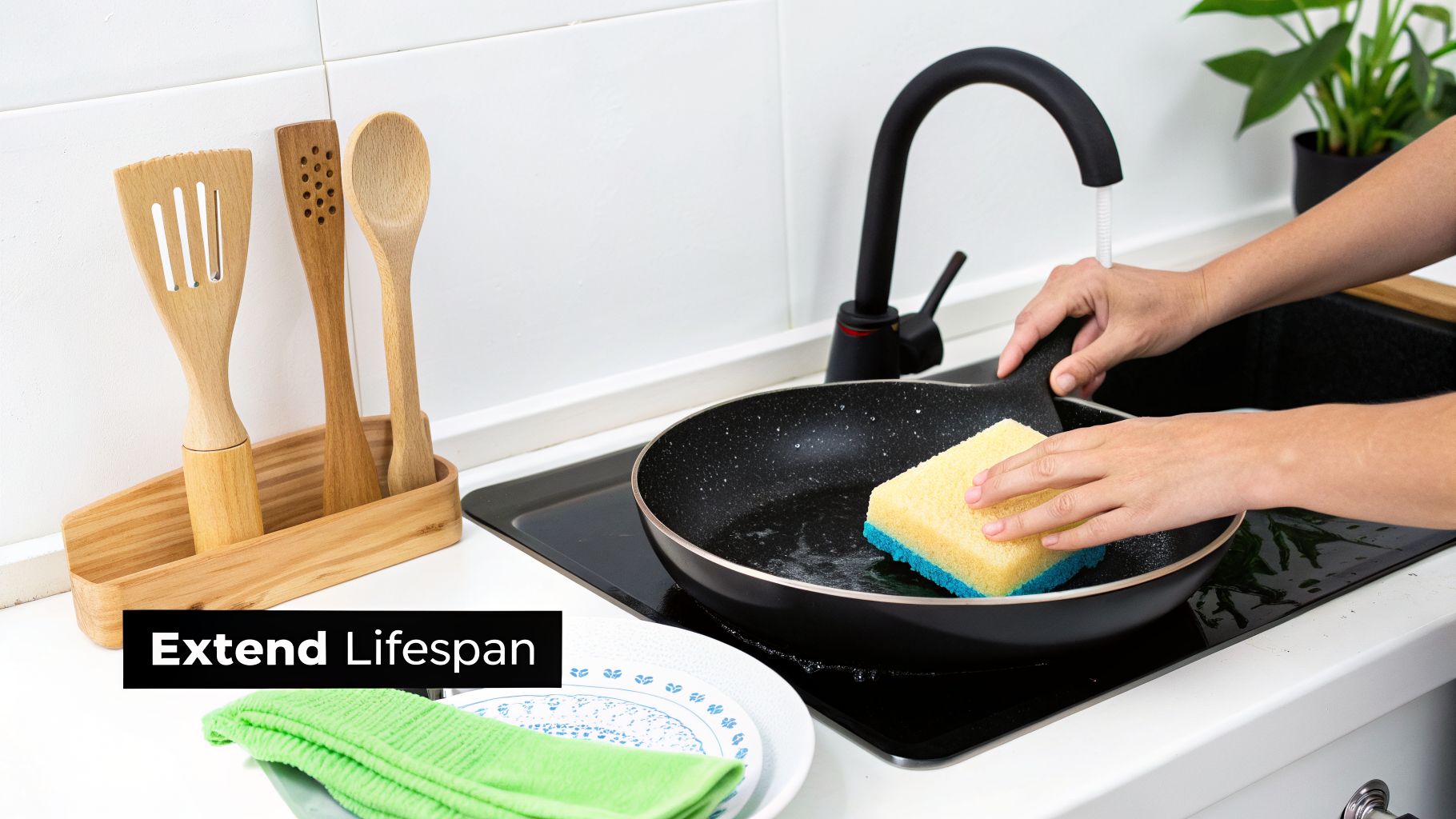
These practices are pretty universal, so you can apply them to almost any pan you own. From how you wash it to the tools you cook with, a little bit of care makes all the difference.
The Gentle Art of Washing Your Skillet
Here’s the golden rule: hand-wash your pan whenever possible. I know the dishwasher is tempting, but the combination of high heat and harsh detergents is the enemy of any non-stick surface. Over time, it will completely strip away the pan's slick properties, whether it’s a PTFE coating or a finely seasoned titanium surface.
For the best results, always let the pan cool down completely before washing. Dunking a hot pan into cold water is a recipe for thermal shock, which can cause it to warp and wobble on your cooktop. A bit of warm, soapy water and a soft sponge is all you need—never use steel wool or abrasive scourers that will create tiny scratches.
Choose Your Tools Wisely
The quickest way to destroy a coated non-stick pan is by grabbing the wrong utensil. Metal spatulas, forks, or tongs will immediately scratch and gouge that delicate surface, ruining its integrity for good.
Instead, make these your go-to kitchen companions:
- Silicone: It's flexible, heat-resistant, and incredibly gentle on coated surfaces. Honestly, it's the perfect choice.
- Wood or Bamboo: These natural materials are also soft enough to prevent scratching while still being sturdy enough for stirring and flipping.
- Nylon: This is a solid, budget-friendly option that is perfectly safe for non-stick pans, though it can sometimes be less heat-resistant than silicone.
The only exception is for seriously durable, uncoated pans like pure titanium or stainless steel, which are built to handle metal tools. For anything with a coating, though, sticking to softer utensils is a non-negotiable rule.
Even a single deep scratch can be the beginning of the end for a coated pan. It creates a weak spot where the coating can start to peel and flake, which is exactly why protecting the surface is so crucial for its lifespan and your safety.
Mastering Temperature and Storage
As we’ve already touched on, extreme heat is bad news for most non-stick coatings. You should always avoid cranking your cooktop to the highest setting. Gently preheating your pan on low-to-medium heat for a minute or two is more than enough. This approach not only prevents the coating from breaking down but also helps the pan heat evenly, giving you much better cooking results.
Proper storage is the final piece of the puzzle. Stacking heavy pots and pans directly inside your non-stick skillet will lead to scratches and scuffs. If you’re tight on space and have to stack, just place a protective layer in between. A simple tea towel, a piece of paper towel, or a dedicated felt pan protector creates a soft barrier that keeps the surface pristine. Follow these simple steps, and your skillet will remain a reliable workhorse for countless delicious meals.
Even after digging into the details, a few questions often pop up.Even after digging into the details, a few questions often pop up. Let’s run through some of the most common ones people ask when they’re about to buy a new non-stick skillet or want to get the most out of their current one.
When Should I Replace My Non Stick Skillet Pan?
The moment you see deep scratches, significant discolouration, or any flaking or peeling of the coating, it's time to replace your skillet. No exceptions. Those are all tell-tale signs that the surface is damaged and it’s no longer performing as it should.
For most traditional coated pans, you can expect them to last anywhere from one to three years with regular use. A dead giveaway that its time is up is when food starts sticking all the time. If your morning eggs are putting up a fight, your pan has likely reached the end of its life.
Can I Use Metal Utensils on Any Non Stick Pan?
On almost all coated pans, the answer is a hard no. You should strictly avoid using metal utensils because they will instantly scratch and compromise that delicate surface. A scratched pan loses its slick, food-release magic and the coating's integrity is shot. Always reach for silicone, wood, or nylon tools instead.
The only real exception to this rule is with uncoated cookware. A tough, durable pan made from pure titanium or high-quality stainless steel can absolutely handle metal utensils without getting damaged.
Investing in a quality skillet is often worth it. A higher price usually signals superior construction, such as a multi-ply base for even heating, and a more durable, longer-lasting surface. This can save you money over time by avoiding frequent replacements.
Is a More Expensive Non Stick Pan Worth It?
In most cases, yes. It's easy to be tempted by a bargain, but those cheaper pans are often made from thin materials that warp under high heat and have flimsy coatings that wear out in no time. A pricier non stick skillet pan is usually an investment in better materials and smarter engineering.
Think of it this way: you’re paying for a pan that heats evenly without creating frustrating hot spots, lasts years instead of months, and just makes cooking more enjoyable and reliable every single day.
Ready to invest in a skillet that offers ultimate safety and durability without any coatings? The Everti pure titanium skillet is designed to last a lifetime, giving you perfect results and total peace of mind. Explore the collection at Everti.