

Australia's projected Black Friday spending exceeds $12.7 billion, with 58% of Australians, about 11.5 million people, intending to shop the sales, according to ING's Australian Black Friday cookware overview. That scale changes the question. Pots and pans Black Friday shopping isn't about finding the biggest red discount sticker, it's about using a crowded sales window to buy cookware you'll still reach for years from now.
My blunt view is simple: most households shouldn't buy a large cookware set. Buy the pan, saucepan or pot that matches your stove, cooking habits and cleaning tolerance. A smaller collection of durable pieces usually beats a discounted bundle full of awkward sizes and duplicate shapes.
Why Pots and Pans Black Friday Matters This Year
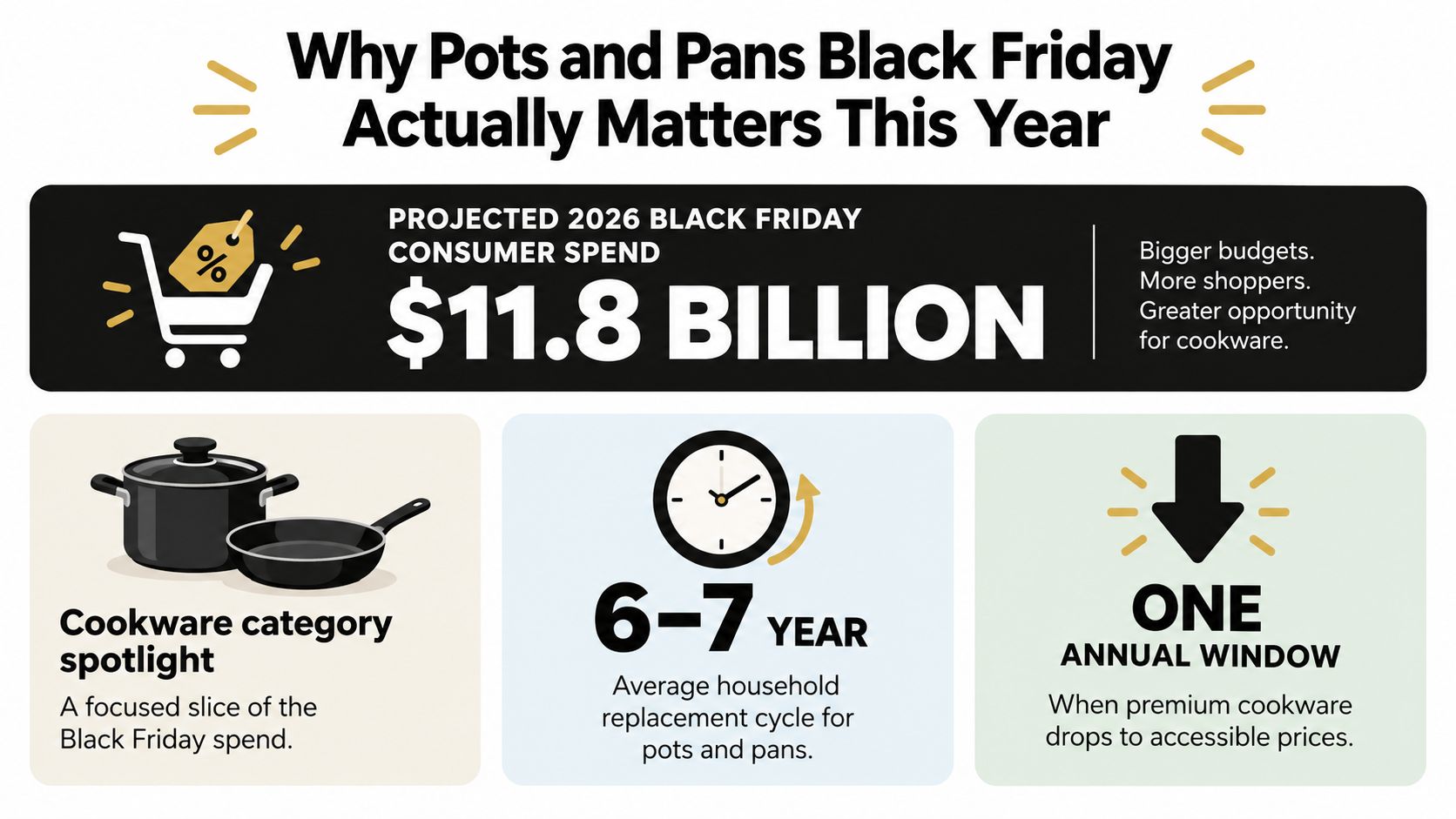
Australian household-essentials spending was forecast at $675 million, with an average spend of $184 per shopper, according to the Australian cookware Black Friday market overview. That budget does not justify filling a cupboard with pieces you will rarely use. A $184 average spend covers one quality frypan and one saucepan rather than a ten-piece set, which is the trade-off that matters.
My recommendation is blunt: most households should buy individual pieces, not a large cookware set. Sets look efficient because the discount is displayed across several items, but unused stockpots, tiny saucepans and duplicate frypans still cost money. Cost per use beats the headline percentage. A pan used several times a week can earn its place. An awkward piece left at the back of the cupboard cannot.
Australian shoppers also concentrate more retail activity around November. CHOICE's Black Friday kitchen appliance guide notes that ABS data has regularly shown national retail spending higher in November than December in recent years. Retailers therefore have a ready audience for replacement cookware, holiday preparation and kitchen upgrades before summer entertaining.
Use the sale to solve a specific problem. Replace a sticking frypan if eggs and fish are regular failures. Replace a cramped saucepan if it cannot handle pasta or batch cooking. If a frypan has warped, inspect its base and construction instead of buying an entire collection.
Check construction before trusting titanium wording. This guide to choosing between pure titanium, titanium alloy and titanium coating explains why those terms describe different materials and finishes.
Practical rule: Decide what you need before opening a sale page. Otherwise, the retailer's bundle becomes your shopping list.
Matching Cookware Materials to the Way You Cook
Material determines how a pan behaves more reliably than the discount percentage does. Before comparing prices, match the construction to your cooktop, the food you prepare and the amount of care you will provide.
Cast iron is the specialist for heat retention, searing and roasting. It holds heat well and can move from stovetop to oven when the design allows it, but it's heavy and responds slowly when you change the temperature. It also demands careful drying and storage to prevent surface problems. Choose it for steaks, braises, roast vegetables and dishes where steady heat matters more than quick manoeuvring.
Stainless steel is the flexible workhorse. It handles high heat, oven cooking and metal utensils, and a well-built multilayer pan can serve for years. It isn't naturally non-stick, though. You'll need to preheat it, add appropriate oil and learn when food has formed a sear before trying to move it. That technique is a fair trade for browning, deglazing and durability.
Hard anodised aluminium suits weeknight cooking. It's generally lighter than cast iron, heats quickly and can offer a useful balance between responsiveness and toughness. Look closely at the base and surface specifications, because “anodised” alone doesn't tell you whether the pan is induction-compatible or whether its handle and coating suit your cleaning routine.
Ceramic non-stick is attractive for eggs, delicate fish and low-effort cleaning. Its easy release can be convenient, but performance may decline with high heat, abrasive utensils or demanding dishwasher habits. Treat it as a convenience piece, not automatically as the only pan in your kitchen.
Titanium appears in several forms, including solid titanium constructions and reinforced or textured non-stick surfaces. It can appeal to shoppers who want lighter cookware and a hard-wearing interior, but the construction matters more than the word on the packaging. Confirm whether titanium is the cooking surface, part of a layered body, or only a marketing reference.
| Material | Heat Retention | Weight | Induction | Care |
|---|---|---|---|---|
| Cast iron | Excellent | Heavy | Depends on the base and enamel | Dry carefully and avoid thermal shock |
| Stainless steel | Moderate to strong, depending on construction | Moderate | Usually compatible when the base is magnetic | Requires cooking technique and prompt cleaning |
| Hard anodised aluminium | Responsive and even | Light to moderate | Only when the product includes a compatible magnetic base | Follow surface and dishwasher instructions |
| Ceramic non-stick | Responsive | Light to moderate | Product-specific | Avoid overheating, abrasion and careless dishwasher use |
| Titanium construction | Varies by design | Often lighter than cast iron | Product-specific | Follow the maker's instructions for the actual surface |
The bread pan with lid guide from The Sourdough Cult shows why shape and intended use deserve as much attention as material. A pan designed for baking, a wide sauté pan for vegetables and a stock pot for batch cooking solve different problems. Don't assume one material or one set can perform every job equally well.
Use this mapping before looking at deals:
- Searing and roasting: Choose cast iron or sturdy stainless steel when heat retention, browning and oven performance matter most.
- Weeknight vegetables and sautés: Hard anodised aluminium is a sensible choice when you want responsive heating without the bulk of cast iron.
- Eggs and delicate fish: Ceramic non-stick or another clearly specified easy-release surface makes the most sense.
- High-heat stir fries: Look for a broad, stable pan with a construction suited to high heat and enough room to move food without steaming it.
- Induction households: Base compatibility is a strict requirement. Sales pages covering Australian cookware specifically warn shoppers to verify magnetic-base construction and set composition before buying. The Good Guys' Black Friday cooking guide is a useful reference for the range of cookware shapes and induction-ready lines appearing during the sales period.
Bundles Versus Curated Singles The Real Cost Question
A bundle looks efficient because the retailer gives every piece a shared price. That logic fails when the set contains cookware you rarely use. A lid that doesn't fit your favourite saucepan, a tiny frypan with no practical role and a large pot that never suits your household still occupy cupboard space, regardless of the discount.
The better comparison is cost per use. Ask how often each piece will perform a job you already do, then compare that usefulness with the price you pay. A frypan used repeatedly for breakfast, vegetables and quick dinners can justify a higher individual price more easily than a specialised piece that leaves the cupboard only for occasional entertaining.
| Cookware Piece | Weekly Uses | Per-Use Cost, Bundle | Per-Use Cost, Curated |
|---|---|---|---|
| Everyday frypan | Frequent | Can be diluted by unused pieces | Usually easier to justify |
| Medium saucepan | Frequent | Depends on whether the included size fits | Directly tied to actual use |
| Large stock pot | Occasional to frequent, depending on household | Often overbought in large sets | Buy only if batch cooking needs it |
| Speciality wok or chef pan | Occasional for many homes | The discount may hide low use | Better bought separately when needed |
The table doesn't need invented prices to expose the problem. If a set includes several pieces you wouldn't have searched for independently, the headline saving is doing the selling. You're not saving on those pieces, you're paying for storage and delayed replacement.
A curated collection might contain an everyday frypan, a medium saucepan, a larger pot and one pan suited to your cooking style. That could mean stainless steel for searing, ceramic non-stick for eggs, cast iron for roasting or a responsive anodised pan for vegetables. The right mix depends on your meals, not the number printed in the product title.
The useful question is not “How much is this set reduced?” It's “What will I cook in each piece, and how often?”
Buying singles also lets you spread decisions across sale cycles. You can secure the pan with the clearest need first, learn how it performs, then choose the next piece with better information. A total cost of ownership guide provides a broader way to assess purchase value beyond the checkout price.
My rule is strict: if a piece won't be used regularly, it doesn't belong in the cart, no matter how dramatic the discount looks. A set only wins when every major component matches your cooktop, storage and cooking habits.
Sizes Induction Bases and Warranty Specs to Verify Before You Pay
A cookware listing can be technically accurate and still be unhelpful. The stated diameter may describe the rim rather than the flat cooking surface, and that difference matters on induction. A pan can look large while presenting a much smaller magnetic base to the coil.
Measure the flat base, not the flared edge. For induction, look for a clear induction-ready symbol or an explicit base specification. “Suitable for most cooktops” is weaker language than a defined magnetic construction, especially when the product page also lists gas and electric compatibility.
Read the measurements like a cook
Think about the burner or induction zone you use most. A base that's too small can waste available cooking area, while a base that's too large can heat unevenly on a smaller zone. Match the pan's flat cooking surface to the meals you prepare and the cookware you already own.
Check internal capacity where the listing provides it. Rim diameter alone won't tell you whether a saucepan can handle your usual amount of pasta sauce, soup or grains. For lids, confirm whether the measurement refers to the pan, the lid or the opening. A lid that rattles, leaves a gap or fits several incompatible shapes is not a saving.
Treat oven and dishwasher claims as conditions
The lowest oven temperature in the construction controls the whole pan. A stainless body may tolerate substantial heat while a coated surface, glass lid, silicone grip or bonded handle has a lower limit. Read the manufacturer's stated oven temperature rather than assuming every part of the product shares the body's rating.
Dishwasher-safe language also needs context. Repeated detergent, heat and drying cycles can affect finishes, handles and coated surfaces even when a product technically permits machine washing. If your household relies on the dishwasher, choose cookware whose care instructions match that habit instead of buying a pan that requires hand washing you won't maintain.
| Spec | What to Check | Red Flag |
|---|---|---|
| Flat base diameter | Measure the cooking surface that contacts the cooktop | Only the flared rim is listed |
| Induction compatibility | Look for a clear symbol and magnetic-base details | Vague “multi-cooktop” wording |
| Oven limit | Check the lowest-rated component, including handles and lids | Body rating is listed but handle limit is missing |
| Lid fit | Confirm the lid belongs to the exact shape and size | Universal lid with loose seating |
| Dishwasher guidance | Read the actual care instructions | Warranty exclusions for dishwasher use |
| Warranty | Check coverage for body, coating, handles and lids | “Lifetime” wording with narrow exclusions |
| Return policy | Confirm who handles returns and the time limit | Return to retailer only, with a short window |
Save the model number, batch information and warranty document before checkout. If a handle loosens or a surface fails, that record makes a claim much easier than trying to reconstruct the listing after the promotion ends. For induction-specific selection, this guide to cookware for induction can help you focus on the base rather than the marketing name.
Discount Depth Does Not Equal Value
A deep discount can be a warning sign. Retailers often use one attention-grabbing product to make the entire sale feel urgent, but a mystery pan with poor construction remains poor value even when the percentage looks spectacular.
The worst purchases tend to share obvious traits:
- Unknown or rebranded seller: You can't identify who made the cookware or who supports it after the sale.
- Unclear origin: The listing avoids explaining where the product was manufactured or finished.
- Vague warranty: The page promises protection without stating what happens to the coating, handle, lid or body.
- Thin pressed aluminium: The pan may heat unevenly, warp or feel unstable on the cooktop.
- Unspecified coating: The retailer doesn't identify the surface technology or give usable care limits.
- Hollow handle construction: The handle description omits rivets, attachment method or oven restrictions.
- Poor lid fit: The lid seats loosely, rattles or doesn't match the pan's shape.
- Suspicious packaging: The presentation closely imitates a recognised premium collection without offering comparable documentation.
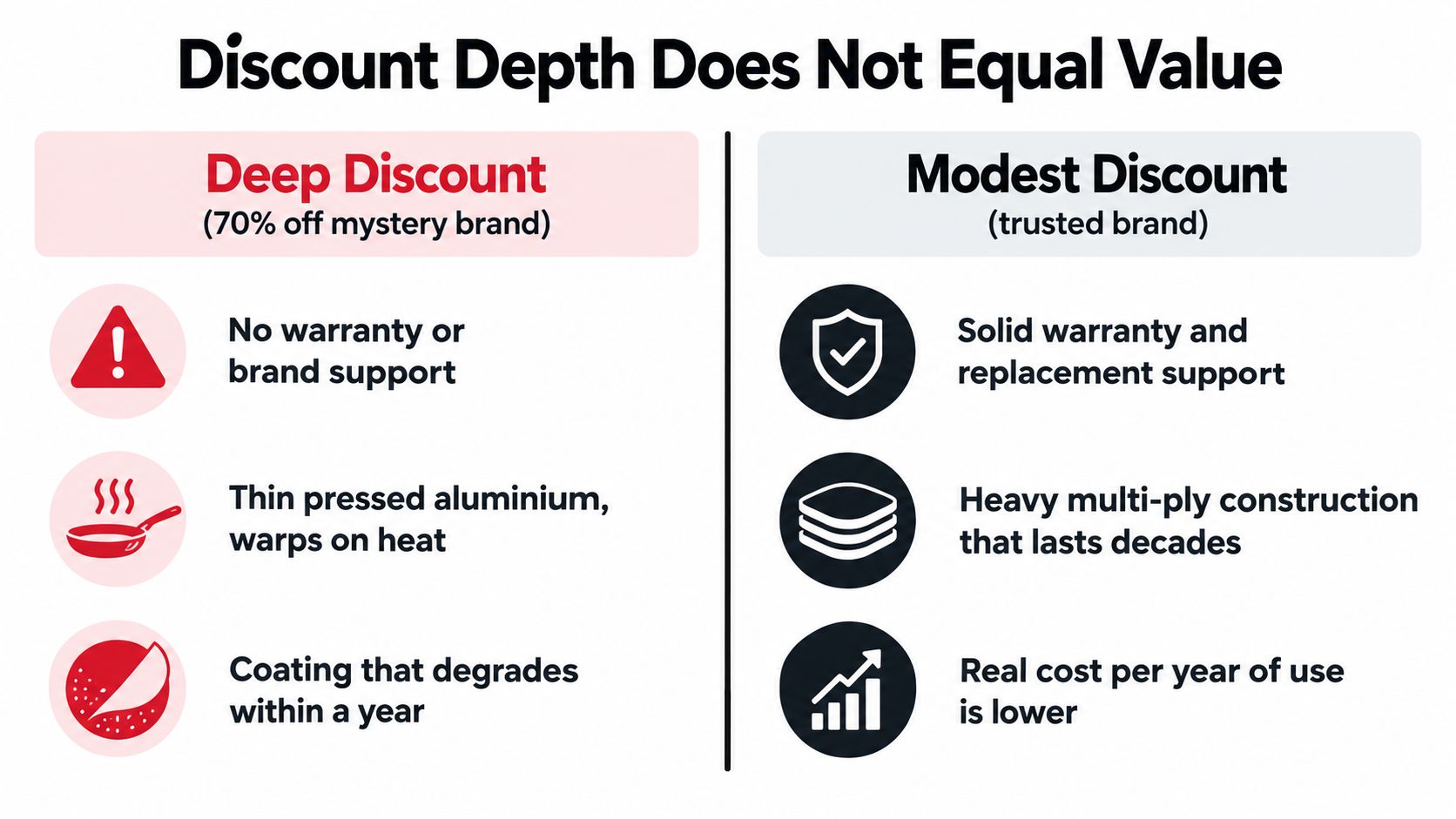
Check the regular price history before trusting the saving. If the retailer raised the reference price shortly before Black Friday, the reduction is theatre. Compare the product's current price with a price tracker or archived retailer listings, and inspect the exact model rather than comparing a similar-looking range.
A modest reduction on a documented, repairable or replaceable product can beat a massive reduction on cookware that needs replacing quickly. Longevity is part of the price, and cost per cooked meal is the measure that exposes weak deals.
When to Buy Through the Black Friday Cookware Window
Treat the promotion as a campaign, not a single day. Australian retailers and brands can start deals before the main event, and some offers run for weeks. That gives you time to research, but it also gives impulse purchases more opportunities to sneak into the basket. Australian Black Friday kitchen deal coverage highlights how early promotions can reduce urgency while increasing the need for comparison.
Week one is for researched premium pieces
Early promotions are the right time to buy a specific premium pan you've already checked for size, base, construction and warranty. Stock is generally easier to find, and popular colours or sizes may disappear before the main event. Don't browse without a shortlist. Early access is useful only when you know what you're buying.
Week two is for watching, not rushing
Pre-Black Friday offers often target mid-range cookware and sets. Track the exact model, note the price and wait for competing retailers to respond. A retailer may add free delivery, a lid or another incentive rather than cutting the listed price, so compare the whole offer.
Week three brings the loudest promotions
The main Black Friday period is where retailers usually spotlight hero products, bundle pricing and broad kitchenware campaigns. This is the time to compare the shortlisted individual pieces against sets. If a bundle forces you to accept several unwanted pans, leave it behind.
Week four is clearance territory
Cyber Monday and the final promotional days can suit shoppers who are flexible about colour, packaging or last-season designs. They can also bring the greatest stock risk. Buy only when the product still meets your requirements and the return terms remain clear.
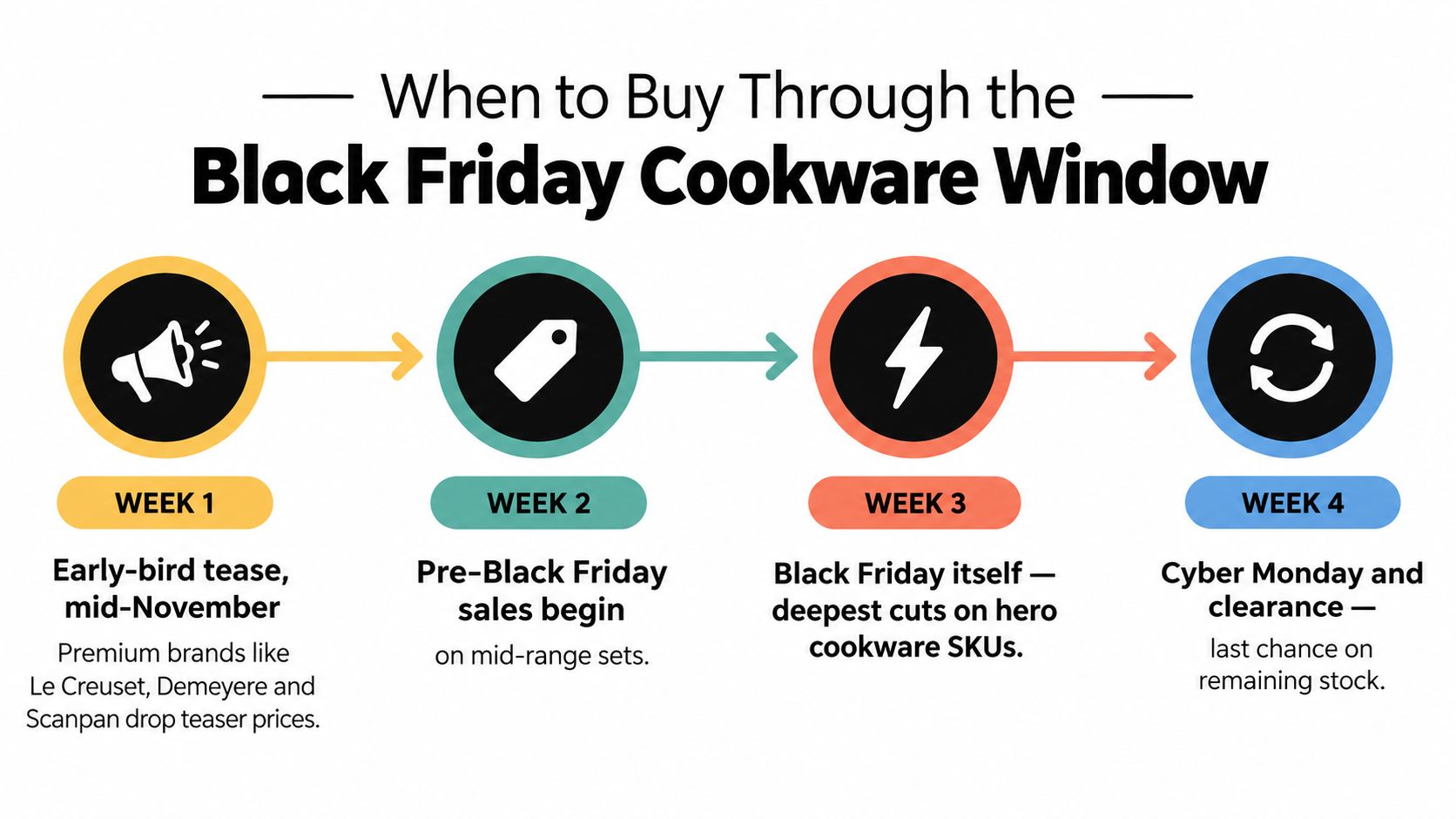
Use the timeline to choose your moment, not to create artificial urgency. If you need a pan for immediate cooking, buy once the specifications and price make sense. If the item is merely attractive, wait until you've compared it with alternatives.
Your Pre Checkout Checklist for Pots and Pans Black Friday Deals
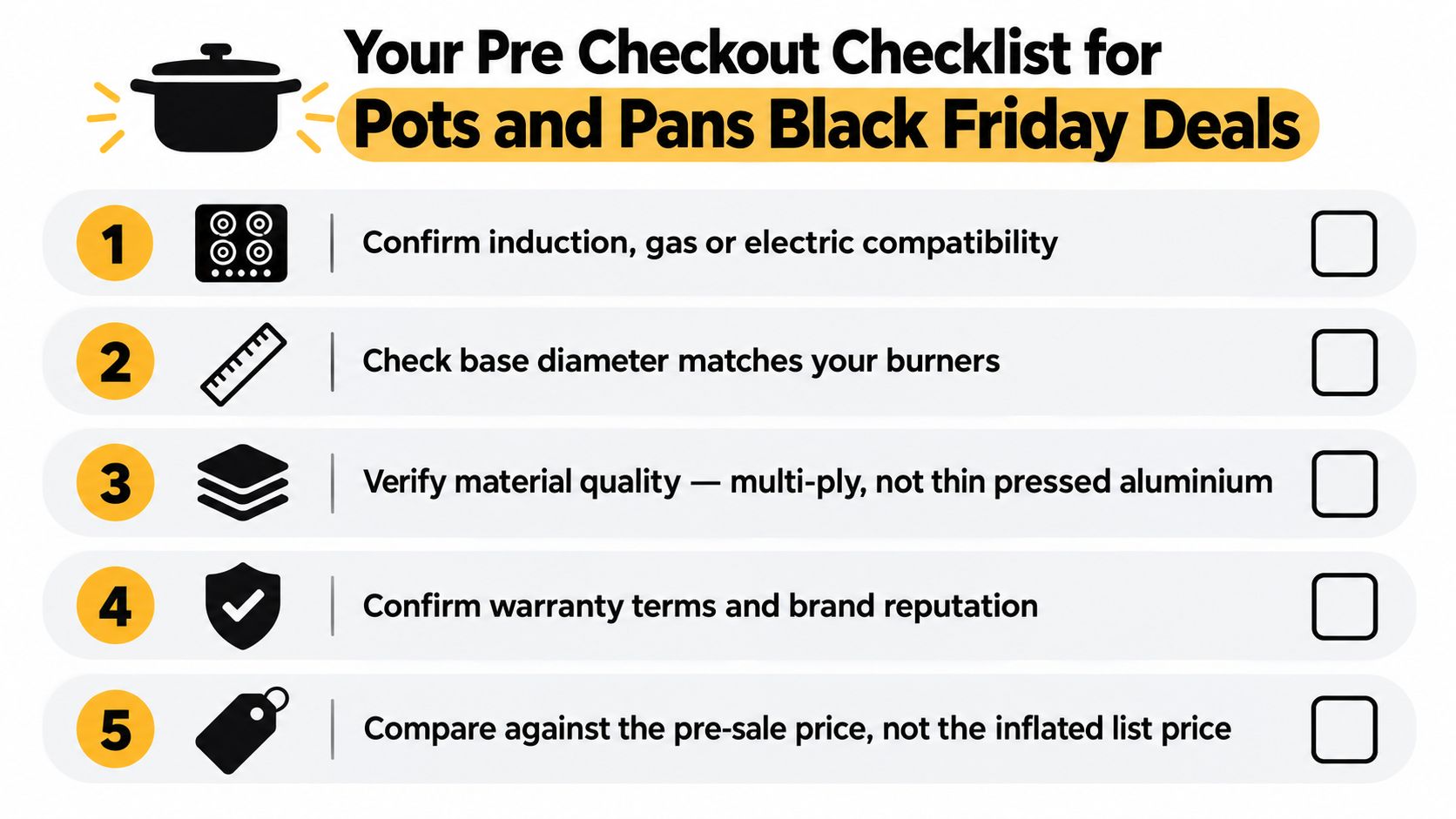
Run this checklist before you pay:
- Confirm the cooktop: Check induction, gas or electric compatibility, then verify that the flat base suits the burner or zone you use.
- Match the material: Choose stainless steel for searing and deglazing, cast iron for retained heat, anodised aluminium for responsive everyday cooking, ceramic for easy release and titanium construction when the product's actual specifications justify it.
- Check the full care burden: Verify the oven limit, lid fit, handle restrictions and dishwasher guidance against your real routine.
- Calculate cost per use: Ignore the percentage until you've considered how frequently you'll use the piece and how long you expect it to remain useful.
- Read the protection terms: Confirm the warranty, return window, model number requirements and the company responsible for handling a claim.
- Reject unwanted extras: If the set only becomes “good value” after adding several pieces you wouldn't choose alone, buy a curated selection instead.
The smartest pots and pans Black Friday purchase is usually boring on the checkout page. It has the right base, the right size, a material that suits your cooking, clear care instructions and a price that makes sense over years of use. That's the cookware worth bringing home.
If you're comparing durable kitchen essentials beyond seasonal cookware offers, visit Everti to explore its pure titanium kitchenware, including uncoated pieces designed for easy cleaning, corrosion resistance and long-term everyday use. Choose the item that solves a real kitchen problem, then buy fewer pieces with greater confidence.