

Most advice gets the saute pan vs wok question backwards. It treats the decision as if it's about cuisine, when in an Australian kitchen the issue is whether the pan matches the cooktop geometry, the batch size, and the way you move food around the heat. A wok can be the wrong choice on one stove and the right choice on another, and a saute pan can beat it for the jobs most home cooks do every week.
| Dimension | Saute Pan | Wok |
|---|---|---|
| Best fit | Flat, controlled contact cooking | Fast, mobile high-heat cooking |
| Cooktop behaviour | Broad, stable base | Needs the right base shape for the hob |
| Tossing | Less natural, more contained | Built for tossing and sweeping |
| Sauces | Strong for reductions and deglazing | Less convenient for shallow sauces |
| Batch handling | Better for even searing in smaller loads | Better when you can keep food moving |
| Versatility | Excellent all-rounder | Excellent specialist, often broader than people think |
Why This Choice Is Really About Cooktop, Not Cuisine
The biggest mistake is assuming a wok belongs to Asian food and a saute pan belongs to Western food. In practice, heat contact wins the argument. SBS Food's Australian guidance points out that a wok concentrates heat most strongly at its centre, and that an immobile wok with side handles works better on induction or other flat electric surfaces because lifting it to toss breaks contact and reduces heating SBS Food guidance on wok use with induction.
That matters because the same pan behaves very differently depending on what it sits on. A flat saute pan spreads food across a wider base, so it tends to suit induction and ceramic hobs that reward broad contact. A wok rewards movement, but only if the burner and the base let it stay hot while you work.
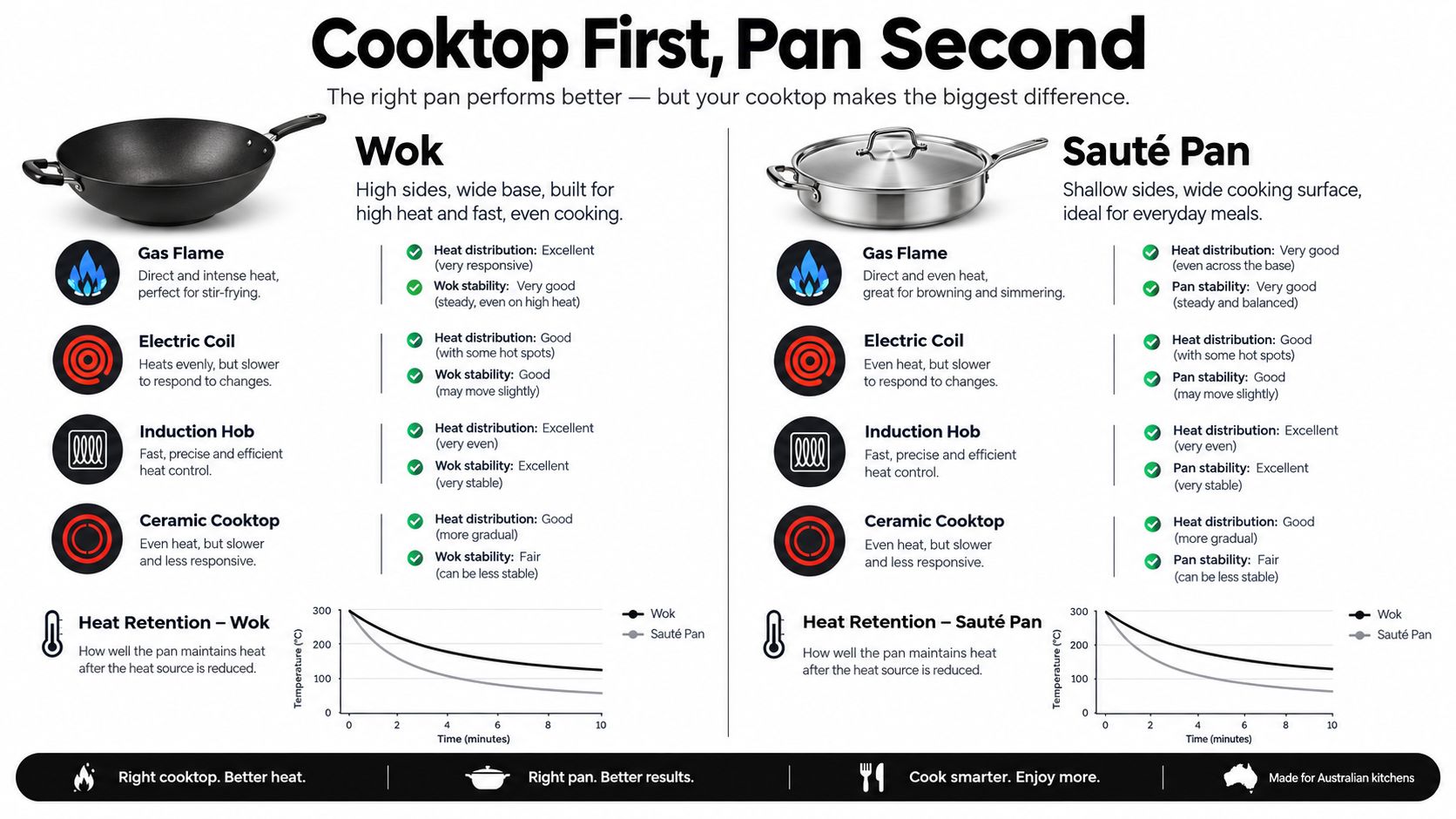
Practical rule: if the pan can't stay in solid contact with the hob, the “better” pan becomes the worse pan very quickly.
The other trap is batch size. A wok only shines when you don't crowd it, because food needs space to sear, move, and recover heat. A saute pan can look less dramatic, but it often gives a home cook the steadier result because the base stays planted and the food stays in the heat zone instead of drifting up curved walls.
For induction buyers, the question is even more literal. A wok is not automatically the right answer for stir-fry, and a saute pan isn't a betrayal of the dish. The right answer is the one that matches your hob first, then your technique. If you're mapping a cooktop around this choice, the most useful starting point is this induction cookware guide.
| Quick Reference | Saute Pan | Wok |
|---|---|---|
| Gas burner | Strong if you want even searing and sauce work | Strong if the burner and batch size support movement |
| Induction | Usually easy to control | Depends heavily on flat-bottom fit and contact |
| Ceramic/electric | Reliable and predictable | Works best when the base is stable |
| Best move | Controlled contact cooking | Constant motion cooking |
Design Differences That Actually Change How You Cook
Base shape and wall profile
A saute pan gives you a flat, wide base with relatively straight sides. That matters because the food stays in contact with the hot surface longer, which helps when you want browning, fond, and a clean deglaze. A wok gives you a curved bowl, which is brilliant for sweeping ingredients up and over hot metal, but less efficient when you want a broad, even sear across the whole load.
A 30 cm saute pan and a 36 cm wok can look similar in total footprint, yet they cook very differently. The saute pan dedicates more of its surface to usable contact, while the wok gives more vertical room for tossing and for keeping food moving without launching it out of the pan. That's why the same ingredients can behave like two different dishes depending on which vessel you choose.
Handles, weight, and lid fit
Handles change the way you cook more than people admit. Long saute-pan handles make one-handed movement easier, especially when you're shaking a sauce or shifting the pan on and off the heat. Many woks use a helper handle or two side handles, which can be better for lifting a heavy load, but less graceful if you're trying to toss aggressively.
Weight matters as much as shape. A lighter wok is easier to lift and flip, but it can feel twitchy if the burner isn't matching the pan. A heavier saute pan is usually calmer and more forgiving, especially when you're reducing liquid or building a sauce. If you want to see why a flat-bottom wok is not a compromise but a deliberate design choice, this flat-bottom wok guide is a useful follow-up.
A lid matters more on a saute pan because shallow braises and covered finishes are part of its core job. On a wok, the lid is more of a situational tool than a constant companion.
The practical difference is simple. The saute pan is shaped for control. The wok is shaped for motion. One keeps food down and spread out. The other helps you gather, toss, and re-centre food fast enough to keep the surface hot.
Heat Distribution and Recovery on Real Cooktops
A pan's performance starts with how quickly it accepts heat, then continues with how well it gives that heat back after food hits the metal. On gas, a carbon steel wok usually feels lively because the flame can lick up the sides and get the pan hot fast. On induction, a flat saute pan often feels steadier because the hob and base stay in close contact, so the heat is more predictable where the food sits.
The Australian food history matters here too. A peer-reviewed review of Asian migration and Australian food practices reports that woks and stir-frying became fairly standard in Australian homes, and it links the spread of domestic stir-frying to Charmaine Solomon's The Complete Asian Cookbook, published in 1976 and widely credited with popularising the technique historical review of Asian food practices in Australia. That history explains why many households own a wok, but it doesn't make the wok the right answer for every cooktop.
| Heat Behaviour on Common Cooktops | Saute Pan | Wok |
|---|---|---|
| Gas | Stable, even contact, good for sauces and searing | Strong for rapid stir-fry, especially with movement |
| Induction | Very reliable with broad base contact | Works best with a flat-bottom model and the right zone size |
| Ceramic | Predictable, even heat spread | Usable, but contact and recovery depend on the base |
| Overcrowding | Becomes steamy if overloaded | Also steams if packed too full |
| Recovery after adding food | Usually steady and forgiving | Can recover quickly if the load stays light and moving |
The recovery issue is the one people feel first and rarely name. Put cold vegetables or wet meat into either pan and the surface temperature drops. If the pan is shaped and heated well, it bounces back quickly. If it isn't, you get pale food and extra moisture instead of browning.
Practical takeaway: the “best” pan is the one that gets back to heat after the food goes in, not the one that looks hottest when empty.
That's why overcrowding ruins both pans, just in different ways. In a wok, too much food kills the tossing rhythm and collapses the sear. In a saute pan, too much food fills the surface and turns the job into steaming. The winning move isn't mystical, it's workload control.
Five Techniques and Which Pan Wins Each
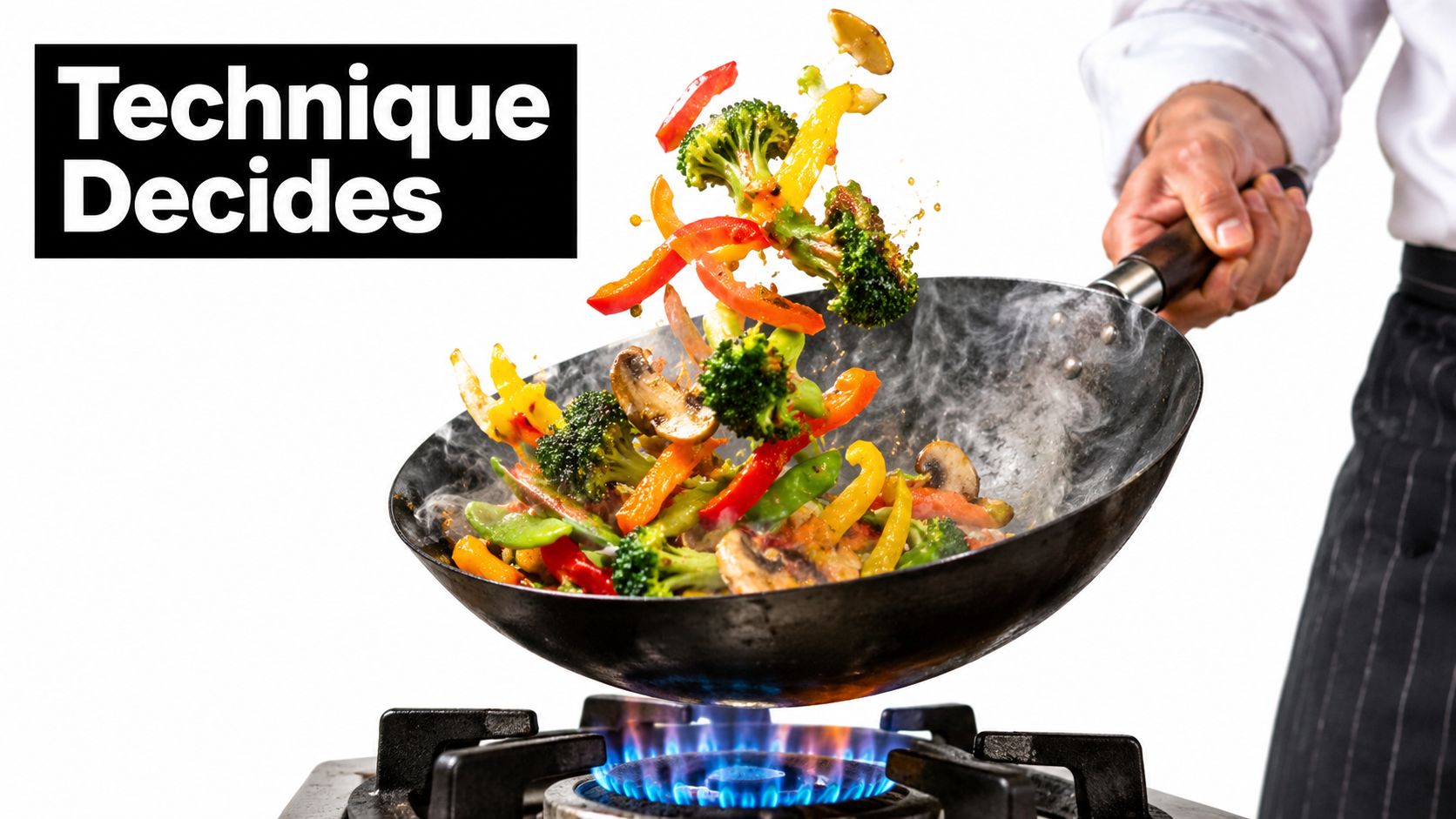
Vegetable stir-fry goes to the wok. The curved sides let you keep food in motion, and that movement is what protects the sear when the load is light and the heat is high. Australian vegetable research found that stir-frying produced comparatively higher ascorbic-acid retention in leafy vegetables and daikon radish than boiling or steaming in the tested comparisons, and 57.1% of respondents rated its stir-fry guidance “very effective” Australian vegetable-industry review. That doesn't make stir-fry a magic health method, but it does support the value of short, high-heat cooking when the technique is tight.
Shallow saute of proteins goes to the saute pan. The wider flat base gives better contact, which matters when you're trying to brown cutlets, fish fillets, or chicken thighs without constantly chasing them around the pan. The sides are high enough to manage splatter, but not so curved that the food disappears into a pocket of metal you can't easily reach.
The middle ground tasks
Sauce reduction favours the saute pan. The flatter surface and more even contact give you better control over evaporation, and deglazing is easier when the browned bits sit where the liquid can reach them. Deep-frying can work in either vessel, but the wok gives you a deeper central well, so it is often the safer shape for oil depth if the load is modest.
Shallow braise also leans saute pan. You want enough base area for browning first, then enough wall height to hold liquid without fighting the pan. A wok can handle it, but the curved base is not as efficient when the method asks for contact, then liquid, then a lid.
Here's the short version. If the job is fast movement, the wok wins. If the job is steady contact, the saute pan wins. For searing then deglazing, the saute pan is usually the cleaner all-in-one tool.
Materials, Coatings and Knife-Friendly Surfaces
The material question is where the wok-versus-saute debate gets messy. Shape tells you how a pan moves heat, but material tells you how it ages, how much abuse it can take, and whether the cooking surface is something you want to trust with high heat and metal utensils. Stainless steel, cast iron, carbon steel, hard-anodised aluminium, and coated surfaces all solve different problems, and none of them are perfect across the board.
Coatings are not a simple safety shortcut
Australia's July 2025 restrictions cover PFOA, PFOS and PFHxS, but PTFE remains a PFAS and isn't automatically excluded by a “PFOA-free” label. Independent Australian consumer guidance also notes that there's no universal method for validating PFAS-free claims Australian consumer guidance on non-stick pans. That means a coated wok isn't automatically cleaner or safer than a coated saute pan, and “non-stick” still needs to be read carefully.
The practical takeaway is boring but important. Coating safety and coating durability are separate questions. A good coated pan can be convenient, but if it overheats, scratches, or wears unevenly, the convenience fades fast. An uncoated steel or cast-iron pan demands more technique, but it usually gives you more control over lifespan and utensil choice.
What the main materials do best
Stainless steel suits browning, deglazing, and rough everyday use. It doesn't offer the easiest release, but it tolerates a lot and stays useful for years if you respect preheating and oil management. Cast iron holds heat well and can be superb for searing, though it's heavier and less nimble to lift.
Carbon steel sits between the two in a way that makes sense for wok cooking. It's lighter than cast iron, heats quickly, and rewards seasoning and regular use. Hard-anodised aluminium is often chosen for lighter handling and good responsiveness, while titanium is valued for durability and corrosion resistance, though it is a different conversation from a standard cooking pan because its appeal is tied to material purity and long-term wear rather than traditional non-stick behaviour.
For knife care, the wider kitchen matters too. Hard surfaces like glass and stone are rough on blades, while softer prep surfaces are kinder. That's not a reason to buy one pan over another, but it is a reminder that cookware, utensils, and prep gear all affect how well the kitchen holds up over time.
Rule of thumb: choose the material for the abuse level you expect, not for the label that sounds cleanest in the box.
If you want a separate breakdown of coating trade-offs for frying pans, this surface comparison guide is the right companion read.
Matching the Pan to Your Australian Kitchen
The best choice changes once you stop imagining a restaurant burner and start looking at a normal Australian kitchen. Market reporting points to growing demand for versatile, durable and induction-compatible cookware, alongside interest in woks, cast iron and specialty pans Australian cookware market reporting. That's exactly why a one-size-fits-all answer misses the point. People want cookware that fits the cooktop they already own and the way they already cook.
| Pan Choice by Cooktop and Cooking Style | Induction | Gas |
|---|---|---|
| Fast vegetable stir-fry | Flat-bottom wok if the zone matches well | Wok, especially with enough flame and room to toss |
| Sauces and reductions | Saute pan | Saute pan |
| Mixed meals, sear then simmer | Deep saute pan | Deep saute pan |
| Deep, tossing-heavy cooking | Flat-bottom wok | Round-bottom wok or flat-bottom wok, depending on burner and setup |
A flat-bottom wok often wins on a standard induction zone because it keeps contact where the hob can heat it. A round-bottom wok makes more sense only when the burner setup supports it, because then the shape works with the flame instead of against the surface. On ceramic or standard electric, a saute pan usually feels more forgiving because it doesn't ask the cook to manage as much movement just to maintain heat.
Small households need to think about batch size. A big wok looks flexible, but if you keep piling food in, you lose the effect that makes the shape worthwhile. A deep saute pan is often the better first buy because it handles searing, pasta sauces, vegetables, and quick braises without making every meal feel like a specialised technique drill.
For apartments, shared kitchens, and outdoor setups, the answer usually narrows fast. If storage is tight and you mostly cook on one induction zone, the saute pan earns its place. If you've got a dedicated gas burner and you stir-fry often, the wok stops being a novelty and starts making sense.
The Situational Verdict
For most Australian households, the smartest single buy is a high-quality clad stainless or hard-anodised saute pan. It handles searing, sauces, shallow braises, and everyday vegetables with less fuss, and it is less demanding about cooktop fit. If you stir-fry regularly, the best second pan is a flat-bottom carbon steel wok, because it brings real speed and motion without forcing you to own a specialised burner.
There are two clear exceptions. If you cook outdoors on a high-output gas burner and you like fast, mobile cooking, a round-bottom wok becomes clearly superior. If you're working in a small apartment with one induction zone, a deep saute pan can cover nearly everything you need without asking for extra storage or extra heat management.
Best default: choose the saute pan first, the wok second.
Best specialist: choose the wok only when the cooktop and cooking style support it.
Worst mistake: buying by cuisine name instead of by burner shape.
A wok is not the “Asian” pan and a saute pan is not the “Western” pan. They're both tools, but they ask for different physical conditions. Once you match the shape to the hob, the debate gets a lot less ideological and a lot more useful.
Common Questions Home Cooks Still Ask
A flat-bottom wok is a feature, not a compromise, on induction and most electric hobs. It's the shape that gives the pan enough contact to heat properly without a wok burner. A non-stick wok can be worth it for low-fuss cooking, but the coating trade-off still needs careful reading because “PFOA-free” doesn't automatically tell you what the surface is made of.
If you've only got a 14 cm induction zone, neither a big wok nor a huge saute pan is ideal. A smaller flat-base pan that matches the zone will outperform a larger pan that barely heats in the centre. A cast-iron skillet can stand in for a wok in a pinch, but it won't toss the same way and it won't give you the same curved-wall movement.
The short answer is still the same. Match the pan to the hob first, then to the food.
If you want cookware guidance that's built around real kitchen conditions, not just product labels, visit Everti for material-focused kitchen essentials and a cleaner way to think about what belongs on your bench.