

A small soup bowl typically holds around 250 millilitres, the common Australian food-service size for soup, sauces and small sides. Bowl capacity is different from a dietary “standard serve”: one describes what the vessel can hold, the other refers to food guidance.
You've ladled soup into an oversized pasta bowl, carried it carefully to the table, and watched it slosh towards the rim. A smaller bowl can make that ordinary moment easier: it's more comfortable to carry, simpler to serve from, and better suited to a modest portion that you'll eat while it's hot.
But “small” isn't a precise specification, and looks alone can mislead. Capacity, shape, material and finish all affect how a bowl works in a real kitchen. A good choice handles everyday use without sacrificing comfort, food-contact suitability or easy care. For ideas on coordinating bowls with the rest of the table, explore this guide to dining table decor.
Why Small Soup Bowls Belong on Every Table
The soup is ready, the table is set, and a full-size bowl feels like too much for a starter. A small soup bowl gives broth, miso or a side dish room to serve neatly without making a modest portion feel lost.
That smaller serving can be easier to carry and eat while the soup is hot. Serve a little, then refill if someone wants more. It's like carrying a cup rather than a bucket: less liquid can slosh over the rim on the way to the table.
In Australian food service, 250 ml is a familiar benchmark for soup, sauces and small sides. At home, it offers a useful point of reference, not a rule for every meal or appetite. For a coordinated setting, browse dining table decor.
A compact bowl earns its place beyond soup, too. It can hold accompaniments during dinner or stay within easy reach for everyday serving. Choose one that suits the food you serve most often and the way you use, store and wash your tableware.
As you shop, check whether the bowl is intended for food contact and hot servings, rather than judging by appearance alone. Finish and material matter, especially for repeated use with hot or acidic foods.
Small Soup Bowl Sizes and Capacities Explained
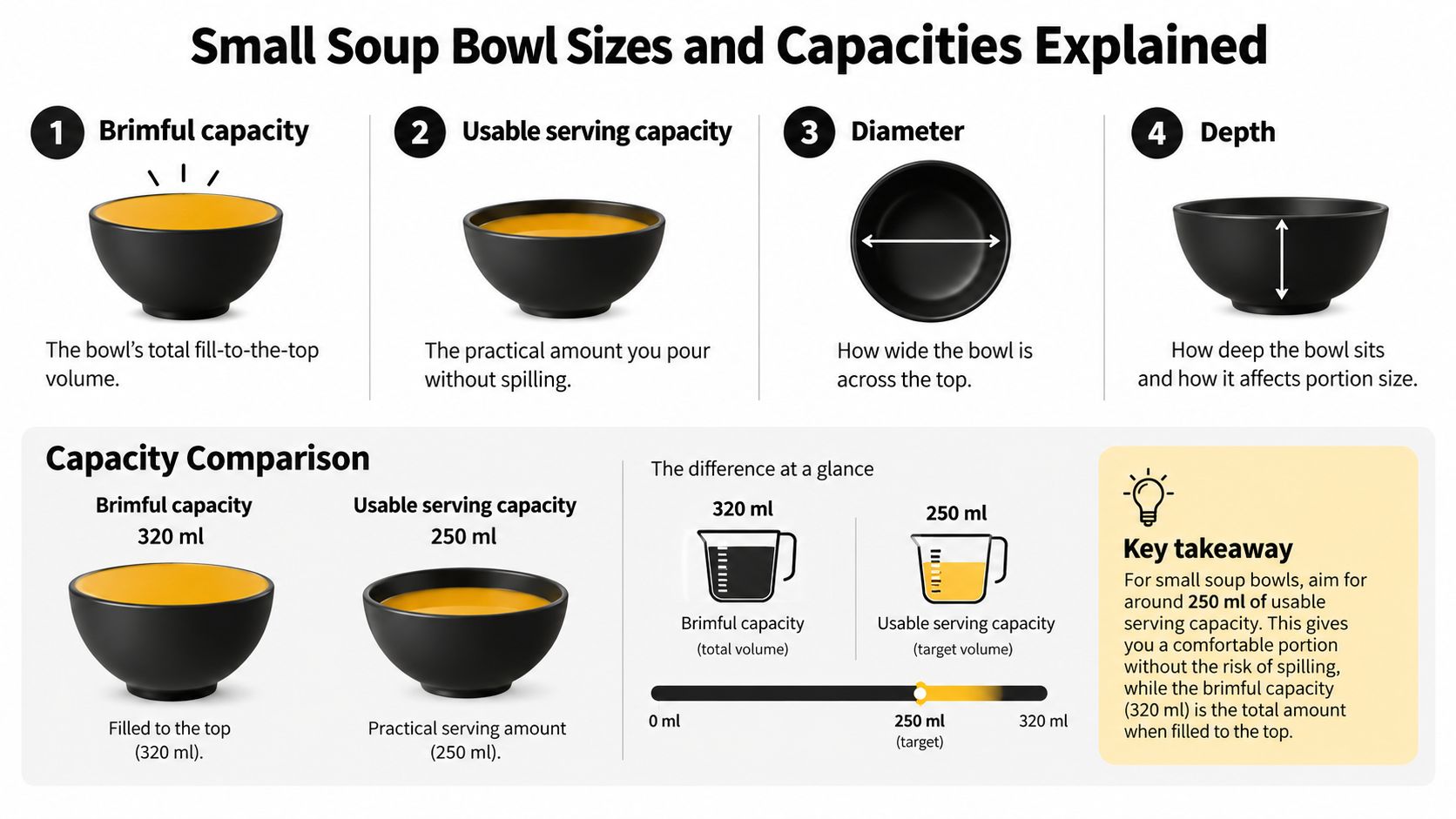
At a crowded dinner table, a bowl filled to the rim is awkward to carry and easy to spill. That's why a product's stated capacity needs context. Check whether it describes the bowl filled to the top or the amount suited to serving.
Three measurements help you judge the fit: capacity, diameter and depth. Capacity describes volume. Diameter is the width across the opening, while depth affects how easily you can carry and spoon from the bowl. A broad, shallow bowl and a narrow, deep one can hold the same volume but feel quite different in use.
Australia's food-service sector uses 250 millilitres as a benchmark for a standard serving of soup. The figure is a useful reference, not a rule for every home portion or a guarantee that a bowl marked “small” will hold that amount comfortably. For example, a bowl with a 250-millilitre brimful capacity would leave no room at the top when filled to that benchmark.
Read the numbers in context
Brimful capacity means the volume up to the very top. Usable serving capacity is lower, leaving space to carry the bowl and lift a spoon without sloshing soup over the edge. If a listing gives only the brimful figure, treat it as the bowl's maximum rather than a comfortable serving amount.
Diameter offers a clue, not a substitute for capacity. Bowls with the same opening width can differ in depth and shape. Museum Victoria records a reconstructed Melbourne archaeological vessel, possibly used as a soup bowl, with a 230-millimetre diameter and a broad 1820s–1840s date range. It provides a local historical comparison, but the record does not establish the vessel's capacity or set a modern standard (Museum Victoria's record of the excavated vessel).
If a listing calls a bowl “small,” look for its volume and check whether that figure is brimful or intended for serving. Where volume is absent, use the dimensions as clues, not a guarantee.
Comparing Small Soup Bowl Materials from Ceramic to Titanium
Material affects how a bowl feels in your hand and how much care it needs. There isn't one best choice for every kitchen: a light bowl that suits a child may not have the reassuring weight someone wants at a dinner table, while a heavy ceramic bowl may be less convenient to carry.
| Material | Heat behaviour | Durability | Food-contact notes | Best for |
|---|---|---|---|---|
| Glazed ceramic | Often feels substantial; the rim can be warm with hot soup | Can chip or develop surface damage if roughly handled | Check that the finished bowl is intended for food use and that the glaze remains intact | Everyday serving and varied table styles |
| Stoneware | Heavier feel can make it steady on the table | Robust in use, but edges can still chip | Inspect the glaze and follow maker care instructions | A weightier, rustic look |
| Porcelain | Often lighter and more refined in feel | Can break if dropped or struck | Verify food-contact suitability and care guidance | Neat, coordinated settings |
| Glass | Lets you see the soup and its colour | Breakage is the main practical concern | Check the product's stated heat and care limits | Clear, simple presentation |
| Stainless steel | Light and resilient in everyday handling | Resists many knocks, though surfaces can mark | Confirm the finished product is food-contact suitable | Busy kitchens and practical service |
| Titanium | Lightweight feel; the rim may feel different from ceramic or glass | Suitable for shoppers prioritising a durable, low-fuss material | Check product-specific suitability and use instructions | Portable, hard-wearing tableware |
Think about the food and the finish
Tomato soup, laksa and other acidic or salty dishes make the condition and formulation of a ceramic glaze particularly relevant. AS 4371:2012 sets maximum permissible release limits for lead and cadmium from ceramic tableware in Australia, alongside performance and marking requirements for relevant products. The Australian Standard for ceramic tableware is a reason to ask about the finished bowl, not just the general name of its raw material.
With any material, look at the rim and interior as well as the outside. A smooth, inspectable surface is easier to clean and assess than one with pits, cracks or visible wear. And don't assume that “ceramic,” “handmade” or “non-toxic” tells you how a particular bowl will handle repeated washing or heating. If you're comparing claims across materials, this overview of dinnerware material considerations can help you organise the questions to ask.
Food Safety and Heat Rules for Hot Soup Servings
A bowl can look beautiful and still leave you unsure whether it's suitable for food you serve hot. That uncertainty matters most when a bowl has a decorative glaze, unknown history or damaged surface. Ceramic or handmade doesn't automatically mean food-safe; you need information about the finished piece and its intended use.
The Australian Government advises consumers not to heat or store acidic food in crockery of uncertain lead content, or use it routinely. Heating, acidity and dishwasher damage can increase the risk of lead migration. The government's advice on lead in ceramic crockery is especially relevant if an older or decorative bowl has no clear food-use information.
Before buying or using a bowl, check:
- Food-contact suitability: Look for a clear statement that the finished product is suitable for food, not just a broad description of its material.
- Surface condition: Check the inside for cracks, crazing, pits or worn decoration where residue could remain.
- Heating instructions: Don't assume a bowl is microwave-safe. Follow the maker's instructions, particularly for metal, metallic decoration or uncertain materials.
- Dishwasher guidance: Confirm whether repeated dishwasher use is permitted, as care limitations may affect the surface over time.
Serving temperature is a separate question
Food safety also depends on how long soup sits after preparation. Australian food-safety guidance sets 60°C or hotter as the hot-control boundary for potentially hazardous food. The Australian guidance on temperature control for food service is a useful reference for service settings.
A small portion is suited to being served and eaten promptly, not left standing on a buffet. Because a smaller amount of soup is spread over a relatively large surface, it can lose heat quickly. For service, use a calibrated thermometer to check the soup itself rather than judging by how warm the bowl feels. At home, pour a portion when someone's ready to eat, then offer more if needed. For more on choosing a vessel for hot dishes, see these considerations for heat-proof bowls.
Everyday Uses for Small Soup Bowls Beyond Soup
A bowl sized for a modest soup serving can earn its place at the table every day. Pour a little miso or clear broth for a starter, serve a tasting course, or offer a child an amount they can carry without wrestling with a full-sized bowl. For sauces and dips, the same compact footprint keeps accompaniments gathered beside the main plate rather than spread across it.
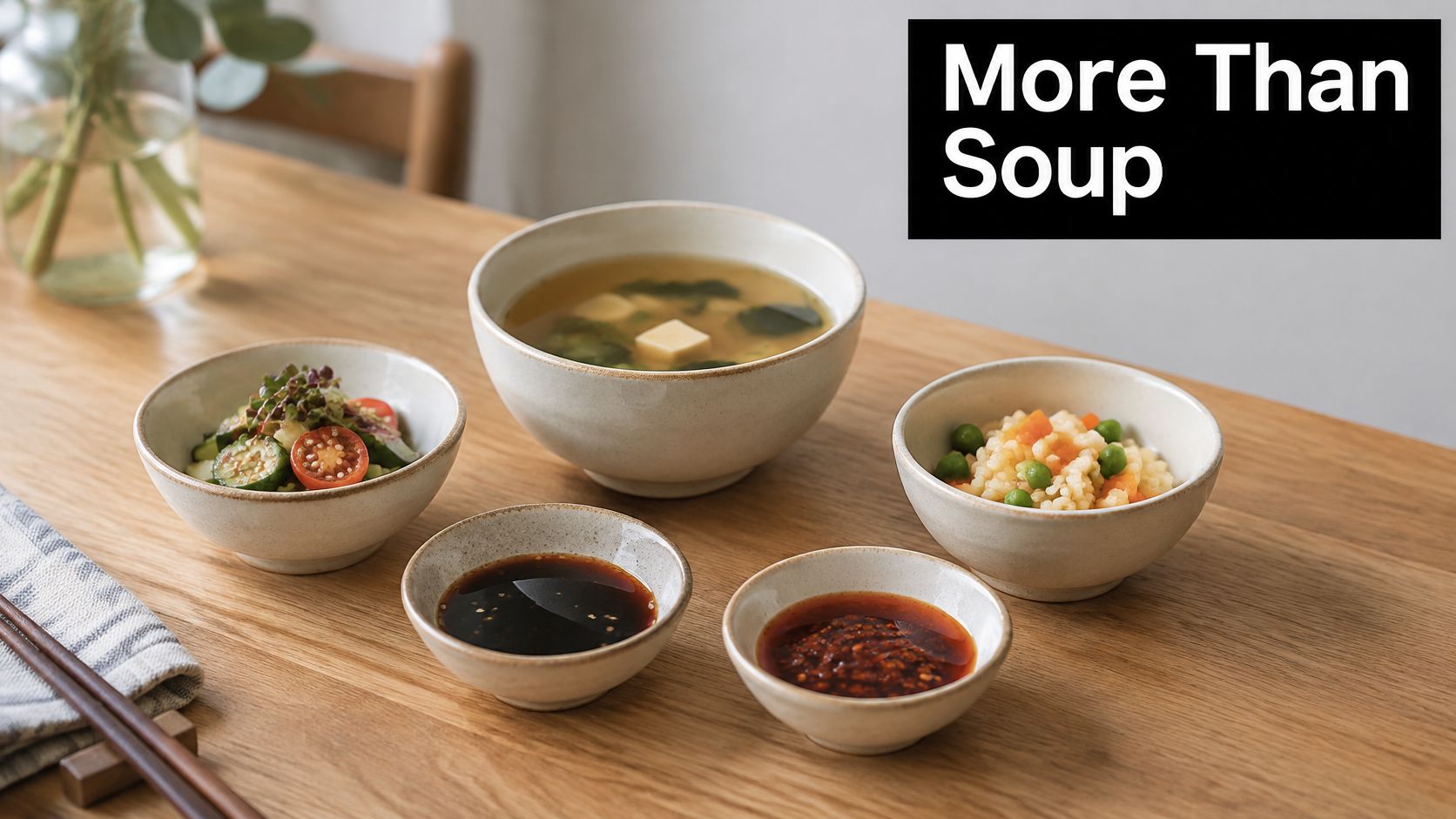
The shape works for food that isn't savoury, too. Use a small bowl for yoghurt toppings, fruit, snacks or dessert. The important detail is whether the usable volume suits the portion you want to serve. A shallow bowl can be easy to spoon from, while a deeper one may feel more secure for broth or a sauce you're carrying.
A useful leftover bowl, if it fits your routine
Small bowls can make leftovers easier to portion and store. If a bowl fits comfortably on a fridge shelf, takes a cover, and is approved for reheating, it can be convenient for a single serving. That's helpful when you want to warm only the amount you'll eat rather than reheat a larger container and put some back.
This has a practical Australian context: the country wastes about 7.6 million tonnes of food annually. Research discussed in NSW's food-waste tracking survey links uncertainty about reheating and storage advice with edible leftovers being discarded. A bowl that's easy to cover, store and use again can support a better leftover routine, but it can't solve unclear storage habits by itself.
The smallest bowl isn't automatically the most sustainable. If it's awkward to hold, easy to overfill, prone to spills or inconvenient in your fridge, it may create more hassle instead of less waste. Choose a useful serving capacity, then check how the bowl stacks and whether its maker allows the reheating method you use.
Styling and Caring for Small Soup Bowls
A collected table can feel more welcoming than a perfectly matched set. In colonial Melbourne, households often mixed mass-produced crockery, with willow patterns among the popular choices. That history offers a useful styling cue: varied bowls can sit comfortably together when they share a colour, pattern or visual weight.
Try a patterned small bowl beside plain plates, or group different finishes in one colour family. A bowl can also bring a small accent to a neutral setting, or keep sauces within reach on a shared table. For more ideas, explore these table-setting ideas.
Keep the surface easy to inspect
Follow the maker's care instructions. A bowl's microwave and dishwasher suitability depends on its finish, decoration and construction, so don't assume another piece made from the same material has the same limits.
Wash bowls soon after serving acidic soup, and check the interior as you clean. New cracks, pits, crazing or worn decoration can make a surface harder to clean thoroughly. Let bowls dry fully before stacking to avoid trapping moisture between them.
Check the rim, too. Chips and rough spots can make a filled bowl uncomfortable to carry. Handle pieces gently when stacking, and stop using any bowl for food if its surface is damaged or its care instructions are unclear.
Choosing Small Soup Bowls That Last a Lifetime
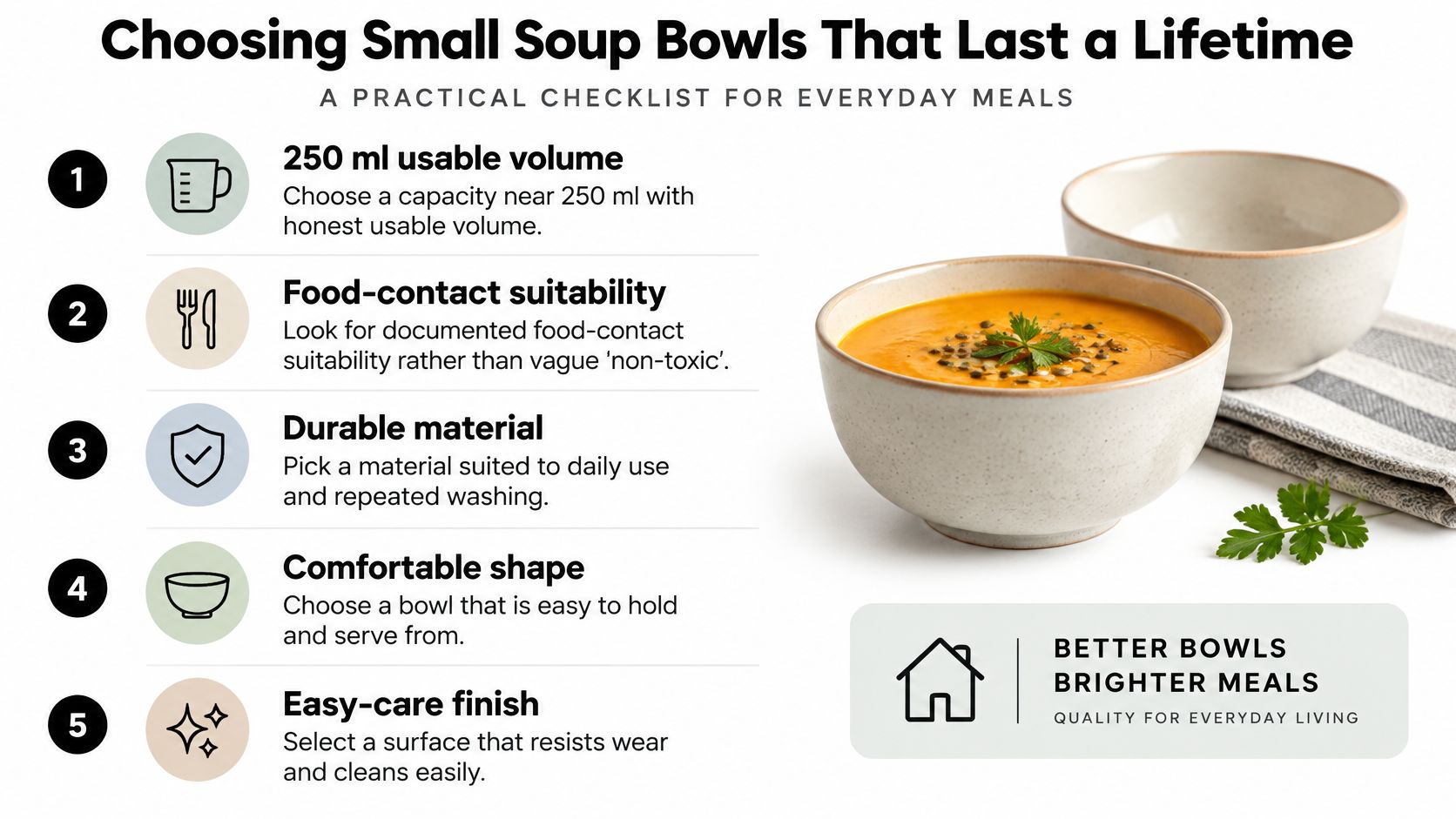
Start with the serving, not the label. A bowl you'll use for broth, a starter or a small side should have an honest usable volume and a shape that feels natural to carry. Then consider where it will live: on a dinner table, in a crowded fridge, or in a kitchen where dishes go through frequent washing.
Use this checklist when comparing options:
- Usable capacity: Look for a stated capacity near 250 millilitres if you want the common Australian food-service reference for soup, sauces and small sides. Check whether that number is brimful or practical serving volume.
- Documented food-contact suitability: Prefer clear product information about the finished bowl over a vague “non-toxic” label.
- Material for your menu: Consider how the bowl handles the hot, acidic or salty food you serve, and follow its heating and care instructions.
- Comfortable shape: Choose a stable base, an easy-to-hold profile and a rim that feels comfortable when the bowl is filled.
- Durable, easy-care finish: Check that the surface is simple to clean and easy to inspect for wear.
Buy for the way you'll use it
A bowl that stores and reheats well can make it easier to use leftovers, but only if its care instructions suit your kitchen. Choose a size that's satisfying for the food you serve, easy to cover, and straightforward to stack. Ceramic can be a sound everyday choice when its food-contact suitability is documented and its surface remains intact.
If you're comparing long-lasting alternatives, focus on evidence and practical details: what the bowl is made from, what foods and heating methods it suits, and what the maker says about care. A premium price alone doesn't establish durability or food safety. The best bowl is the one whose capacity, construction and care requirements match your regular meals.
Everti offers titanium tableware for cooks looking for a durable option for everyday serving. If you're comparing small soup bowls and want to consider a different material, explore the range at Everti.