

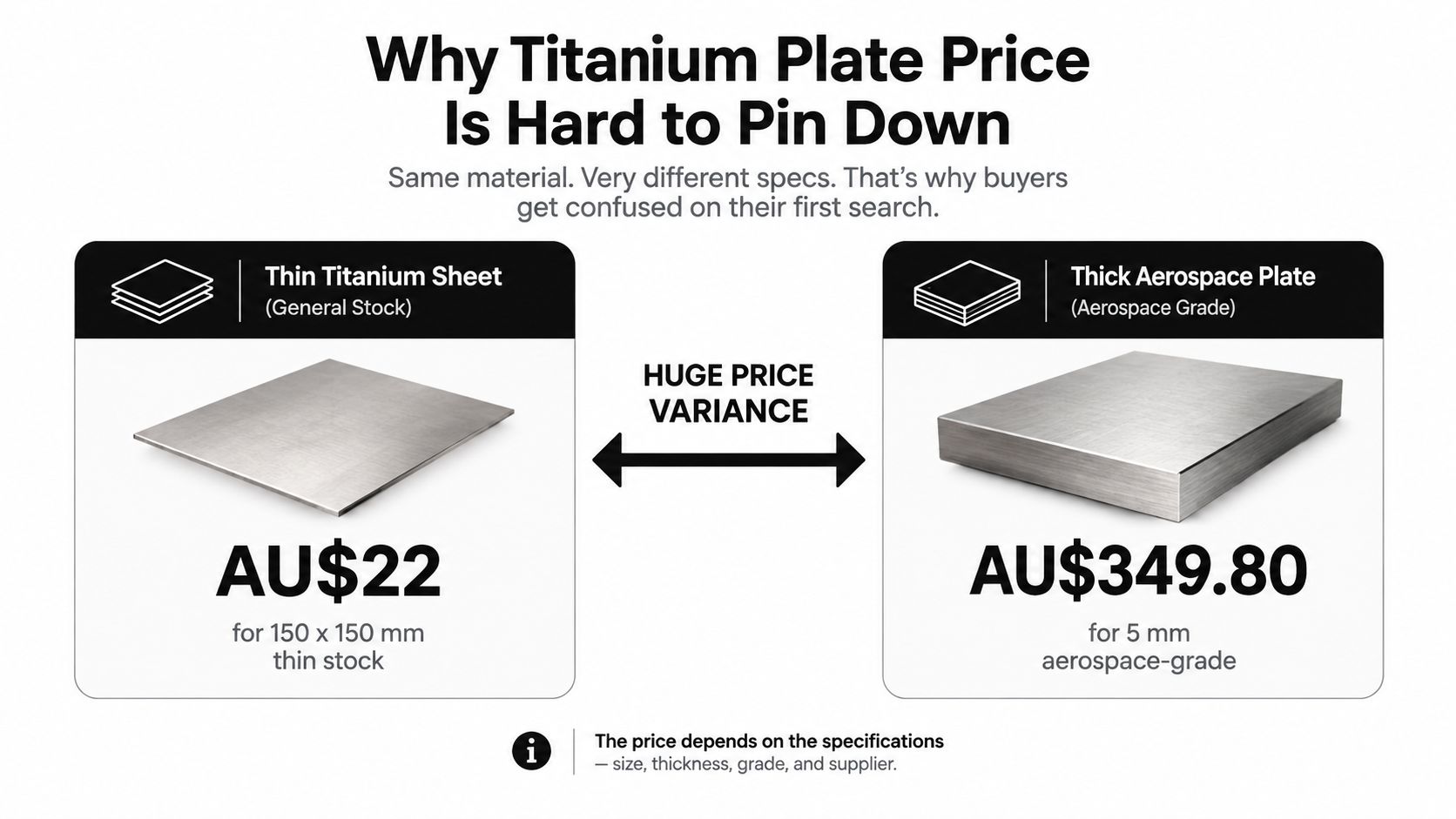
A 150×150 mm titanium plate can cost about AU$22 in thin stock or climb to AU$349.80 for 5 mm aerospace-grade sheet. That spread is the answer to titanium plate price in Australia. Buyers don't purchase “titanium” in the abstract. They purchase a specific grade, thickness, cut size, finish, and level of certification, and that's where the bill blows out.
Most guides get this wrong because they treat titanium like a simple commodity. It isn't. A kitchen buyer looking for a clean, corrosion-resistant prep surface is shopping in a different universe from a fabricator chasing Grade 5 offcuts for a high-stress bracket. If you use one benchmark for both, you'll either overpay badly or buy the wrong material.
The smarter way to read titanium plate price is this: start with the piece price you'll pay, then work backwards to the cost drivers, then judge whether the part will earn its keep over years of use. That last step matters more than most buyers realise.
Why Titanium Plate Price Is Hard to Pin Down
The first problem is simple. There is no single Australian titanium plate price.
One Australian supplier listed titanium sheet at AU$9.00 for a 75 mm × 75 mm × 0.5 mm piece, AU$22.00 for 150 mm × 150 mm × 0.5 mm, and AU$29.00 for 150 mm × 150 mm × 1.0 mm on its Australian titanium sheet listings. Another Australian supplier listed 300 mm × 300 mm titanium 6Al4V sheet at AU$55.00 for 0.5 mm, AU$83.60 for 1.14 mm, AU$119.90 for 1.6 mm, and AU$349.80 for 5 mm on its titanium sheet product range.
That's why buyers get confused after a quick search. They see one small thin sheet priced like a hobby material, then another piece priced like aerospace stock, and both are called titanium sheet or plate.
Three price languages buyers mix up
Retail buyers usually collide with three different pricing systems at once.
- Per-piece retail pricing is what you pay at checkout for a cut panel or offcut.
- Per-kilogram benchmark pricing helps compare quotes across different sizes.
- Import and export trade pricing reflects broader market movement, not the sticker on your exact plate.
Those numbers don't line up neatly. They can't. A warehouse selling small cut pieces is charging for handling, cutting, stocking slow-moving dimensions, and carrying specialised material in Australia.
Practical rule: If a seller only gives you a per-piece number and won't tell you the grade or thickness clearly, you're not comparing titanium quotes. You're comparing mystery packs.
Why Australian buyers feel the spread more
Australian buyers deal with a thinner local supply chain than larger industrial markets. That means fewer stocked sizes, more dependence on imports, and more markup when you need something outside common cuts. Small-batch handling, freight, and documentation can push a modest plate into “why is this so expensive?” territory.
Here's the spine I use when judging any titanium plate quote:
- Grade
- Thickness
- Size
- Finish
- Certification and supplier handling
A home cook buying a prep board, a small fab shop ordering a one-off part, and an outdoor user chasing lightweight corrosion resistance should all read the same quote differently. That's the whole game.
The Five Factors That Drive Titanium Plate Price
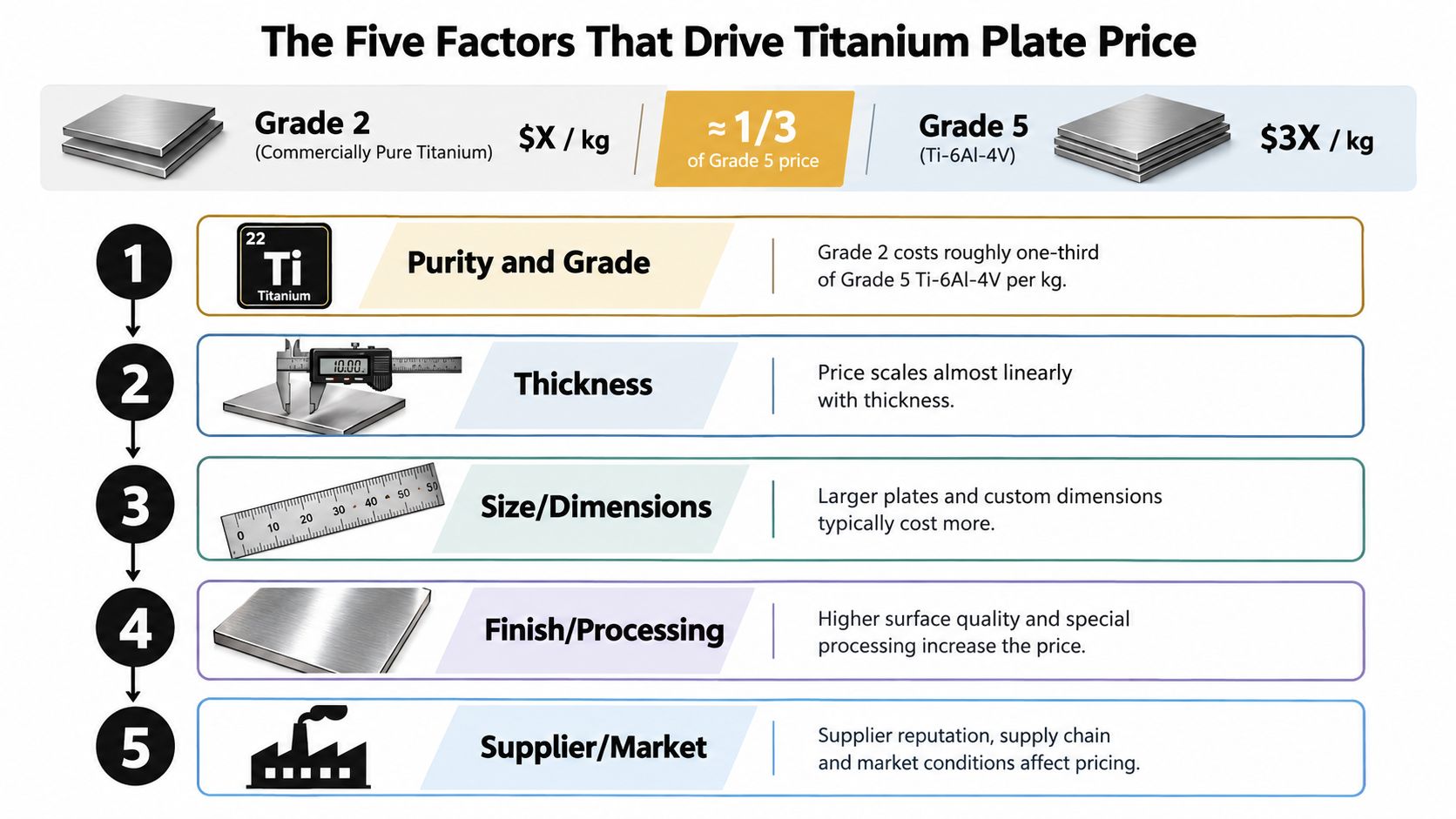
The biggest mistake buyers make is obsessing over the word titanium and ignoring the specification line beneath it. The metal name doesn't set the price. The spec does.
Grade decides whether you're buying utility or performance
Grade comes first because it changes the whole use case. Commercially pure titanium suits many kitchen, corrosion, and general-use applications. Alloyed material such as Grade 5 sits in a different lane and is often bought for strength-focused jobs.
If you're still deciding between pure titanium, alloy, or a cosmetic titanium finish, this guide to pure titanium, titanium alloy, or titanium coating is worth reading before you compare quotes. Buyers routinely pay alloy pricing for jobs that only need corrosion resistance and low maintenance.
Thickness changes the bill fast
Thickness is where casual buyers under-budget. Going from a thin sheet to a thick plate doesn't just add material. It also changes how easy the part is to stock, cut, ship, and package.
A direct retail example proves it. On one Australian listing, 300 mm × 300 mm titanium 6Al4V sheet moved from AU$55.00 at 0.5 mm to AU$349.80 at 5 mm on the same supplier product page. That's why asking “what's titanium plate price?” without thickness is useless.
Size changes markup, not just material
Cut size matters in a less obvious way. Small pieces can carry a steep convenience markup because the seller has already done the cutting, labelled the piece, and made it easy to buy. Larger plates can look expensive upfront but sometimes make more sense if you need multiple parts from one blank.
A local category listing showed 300×300 titanium plate at AU$65.00 and 500×500 at AU$185.00, while the same supplier noted that pricing depends on grade, thickness, dimensions, quantity, surface finish, manufacturing requirements, and market conditions. That listing also cited about AU$42.49/kg for Grade 5 titanium alloy in Australia as a benchmark on its Australian titanium category page.
Finish and paperwork aren't cosmetic details
Mill finish, polished finish, and tightly controlled surface prep don't land in the same pricing bucket. Neither does traceability. If your job needs confidence in what landed on the bench, ask for the certificate before you pay, not after.
A cheap plate without clear grade traceability is only cheap until you machine it, weld it, or put it into contact with food and realise you guessed wrong.
My cost-impact hierarchy
If you want the blunt version, this is the order I'd rank cost drivers in most real purchases:
- Grade
- Thickness
- Finish
- Size
- Supplier handling and certification
Buyers usually blame “the market” when the quote looks ugly. More often, they've specified premium grade, extra thickness, and unnecessary finish on a job that didn't need any of it.
Real AU Retail Price Ranges at a Glance
Forget abstract benchmarks for a minute. This is the view that matters when you're buying. Australian retail titanium pricing is easiest to judge when you compare likely cut sizes side by side and accept one reality: many listed prices are for stocked cuts, not perfect apples-to-apples grade matches.
AU retail titanium plate price ranges by grade and thickness
| Grade | Thickness | 150×150 mm | 300×300 mm | 600×600 mm |
|---|---|---|---|---|
| Commercially pure titanium retail stock | Thin sheet range | AU$22.00 to AU$29.00 based on listed 150×150 mm pieces in 0.5 mm and 1.0 mm sizes from an AU titanium sheet seller | AU$65.00 for a listed 300×300 titanium plate on an AU titanium category listing | Quote required in most cases. Expect size, freight, and cut method to dominate. |
| Grade 5 / 6Al4V retail stock | Thin to thick cut sheet range | Retail listings vary. Small Grade 5 cuts are less consistently listed than larger panels. | AU$55.00 at 0.5 mm, AU$83.60 at 1.14 mm, AU$119.90 at 1.6 mm, AU$349.80 at 5 mm for 300×300 mm on an AU 6Al4V sheet listing | Quote required in most cases. Large Grade 5 cuts usually shift from shelf pricing to quote-based pricing. |
| Mixed retail benchmark | Larger plate stock | Small pieces often carry convenience markup. | AU$65.00 for 300×300 and AU$185.00 for 500×500 on an AU titanium product category page | Few reliable shelf listings. Regional freight often decides whether a quote is fair. |
What this table actually tells you
First, piece price beats theory. If you need one plate now, the listed cut matters more than a vague “market rate”.
Second, buyers should stop expecting tidy linear pricing across retailers. One seller may list small general-use sheet. Another may focus on alloyed stock, thicker cuts, or automotive and fabrication buyers. That's why the shelf price on one site can look disconnected from another.
For most small buyers, the fastest quote sanity check is this: compare your plate against a listed retail cut of similar dimensions, then ask what part of the difference comes from grade, thickness, finish, or certification.
If a supplier can't explain that difference clearly, keep shopping.
How Global Markets Shape Local Plate Pricing
The broad market matters, but not in the simplistic way many buyers assume.
Australia's average titanium import price was US$16,755 per ton in 2024, down 31.2% from the previous year, while the average export price was US$1,351,146 per ton, up 311% year over year, according to Australia titanium trade data. That gap tells you something important. Titanium is not trading as one clean commodity. Product form and value-added processing matter massively.
Why retail didn't fall in lockstep
A lower import benchmark doesn't mean your local cut plate suddenly gets cheap. Retail plate pricing still has to absorb warehousing, imported lot availability, cutting, freight, and the fact that many Australian buyers purchase in tiny volumes.
Small buyers often expect a global drop to flow straight to the shelf. It rarely does. Distributors may still be selling older inventory bought at higher replacement cost. Some dimensions move slowly. Some grades are niche enough that each stocked piece carries a healthy margin because shelf space is expensive.
Which market signal matters most
The wrong way to buy is to track one headline price and assume it governs your quote.
The better approach is this:
- If you're buying small cut pieces, watch retail listings first.
- If you're buying workshop quantities, compare against local kilogram references.
- If you're planning a larger order, broader import direction helps with timing.
Another Australia-focused market reference repeated that the average import price fell to USD 16,755 per ton in 2024, down 31.2% year over year, but many writeups fail to connect that move to downstream shelf pricing, leaving buyers without a practical benchmark, as noted in this Australia-market pricing discussion.
My buying read
If import pricing softens and local plate sellers don't adjust at all, ask harder questions. That doesn't mean every quote should collapse. It does mean you shouldn't accept “that's just titanium” as an explanation for any number put in front of you.
A buyer who understands the gap between commodity movement and retail cut pricing negotiates better. A buyer who doesn't usually pays for someone else's stock risk.
Cost Per Use and Lifetime Value by Use Case
Sticker shock is real. It's also a bad way to judge titanium.
If you're buying a plate for repeated use, the only sensible question is what the part costs over its working life. That framework is far more useful than staring at the invoice and pretending the cheapest metal is always the cheapest choice.
Cost per use by use case
| Use Case | Titanium Plate Spec | Sticker Price (AU$) | Estimated Uses | Cost Per Use | vs. Stainless/Aluminium |
|---|---|---|---|---|---|
| Kitchen prep board | Thin commercially pure titanium plate or board-format piece | Higher upfront than common plastic or basic stainless options | Repeated daily kitchen use over a long service life | Drops sharply over time if used constantly | Stainless is cheaper to enter. Titanium wins where buyers value non-reactive, corrosion-resistant, low-maintenance use. |
| Outdoor plate or ultralight field surface | Thin titanium sheet | Upfront premium for a lightweight piece | Repeated trip use | Strong value when low weight and corrosion resistance matter every trip | Aluminium is cheaper. Titanium is tougher in rough, wet, long-term use. |
| Small fab shop one-off | Grade 5 or other specified plate | Often the highest upfront line item | Single build or limited-run part use | Value comes from fit-for-purpose performance, not repeated use count | Carbon steel and aluminium are easier on budget. Titanium earns its keep when corrosion, weight, or application requirements justify it. |
Kitchen buyers should stop comparing titanium to disposable boards
For kitchen use, buyers often compare titanium against plastic on purchase price alone. That's lazy buying. Plastic gets scarred, holds odours, and gets replaced. A properly specified titanium prep surface can stay in service for years with very little drama.
That's one reason some buyers move to purpose-built products rather than raw sheet. For example, Everti's Pure Titanium Cutting Board is sold as a finished kitchen product rather than a workshop plate, which matters if you care about food-contact use, edge finishing, and verified material claims rather than DIY fabrication.
Outdoor users buy weight savings and zero fuss
Bushcraft and travel buyers don't just buy metal. They buy something that can live wet, dirty, and neglected without complaining. Titanium often looks expensive until you've dragged cheaper gear through enough trips to understand why corrosion resistance and low maintenance are worth paying for.
Buy titanium for outdoor use when failure, rust, or weight annoys you every trip. Don't buy it just because the word sounds premium.
Workshop buyers need a harder value test
Fab shops should be stricter. Titanium plate is worth it when the job demands titanium. That means corrosion, weight, compatibility, or performance requirements that stainless, aluminium, or carbon steel don't meet cleanly.
If you're making a one-off and trying to judge true ownership cost instead of just purchase price, this total cost of ownership perspective is the right frame. Cheap material that creates rework, coating issues, corrosion callbacks, or early replacement often stops being cheap the moment the job leaves the bench.
How to Evaluate a Titanium Plate Quote
Most bad titanium purchases happen before the material arrives. The buyer accepted a vague quote.
You want a quote that tells you exactly what you're paying for and what risk you're taking. If the seller can't provide that, assume the cheap number has missing detail baked into it.
The same-day quote checklist
Run through these checks before you approve anything:
-
Confirm the grade
Don't accept “titanium” as a material description. Ask whether it's commercially pure titanium or a specific alloy such as 6Al4V. If the application matters, ask for the mill cert. -
Check the true thickness
Listed thickness and actual delivered thickness aren't always the same thing in practical buying. If your part has fit, flushness, or machining implications, make the tolerance explicit on the quote. -
Ask how the piece was supplied
Was it cut from sheet, plate, or coil? Is it an offcut? Was it sheared, sawn, or waterjet cut? Edge condition affects both finishing work and use readiness. -
Verify finish
Mill finish is fine for many jobs. Polished or presentation-grade surfaces should be specified, not assumed. A kitchen-facing item, a visible fabrication part, and a hidden bracket don't need the same finish. -
Convert the quote into a comparable basis
Piece price is convenient, but it can hide ugly markups. Ask enough questions to compare like with like across suppliers.
What a strong quote looks like
A good quote is boring in the best way. It states the grade, dimensions, thickness, finish, and whether documentation is available. It also makes clear whether freight, cutting, and GST are inside the number or sitting outside it.
The quote should remove ambiguity, not create it. If you need three follow-up emails to figure out what metal they're selling, the process is already telling you something.
Situational picks I'd make
Use the application to strip out unnecessary cost.
-
For kitchen use
Go for commercially pure titanium with a practical finish suited to food-contact handling and easy cleaning. Don't pay alloy pricing for a prep surface unless you have an unusual reason. -
For outdoor gear
Choose thin stock that keeps weight low and keeps corrosion resistance high. Fancy finish is rarely worth it once the item hits dirt and fire. -
For workshop and fabrication jobs
Match the grade to the performance requirement, then buy enough thickness to do the job without heroics. Overspecifying grade and thickness at the same time is where many one-off jobs become silly.
If you want extra confidence before paying a premium for stated material, use a supplier who can support verification or read through this material composition testing guide. A grade claim you can't verify isn't worth much.
Titanium Plate Price Questions Buyers Still Ask
Is Grade 2 the smarter buy than Grade 5
For many buyers, yes. If the job is a kitchen surface, corrosion-focused application, or general-use panel, commercially pure titanium is often the more sensible purchase. Grade 5 makes sense when strength-driven performance is the reason you're buying titanium in the first place.
Is now a good time to buy
If you're in Australia and you've seen local quotes stay stubborn while broader import pricing has softened, it's a reasonable time to press suppliers on price rather than passively accept the first number. Don't wait forever for a perfect dip. Do ask why a quote looks disconnected from current supply conditions.
How do you verify a quoted grade before paying
Ask for the mill certificate before payment if the application justifies it. If the seller gets vague, treat that as a pricing problem, not just a paperwork problem. Premium titanium pricing without traceability is a poor deal.
Is titanium plate actually worth the cost
For kitchens, often yes if you want a long-life, low-maintenance, non-reactive surface and you'll use it constantly. For workshop builds, only when the part needs titanium's properties. For lightweight outdoor projects, it's often worth it because the benefits show up every time you pack, carry, wash, and store the gear.
My blunt verdict is this. Titanium plate is worth the money when the use case keeps paying you back. If the job doesn't need corrosion resistance, weight savings, food-safe simplicity, or long service life, buy something cheaper and move on.
If you're comparing titanium plate options for kitchen use, food-contact confidence, or long-life daily gear, Everti offers pure titanium products built around that exact value equation. Visit Everti to see how finished titanium essentials differ from raw plate buying, and to judge whether a ready-made solution makes more sense than sourcing cut stock yourself.