

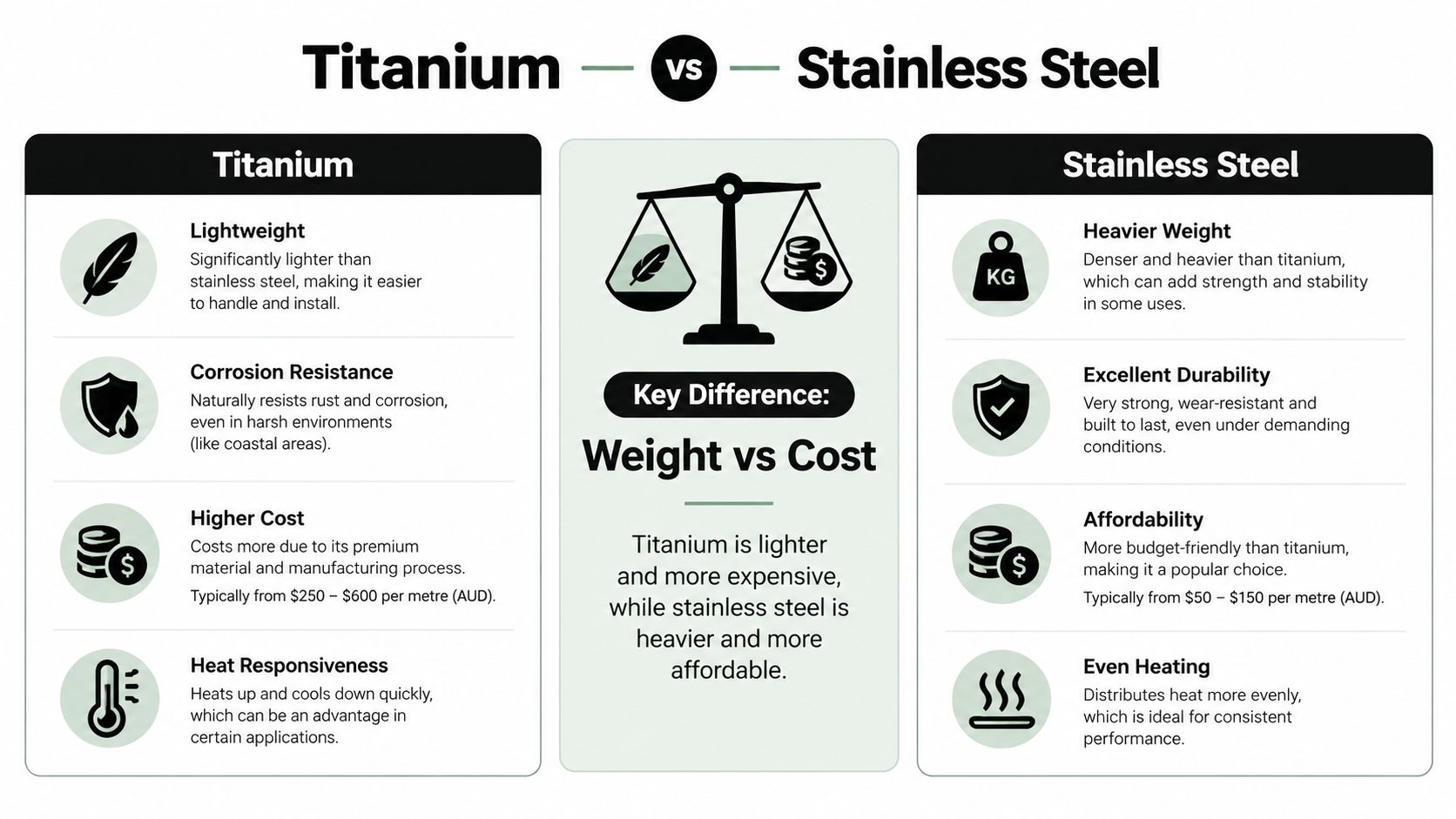
Titanium and stainless steel are two different materials, and 304/316 stainless is the practical default for most kitchens, while titanium makes sense when weight, corrosion resistance, and portability matter more than price. The right pick depends on what you cook, how often you use it, and how much flex, rigidity, and maintenance you'll accept.
| Property | Titanium | Stainless Steel (304/316) |
|---|---|---|
| Weight | Much lighter for the same shape | Heavier, more substantial |
| Stiffness | More flexible | More rigid |
| Corrosion behaviour | Excellent, especially in harsh conditions | Very good, with 316 stronger in salt and chloride exposure |
| Knife friendliness | Better than glass, stone, or steel surfaces, but not as kind as wood | Depends on thickness and finish, but still harder on edges |
| Food-contact clarity | Must be verified by grade and construction | Familiar, traceable, and widely used in food-contact gear |
| Best use | Portable cookware, outdoor gear, high-corrosion settings | Everyday kitchen tools, prep surfaces, durable household use |
What "Titanium Stainless Steel" Actually Means
A lot of shoppers search titanium stainless steel as if it were one material. It isn't. Titanium and stainless steel are separate metals with different performance profiles, and the phrase is often just sloppy marketing that hides what you're buying.
That matters in Australia because the country's titanium story is mainly a mineral-resources story, not a broad kitchenware manufacturing story. Australia holds roughly 40% of the world's rutile resources and 19% of global ilmenite resources, but has historically had limited capacity to turn those minerals into titanium metal, so “Australian titanium” kitchenware is rarer than the label suggests (Australian Mining Review). If a product claims titanium, you should want the substrate, grade, and finish spelled out.
The phrase buyers should question
If a listing says “titanium stainless steel,” ask one blunt question: is it solid titanium, titanium-coated stainless steel, or just stainless steel with titanium-style branding? Those are not interchangeable, and the difference affects everything from corrosion behaviour to how much trust you should place in the product.
Practical rule: if the seller won't name the grade or explain the construction, treat the claim as marketing, not a material specification.
That's why a fake-titanium warning matters so much in kitchenware, especially with online imports. If you want a blunt consumer read on how brands blur the line, see this guide to fake titanium in Australia.
What you're really choosing
For kitchen gear, the decision is usually simple. Titanium gives you lightness and strong corrosion resistance. Stainless steel gives you rigidity, lower cost, and familiar food-contact performance.
If you mainly want a cutting board, bowl, bottle, or cooking vessel that's easy to carry and resistant to salty, acidic, or humid conditions, titanium deserves attention. If you want a heavy, stable, affordable workhorse for daily cooking, stainless steel is usually the sane choice.
| Property | Titanium | Stainless Steel (304/316) |
|---|---|---|
| Material category | Separate base metal | Separate base metal |
| Typical kitchen role | Lightweight, corrosion-resistant tools | Everyday cookware and food-contact equipment |
| Buyer risk | Mislabelled coatings and vague branding | Picking the wrong grade for the environment |
| Decision driver | Portability and surface stability | Cost, rigidity, and familiar performance |
Core Material Properties Explained
Titanium gets treated like the premium answer because it is lighter, but weight is only one part of the choice. For kitchen gear, the comparison is corrosion, stiffness, food reactivity, cleanability, and durability.
Weight versus stiffness
Titanium is lighter, and that matters on the move. CSIRO reports titanium's elastic modulus at roughly 105 to 120 GPa, compared with about 190 to 200 GPa for common austenitic stainless steels (CSIRO). Lower stiffness means more flex in a piece with the same shape, so a lightweight pan, bowl, or board can feel less rigid in use. For travel kit, that trade-off is fine. For a tool that needs to stay planted, stainless usually feels better.
Corrosion, reactivity, and finish
Corrosion resistance depends on both the alloy and the finish. Queensland food-hygiene guidance identifies 304 and 316 as the dominant food-contact stainless grades, with 316 offering better resistance in saline or chloride exposure because of its molybdenum content (Queensland food-hygiene guidance). Titanium also resists corrosion very well, but that does not rescue sloppy design, rough welds, or surfaces that trap grime.
Buy the finish, not just the metal. Smooth surfaces, clean welds, and easy rinse-off matter as much as the alloy name.
What matters in a kitchen
The practical choice is straightforward.
- Choose titanium when weight matters: Portable cookware, travel gear, and outdoor kit benefit from it.
- Choose stainless when rigidity matters: Prep tools, bowls, and rigid cookware usually feel better in stainless.
- Choose 316 over 304 near salt: Coastal homes, salty marinades, and humid storage are harder on lower-spec steel.
- Do not treat “stainless” as one thing: 304 and 316 behave differently in real kitchens.
For a more engineering-style breakdown of strength, see this titanium versus stainless steel strength guide. For Australian buyers, the call is simple. Titanium wins on portability and specific strength. Stainless wins on cost, stiffness, and everyday kitchen practicality.
Kitchen Safety, Microplastics and Coatings
Kitchen safety gets muddled fast because brands use words like non-toxic, BPA-free, and titanium-coated as if they were proof. They aren't. Australia and New Zealand food-contact rules are based on whether substances migrate into food during realistic use, which is why those labels do not replace actual composition and migration evidence (Everti on food-contact materials).
That's the first thing to get straight: material names are not safety certificates. A high-quality stainless steel product can be completely appropriate for food contact, and a badly made titanium-looking item can be a worse buy than a traceable stainless-steel piece.
Coatings are where people get burned
A “titanium-coated” product may still be a steel item underneath, and that's where buyer confusion starts. If the coating isn't disclosed clearly, you don't really know what touches your food, what the core metal is, or how the product will age after repeated washing.
What to ask for is plain and practical:
- Exact substrate: Is it solid titanium or a coated base metal?
- Grade or purity: What alloy is it, and is that stated in writing?
- Intended use: Is it designed for food contact, hot liquids, or just display?
- Independent verification: Is there actual testing, not vague label language?
If you're worried about the broader home environment, a guide for homeowners on microplastic removal is useful background, because kitchen safety isn't only about the pan or board in your hand. It's about what's in the water, the packaging, and the surfaces you clean every day.
Why titanium still has a real safety case
Titanium has a stable, chemically inert feel in kitchen use. It doesn't rely on a coating to be usable, and that's a big reason it appeals to buyers who want fewer unknowns. Stainless steel can also be excellent, but only when the grade is right and the finish is properly made.
If you're shopping for food-contact gear, ignore the buzzwords. Read the construction, check the alloy, and reject anything that hides the substrate behind lifestyle language.
Knife Care and Cutting Surface Trade-offs
Knife care is where marketing gets lazy. The honest question isn't whether titanium is “knife friendly” in some abstract sense, it's how it compares with the surface you'd otherwise use every day.
An Australian comparison reports approximately 15 to 20% faster dulling on titanium than premium end-grain wood, while glass, granite, or stainless steel produced roughly 300 to 400% faster dulling in the same testing (Terra Wellness). That tells you titanium sits in a useful middle zone. It's not the gentlest surface, but it's a lot kinder than the brutal ones.
What that means for real cooks
If you prep vegetables, herbs, and boneless proteins daily, wood still gives the nicest edge life. If you need a non-porous surface for easy cleaning, odour control, or travel, titanium is a sensible compromise.
Practical rule: use wood for everyday chopping, use titanium for situations where cleanability and durability matter more than maximal edge retention.
That's the part most product pages skip. A metal surface may be easier to sanitise and less likely to hold odour, but it still won't treat your knives as gently as a quality wooden board. “Gentler than stainless steel” is not the same thing as “ideal for knife life.”
How I'd pick it
- Choose wood if your priority is knife longevity and routine prep.
- Choose titanium if you want a hard, cleanable, corrosion-resistant surface and accept a modest knife-care penalty.
- Avoid glass, granite, or bare stainless as chopping surfaces if knife sharpness matters to you at all.
If you want a deeper buyer-focused comparison, this knife-friendly cutting board guide is worth reading. My view is simple, titanium is a compromise surface, not a miracle surface, and you should buy it with that in mind.
Matching Materials to Real Kitchen Scenarios
The right material depends on what the kitchen needs, not on material snobbery. A family kitchen, a caravan setup, a humid coastal home, and a prep-heavy bench each reward a different choice, and “titanium stainless steel” is often just marketing shorthand unless the spec sheet says exactly what you are buying.
Daily family cooking
For normal weekday cooking, stainless steel is usually the better buy. It is rigid, familiar, and cheaper, and it handles stacking, rough handling, and regular dishwashing without drama.
If you are cooking pasta, sautéing vegetables, or setting food out for the family, stainless makes practical sense. You get a material that does the job without asking for much care.
Outdoor and travel use
For camping, van life, picnics, and lightweight travel kits, titanium wins. It is lighter to carry and less fussy in damp storage, salty air, and repeated packing and unpacking.
If you have hauled a heavy metal kit through an airport or into a campsite, you already know why that matters. Weight becomes annoying fast.
Coastal and humid homes
In coastal or salt-heavy kitchens, 316 stainless is the minimum sensible default if you are choosing stainless at all. As covered above, 316 handles chloride exposure better than ordinary 304, so it is the safer choice when salt and humidity are part of daily life.
Titanium also makes sense in that setting because it avoids some of the same corrosion worries. Do not buy plain 304 and hope branding will cover the difference.
Where the publisher's product fits
If you want a titanium board specifically, Everti sells titanium kitchen products, including cutting boards, cookware, drinkware, and tableware. That kind of product fits buyers who want a lightweight, corrosion-resistant, easy-to-clean surface and are willing to pay for those traits.
If your prep surfaces include stone, the same task-first logic applies, and this guide to kitchen marble and granite covers how those surfaces behave.
Acidic-food-heavy cooking
If your kitchen leans hard on citrus, vinegar, tomato, or salty marinades, the choice gets sharper. Titanium handles those conditions well, and 316 stainless is the stainless grade I would pick over ordinary 304.
For most households, the sensible split is simple. Choose 316 stainless if you want the familiar, rigid, lower-cost option. Choose titanium if you want lighter weight and a cleaner corrosion profile.
A Buyer Checklist Before You Spend
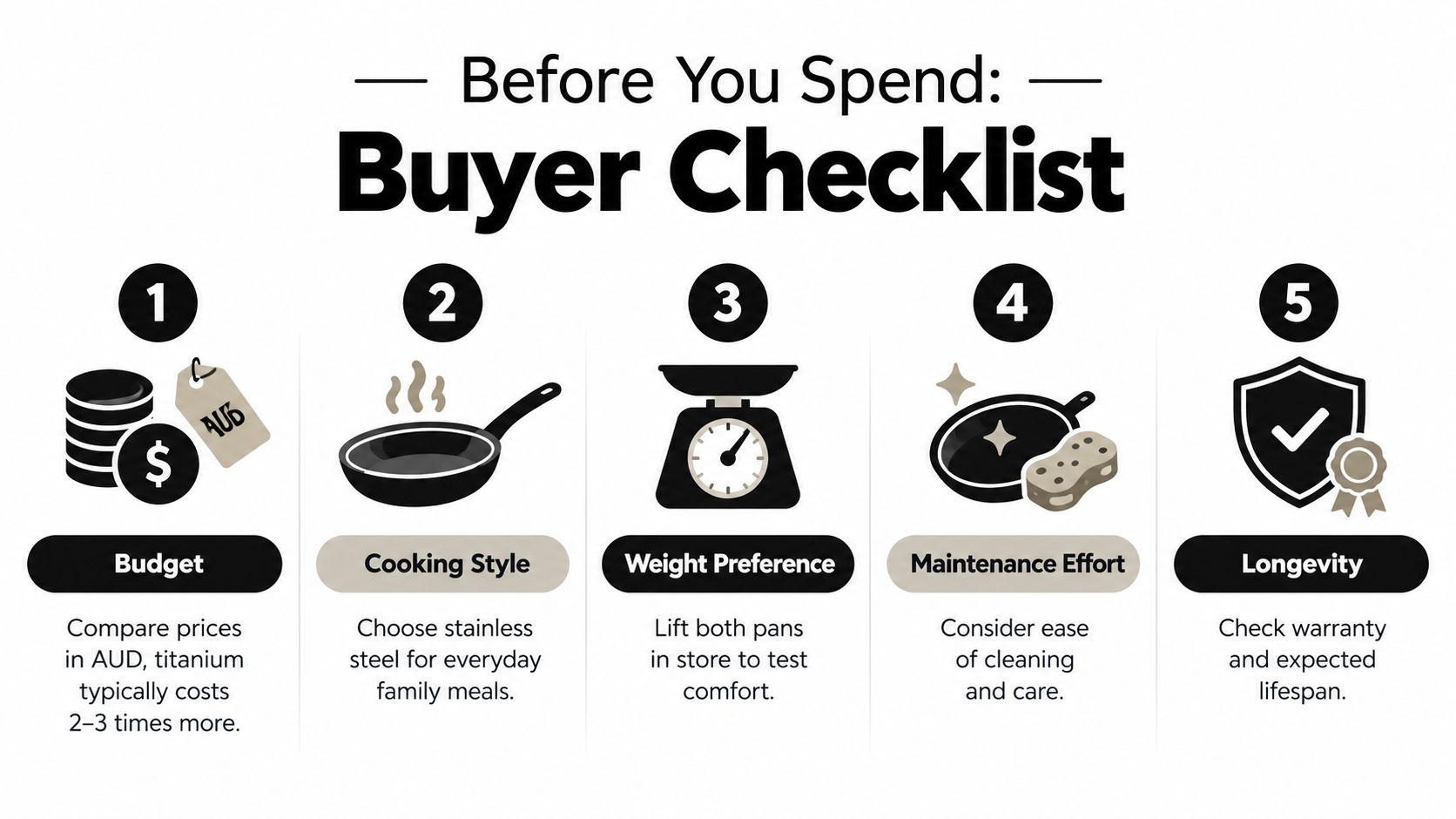
If you want the short shopping version, use this checklist and ignore the marketing copy.
What to verify before checkout
- Check the exact material. Solid titanium, titanium-coated steel, and stainless steel are different purchases.
- Ask for the grade. For stainless, you want to know whether it's 304 or 316. For titanium, you want the alloy or purity stated clearly.
- Inspect the finish. Smooth welds and easy-clean surfaces matter more than hype.
- Request migration or compliance evidence. Safety claims should be backed by actual food-contact documentation.
- Compare weight in person if you can. Titanium's lightness is real, and some buyers love it while others find it too insubstantial.
Here's the rule I'd use in a store: if a seller can't tell you what the item is made of, don't buy it. A clear product spec is the minimum requirement, not an extra.
| Check | Why It Matters | What Good Looks Like |
|---|---|---|
| Material clarity | Stops you paying titanium prices for steel | Solid titanium or clearly specified stainless |
| Grade disclosure | Tells you how it behaves in salt and humidity | 304 or 316 for stainless, named titanium alloy for titanium |
| Finish quality | Affects cleanability and corrosion risk | Smooth seams, no rough welds |
| Documentation | Separates marketing from proof | Food-contact evidence or independent verification |
| Weight and feel | Changes everyday usability | Comfortable in your hand, not just impressive on paper |
My blunt recommendation
If you want the cheapest reliable kitchen material, buy good stainless steel and stop there. If you want a lighter, more corrosion-resistant, more travel-friendly tool and you're happy to pay for it, buy titanium.
There's no reason to buy vague "titanium stainless steel" branding when the choice is plain and visible.
Frequently Asked Questions for Australian Buyers
Is titanium kitchenware dishwasher safe? Usually, yes, if it is titanium and the maker approves it. Check the product finish and the joints first, because those affect day-to-day use more than the label.
How do I clean a titanium cutting board? Use warm water, mild detergent, and a soft cloth, then dry it fully. Skip abrasive pads, which can scratch the finish.
Is stainless steel really food grade? It can be, but the stamp matters. Look for clear grade markings such as 304 or 316 on the product, packaging, or paperwork, and treat vague “food safe” wording as weak proof. If you cook near salt or humidity, 316 is the better pick.
How do I tell if a product is solid titanium? Ask for the alloy grade, check whether it is coated, and ask for documentation that matches the item in your hand. If the seller will not answer plainly, the branding is hiding the actual material.