

The most popular advice on where to buy pots and pans is also the least useful. Find a well-known brand, wait for a sale, buy the biggest set you can afford. That approach treats a pan as a commodity and ignores the questions that decide whether you're still happy with it years later. What is the cooking surface made from. Who'll honour the warranty. What happens when a coating fails. Start with those questions, and the right seller usually becomes obvious.
Why Where You Buy Matters More Than You Think
A pan isn't just a pan. Two frying pans can share a diameter, a colour and a price tag, then behave completely differently on your cooktop, wear at different rates and leave you with very different options when something fails.
Most households buy cookware rarely and live with the result daily. That makes the purchase closer to hiring a tradesperson than buying groceries. The quoted price matters, but it tells you little about workmanship, what happens after the job is finished, or whether anyone will answer the phone when a problem appears.
You're Mostly Choosing a Channel, Not a Country of Origin
Australian shoppers aren't usually choosing between competing local manufacturers. One market analysis estimates overseas supply, predominantly from China, accounts for approximately 80% to 90% of cookware unit volumes and about 85% to 95% of domestic consumption by value, with annual retail sales of roughly AUD 700 million to AUD 900 million across approximately 4 million to 6 million individual pieces, according to IndexBox's Australian pots and pans market analysis.
That same analysis puts the average replacement cycle at five to eight years. So you're making an infrequent decision with long consequences, in a market dominated by imported product sold through different retail channels. The seller's range, advice, documentation and after-sales process are therefore part of the product, whether the box says so or not.
Practical rule: Don't compare pans until you can name the material, the seller who'll handle a fault, and what you'll do with the pan at the end of its life.
The Four Decisions Behind Every Purchase
- Channel: Does this seller suit how you want to inspect, compare and return cookware.
- Material: Does the cooking surface suit your cooktop, your food and the care you'll realistically give it.
- Verification: Can the seller substantiate coating, purity and warranty claims in writing.
- Lifetime cost: What will you pay across purchase, replacement, shipping and disposal.
Shoppers who skip straight to price often buy twice. They discover induction incompatibility at home, learn a warranty excludes the exact failure they have, or find a marketplace seller has disappeared. Working through the four decisions in order takes less time than returning a set.
Choosing Between Local, Specialty and Online Retailers
Each channel does one job well and compromises on another. Match the channel to the question you most need answered, not to habit.
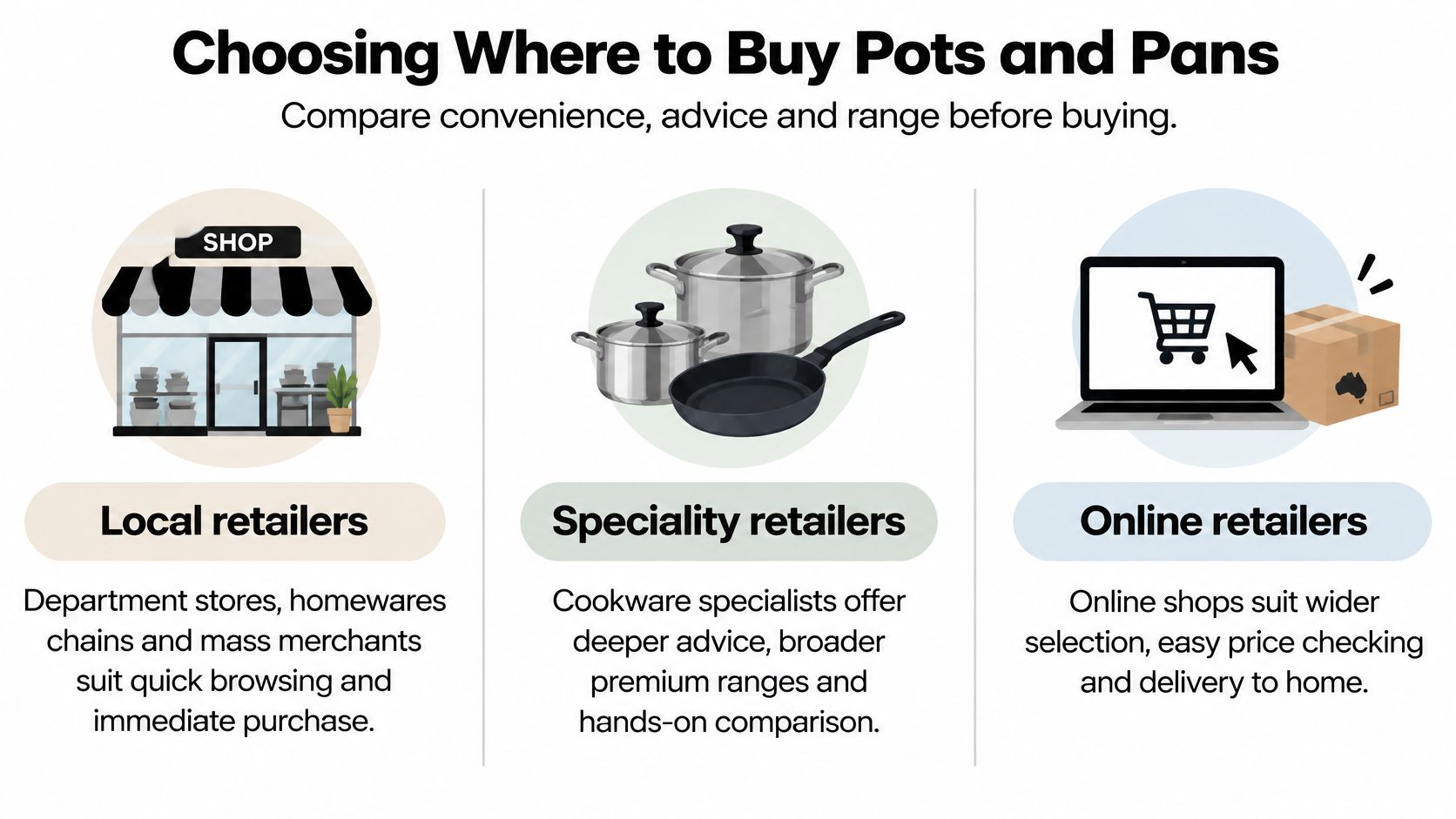
Local department stores, homewares chains and mass merchants are strongest when you need a basic piece today. You can lift the pan, check handle balance, confirm the base sits flat and take it home without freight. The trade-off is depth. Staff often cover several departments, ranges favour fast-moving sets, and detailed questions about coating composition or imported stock may stop at whatever is printed on the box.
The comparison below shows the three main routes at a glance.
Specialty Stores Earn Their Keep on Advice
Australia has a substantial specialist network. IBISWorld reports 1,296 kitchen and cookware-store businesses operating nationally in 2025, up 0.4% from 2024 and growing at an average annual rate of 2.2% between 2020 and 2025, in a category with a reported 2025 market size of approximately AUD 1.5 billion, according to IBISWorld's count of Australian kitchen and cookware-store businesses.
That scale matters because specialist staff compare materials for a living. They can explain why a heavy base suits a sauce, why a light pan responds faster, and which pieces work on your cooktop. If you're undecided between stainless steel, cast iron and coated aluminium, this is usually the best place to decide. You'll often pay more than a marketplace listing, but you're buying screening and advice with the pan.
Online Sellers Win on Range, Vary on Accountability
Online stores and marketplaces give you the widest selection and the easiest price comparison. They're also where seller quality varies most. Before ordering, confirm the seller's Australian business identity, who pays return freight, whether the warranty is handled locally or overseas, and whether the listing names the actual cooking-surface material.
The same discipline applies to other repeat kitchen purchases. If you're building a habit of checking sellers rather than headlines, it helps to compare Keurig water filter retailers the same way, by looking at authenticity, returns and seller identity before price.
| Channel | Strongest for | Points to check |
|---|---|---|
| Local retailers | Immediate purchase, handling the pan, basic sets | Cooktop compatibility, actual material, warranty process |
| Specialty retailers | Material advice, premium ranges, hands-on comparison | Price against included advice and after-sales support |
| Online retailers | Widest range, niche materials, home delivery | Australian business identity, return freight, warranty handler |
Matching Pots and Pans to Material and Cooking Use
Material choice works like footwear. Trail shoes, work boots and sandals all cover your feet, but you wouldn't pick one pair for every surface. Start with the cooking you do in an ordinary week, not the cooking you imagine doing with new equipment.
This overview of common materials is a useful starting point before you handle pieces in store.
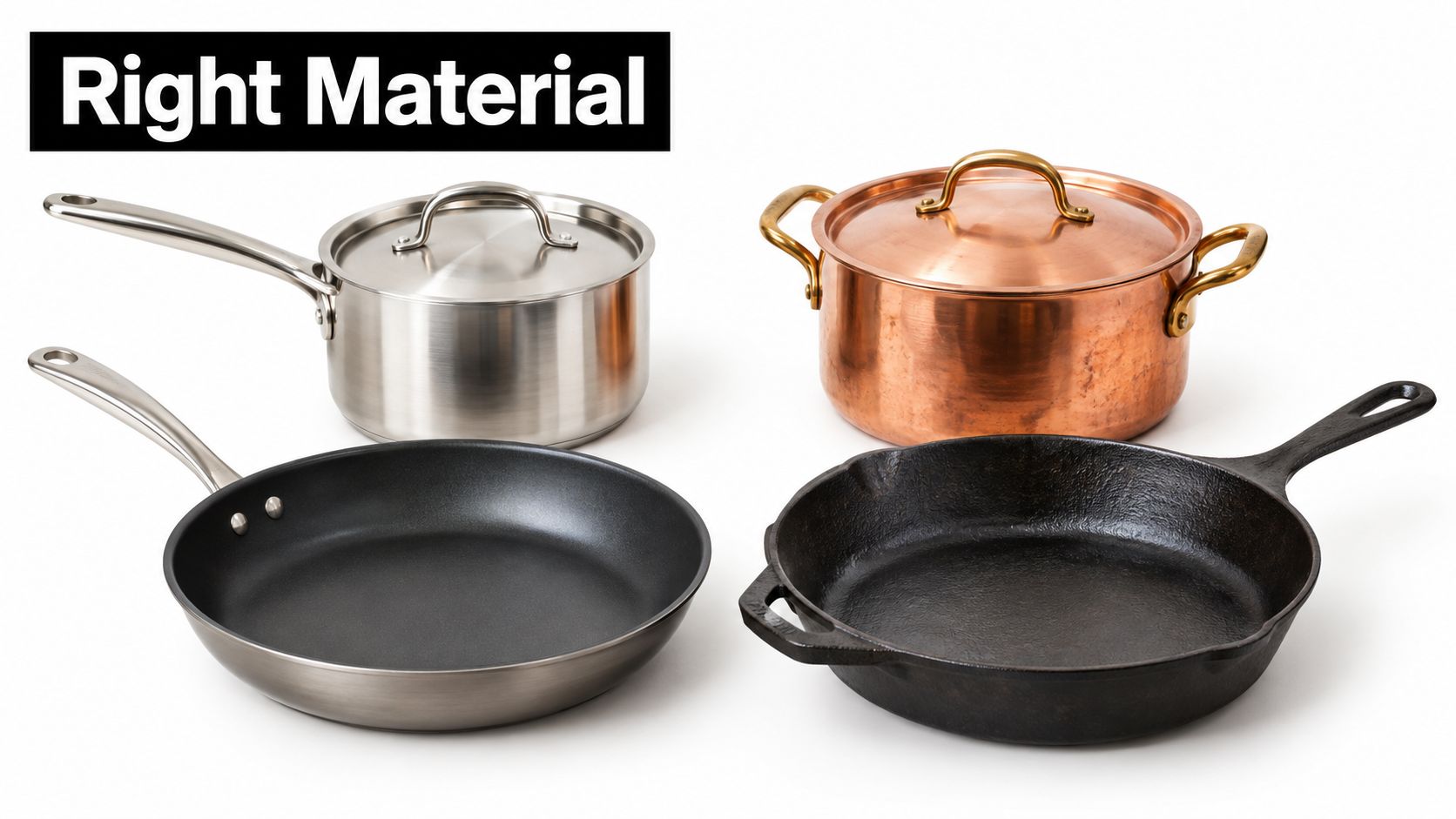
Match the Pan to the Job
Stainless steel suits browning, pan sauces and everyday durability. It tolerates high heat and metal utensils better than coated pans, and fond left after searing becomes the base of a sauce. It isn't naturally non-stick, so eggs and delicate fish demand heat control and enough fat.
Cast iron holds heat for steaks, chops and long braises. A heavy Dutch oven moves from stovetop to oven and keeps a stew at a steady simmer. The costs are weight, slower response to temperature changes and, for bare iron, drying and light oiling to prevent rust. Enamelled iron reduces seasoning work but the enamel can chip if knocked.
Carbon steel is the responsive middle ground many cooks use for stir-fries, crepes and searing. It heats and cools faster than cast iron and develops seasoning with use. It also needs that seasoning maintained, which makes it a poor choice if you know every pan in your house goes straight into the dishwasher.
Where Lighter and Coated Options Fit
Aluminium is light and conducts heat readily, which suits large stockpots you'll lift when full. Bare aluminium can react with acidic foods, so it's often anodised or used as a core beneath another surface. Coated non-stick remains the easiest option for eggs, pancakes and fish with minimal fat, but the coating is the wear layer. Once it deteriorates, the pan's main advantage goes with it.
Titanium appeals where weight and corrosion resistance matter, including travel and outdoor cooking. Check whether a product is solid titanium or titanium used as part of a coated or layered construction, because those are different purchases. If you're mapping shapes as well as surfaces, this guide to the main types of cooking pots and their uses helps you separate stockpots, saucepans and Dutch ovens before you pay for pieces you'll rarely reach for.
The short demonstration below is worth watching with your own cooktop in mind, since base construction and cooktop type decide compatibility as much as the headline material does.
One versatile pan rarely does everything well. For most kitchens, a stainless or cast iron workhorse plus one pan chosen for delicate food covers more real meals than a large matching set with duplicate sizes.
Checking Warranties, Certifications and Coating Claims
Treat every safety and durability claim as a request for evidence. A label can be accurate and still answer a narrower question than the one you're asking.
From 1 July 2025, Australia prohibited the import, manufacture and use of PFOS, PFOA and PFHxS under IChEMS, but the rules don't cover every PFAS, don't require a universal cookware label and generally don't remove products already on the market, as set out in the Australian Parliament's report chapter on PFAS policy and regulation.
That leaves a gap shoppers have to close themselves. PFOA-free means a named substance is excluded. Coating-free means there's no applied coating on the cooking surface at all. Those phrases aren't interchangeable, and a seller who uses them as if they are hasn't answered your question.
Questions That Separate Evidence From Marketing
Ask what the cooking surface is made from, in plain material terms. Then ask what any coating contains, whether independent testing supports the claim, and what documentation covers imported stock. A credible seller answers directly or says they don't know. Both responses are useful. Vague reassurance isn't.
The same scepticism transfers to other household claims. Learning to spot greenwashing in home care builds the habit of asking who tested a claim, what they tested and whether the result covers the whole product or one ingredient.
This checklist condenses the checks worth making before you pay.
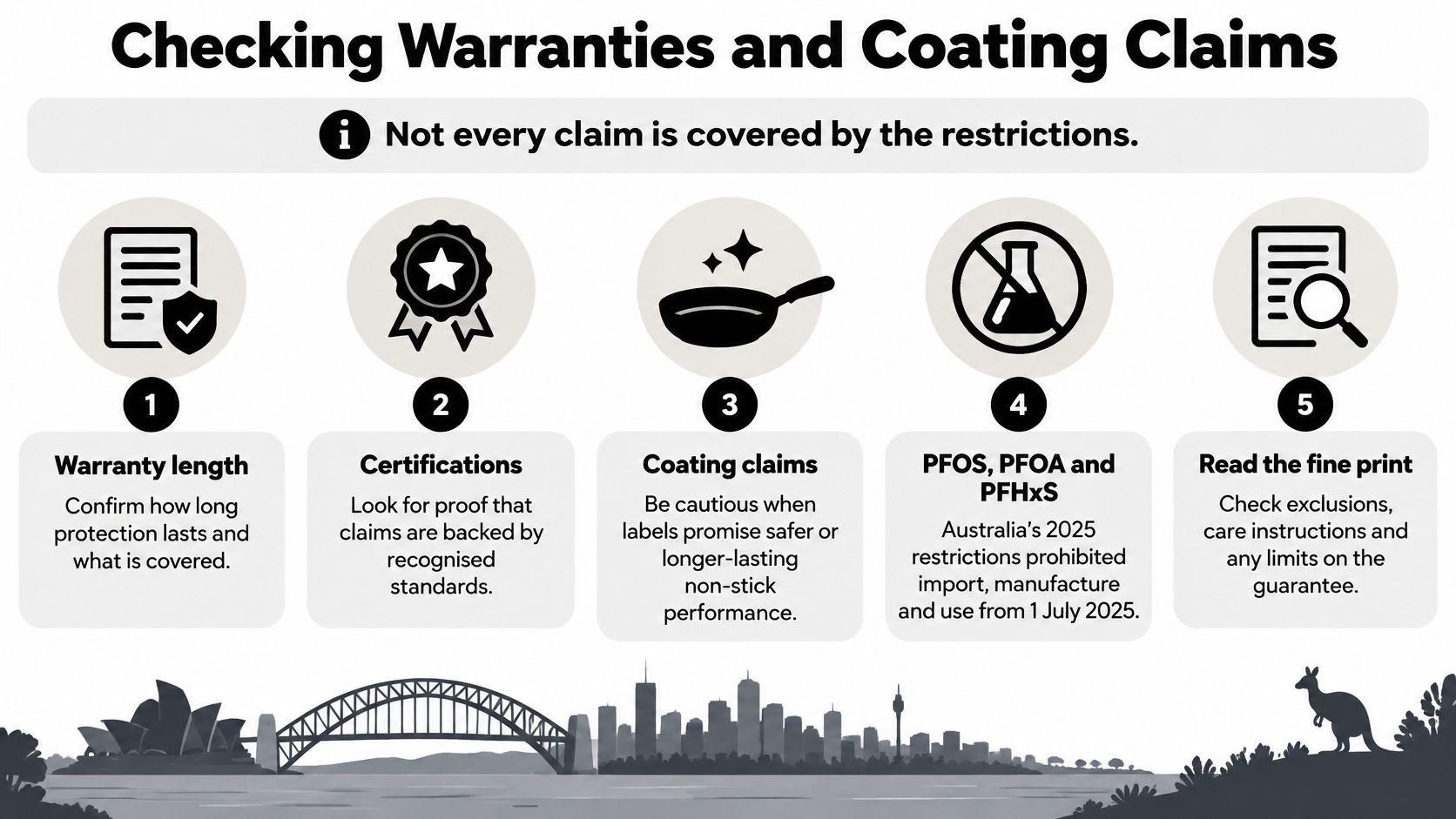
Read the Warranty Like a Contract, Because It Is One
- Duration and start point: When does cover begin, and does registration change it.
- Covered failures: Does it include coating wear, warping, handles and lids, or only manufacturing defects.
- Exclusions: Check overheating, dishwasher use, metal utensils and commercial use.
- Claim process: Who assesses the pan, who pays freight and what proof of purchase is required.
Australian Consumer Law sits behind any voluntary warranty, so a short warranty doesn't erase your rights if a product fails prematurely. Still, a clear written warranty makes a claim faster. This explanation of how lifetime warranty cookware terms work in practice is a useful reference when you're comparing a long guarantee against a short one.
Don't accept a verbal assurance on coating safety or warranty cover. If it matters to your decision, get it in writing before checkout.
Sourcing Alternative Materials Like Titanium
Alternative materials attract buyers who want an uncoated surface, lower weight or simpler care. They also attract looser marketing, because fewer shoppers know how to test the claims. Slow down and verify construction before comparing prices.
Titanium's practical strengths are corrosion resistance, a strong strength-to-weight ratio and a surface that doesn't rely on a polymer coating to function. That suits campers counting grams, coastal households tired of rust spots and cooks who want to scrub a pan without protecting a coating. Titanium on its own doesn't spread heat as evenly as a thick aluminium core, so base design and thickness matter for stovetop cooking. Ask how the base is built rather than assuming the material name settles performance.
What Verified Actually Looks Like
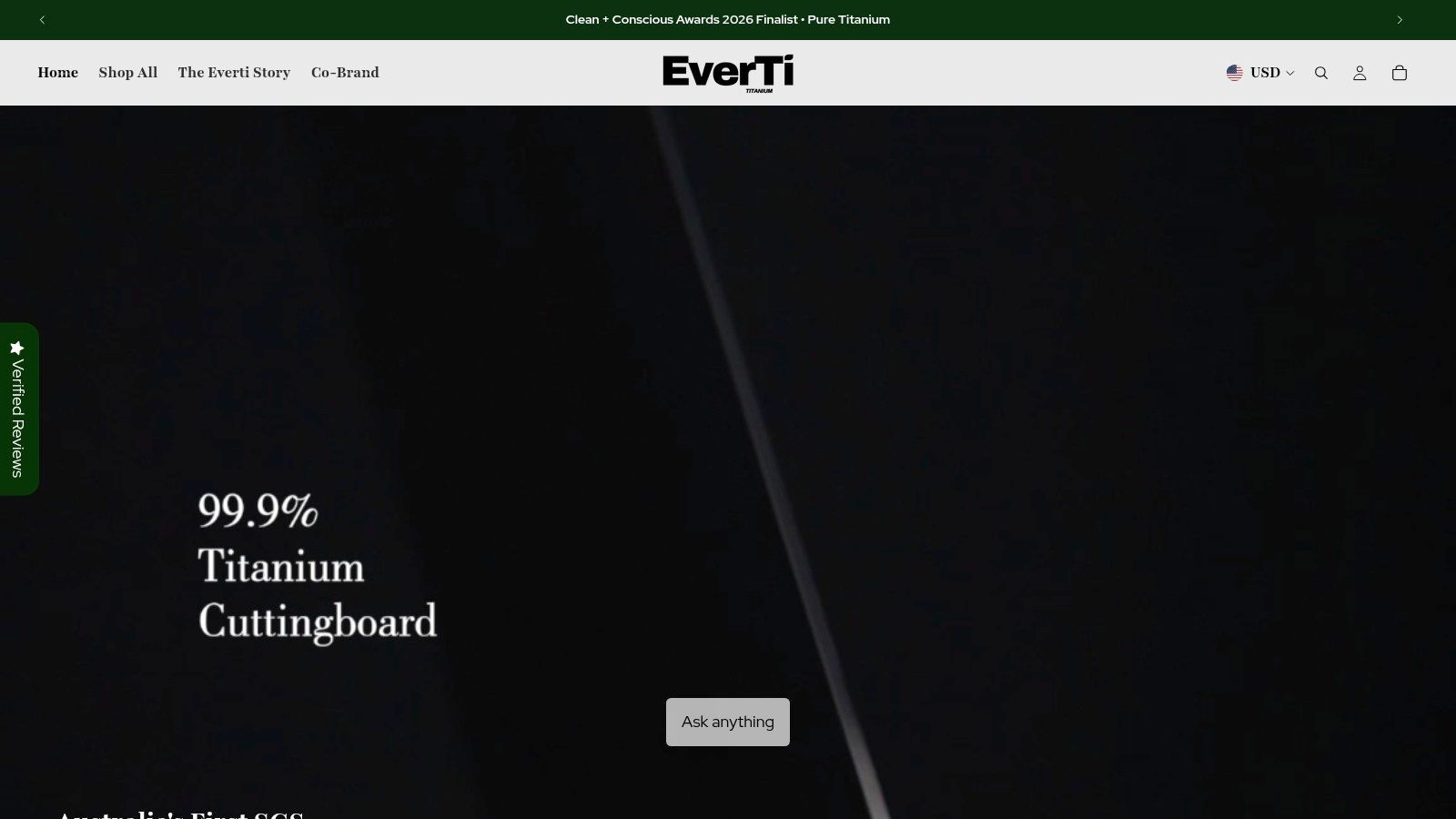
Everti, a Melbourne-based brand, is a useful worked example of how to read an alternative-material seller. It describes its cookware and cutting boards as uncoated, says its flagship Titanium Cutting Board is SGS-verified at 99.9% titanium, and notes that its Aura colours come from controlled heat treatment rather than dyes. The cutting board carries a lifetime warranty, and the wider range covers cookware, drinkware and tableware, including a food-grade titanium foldable frying pan designed for indoor and outdoor use.
None of that should be taken on trust, which is exactly the point. Each claim is specific enough to check. Purity names a testing body. Colour names a process. Warranty names a duration. Compare that with listings that say only premium titanium finish, which could describe colour, a coating ingredient or a thin surface layer.
The screenshot below shows how the seller presents its titanium range and product information.
Questions for Any Alternative-Material Seller
- Construction: Is the piece solid material, layered, coated or surface-treated.
- Verification: Who tested purity or composition, and can you see the documentation.
- Care limits: Which utensils, detergents and heat sources are approved.
- Warranty scope: Does cover include warping, hinges, handles and discolouration.
Set titanium beside its realistic rivals on the job you have in mind. Carbon steel will usually sear with more thermal mass. Stainless steel with a bonded base will usually spread heat more evenly. Titanium earns its premium when weight, corrosion resistance and an uncoated surface are the priorities, and the seller proves what the piece is made from.
Weighing Lifetime Cost and End-of-Life Options
Shelf price is the first payment, not the total. A cheap coated pan replaced repeatedly, plus freight and disposal each time, can cost more than a durable uncoated pan bought once. Do the arithmetic before deciding which option is the bargain.
Start with a simple calculation. Divide the purchase price, including delivery, by the years of service you reasonably expect. Then adjust for warranty cover, because a warranted failure costs you time and possibly freight rather than a full replacement. This breakdown of total cost of ownership for long-life kitchenware sets out the same logic if you want to model two candidates side by side.
Satisfaction Scores Don't Answer the Cost Question
Canstar Blue's latest cookware research surveyed 1,573 Australians who had bought and used cookware within the previous two years, and its commonly reported criteria include durability, performance, design and overall satisfaction, according to Canstar Blue's Australian cookware ratings and research.
Recent-user satisfaction is useful for shortlisting. It can't tell you what a pan costs per year, whether replacement parts exist, or where the pan goes when it fails. A pan can rate well at year one and still be poor value if its coating is finished at year three. Use ratings to screen for obvious duds, then run your own numbers.
Plan the Exit Before You Buy
Material simplicity decides how clean the exit is. A single-metal pan with a removable handle is easier for a scrap metal recycler to accept than a bonded, coated pan with plastic fittings. Australian local-government guidance treats steel and aluminium as recyclable materials, but acceptance rules for bulky household items vary by council, so check your council's current instructions rather than putting a pan in the kerbside bin and hoping.
Don't assume a retailer will take your old pan back. Some run occasional trade-in or recycling programs, many don't. Ask at purchase, while you still have room to negotiate, and factor the answer into the comparison.
Cost test: If a seller can't tell you the expected wear point, the warranty remedy and the disposal route, you don't yet know what the pan costs.
Premium and outdoor buyers gain most from this discipline. Higher upfront prices need a longer service life to justify them, and gear used outdoors faces knocks, moisture and heat sources that shorten the life of coatings and fittings.
Your Next Step Before You Buy
You can run this whole process in one sitting this week. It takes a notebook, two shortlisted sellers and the discipline to ask the same questions of both.
Start with your cooking, not a catalogue. Write down the meals you make most often, your cooktop type, your storage space and the care you'll provide. That list usually eliminates half the materials on the market. A household frying eggs daily and using a dishwasher needs a different answer from a camper searing meat over a portable stove.
A Short Routine That Works
- Pick the material first: Choose one primary surface for your main tasks and, only if needed, one secondary pan for delicate food.
- Shortlist two channels: Take one specialty store for hands-on comparison and one online seller for range and price.
- Ask identical questions: Cooking-surface material, coating composition, independent testing, warranty terms and documentation for imported stock.
- Run the lifetime numbers: Price plus delivery, divided by expected years, adjusted for warranty and disposal.
- Confirm in writing: Get warranty scope and any coating or purity claim documented before you pay.
If titanium is on your shortlist, apply the same routine rather than a softer one. Check construction, purity verification, sizing against your cooktop and storage, shipping costs and what the warranty excludes. Alternative materials reward scrutiny because the terminology varies so much between sellers.
Then commit. Choose one candidate pan, confirm its warranty in writing, and buy it from the seller who answered every question directly. That seller has already demonstrated the quality you'll need if anything goes wrong later. Knowing where to buy pots and pans turns out to be less about finding a store and more about finding a seller whose evidence survives your questions.
If an uncoated, verified material is where your shortlist lands, Everti offers SGS-verified titanium cookware, cutting boards and tableware backed by a lifetime warranty on its flagship board. Browse the range, check the purity documentation and warranty terms against the questions above, and buy only when the answers satisfy you.