

You're probably here because you saw apricot seeds for sale online, noticed words like raw, bitter, or B17, and wondered whether they're a niche health food, a baking ingredient, or something you should avoid altogether.
That confusion is understandable. Apricot kernels sit in an awkward space between food, wellness marketing, and safety regulation. In Australia, that matters more than it does in many other places. What looks like a simple pantry purchase can also raise legal and toxicology questions.
If you cook at home and like understanding ingredients before they go into your kitchen, treat apricot kernels the same way you'd treat wild mushrooms or very strong herbal products. Curiosity is fine. Blind trust in marketing isn't.
Why Are Apricot Seeds a Trending Topic
Search interest in apricot kernels makes more sense when you zoom out. Internationally, they're still a real commercial product category. The IMARC Group apricot kernel market report estimates the global market reached 59,536 tons in 2024 and projects growth to 86,216 tons by 2033, with a 3.8% CAGR during 2025 to 2033.
That tells you something important. People aren't searching for apricot kernels only because of fringe wellness claims. They're also searching because kernels are used in food, cosmetics, and pharmaceuticals, and because they keep appearing in recipes, natural product shops, and supplement-style listings.
Why the search term feels misleading
In a general online marketplace, “apricot seeds for sale” sounds harmless. It sounds like buying sunflower seeds, pumpkin seeds, or almonds. That's where many people get tripped up.
Apricot kernels aren't a standard grocery item in the Australian context. The same phrase can point to very different products:
- A culinary ingredient
- A planting seed
- A wellness product
- A raw bitter kernel with a safety risk
Those are not interchangeable categories.
Practical rule: If a listing makes apricot kernels sound ordinary, slow down. Their safety depends on the type of kernel, the intended use, and the legal setting where you live.
Why Australians need a different lens
Many articles on apricot kernels are written for a broad global audience. They talk about tradition, flavour, or natural health trends. They often skip the part that matters most to an Australian reader, namely whether the product can legally be sold for eating and whether the seller explains the risk clearly.
That's why a buyer's guide in Australia can't be just about price, pack size, or whether the product is “natural”. It has to start with the questions that come first here:
- Is it legal to sell for consumption?
- What kind of kernel is it?
- Is the seller transparent about risk?
- Are you looking at food, planting stock, or a pseudo-supplement?
Once you frame the issue that way, the whole category becomes easier to understand.
Understanding Apricot Kernels Sweet Bitter and Their Uses
The first thing to know is that not all apricot kernels are the same. The biggest divide is between sweet kernels and bitter kernels.
A useful analogy is almonds. Many consumers know sweet almonds as a food. Bitter almond flavour, by contrast, is associated more with extracts and strong flavour compounds than casual snacking. Apricot kernels create a similar kind of confusion because one name covers products with very different taste and risk profiles.
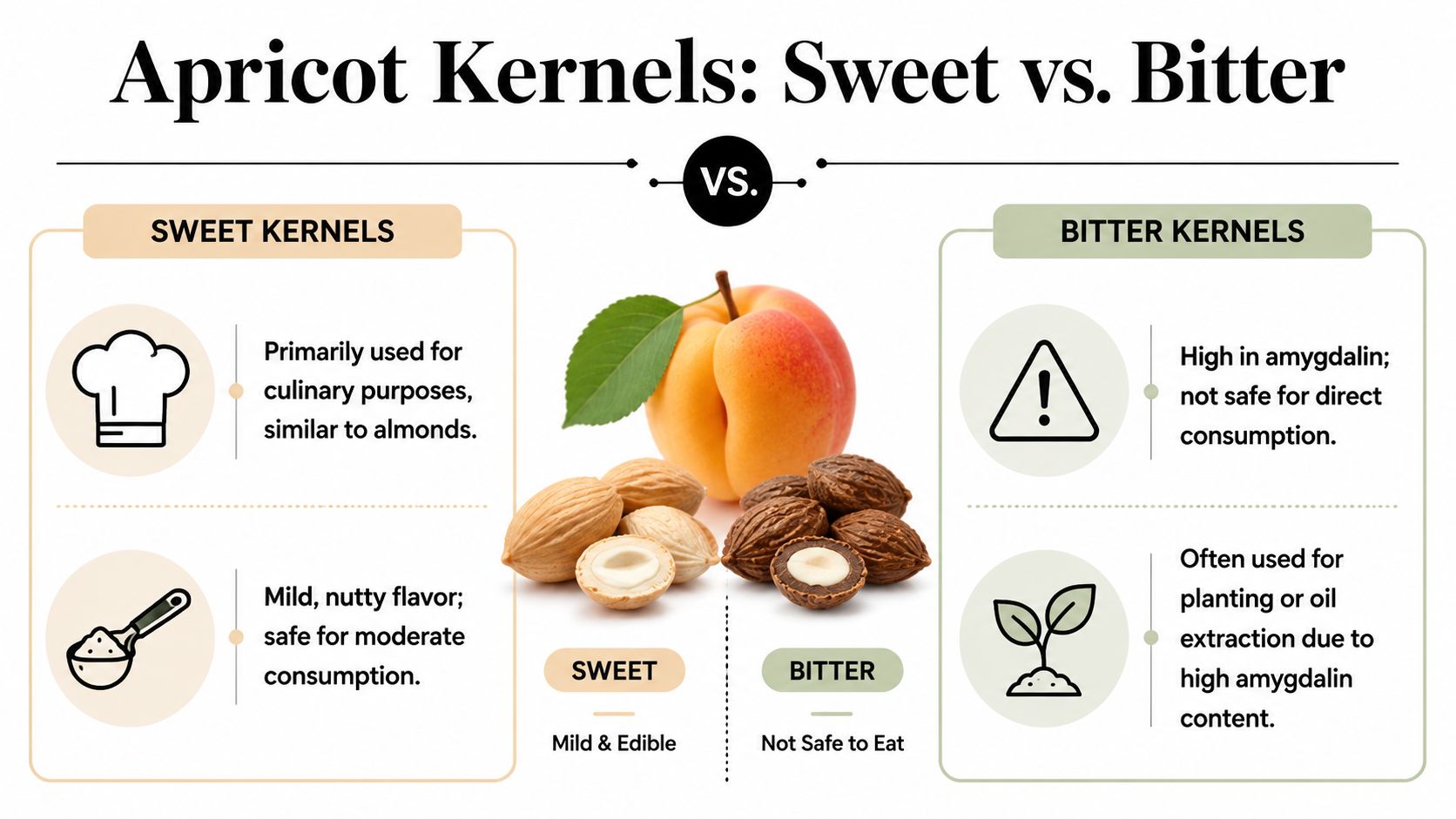
Sweet and bitter don't just describe flavour
“Sweet” and “bitter” sound like tasting notes. In practice, they also signal likely use.
Sweet kernels are the kind people usually imagine when they think of a nut-like ingredient for baking. Bitter kernels are more likely to appear in controversial listings, oil extraction contexts, or wellness-oriented product pages.
Commercial listings often describe apricot seeds as bitter, raw, non-GMO, and California-grown, with pack counts around 375 seeds per 8 oz according to a Fruitful Yield product listing for bitter raw apricot seeds. That matters because a listing with a high seed count and “raw bitter” language isn't describing a casual nibbling food in the same way a bag of nuts would.
Sweet vs Bitter Apricot Kernels
| Feature | Sweet Apricot Kernels | Bitter Apricot Kernels |
|---|---|---|
| Taste | Mild and nutty | Sharper, more bitter |
| Typical use | Limited culinary use, similar to nut ingredients | Often associated with wellness claims, planting, or oil extraction |
| Listing language | May be described in culinary terms | Often described as raw, bitter, or B17 |
| Risk profile | Lower perceived risk in food-style use | Higher concern because bitter kernels are tied to amygdalin exposure |
| Buyer mindset | Ingredient evaluation | Safety and compliance evaluation |
Seeds for eating and seeds for planting aren't the same decision
People also mix up kernel and seed in online searches. Botanically, sellers may blur the terms. From a practical point of view, you need to focus on intended use.
If you're buying for planting, your questions are about cultivar, viability, and import or shipping rules. If you're buying something promoted for eating, your questions are about food law, warnings, and exposure risk.
A home cook should read the listing like a label investigator, not a bargain hunter.
That means checking whether the product page clearly states what the item is for. If the seller leaves that vague, that's not a minor detail. With apricot kernels, vagueness is often the biggest warning sign.
The Critical Health Warning Amygdalin and Cyanide Risk
A cautious buyer in Australia might see a small bag of apricot kernels online and assume it belongs in the same category as nuts or seeds for snacking. The chemistry puts it in a different category.
Raw apricot seeds contain amygdalin, and the body can convert that compound into cyanide during digestion, as explained in WebMD's apricot seed safety overview. That matters because the risk is tied to what happens after eating the kernel, not just to how natural or traditional the product sounds in marketing.
A simple way to understand the chemistry
Amygdalin can be compared to a locked box. By itself, it is not the final hazard. The concern is what digestion can do to it. Once the compound is broken down in the gut, cyanide can be released.
For a home cook, the useful comparison is with ingredients that are harmless only after proper processing. Some foods need soaking, heating, fermenting, or careful portion control before they are reasonably safe. Apricot kernels raise concern for the opposite reason. Eating them raw can create the problem inside the body.
That is why labels such as “natural,” “raw,” or “traditional” should not reassure you here. Natural substances range from safe everyday foods to potent toxins. Safety depends on the compound, the amount, and the intended use.
Why small amounts can still matter
The dose matters, and the margin for error can be much smaller than buyers expect. The same WebMD source notes that adults have been hospitalised after consuming 20 to 30 kernels, and children may become ill from as little as half a seed.
Those numbers help explain why bulk listings deserve careful scrutiny. A pouch that looks modest by weight may still contain many individual exposures. Child access also changes the risk calculation immediately.
A practical way to read a listing is to ask three plain questions:
- How many kernels are in the pack, not just how many grams?
- Could a child reach this product at home?
- Does the seller describe use casually, as if this were an ordinary snack ingredient?
A product linked to illness at very small amounts should never be treated like pantry trail mix.
Why “Vitamin B17” claims deserve extra caution
Apricot kernels are often promoted with cancer-related language, especially the term “Vitamin B17.” That label can make a risky product sound like a recognised nutrient. It is not a vitamin in the ordinary dietary sense, and the marketing can distract buyers from the more immediate question, which is poisoning risk.
This is also where safety and law start to overlap for Australian readers. If a seller frames a kernel primarily as a wellness shortcut, the sales message may blur the line between folklore, supplement-style promotion, and food use. For a cautious consumer, that is a warning sign, not a selling point.
If you or someone close to you is considering apricot kernels because of a serious diagnosis, reconsider product marketing and explore evidence-based alternative cancer treatment centers that discuss integrative options more responsibly.
For readers who want a visual explanation before they buy anything, this short video helps illustrate why health authorities treat apricot kernels cautiously.
The Australian Legal Landscape for Apricot Seeds
Australia takes a firmer line on raw apricot kernels than many casual buyers expect. According to Food Standards Australia New Zealand guidance on raw apricot kernels, the sale of raw apricot kernels for consumption is explicitly prohibited under the Food Standards Code because of the risk of cyanide poisoning.
That changes the whole meaning of “apricot seeds for sale” for an Australian reader. You're not just comparing products. You're also checking whether the product is being offered in a way that aligns with Australian food law.
What prohibited for sale as food means in plain English
If a seller is offering raw apricot kernels to eat, compliant retail channels in Australia can't legally treat that as an ordinary food item. That's the key point.
For shoppers, the practical consequences are straightforward:
- A normal food-style listing for raw kernels should raise concern.
- Wellness branding doesn't cancel food safety rules.
- “Natural” doesn't create a loophole.
Many online listings become confusing at this point. Some pages talk as if the product sits halfway between a pantry ingredient and a supplement. That murky presentation can make people think legality is uncertain when, for raw kernels sold for consumption, the restriction is quite clear.
Where people get confused online
One listing may sound like a food. Another may hint at “health support”. Another may imply the item is for planting. Those categories can look similar in a search result, especially if the seller uses broad terms like kernel, seed, or raw without stating the intended use plainly.
A sensible Australian buyer should ask:
- Is this listing clearly for consumption?
- Does it acknowledge Australian restrictions?
- Is the seller trying to dodge the underlying issue with vague wording?
A compliant label should make the intended use clearer, not murkier.
Processed ingredients and cosmetic oils are a different topic from raw kernels sold for eating. But if a page is pushing raw kernels as something to consume, the Australian legal position is the first filter, not the last.
How to Evaluate Suppliers of Apricot Seeds
Once a seller starts leaning on buzzwords instead of clarity, stop treating the listing as trustworthy. Apricot kernel pages often use wellness-heavy language while giving very little practical safety information. A wholesale apricot kernel listing illustrates the wider problem: sellers may emphasise terms like B17, bitter, or raw while failing to provide clear serving limits or poison-risk guidance.
What a careful buyer should look for
A serious supplier should act more like a technical ingredients vendor than a miracle-food marketer.
Green flags include
- Clear intended use. The seller states whether the product is for planting, oil extraction, cosmetic use, or another non-food purpose.
- Direct caution language. Risk statements are easy to find and written in plain English.
- Batch and pack details. The page gives enough detail for you to understand what you're buying.
- No inflated health promises. The seller doesn't imply that the product can replace medical care.
Red flags that matter more than a low price
Many buyers focus on origin claims, organic language, or whether the product sounds artisanal. For apricot kernels, those aren't the first questions.
Watch for these warning signs:
-
“B17” doing all the marketing work
If the listing relies on that term but skips safety guidance, the page is selling a story, not helping you make a safe decision. -
No practical warnings
If children, storage, dosage risk, or contraindications aren't mentioned, the seller may be minimising the most important information. -
Food-like styling for a high-risk product
Recipe-style photos and snack-style wording can make a risky item feel routine. -
Vague shipping language
Cross-border listings can get messy. If you're trying to understand the broader compliance issues that often surround seeds and plant materials, this guide on managing complex plant shipping rules is useful background reading.
Supplier evaluation is part of kitchen safety
Home cooks often think supplier vetting is something importers or retailers do. For unusual products, you need to do some of that work yourself.
One helpful mindset is to borrow from broader e-commerce due diligence. If you already read about how sellers structure listings and fulfilment choices in guides like drop shipping on Amazon, apply that same scepticism here. Product pages are built to convert attention into orders. Your job is to ask what the page leaves out.
Choose documentation over branding. A calm, plain warning is worth more than a page full of glowing wellness language.
Safe Storage Preparation and Basic Usage Guide
If you legally obtain apricot kernels for an appropriate purpose, handling still matters. Think in terms of containment, identification, and separation.
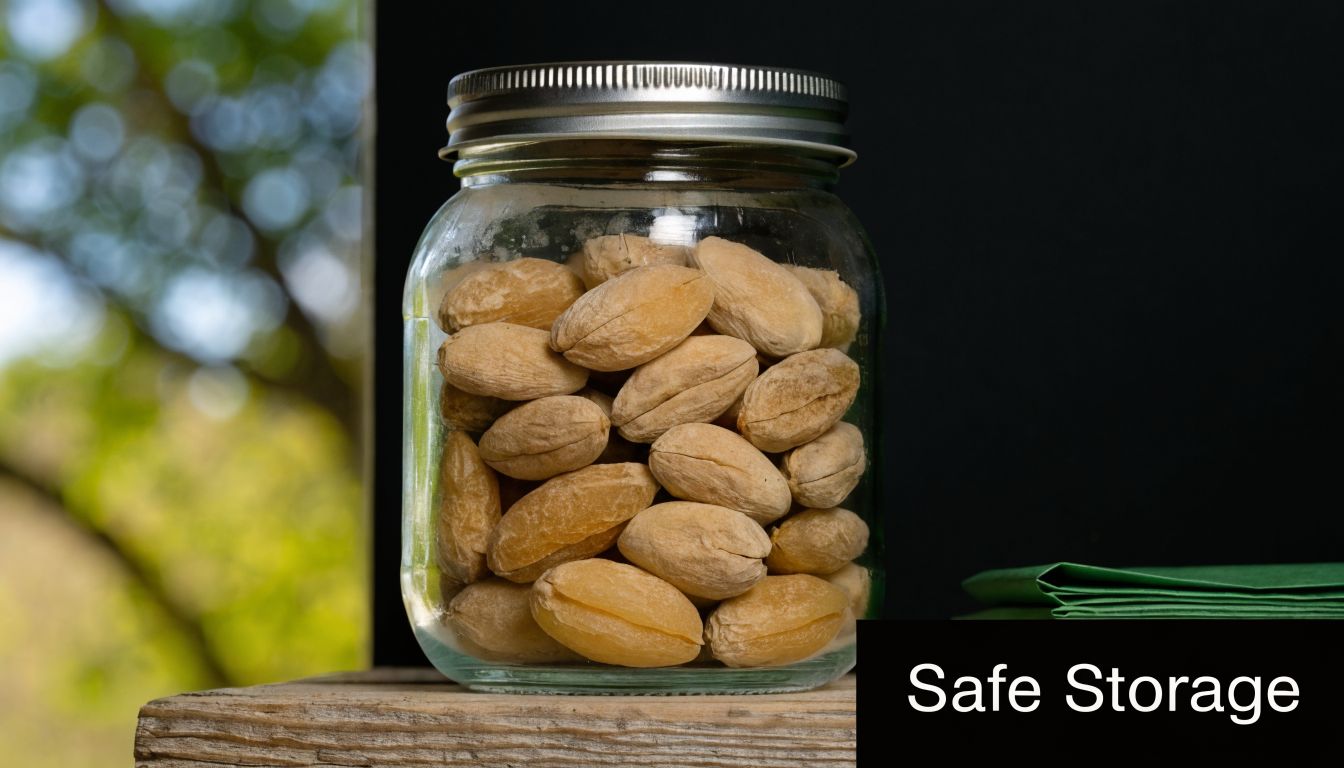
Storage that reduces household risk
Use a sealed container with a clear label. Don't leave loose kernels in a mixed nuts jar, a pantry tub, or an unmarked produce bag. That sounds obvious, but a surprising amount of kitchen risk comes from foods and non-routine ingredients being stored in familiar-looking containers.
Keep them:
- Away from children
- Away from everyday snack foods
- Away from shared prep clutter
If you care about kitchen hygiene more broadly, this guide to prevent cross contamination is a helpful refresher on separating higher-risk items from ordinary prep zones.
Preparation for culinary use needs restraint
For any lawful culinary use involving suitable kernels, less is better. The safest habit is to treat them as a minor accent ingredient, not a handful food.
Examples of restrained use might include:
- A tiny garnish over a dessert where flavour matters more than volume
- A very small amount in biscotti or pastry where the kernels function more like a flavour note than a snack ingredient
Roasting is often discussed as part of preparation, but it shouldn't be used as a reason to become casual about safety. Heat and processing don't turn a risky ingredient into something you should handle carelessly.
Store unusual ingredients the way a professional kitchen stores allergens or strong spices. Label clearly, separate physically, and never assume everyone in the house knows what they are.
If the product is for planting
Don't handle a planting purchase as if it belongs in the pantry. Keep it physically separate from edible foods and clearly marked.
If you're interested in household-level food safety systems, it can help to look at what inspectors focus on in real kitchens. This overview of EHO inspections 101 gives useful context on why labelling, separation, and storage discipline matter so much.
Frequently Asked Questions About Apricot Seed Safety
Is Vitamin B17 a real vitamin
No. “B17” is marketing language, not a recognised vitamin category. If a seller centres that claim, treat it as a prompt for caution, not confidence.
Are bitter apricot kernels safe because they're natural
No. Natural substances can still be toxic. With apricot kernels, the concern is the compound discussed earlier and the body's ability to convert it into cyanide.
Can children have a small amount
Children are the group that calls for the most caution. They should not be treated as miniature adults with the same tolerance for unusual ingredients.
What if a listing doesn't mention Australian law
That's a warning sign. A seller targeting Australians should not ignore the local safety and compliance context.
Are all apricot kernel products the same
No. Raw kernels, planting seeds, oils, and processed products are different categories. Never assume one label rule or one use pattern applies to all of them.
Where can I check more general kitchen and product questions
If you want broader brand and product guidance beyond this article, the Everti FAQs page is a useful place to find practical answers about safe everyday kitchenware and care.
If you want a cleaner, lower-fuss kitchen setup for handling everyday ingredients safely, Everti makes durable titanium kitchen essentials designed for hygienic prep, easy cleaning, and long-term use. For health-conscious home cooks, that means fewer worries about coatings, lingering odours, and hard-to-clean surfaces.