

A drawer catches your knuckles as you pull it open. Inside, three whisks compete for space, the useful spatula has disappeared, and a wooden spoon is splitting near the handle. You can still bake, but every recipe begins with a small search operation.
A coordinated baking utensil set brings order to that routine. The value isn't only visual. Matching handles, surfaces and care requirements make it easier to choose the right tool quickly, clean everything properly and store the set in a compact Australian kitchen. The best collection isn't necessarily the one with the most pieces. It's the one that covers your regular recipes without filling every drawer.
Australia already has a substantial kitchenware base behind this category. The Kitchen and Cookware Stores industry is estimated at $1.5 billion in 2026, with 1,264 businesses operating nationwide, according to IBISWorld's Australian kitchen and cookware industry profile. This guide focuses on the practical decisions underneath the product label: which tools earn their place, how silicone compares with wood and metal, what hygiene looks like after repeated use, and how premium materials such as titanium may fit a long-term kit.
Why a Baking Utensil Set Matters
A cake batter is halfway mixed, the oven is heating, and the spatula you need has vanished beneath three similar whisks. This familiar kitchen moment shows why a baking utensil set matters. The problem is rarely a lack of tools. It is the lack of a clear system.
A coordinated set gives each utensil a defined job and a predictable place. A child or flatmate can learn that the broad spatula folds and scrapes, the whisk incorporates air, and the scraper divides dough. That shared vocabulary saves time when several tasks are happening at once.
Practical rule: Buy for the recipes you make repeatedly, not for an imaginary commercial bakery.
A set also reduces guesswork. Handles with a similar shape are easier to recognise in a crowded drawer, while shared care instructions make cleaning more consistent. You can check whether a tool is dishwasher-safe before it goes into the sink, rather than discovering that a soft grip has degraded or a metal edge has marked a coated tin.
This matters in compact Australian kitchens, where a utensil set must earn its storage space. A smaller, well-chosen group can work like a reliable toolbox: each piece has a purpose, and duplicates do not crowd out the tools used every week. The same principle supports hygiene. Fewer, better-maintained utensils are easier to inspect for cracks, trapped batter and worn surfaces.
Australia has a long domestic history of equipping kitchens with practical implements. The Australian Food Timeline's history of Willow kitchenware records that Willow began as a Melbourne metalworking business in 1887 and later produced baking pans, cake tins, pie dishes, funnels and other kitchen items. Its move into plastics in 1959 also reflects how household materials changed over time.
The IBISWorld industry profile places these purchases within Australia's wider kitchenware retail market. For a long-term kit, that makes durability worth considering. Premium materials such as titanium may suit the tools you keep for years, while replaceable lower-cost pieces can handle the rest of the workload.
Core Tools Every Baking Set Should Include
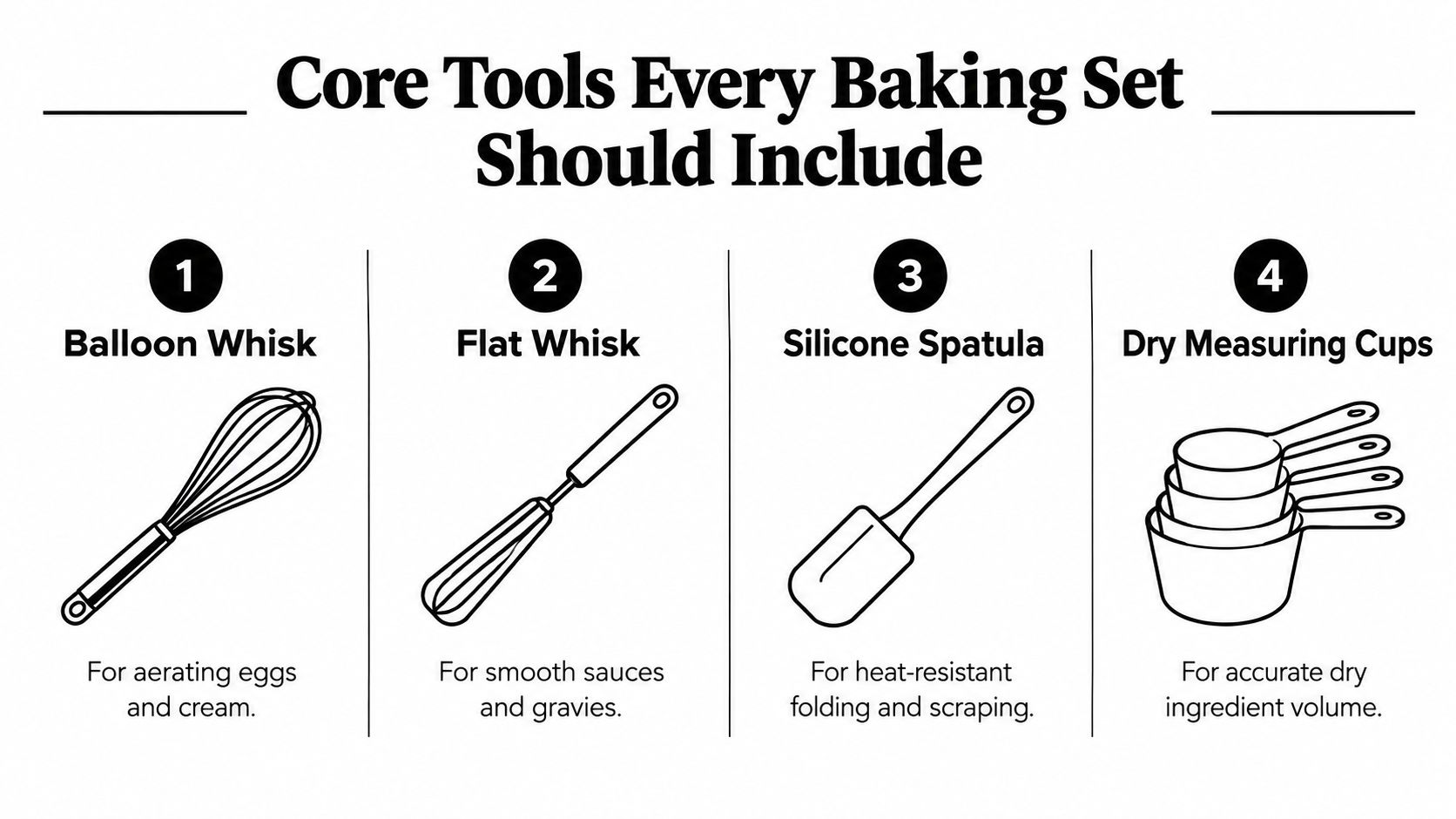
Think of a set as a group of workstations rather than a pile of objects. Mixing tools handle texture, measuring tools control proportions, and finishing tools help you move, cool and decorate the bake.
Mixing tools
A balloon whisk is the everyday choice for eggs, cream and thin batters because its shape moves air through the mixture. Choose one with wires firmly sealed into the handle. A flat whisk reaches into the corners of a saucepan and works well for smooth custards, gravies and curds.
The silicone spatula is the tool that prevents waste. Use a firm, flexible head to scrape the base and sides of a bowl, fold flour into a cake batter and transfer icing without leaving a thick layer behind. A bench scraper is less glamorous but highly useful for sticky dough, portioning and cleaning flour from the bench.
Measuring and prep
Dry measuring cups and measuring spoons are convenient for recipes written by volume. A digital kitchen scale earns its space when you want repeatable results, especially for flour, cocoa, butter and dough. It also lets you weigh ingredients directly into the bowl, which can reduce washing up.
A sieve is a sensible addition if you regularly use cocoa, icing sugar or flour that forms lumps. It can also help produce a smoother custard or curd. Beginners can leave a pastry blender, dough docker and specialist cutters until a recipe gives them a clear purpose.
Handling and finishing
A cooling rack allows air to reach the underside of a cake, biscuit or slice. A silicone baking mat protects the tray and simplifies release, while an offset spatula makes frosting a small cake far easier than a straight knife.
Tongs, a slotted spoon and a turner may sit outside a strict baking-only list, but they help with hot trays, melted ingredients and general kitchen handling. Before buying a large bundle, compare the contents with the practical Recipe One's cooking tools resource and remove pieces you already own.
A useful starter collection should cover mixing, measuring, scraping, cooling and finishing. The exact count matters less than whether each tool solves a task you perform. A lamington tin, a baking tray and a mixing bowl may be more valuable to your routine than a specialised dough docker that stays in its packaging.
For a video demonstration of basic tool handling, use the following resource:
Comparing Silicone, Wood, and Metal Materials
Material choice becomes easier when you ask three questions. How much heat will the tool meet? What surface will it touch? How will you clean it? A material that feels perfect for folding batter may be unsuitable for scraping a hot pan or working with a delicate coating.
Silicone is flexible, quiet and suitable for non-stick bakeware when the head is soft and well finished. It can scrape curved bowls closely and usually handles wet mixtures without absorbing them. Lower-quality silicone may hold odours or show colour from strongly pigmented ingredients, so inspect the surface for a clean, uninterrupted finish.
Wood has a warm feel and gives good control during stirring. It won't usually mark a coated pan, but it is porous. A wooden spoon needs prompt hand washing and thorough drying, particularly around the joint between the handle and bowl. Wood is best treated as a tactile mixing tool rather than an all-purpose hygienic surface.
Stainless steel and aluminium provide stiffness and precision. A steel whisk keeps its shape during vigorous mixing, and a metal bench scraper gives clean cuts through dough. The trade-off is hardness and heat conduction. Metal can mark coated bakeware and become uncomfortable near heat, so it needs a defined role.
Titanium and titanium-coated tools sit in the premium part of the market. Buyers often choose them for corrosion resistance, a non-reactive surface and a long-service approach. They can make sense when you want fewer replacements, but they still need to match the task. A rigid metal edge isn't automatically better for a flexible bowl or a non-stick surface.
| Material | Heat Resistance | Hygiene & Care | Best For |
|---|---|---|---|
| Silicone | Follow the maker's stated rating and keep it away from direct flame | Usually easy to wash; inspect for odour, staining and splits | Folding, scraping, non-stick bakeware |
| Wood | Keep away from prolonged heat and moisture | Hand wash and dry promptly; replace when damaged | Stirring and gentle mixing |
| Metal | Handles heat well, but conducts heat to the grip | Non-porous and generally simple to clean | Whisks, scrapers and precise cutting |
For an Australian-focused discussion of choosing and caring for silicone utensils, see this guide to silicone utensils in Australia. Most experienced home bakers end up with a hybrid kit: silicone for scraping, wood for comfortable stirring, and metal for strength and accuracy.
Hygiene and Heat Resistance Over Time
A new utensil can look perfect while hiding the care issue that will appear later. Repeated washing, contact with fats and exposure to heat reveal the differences between materials. The correct question isn't whether a tool is attractive on day one. It's whether its surface remains cleanable after regular baking.
Wood absorbs moisture and oils. The grain may swell near a handle joint, and a damaged area becomes harder to clean thoroughly. Never treat a dishwasher as a harmless shortcut for wooden tools. Hand wash them, dry them upright or in an open position, and retire any spoon that develops deep cracks, rough splinters or a persistent smell.
Plastic and inexpensive silicone can warp, discolour or develop small surface splits. Berry pigments, turmeric and cocoa may leave visible marks even when the tool remains usable. A stain isn't automatically a hygiene failure, but a crack, peeling layer or sticky surface is a reason to replace the item rather than scrub harder.
Cleaning decision: If you can't inspect and wash the whole food-contact surface, it no longer belongs in the active baking set.
Stainless steel is non-porous and resists staining. It can tolerate routine washing well, although thin metal may dent or transfer heat quickly to the handle. A sealed handle joint is preferable to a hollow construction with a gap where batter can collect.
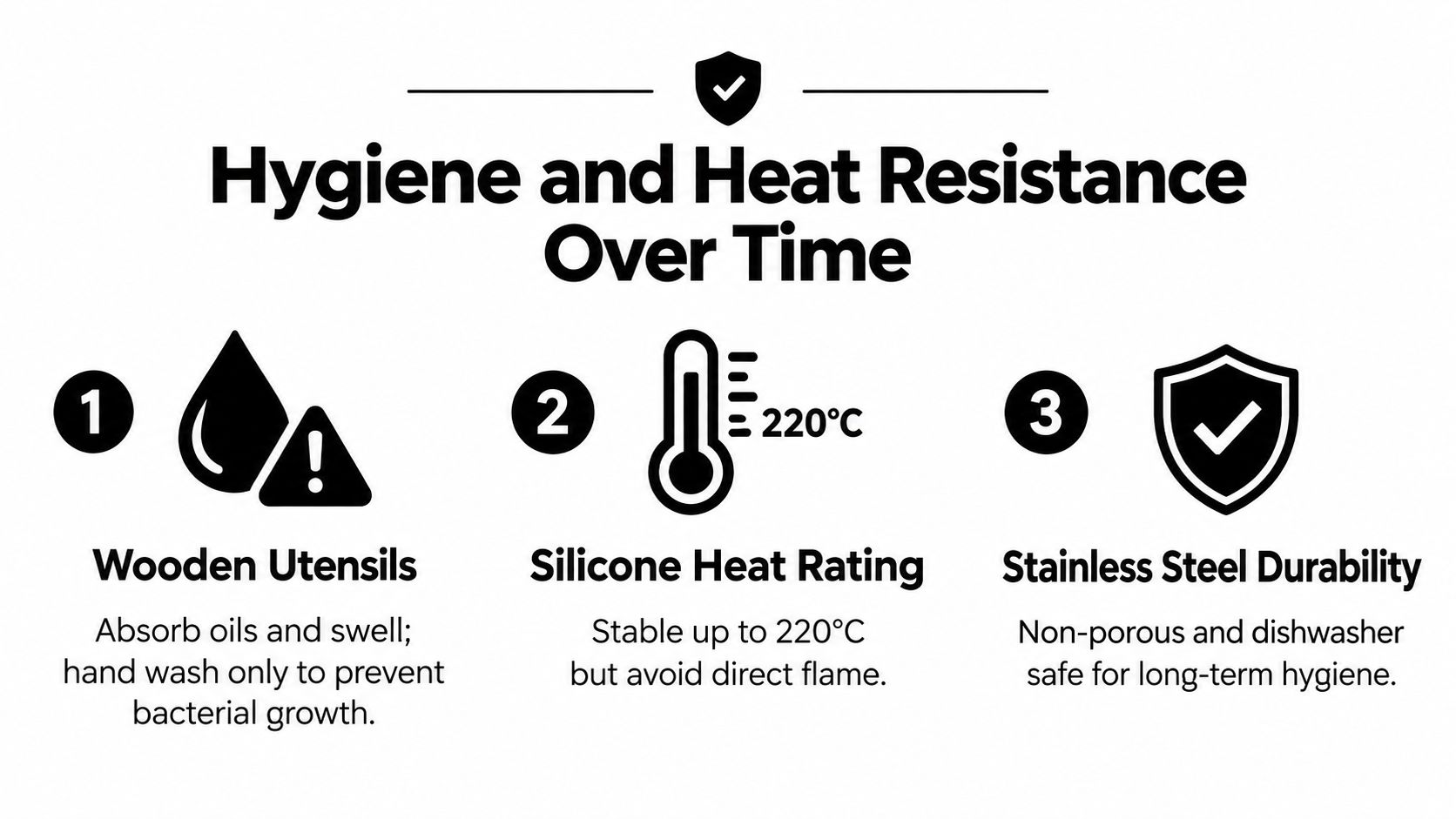
Temperature ratings need practical interpretation. A silicone spatula with a stated high-heat rating may be suitable for stirring a warm mixture, but that doesn't mean you should leave it pressed against a hot pan rim or expose it to a naked flame. Always follow the product's own instructions, especially where the handle contains plastic, an adhesive joint or a different material from the head.
For broader food-contact cleaning principles, use this guide to hygienic food preparation. In daily use, visible damage should guide replacement more reliably than an arbitrary calendar. A clean, intact tool can remain useful, while a warped, split or peeling tool should leave the drawer immediately.
Storage Solutions for Compact Kitchens
A baking utensil set must fit the room you have, not the kitchen shown in a catalogue. Narrow galley layouts, shallow drawers and limited bench space make storage footprint part of the buying decision. A set that nests neatly may serve you better than a larger bundle with impressive packaging.
Start with the tools that can stack. Place smaller measuring cups inside the largest cup, keep measuring spoons on one ring, and store silicone mats flat against a tray or baking tin. Mixing bowls can nest if their rims don't catch on one another. Avoid tightly rolling a mat if the manufacturer says it should be stored flat.
Give each tool a home
Long-handled whisks and spatulas are easier to grab from a deep crock beside the bench than from a crowded drawer. Keep the crock away from the cooktop so handles don't sit over heat. A drawer divider can separate wet prep, dry measure and heat tools, preventing a whisk from tangling with a scraper.
A wall-mounted rail uses vertical space for frequently used items. Renters can consider removable hooks or an over-door caddy, provided the fixing method suits the wall and the weight of the tools. Heavy rolling pins need stronger support than lightweight spatulas.
The Australian kitchenware market was valued at USD 4,091.5 million in 2025, and IMARC's Australian kitchenware market coverage identifies compact, multifunctional and space-saving products as an opportunity. That context makes nesting and multi-use design more than a styling preference for people living in smaller urban kitchens.
A corner shelf can create a defined landing place for bowls, scales or a utensil crock without spreading equipment across the bench. This kitchen counter corner shelf guide offers one way to think about unused vertical and corner space. Label zones if several people share the kitchen. A tool is easier to return when its home is obvious.
Building Your Kit Over Time
A useful kit grows from repeated problems. Begin with one mixing bowl, a sturdy whisk, a silicone spatula, a wooden spoon, measuring cups and a baking liner. That group supports simple cakes, biscuits, muffins and many tray bakes without forcing you to buy specialist equipment before you know what you enjoy making.
After regular use, note the moment that slows you down. Sticky dough points towards a bench scraper. Frosting that looks uneven suggests an offset spatula. Inconsistent results from volume measurements make a digital scale a more logical purchase than another decorative whisk.
Test every new tool on a familiar recipe. If the spatula feels awkward while scraping a basic cake batter, it will not become comfortable just because it was sold as part of a large set. Hold the whisk with wet hands, check whether the handle joint traps residue, and see whether the tool fits your bowls and trays.
Buy by recurring frustration, not by bundle size.
Retire items that chip, warp, split or remain untouched through several baking sessions. This approach prevents duplicates and keeps storage under control. It also gives you a clearer picture of whether a premium tool would replace several cheaper items or merely add another object to the drawer.
If baking begins to move beyond household treats, the same discipline applies to scaling a small operation. This guide to scaling a cottage food business is a useful resource for thinking about equipment, workflow and growing demand without buying everything at once.
A Quick-Reference Framework for Choosing a Set
Use this checklist while shopping in a store or comparing product pages. Score the set by usefulness, not by the number printed on the box.
- Tool variety: Look for mixing, scraping, measuring and handling tools. A set with several nearly identical spatulas may leave you without a whisk or scraper.
- Material quality: Check whether the food-contact surface is stainless steel, food-grade silicone, wood or a clearly stated premium material. Avoid vague descriptions that don't identify construction.
- Heat information: Find the maker's stated temperature guidance for silicone and plastic parts. If no rating is supplied, don't assume the tool belongs near a hot pan.
- Hygiene credentials: Prefer surfaces that are non-porous, sealed and easy to inspect. Confirm dishwasher guidance rather than treating every silicone handle as automatically dishwasher-safe.
- Storage footprint: Measure your drawer, crock or rail before buying. Nesting cups and flat-storing mats can matter more than an extra specialist tool.
For readers who want a replace-everything-else approach, titanium and other premium materials deserve a separate look. Their appeal is a corrosion-resistant, non-reactive surface and a focus on long service, but the initial price can be higher. Choose that route because it matches your hygiene, durability and storage priorities, not because a premium material removes the need to care for tools.
Frequently Asked Questions About Baking Utensil Sets
How often should silicone spatulas and wooden spoons be replaced? Replace them when you see splits, peeling, warping, exposed joins, deep cracks or a smell that remains after washing. A sound tool doesn't need replacing just because it has been used for a certain length of time.
Is a pre-made set more economical than buying tools individually? It can be, but only when most of the pieces match your recipes and storage. Individual purchases are often better if you already own measuring cups, bowls or a whisk.
Can silicone tools go in the dishwasher or oven? Some can go in the dishwasher and some can tolerate oven heat, but the answer depends on the complete tool, including its handle and join. Check the manufacturer's stated care and temperature limits, and never place silicone over direct flame.
What is safest for non-stick bakeware? Soft silicone and smooth wood are less likely to scratch a coating than rigid metal heads. Replace any tool whose edge has become rough, chipped or damaged.
Choose the tools that match your recipes, storage space and cleaning habits, then explore Everti for titanium kitchen and table essentials designed around durable, easy-care materials. A considered baking utensil set will give you a calmer bench, cleaner workflow and fewer replacements without filling your kitchen with tools you never use.