

You've rinsed quinoa, tipped the bowl towards the sink, and watched a good portion disappear down the plughole. Then, on another night, you've tried to drain spaghetti through a fine mesh strainer and ended up waiting while the water crawls through a blanket of starch. These aren't cooking failures. They're tool-selection failures, and they're common because colanders and strainers look close enough to interchangeable.
The useful distinction is simple, but it goes further than large holes versus fine mesh. A colander handles bulk drainage and larger food. A strainer retains smaller particles and filters liquid more precisely. The material, shape, stability and clean-up burden then determine whether the utensil helps your workflow or creates another job beside the sink.
The Right Tool for the Job
A colander belongs beside a pot of pasta. Its broad bowl and open perforations let a large volume of water escape quickly while keeping noodles, potatoes or vegetables contained. A fine mesh strainer belongs over a bowl, saucepan or measuring jug, where its job is to hold back small particles rather than move water as fast as possible.
Australian kitchen guidance generally makes the same distinction. A colander is the larger, wider-holed vessel for draining pasta or rinsing vegetables, while a strainer uses finer mesh for sifting and rinsing smaller foods such as grains, as reflected in Australian retail descriptions of these tools for fast draining and fine mesh tasks (Australian stainless-steel colander guidance).
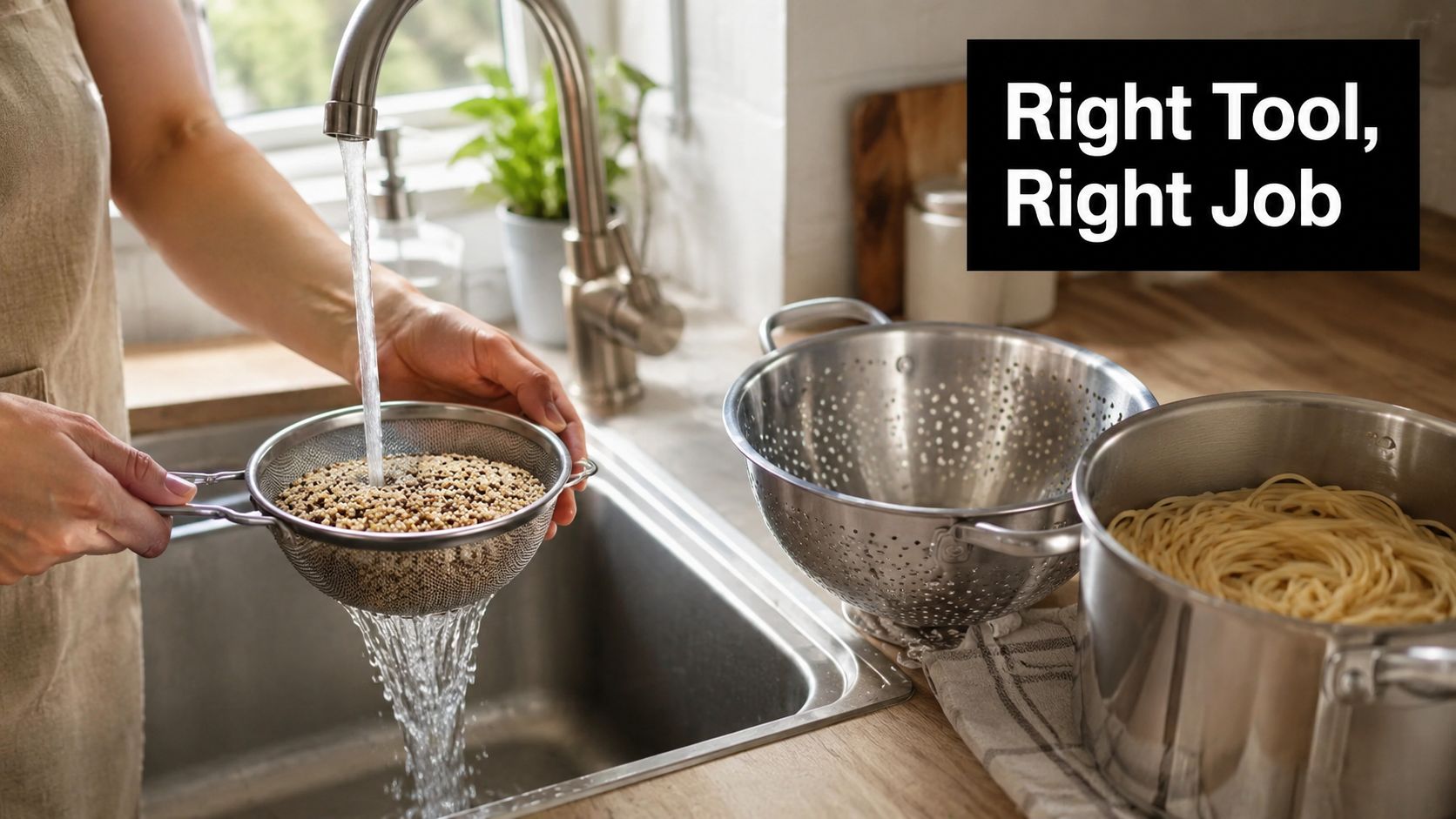
What goes wrong in a busy kitchen
Quinoa is the classic trap. The grains are small enough to pass through many perforated colanders, especially when the holes are intended for pasta or produce. A fine mesh strainer keeps the grains in place while you rinse away dust and excess starch. The trade-off is capacity. A small strainer can rinse a modest quantity neatly, but it may overflow if you fill it with more than it can comfortably hold.
Pasta creates the opposite problem. A fine mesh basket can retain noodles, but its surface quickly becomes covered with starch and the water drains slowly. That delay encourages you to shake or press the pasta, which can damage delicate shapes and makes the utensil harder to clean. A roomy colander allows the water to leave quickly and gives you enough space to toss the pasta without forcing it through a congested mesh.
Practical rule: Choose the tool according to the size of the food you need to retain, then consider how quickly the liquid must leave.
The distinction also affects waste. Rice, quinoa and small grains need a barrier that's fine enough to stop the food. Citrus pulp, stock sediment and sauce particles need even finer retention, often with a stable rim or handle that lets you work over another vessel. Larger produce, pasta and boiled vegetables need open drainage and room to move.
A quick decision before you cook
Ask three questions before reaching for the drawer:
- What must stay inside? Large pieces and pasta point towards a colander. Fine grains and pulp point towards a strainer.
- How much liquid needs to leave? A pot of cooking water needs rapid bulk drainage. A sauce or stock needs controlled filtration.
- Where will the tool sit? A sink-friendly colander needs stability and capacity. A strainer used over a saucepan needs a suitable rim, handle or support.
The name on the packaging won't always settle the matter. Australian shoppers encounter hybrid labels such as “colander-strainer” and “sink colander”, so inspect the perforation pattern and the intended position in your workflow rather than trusting the product name alone. The right utensil is the one that avoids clogging, prevents food loss and leaves less residue to scrub.
Defining the Differences in Design and Function
The physical design tells you more than the label. A colander is usually a bowl with a rigid body and larger perforations distributed across its base and sides. That geometry gives water multiple exit points and makes the utensil suitable for a heavy load of food. Some models sit on feet, while others use side handles or a raised base to keep the bowl away from standing water in the sink.
A strainer is built for retention. It may use woven mesh, punched fine holes or a small basket with closely spaced apertures. The liquid passes through, but small grains, flour particles, seeds, sauce solids and citrus pulp remain inside. Fine mesh can also clog more readily, particularly when the food is sticky or the liquid contains starch and sediment.
Australian kitchenware guidance consistently separates these categories by hole geometry and use case. Perforated colanders suit bulk drainage, while mesh strainers suit particle retention and finer filtration (Australian colander and strainer guidance).
Design and Function Comparison
| Feature | Colander | Strainer |
|---|---|---|
| Primary job | Fast drainage of larger quantities | Fine filtration and particle retention |
| Opening pattern | Larger, spaced perforations | Fine mesh or smaller apertures |
| Best for | Pasta, potatoes, vegetables and larger produce | Quinoa, rice, flour, stock, sauces and citrus pulp |
| Typical position | In or over a sink, or over a large bowl | Over a saucepan, bowl, jug or cup |
| Main limitation | Small foods can escape | Mesh can clog under heavy, starchy loads |
| Useful design priorities | Capacity, stable base and rapid drainage | Fine mesh, secure handle and easy rinsing |
The most practical decision isn't “colander or strainer?” in the abstract. It's which tool matches the food size, drainage speed and clean-up required for this task. Australian guidance makes that task-based distinction clear: colanders are suited to pasta and larger produce, while strainers are better for quinoa, rice, stock, sauces and removing citrus pulp (task-focused Australian utensil guidance).
Why shape changes the result
A wide colander gives food room to spread, so water can escape rather than pooling around a dense central mass. That matters when draining pasta or rinsing leafy vegetables. A deep bowl can hold more, but if its drainage holes are only at the bottom, food may still sit in water unless you lift, shake or tilt the utensil.
A strainer concentrates the filtering surface. That's useful when you need a clean liquid, but it makes technique more important. Rinse grains under a moderate flow and move them gently so water reaches the whole contents. For a sauce, pour steadily rather than dumping a thick mixture into the mesh all at once. If you overload the strainer, the top layer can act like a plug.
Handles and support points matter as much as openings. A single-handled strainer is convenient over a saucepan, but it needs a bowl or pot with a compatible rim. A colander with broad handles is easier to lift when full, while a footed model can keep food above sink water. These details determine whether you can drain safely with wet hands and whether the utensil stays stable when you turn on the tap.
The category has also remained recognisable over time. A Victorian Collections record dated 1900–1920 identifies a domestic utensil as a “colander, sieve or cullender” and describes the established perforated bowl design used for straining food and rinsing vegetables (Victorian Collections kitchen utensil record). The terminology has shifted, but the mechanical question hasn't: are you moving water away from substantial food, or retaining fine particles?
Material Matters, Steel, Titanium, and Plastic Trade-offs
Once the opening pattern suits your cooking, material becomes the next serious choice. The wrong material can warp near heat, pick up odours, dent during ordinary use or create awkward washing routines. A good utensil should tolerate the environment you cook in, not just look attractive on a shop shelf.
Stainless steel as the kitchen workhorse
Stainless steel is the dependable option for a colander that will handle boiling pasta, hot vegetables and frequent washing. Australian product guidance repeatedly positions stainless-steel colanders as dishwasher-safe, dent-resistant and stackable, with a stronger fit for commercial or high-volume use than many lightweight alternatives (Australian kitchenware material guidance).
That doesn't mean every steel product performs identically. Thin steel may flex when loaded, while a heavier rim and well-formed handles can make lifting safer. Welded joins, rolled edges and smooth perforations are worth inspecting because rough seams collect food residue and make hand-cleaning unpleasant.
Steel also conducts heat, so handles and rims can become hot when a colander is used over steam or placed near a boiling pot. That isn't a reason to avoid it. It's a reason to use dry grips, keep handles clear of heat and choose a shape that doesn't rest directly on a hot surface.
Titanium for lightness and corrosion resistance
Titanium appeals when weight, corrosion resistance and long service matter. It's especially practical for outdoor cooking, compact kitchens and anyone who regularly carries equipment between locations. A titanium utensil can feel less substantial than a thick steel one, but low weight isn't the same as fragility. Pay attention to the rim and handle design, because the weakest point in a lightweight tool is often the attachment rather than the bowl.
Titanium can command a premium, so it makes most sense when you value portability, material longevity and a minimal setup. For a closer look at the broader strength trade-off between these metals, compare titanium and stainless steel construction. The relevant question for a draining tool isn't just which metal is stronger. It's whether the finished utensil stays stable, cleans easily and suits the heat and handling it will receive.
Plastic and silicone in context
Plastic is light, affordable and less likely to mark a non-stick pot or benchtop. Silicone can fold for storage and feels gentle against delicate cookware. Those are legitimate advantages, particularly in a small kitchen where compact storage matters.
Heat changes the calculation. Australian buying guidance notes that plastic colanders can be unsuitable for steaming or sudden temperature changes, while stainless-steel models are more appropriate for demanding heat and repeated use (Australian kitchenware material guidance). A plastic colander may be perfectly serviceable for washing salad leaves, but it shouldn't automatically become the basket you place over a pot of boiling water.
Inspect older plastic and silicone tools for warping, deep scratches, tackiness or persistent smells. A distorted rim can make the utensil unstable, and damaged surfaces are harder to clean thoroughly. Coated metal also deserves scrutiny. If the coating chips or peels, the product no longer offers the clean, predictable surface you bought it for.
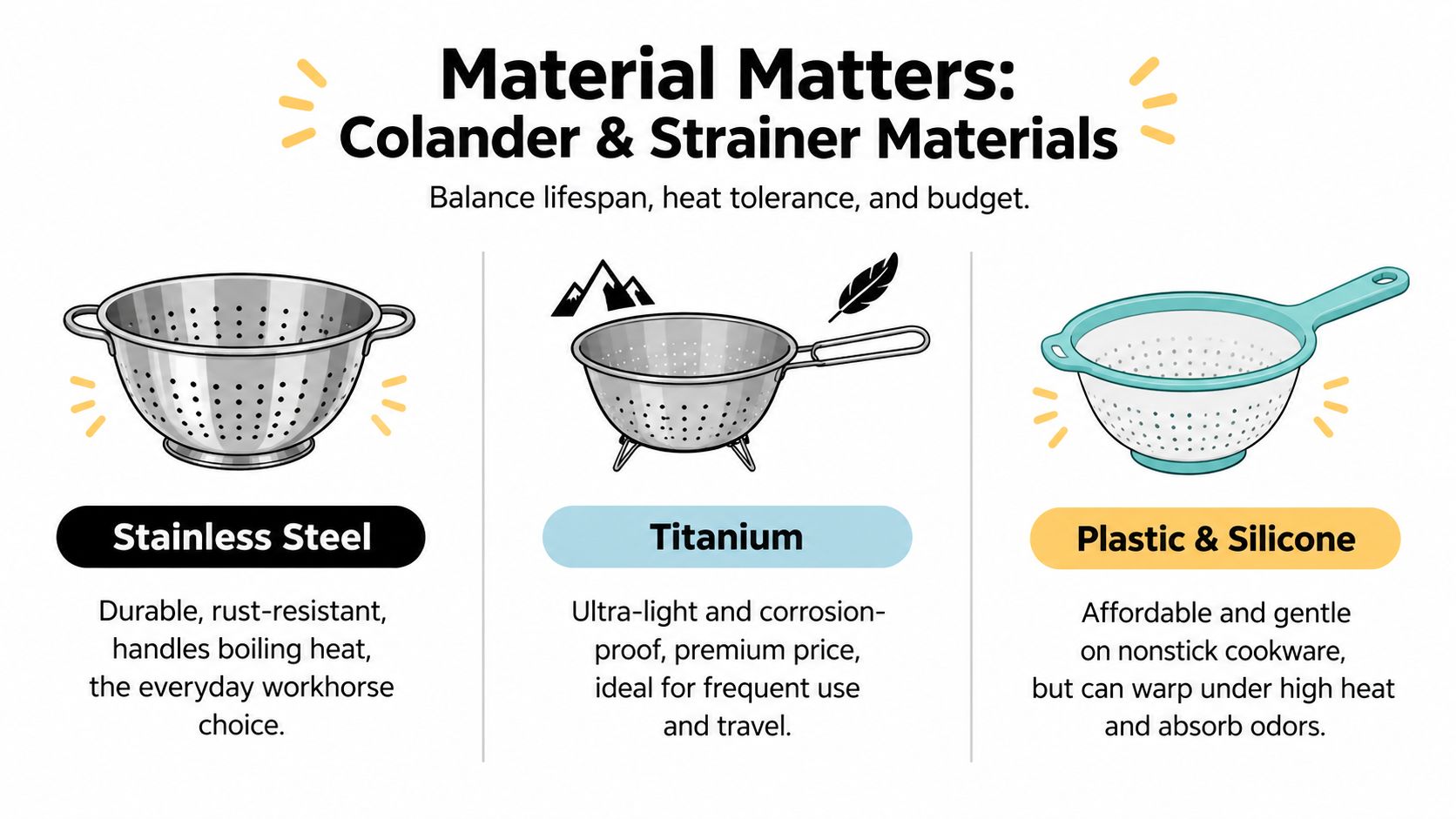
| Material | Heat resistance | Durability |
|---|---|---|
| Stainless steel | Well suited to hot draining and demanding kitchen use | Dent-resistant, stackable and suitable for frequent washing |
| Titanium | Suitable where low weight and corrosion resistance matter | Lightweight and durable when the rim and handles are well made |
| Plastic | Check the product carefully before exposing it to steam or sudden temperature changes | Light and affordable, but can warp or retain wear-related damage |
| Silicone | Useful for flexible storage and gentle contact with cookware | Convenient, though heat and odour retention depend on the specific design |
The material should follow the workflow. A professional kitchen or a household that drains hot food daily will usually benefit from a rigid metal tool. A camper may prioritise titanium's low weight. A cook with delicate non-stick cookware may choose plastic or silicone for a particular task, while keeping a metal colander for boiling-hot food.
This video offers a visual look at how different colander and strainer formats work in the kitchen:
Matching the Utensil to Your Cooking Tasks
The easiest way to choose is to name the food before you name the tool. Start with the particle size, then consider the amount of liquid and the temperature. That small pause prevents most of the waste and clogging problems associated with the colander vs strainer decision.
Pasta and vegetables
Use a broad, perforated colander for spaghetti, penne, potatoes, broccoli and larger pieces of produce. Tip the pot carefully, keep both hands on the handles if the load is heavy and allow the water to run through without pressing the food into the base. If you're reserving pasta water, remove it with a jug before draining, because a colander can't separate that liquid once it reaches the sink.
For leafy vegetables, a colander gives you space to rinse and toss. Shake it over the sink, then leave the food to drain briefly rather than piling wet leaves straight into a salad spinner or storage container. A crowded vessel slows drainage and leaves water trapped between layers.
Quinoa, rice and small grains
Use a fine mesh strainer. Quinoa and rice are exactly the foods that expose a colander's limitation, because small grains can pass through openings designed for fast bulk drainage. Hold the strainer securely under running water and agitate the grains with your fingers or a spoon so the water reaches the whole batch.
Don't fill the mesh to the rim. Fine particles and starch can form a dense layer, turning the strainer into a slow, blocked surface. If the grains are sticky, rinse in stages and give the mesh a quick flush immediately afterwards.
Stock, sauces and citrus
A fine strainer is the better choice for stock sediment, sauce solids, flour and citrus pulp. Place it over a vessel that can support the rim, then pour steadily. For thick sauces, use a ladle rather than forcing the entire pan through at once. Pressing aggressively may push unwanted solids through the mesh and can make the final clean-up harder.
Citrus work also rewards a small, fine tool. A strainer placed over a jug catches seeds and pulp while allowing juice through. A colander is too open for this job, and a large mesh basket creates more surface area to wash than the task requires.
A workflow that saves food and time
Keep one tool near the sink for bulk rinsing and another near the saucepan for fine filtration. Rinse the utensil immediately after use, especially after grains, flour or starchy liquids. Those residues dry quickly and can block the openings before you reach the dishwasher.
Kitchen test: If the food can fall through the openings before the water drains, the utensil is too open. If the liquid sits on top of the food, the utensil is too fine or overloaded.
The old names don't change this decision. Historical Australian records describe the category as a colander, sieve or cullender, which reflects how closely these tools have overlapped in domestic use (historical Australian utensil record). In modern kitchens, the practical test remains more useful than the label. Match the tool to the food, drainage speed and amount of cleaning you're prepared to do.
Hygiene, Cleaning, and Long-Term Maintenance
A utensil that touches rinsed grains, cooked pasta, raw vegetables and ready-to-eat food needs a cleaning routine that fits real life. Hygiene isn't created by a material name alone. It depends on whether the surface stays intact, whether food can lodge in joins and whether you can wash and dry every part without special effort.
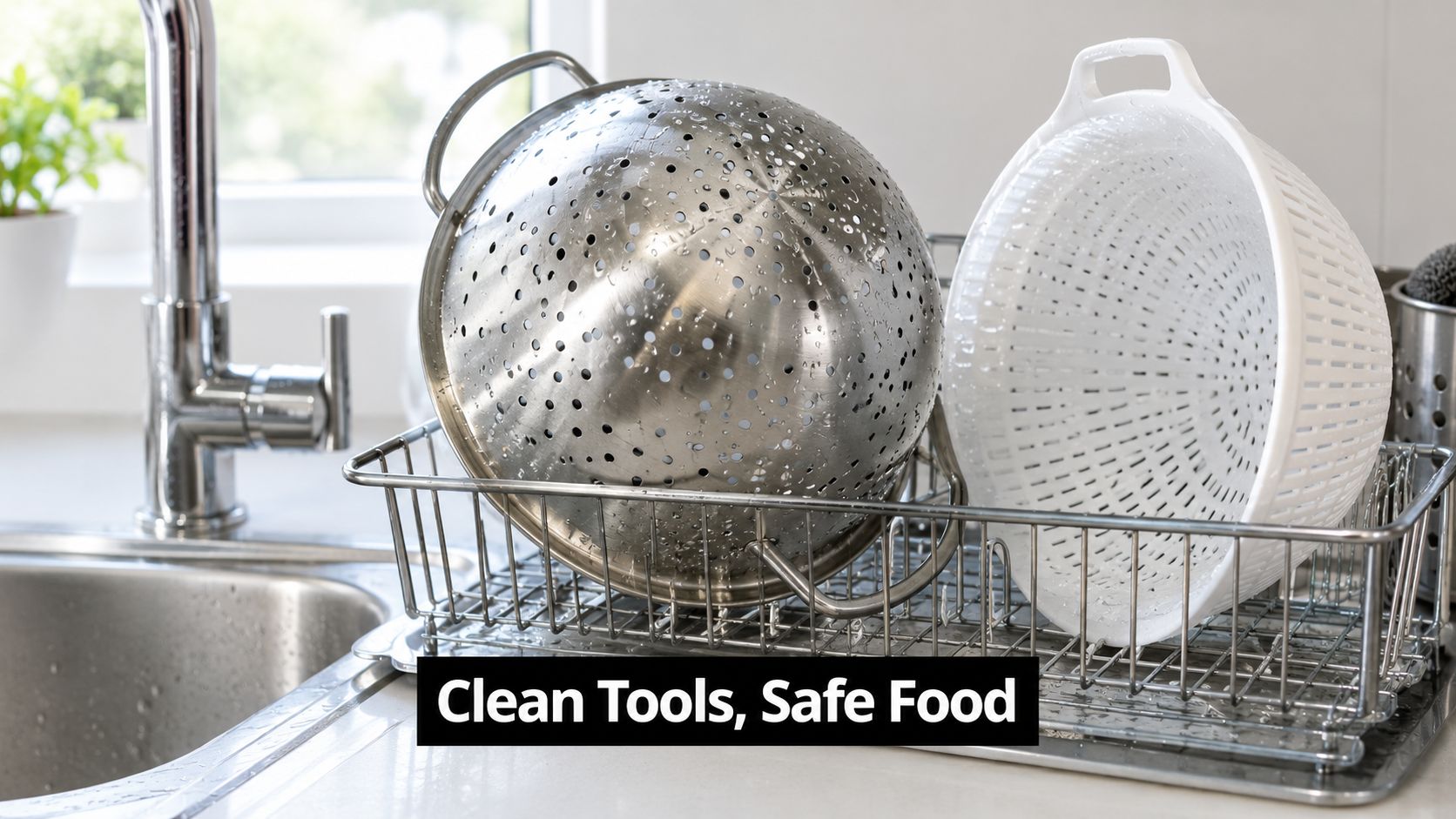
Start with the openings and joins
Fine mesh retains more than food. Flour, starch, citrus pulp and tiny vegetable fibres can settle along the rim or inside the handle connection. Rinse from the clean side of the mesh, use a soft brush where needed and inspect the underside before putting the strainer away.
Perforated colanders are easier to flush when the holes are open and the body has smooth transitions. They become frustrating when punched edges are rough, handles are hollow or seams trap residue. Run water over the full surface rather than rinsing only the centre of the bowl.
A quick post-use routine is more effective than a late rescue:
- Empty the utensil promptly. Don't leave grains, pulp or starchy water drying in the openings.
- Rinse from both sides. Turn the tool so the flow dislodges residue rather than driving it deeper.
- Wash the rim and handles. These are easy to overlook, especially on a fine mesh basket.
- Dry completely. Stand the utensil so water can leave the bowl and air can reach the underside.
- Check before reuse. Look for trapped food, damaged mesh, sharp edges or a distorted shape.
Comparing solid metal with plastic
Stainless steel is attractive for busy kitchens because Australian product guidance describes it as dishwasher-safe, dent-resistant and stackable, with suitability for commercial or high-volume use (Australian stainless-steel kitchenware guidance). A rigid, uncoated metal surface also gives you a predictable shape during washing and draining. It won't soften in the same way a heat-sensitive plastic body can.
Plastic remains useful when you need a light utensil or a surface that feels gentle against non-stick cookware. The concern is long-term condition. Australian guidance notes that plastic colanders can be unsuitable for steaming or sudden temperature changes (Australian kitchenware guidance on material trade-offs). Repeated heat exposure can change the shape, and a warped bowl may sit unevenly or make the holes less effective.
Avoid turning general material preference into an unsupported hygiene promise. Stainless steel and titanium don't replace proper washing, and plastic isn't automatically unsafe because it's plastic. The practical advantage of a well-made, solid metal utensil is that it can retain its intended form through demanding use, making it easier to rinse, inspect and maintain.
Preventing cross-contamination
Use separate routines for raw and ready-to-eat foods. Rinse a colander after raw vegetables before using it for cooked pasta, and don't place drained food back into a vessel that held raw ingredients without washing it first. A clean-looking mesh can still hold residue in its rim or handle joint.
For a broader kitchen routine, learn how to prevent cross-contamination across boards, utensils, hands and work surfaces. The same principle applies here: clean the tool according to the food it handled, not according to whether it looks visibly dirty.
Storage affects maintenance too. Nesting a damp fine mesh strainer inside another utensil traps moisture and makes inspection difficult. Hang it, stand it upright or store it where air can circulate. Keep heavy pots from pressing on a mesh basket, since a bent rim can stop it sitting securely over a bowl.
A clean tool is one you can inspect. If the design hides residue or makes drying awkward, it creates maintenance work every time you use it.
For health-conscious cooks, the best purchase is often the one that encourages consistent care. A simple, smooth utensil that rinses quickly and dries fully will generally serve you better than a complicated design with clever folding parts that stay damp. Longevity matters because replacing a warped or odorous tool repeatedly creates more waste and more opportunities to tolerate poor condition.
Building a Cohesive and Durable Kitchen Setup
A colander or strainer doesn't work in isolation. It occupies sink space, rests on bowls and pots, touches benches and often handles food that is moving straight to a cutting board or serving dish. The best choice supports the rest of the kitchen rather than creating a new point of friction.
Start with your dominant workflow. If you cook pasta and vegetables regularly, choose a stable colander with enough room to drain without compressing the food. If grains, sauces and citrus feature heavily, prioritise a fine mesh strainer with a secure handle and a rim that sits safely over your usual saucepan or bowl. If both patterns are routine, owning one of each is more efficient than forcing a hybrid tool to perform two incompatible jobs.
Pairing materials with your surfaces
Metal tools need sensible handling around premium benches and preparation surfaces. A steel rim can scratch a delicate finish if you drag it across the surface, while a lightweight titanium design may be easier to lift and reposition without knocking other equipment. Set the utensil down rather than sliding it, and use a clean mat when you're working beside the sink.
Families often benefit from a durable stainless-steel colander that can handle hot food and frequent washing. Outdoor cooks may prefer a lightweight, corrosion-resistant titanium strainer that packs neatly with a pot. A small kitchen may favour a collapsible silicone option for storage, while keeping a rigid metal tool available for high-heat tasks.
Reduce the number of tools that fight for space
A cohesive setup doesn't mean owning every variation. Group the tools by task, keep the frequently used pair accessible and remove pieces that have warped, rusted, developed rough edges or no longer fit your cookware. For broader ideas on reducing clutter while keeping practical essentials close at hand, organize with HYDAWAY essentials.
The right colander vs strainer setup should make the next action obvious. Pasta goes into the broad basket. Quinoa goes into fine mesh. Stock passes through a supported strainer. Each tool has a defined home, and each one can be washed, dried and inspected without dismantling the kitchen.
Everti creates durable titanium essentials for kitchens and tables, including lightweight, easy-to-clean tools designed for health-conscious cooks and demanding daily use. Visit Everti to explore its titanium range and choose long-lasting kitchenware that fits the way you prep, rinse and cook.