

You're unloading the dishwasher when you notice a chip on a dinner plate. The cereal bowls no longer match, your favourite pasta bowl won't stack neatly, and replacing everything suddenly seems easier than finding another individual piece. Before you buy the prettiest boxed set, it's worth asking what your current dinnerware gets wrong about daily life.
Good dinnerware plates and bowls need to suit the meals you cook, the people carrying them, and the way you wash and store them. Colour matters, but so do usable capacity, food-contact documentation and whether a bowl fits between your dishwasher racks.
Why Your Plates and Bowls Deserve More Thought
A replacement plate can look almost identical to its predecessor and still be awkward to use. Perhaps its rim leaves less room for food, its base slides across the table, or its weight makes carrying a stack uncomfortable. These are details you're unlikely to notice in a styled product photograph.
Start with an ordinary evening meal. You're serving roast vegetables, something with sauce, and a side salad. Does everyone reach for a dinner plate, or do some people prefer a bowl? When children carry their dishes to the kitchen, can they grip the edges comfortably?
Buy for the routine, not the photograph
Think about the whole journey from cupboard to table and back again. A dinnerware purchase should answer practical questions before it answers decorative ones:
- Serving: Does the eating surface suit your usual meals?
- Handling: Can household members lift, carry and steady each piece?
- Storage: Can you retrieve a bowl without dismantling a precarious stack?
- Cleaning: Does the shape fit your dishwasher without blocking neighbouring dishes?
Australia's buying context also deserves attention. In 2024, Australia imported approximately US$80.7 million in the ceramic tableware and kitchenware category, with China supplying roughly 82.7% of import value, according to World Bank WITS trade data. Country of manufacture alone doesn't answer whether an individual product suits your kitchen, so compare documentation and design rather than assuming origin settles quality.
Dinnerware Categories at a Glance
| Category | Typical Diameter / Capacity | Best For |
|---|---|---|
| Dinner plate | Broad eating surface, check actual dimensions | Main meals with separate components |
| Side plate | Smaller than the main plate | Toast, snacks and accompaniments |
| Bread plate | Compact surface | Bread and small extras |
| Shallow bowl | Wide opening with modest depth | Pasta and composed meals |
| Everyday bowl | Moderate capacity, verify usable fill | Cereal, soup and curry |
| Deep bowl | Greater depth relative to opening | Noodles and broth |
Treat these categories as shopping vocabulary, not fixed specifications. A useful set begins with the pieces you reach for willingly, rather than the pieces you tolerate because they came in the box.
Plate and Bowl Categories by Size and Shape
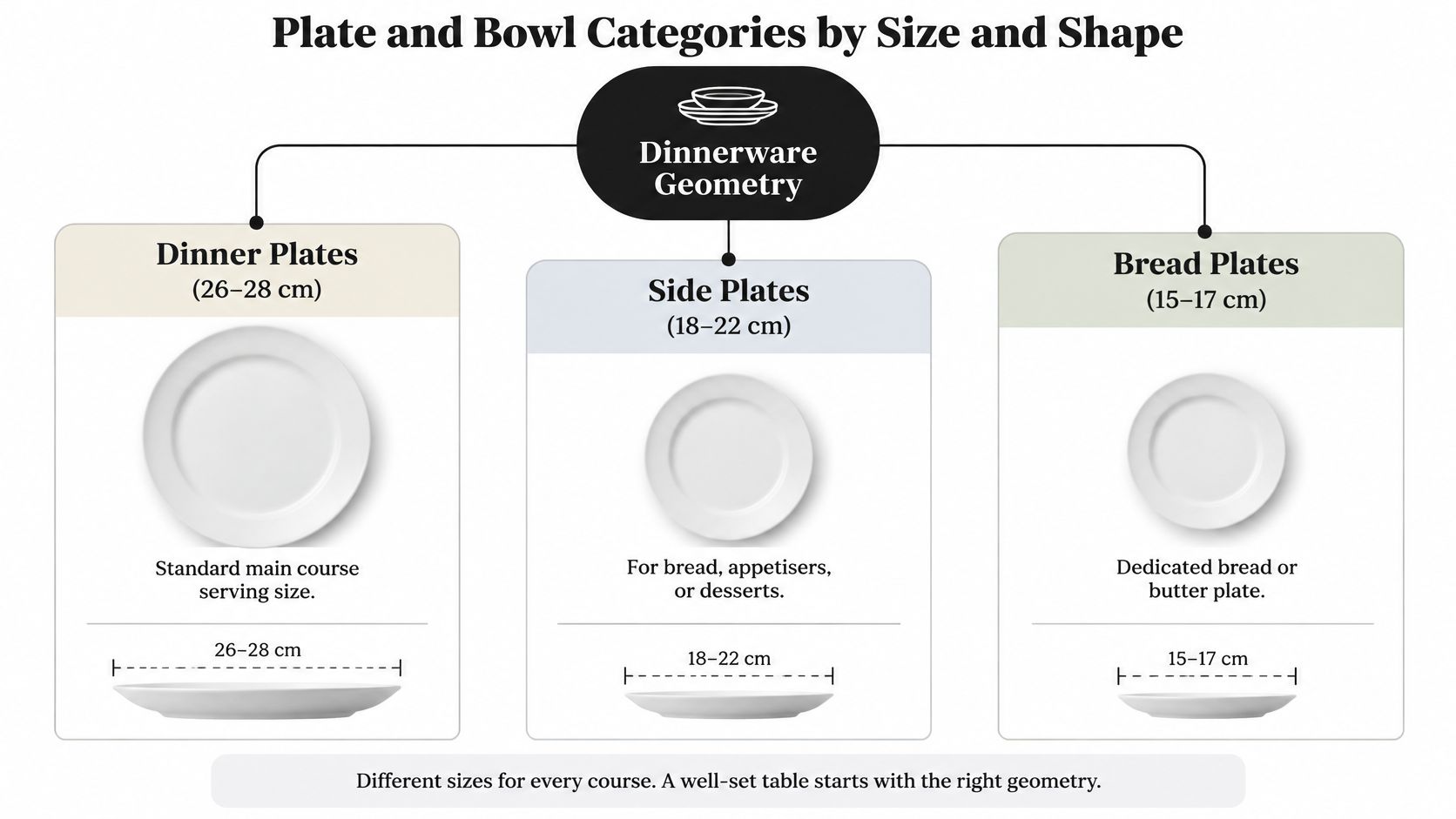
Compare usable space, not just the measurement across the outside edge. A broad rim can leave less room for dinner than a narrower-rimmed plate with the same outer dimensions. For bowls, ask whether the listed capacity means filled to the brim or comfortably filled for eating.
The chart below offers a visual introduction to plate categories. Treat its size bands as illustrative shopping references, not compulsory standards.
Match the shape to the meal
A flat dinner plate gives you room to arrange foods separately. That's helpful for a meal where you want salad away from gravy, but less useful when you're chasing the last spoonful of curry sauce.
A shallow pasta bowl offers a different compromise. Its open centre gives you access with a fork, while the raised edge provides somewhere to gather sauce. A deeper bowl may suit broth and noodles better, provided its opening leaves enough room to manoeuvre your cutlery.
- Soup and cereal bowls: Check the depth, spoon access and comfortable carrying grip.
- Noodle bowls: Look at the space above the intended serving, not just total capacity.
- Dessert and condiment bowls: Decide whether you need separate pieces or can reuse existing small bowls.
Practical rule: Choose a dish for the food you put in it, then check whether that dish fits your cupboard and dishwasher.
Don't overlook the base. Set a sample on a flat surface, check that it sits steadily, and see how it nests with another piece. If shopping online, request photographs from the side and underneath.
You can still enjoy dinnerware-inspired styling without confusing decoration with dining equipment. For a decorative reference, browse the Dishes We Meet Again decor from Farmhouse World, while keeping decorative purchases separate from your food-contact checklist. Something can belong beautifully in a kitchen without being intended to hold food.
Comparing the Main Dinnerware Materials
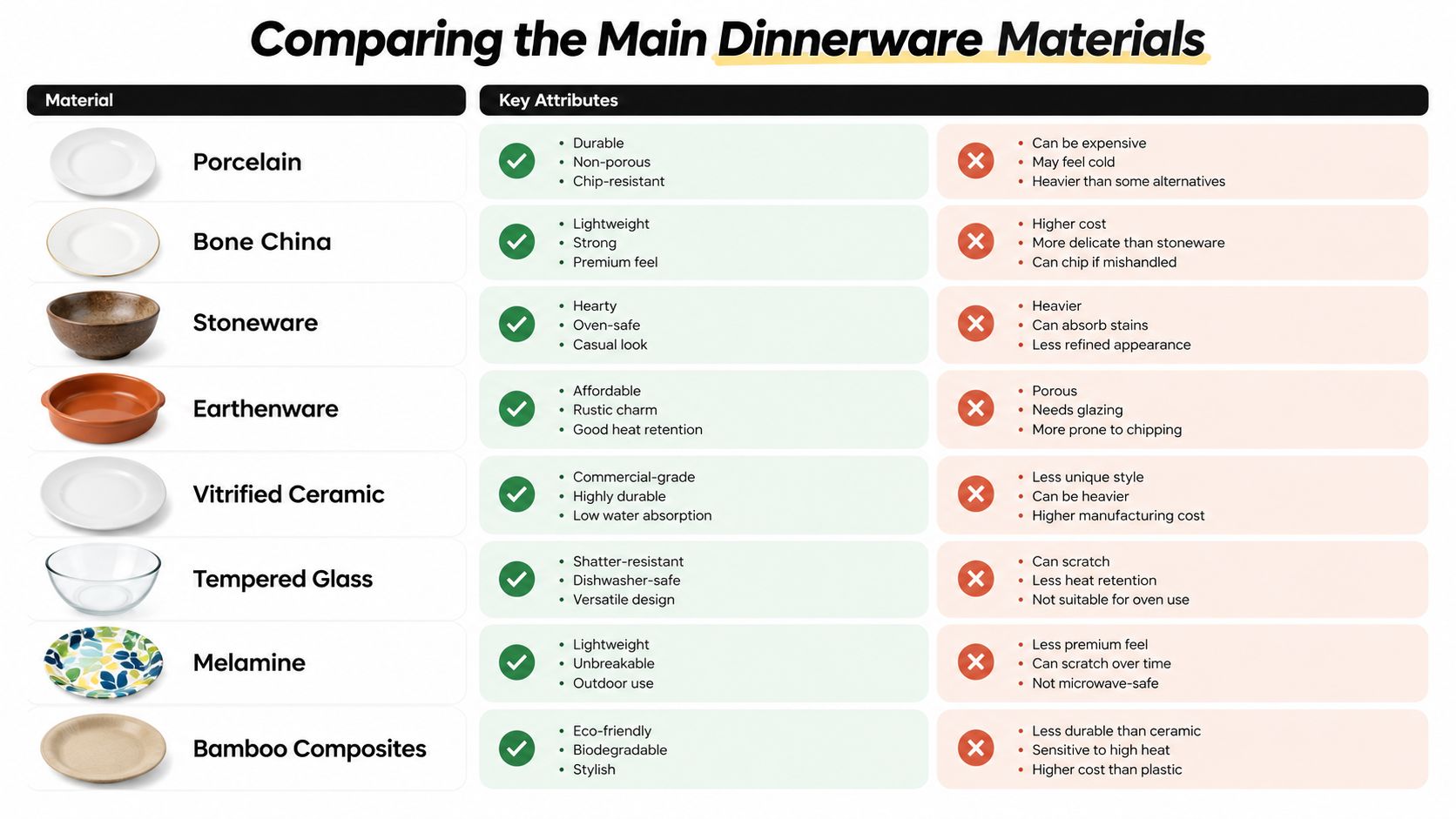
Material names are useful starting points, but they aren't complete specifications. Porcelain, bone china, stoneware, earthenware and vitrified ceramic should prompt questions about the finished product, including its glaze, decoration, weight and permitted uses. Don't assign microwave or dishwasher suitability from the category name alone.
The same caution applies to tempered glass, melamine, bamboo composites and titanium. You're buying a manufactured object, not an abstract material, so compare the item's instructions and evidence rather than relying on a simple ranking.
Use the graphic below as a list of materials to investigate, not as a substitute for product documentation. Absolute descriptions such as unbreakable, universally oven-safe or biodegradable need product-specific support.
Compare finished pieces side by side
Dinnerware Materials Compared
| Material | Weight | Chip Resistance | Microwave / Dishwasher | Best Match |
|---|---|---|---|---|
| Porcelain | Handle a sample | Ask about rim durability | Verify both claims | Buyers comparing refined ceramic designs |
| Bone china | Compare the actual piece | Check product evidence | Check decoration restrictions | Buyers prioritising handling and appearance |
| Stoneware | Test a loaded stack | Inspect edges and finish | Confirm intended conditions | Casual table settings |
| Earthenware | Assess thickness and heft | Examine glazed edges | Follow item instructions | Buyers drawn to pottery styling |
| Vitrified ceramic | Compare like-sized pieces | Request performance details | Verify declared uses | Buyers seeking documented everyday performance |
| Tempered glass | Check grip and balance | Check damage guidance | Follow manufacturer limits | Those who prefer a glass finish |
| Melamine | Assess the finished item | Inspect edges after use | Never infer heating suitability | Buyers considering non-ceramic options |
| Bamboo composite | Ask for full composition | Check surface durability | Require explicit instructions | Buyers willing to investigate composite claims |
| Titanium | Compare actual construction | Assess dents and deformation too | Don't assume microwave suitability | Buyers exploring metal tableware |
For bamboo composites, ask what binds the fibres together. A plant-based ingredient doesn't establish the composition of the entire plate, its disposal pathway or its suitability for hot food. Equally, choosing metal shouldn't mean overlooking seams, surface finishes or cleaning instructions.
For decorative glass inspiration rather than a performance comparison, IFM Gourmet Food Store's Italian gourmet gifting with a Venetian touch offers another aesthetic reference. Keep that visual exploration separate from selecting everyday food-contact pieces.
The best material is the one whose documented capabilities match your actual use. A category-wide winner would hide too many differences between individual products.
Food Safety and Migration You Can Actually Verify
A tomato salad dressed with vinegar is a useful reminder that dinnerware must do more than hold dry toast. The finished food-contact surface matters, including any glaze, coating or decoration.
This everyday combination makes the question concrete.
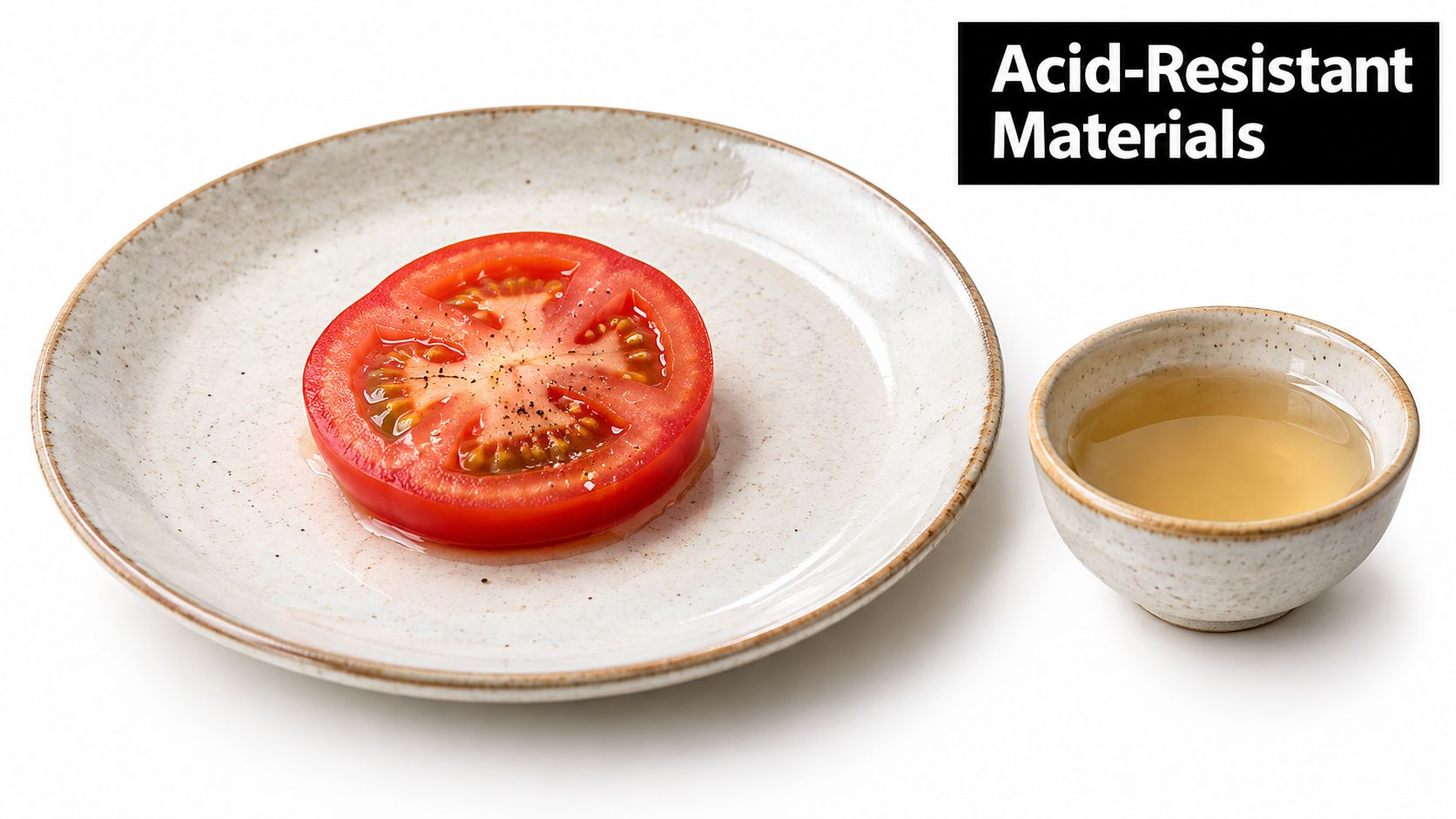
Chemical migration means constituents of a food-contact material transferring into food. Food type, contact time, temperature, heating and repeated cleaning can influence that transfer, so a general food-safe claim shouldn't be treated as permission for every use, as explained in FSANZ guidance on food-contact packaging.
Ask about the finished surface
For food-service equipment, FSANZ requires suitable food-contact surfaces to be smooth, appropriately impervious and capable of withstanding intended cleaning and sanitising; it also identifies chemical contamination risks, including lead from some ceramic utensils, in its food premises and equipment guidance. Those principles make a useful buying benchmark at home.
Ask the seller for:
- Food-contact documentation: Evidence that applies to the finished product, including its decoration.
- Relevant ceramic testing: The applicable Australian benchmark and what the test assessed.
- Intended-use limits: Clear instructions covering hot food, acidic food, heating and cleaning.
- Damage guidance: Advice on recognising glaze failure and withdrawing damaged pieces.
Neither handmade nor brightly coloured automatically means unsafe. Neither natural nor lead-free automatically answers every migration question. For ceramics, ask specifically about documented lead and cadmium release testing, a concern discussed in Australian kitchenware import compliance guidance.
For further terminology to use when comparing claims, consult this guide to non-toxic dinnerware materials.
The accompanying video offers another format for exploring the topic; supplier documentation should remain your basis for product-specific decisions.
An inherited decorative plate with an unknown history deserves a different decision from a new plate with traceable instructions. If its intended use can't be established, enjoy it as a display piece rather than testing it with dinner.
Building a Set That Matches How You Eat
Open your cupboard before opening a shopping tab. Separate the pieces you use routinely from those you keep moving aside, then identify what's missing. You may need more everyday bowls, not another complete service.
Let your household determine the mix
Start with how many people usually eat at home and how often you wash dishes. Then consider visitors and storage. Occasional entertaining doesn't necessarily justify keeping a large matching service in your most accessible cupboard.
Build your shopping list by function:
- Main-meal pieces: Choose dinner plates, shallow bowls or a mixture according to your meals.
- Everyday bowls: Prioritise the shape that works for breakfast and the dinners you cook regularly.
- Small plates: Include them if toast, lunch and snacks make them useful.
- Serving pieces: Buy for the dishes you bring to the table, not an imagined formal menu.
- Cups and mugs: Keep existing favourites if they already work.
A couple who mostly cook pasta and curry might prioritise bowls. A household with children might focus on manageable grip and accessible storage. Frequent hosts might want flexible serving dishes more than additional individual place-setting components.
Prefer replaceability over forced completeness
Open-stock buying lets you purchase pieces individually. Before choosing a collection, ask whether replacements are available and whether the seller expects to keep the shape in its range. Don't treat future availability as guaranteed.
If you're considering country-specific styling, Miller Waldrop Furniture & Decor's authentic dinnerware from Portugal can be a browsing reference. Judge any prospective purchase against the same practical requirements, rather than treating provenance as a performance certificate.
Mixing materials is also a reasonable design choice. A serving board doesn't need to match your bowls, although it does need its own appropriate care instructions. Use table-setting ideas to plan how existing and new pieces could work together before replacing usable dinnerware.
A coordinated table can come from repeated colour or shape. It doesn't require every object to come from the same box.
Sizing, Food Waste, and Low-Impact Washing
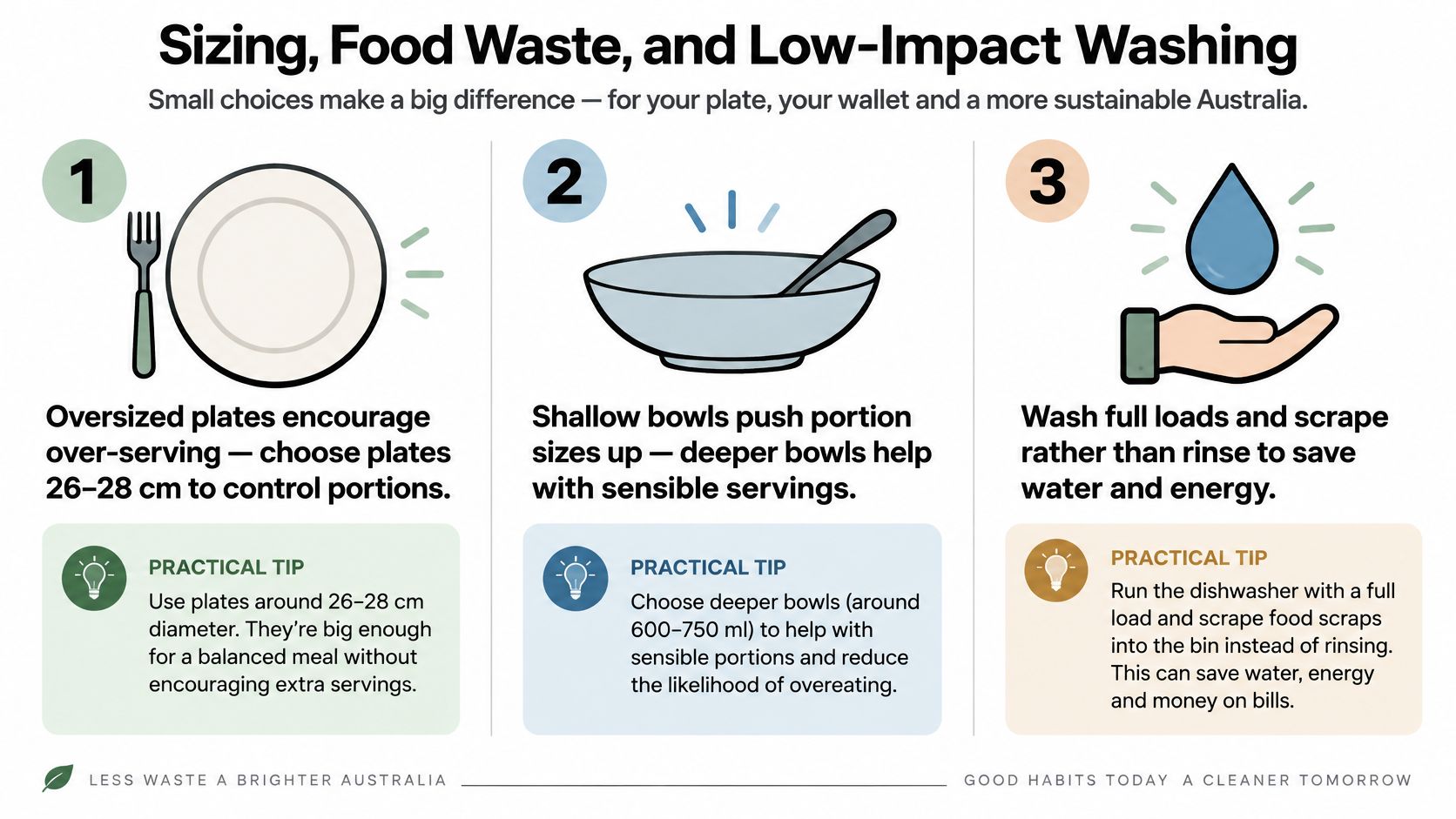
A smaller plate isn't automatically a food-waste solution, and a deeper bowl isn't automatically a sensible portion. What matters is how you serve, eat and handle what remains. Choose geometry that helps you recognise a comfortable serving rather than filling every available surface.
Australia wastes more than 30% of purchased food, with households responsible for approximately 2.54 million tonnes annually, while modern dishwashers can clean a full 15-place-setting load using less than 10 litres, according to Australian Government guidance on reducing waste. That guidance also recommends scraping instead of pre-rinsing and notes that modern dishwashers often use less water and energy than handwashing.
Test portions with your actual meals
Serve a familiar meal into a dish you already own and notice the result. Does the food look lost, prompting you to add more? Does a narrow, deep bowl hide how much you've served? These observations are more useful than assuming a particular silhouette controls appetite.
The infographic offers prompts for reviewing your routine. Its portion-control messages aren't universal rules: neither a diameter nor bowl depth guarantees an appropriate serving.
Make the washing routine part of the purchase
Before committing to a set, check whether the pieces can sit securely in your dishwasher. Bowls that occupy awkward spaces may make it harder to assemble an efficient load.
- Scrape first: Remove food scraps rather than routinely pre-rinsing.
- Load effectively: Leave access for washing water and follow the machine's loading diagram.
- Choose the appropriate cycle: Use the eco programme where suitable for the load and appliance instructions.
- Avoid unnecessary transfers: If a bowl is suitable for covered leftover storage, consider whether it can serve that purpose without using another container.
A sustainable purchase should work with your washing habits, not depend on an ideal routine you're unlikely to maintain.
For leftovers, food-storage safety still comes first. A convenient dinner bowl isn't automatically suitable for refrigeration, reheating or prolonged storage.
Care, Storage, and When to Retire a Piece
Inspect dinnerware when it's clean and dry, before returning it to the cupboard. Look along rims, inside bowls and around the base. Good lighting makes this easier than checking a plate while you're already serving dinner.
Protect pieces during everyday handling
Follow the manufacturer's cleaning instructions rather than improvising a universal care routine. In the dishwasher, position pieces securely so they won't knock against each other, and check that tall plates don't obstruct moving parts.
For storage, choose stacks you can lift comfortably. If you use felt or cork separators for special pieces, keep them clean and dry. Avoid wedging unlike shapes tightly together just to make the cupboard appear tidier.
- Keep daily pieces accessible: Don't make breakfast depend on lifting a heavy serving platter.
- Respect temperature limits: Avoid abrupt temperature changes unless the manufacturer explicitly permits the transition.
- Separate special finishes: Keep decorated pieces with their care instructions so they aren't accidentally put through unsuitable heating or washing.
- Check awkward cupboards: Use this guide to storing plates and bowls to plan a more manageable arrangement.
Distinguish cosmetic marks from damage
A mark isn't necessarily a crack, and a clean-looking surface isn't proof that it remains suitable for food contact. If you can't identify a change, set the piece aside and ask the supplier rather than testing increasingly harsh cleaning methods.
The food-contact principles discussed earlier support a clear response to chips and cracks: withdraw the piece from food use. Crazing, flaking decoration or an altered surface also warrants investigation, particularly where it affects the area touching food.
Retirement cue: Don't wait for a damaged plate to break completely before taking it out of service.
Keep a practical distinction between sentimental value and serving suitability. A much-loved bowl can remain meaningful on a shelf without continuing to hold breakfast.
Putting It All Together
The most useful dinnerware purchase isn't necessarily a complete set. It may be a replacement for a damaged plate, a better-shaped bowl or a smaller collection that you can store without frustration. Start with the problem you can identify, not a general feeling that everything should match.
Make the decision in a practical order
Choose the material against your requirements. Use the material comparison to decide which questions matter most for your household. Handling, appearance and documented performance deserve consideration together.
Choose the shape against your menu. Use the category guidance to compare the meals you cook with the pieces you're considering. Check the usable centre, comfortable fill and cupboard footprint rather than relying on a product name.
- Verify the purchase: Use the food-safety checklist to request the relevant documentation before ordering.
- Check the household fit: Apply the set-building advice to avoid unwanted extras.
- Plan the routine: Check dishwasher placement and storage before expanding the collection.
Leave room to learn from daily use
If possible, try an individual piece before buying the wider range. Carry it, eat from it and place it where it will live. A dish that feels right in a shop may still be inconvenient beside your existing bowls.
You don't need to reject colour, handmade finishes or a distinctive table setting. You need to separate what you enjoy looking at from what you can verify about everyday performance.
That distinction makes shopping calmer. You can appreciate an attractive glaze while still asking for documentation, or enjoy a mixed table without replacing pieces that already serve you well. Buy for real meals, verify the intended use, and make the care routine achievable.
Everti is a Melbourne-based brand offering titanium essentials for the kitchen and table, including tableware, cookware and cutting boards. Visit Everti to compare the available pieces with your everyday meals, then check product dimensions and care instructions before choosing what belongs in your kitchen.