

You're standing in the kitchen with a new non stick pot set on the bench, wondering whether the “healthy”, “stone”, or “PFAS-free” label means anything beyond attractive packaging. The first meals are easy. Eggs slide out, pasta doesn't cling, and cleaning takes minutes. Then a fork slips, the dishwasher gets involved, and the surface starts looking tired long before the rest of the set does.
That is the core buying decision in Australia. You are not just choosing a brand. You are choosing how much day-one convenience you want, how much wear you'll tolerate, and what you'll do when the coating fails. A coated set may be the right tool for a short-term rental or a busy weeknight kitchen, but an uncoated option can make more sense if you're tired of replacing pans and throwing materials away.
What a Non-stick Pot Set Actually Is in Today's Market
Australia has a substantial cookware market, and non-stick products sit at its centre. The country's nonstick cookware market was estimated at USD 338.3 million in 2024 and is projected to reach USD 557.7 million by 2030, with a projected 8.7% CAGR from 2025 to 2030, according to Australia's pots and pans market analysis. Pans and woks were the largest product segment, accounting for 52.68% of revenue in 2024, so a non stick pot set is part of a broad, pan-heavy category rather than a niche purchase.
Australian cookware research also estimates that non-stick cookware represents about 40–45% of units sold in the wider pots-and-pans market, while imports supply roughly 85–95% of domestic cookware consumption by value, as reported in GreenPan Australia's discussion of PFAS and cookware. That combination gives shoppers plenty of choice, but it also makes packaging claims harder to compare. You're often choosing between a sprayed surface, a bare metal surface, or a material positioned as an alternative to both.
The three decisions that matter
Start with the surface, not the colour or the number of pieces in the box.
- Coated metal: PTFE, ceramic and enamel-coated cookware give you a finished surface over aluminium or steel. They're convenient, but the surface is a wear component.
- Uncoated metal: Stainless steel, cast iron and carbon steel have no synthetic release layer to peel away. They demand more technique, but the cooking surface remains the material itself.
- Solid titanium: A titanium pan avoids a separate coating altogether. It behaves differently at first and needs a cooking routine that builds release over time.
A good kitchen-material guide, such as top green remodeling choices, is useful when you're thinking beyond the product label and considering durability, material choice and disposal. The same principle applies here. “PFOA-free” doesn't mean every fluorinated compound is absent, while “ceramic” doesn't guarantee a surface that will remain slick indefinitely.
Before buying, ask a blunt question: would I rather manage a coating carefully, or learn an uncoated surface once and keep using it? The answer matters more than a fashionable finish. You can also compare construction details and care requirements in this guide to non-stick pots and pans, especially if you're weighing a conventional set against a solid-metal alternative.
Coating Types Compared and Why They Fail
The coating determines how the set cooks on day one and how it eventually leaves your kitchen. Treat it as the main engineering decision, not a decorative feature.
| Coating | Base Material | Max Safe Temp | Typical Lifespan | Dominant Failure Mode |
|---|---|---|---|---|
| PTFE | Usually aluminium | Keep below the manufacturer's stated limit and avoid overheating empty cookware | Variable, depending on heat, utensils and washing | Abrasion, loss of release and surface damage |
| Ceramic | Usually aluminium or steel | Follow the manufacturer's temperature limit | Variable, often shorter than owners expect | Loss of release, staining, cracking or thermal-shock damage |
| Enamel | Steel or cast iron | Depends on the vessel and manufacturer | Long-lasting body, but not genuinely non-stick | Chipping, staining and sticking |
PTFE remains the slickest option
PTFE, or polytetrafluoroethylene, is a fluoropolymer bonded to a metal base, commonly aluminium. It gives the most effortless release of the three coated options, especially for eggs, delicate fish and low-fat cooking. That convenience is why it remains so common.
The trade-off is physical wear and heat discipline. Don't heat an empty PTFE pan aggressively, don't use metal utensils, and don't assume dishwasher cleaning is harmless. The surface can lose its release through abrasion, repeated high heat and rough handling long before the aluminium body becomes unusable.
Ceramic starts clean and often declines sharply
Ceramic non-stick surfaces are generally sol-gel coatings, often based on silica chemistry, applied over a metal body. They're attractive to shoppers who want to avoid conventional fluoropolymer coatings, and they can feel exceptionally smooth when new.
Ceramic's weakness is performance retention. High heat, cooking sprays, abrasive washing and sudden temperature changes can accelerate surface decline. A ceramic pan may still look presentable after it stops releasing food well, which makes the failure especially frustrating. You're left with a sound-looking pot that needs oil for tasks it once handled dry.
Enamel is durable, but don't call it non-stick
Enamel-on-steel and enamel-on-cast-iron cookware provide a hard, coloured glass-like surface. They're useful for acidic foods, braises and attractive serving pieces, but they don't offer the slick release associated with PTFE. Eggs and sticky rice will still behave like eggs and sticky rice.
Bare stainless steel, carbon steel and cast iron sit outside the coating comparison. They can develop better release through heat control, seasoning or cooking fat, but they won't deliver the frictionless first-use experience of PTFE.
Buying rule: Choose the coating for its failure behaviour, not its launch-day smoothness.
The practical conclusion is uncomfortable but simple. Coated cookware turns durability into a managed-wear problem. You're buying convenience now and accepting that the release layer, rather than the whole pot, has a service life.
PFAS-Free Claims and What Lab Testing Reveals
Packaging language often compresses a complicated chemistry question into a reassuring badge. “PFOA-free” names one particular compound and doesn't establish that every PFAS compound is absent. “PFAS-free” is a broader claim, so it should come with clear evidence about what was tested, which laboratory performed the work, and what detection method was used.
CHOICE testing found a wide spread in total fluorine readings from conventional non-stick pans. Earlier pilot samples returned readings from 310,000 to 730,000 mg/kg, equivalent to 31–73%, while products marketed as PFAS-free measured 16 to 620 mg/kg, according to CHOICE's analysis of PFAS-free claims. Those figures don't identify every individual compound, but they show why a marketing phrase shouldn't replace material verification.
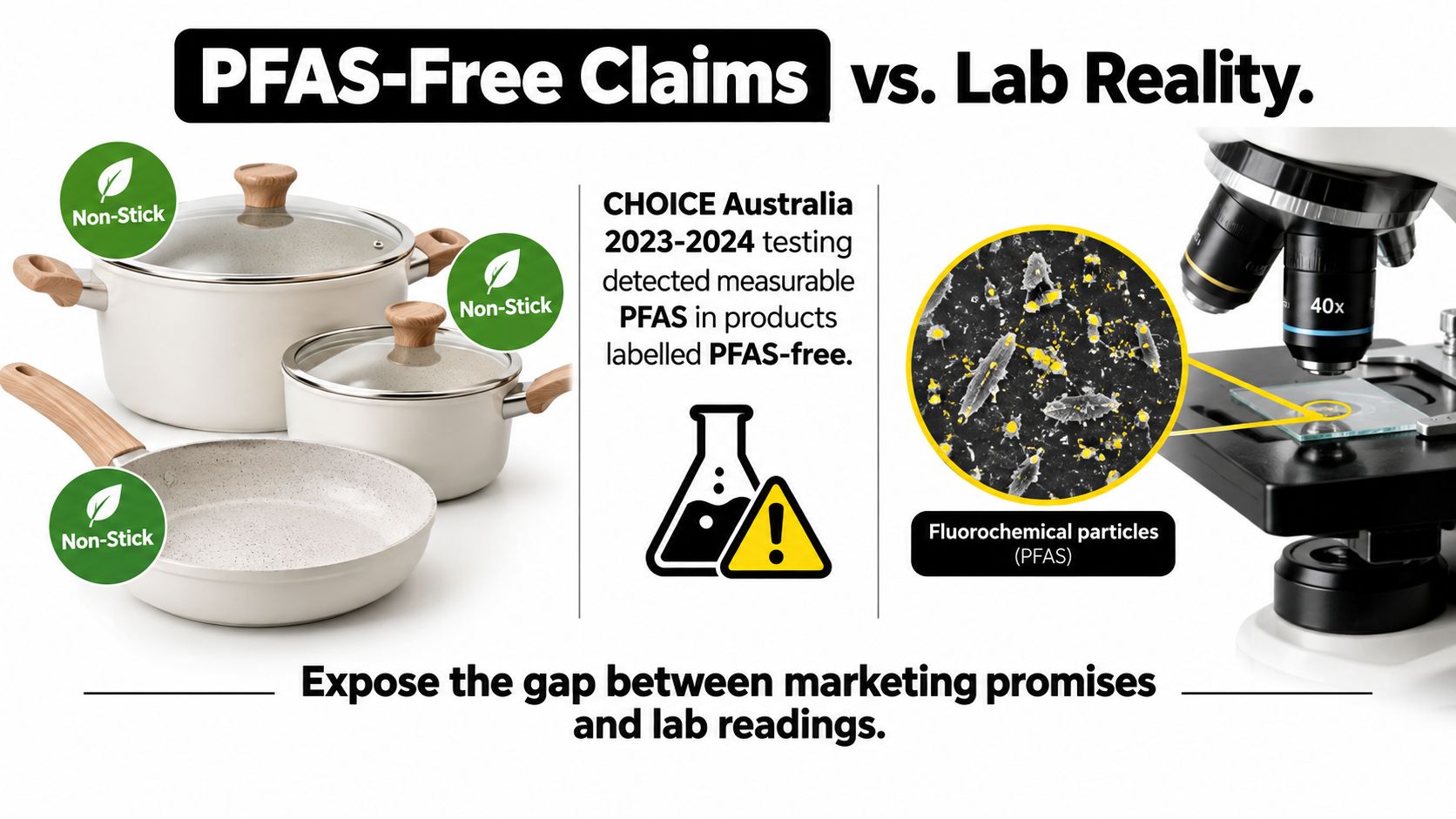
A fluorine result is a screening signal, not a direct prediction of what a meal contains. It tells you that fluorine was detected in the tested material, but it doesn't by itself explain whether the source was a deliberately added PFAS coating, processing residue or another fluorinated substance. That's why the test method and the manufacturer's declaration matter.
Questions that expose weak claims
Ask the retailer or manufacturer:
- What exactly was tested? “PFOA-free” isn't the same statement as “PFAS-free”.
- Was the finished cookware tested? A raw coating certificate may not represent the applied surface, printing or other components.
- What does the report measure? Total fluorine is useful for screening, but it isn't a complete compound-by-compound identification.
- Who performed the test? Look for a named, independent laboratory and a report that matches the product.
- Does the claim cover the entire set? Lids, rivets, exterior finishes and different pan sizes may not share identical construction.
Australian Consumer Law requires PFAS-free claims to be truthful and evidence-based, but CHOICE notes that there isn't one universal substantiation framework. That leaves shoppers doing more work than they should. If a box uses several vague phrases, displays no testing details and leans heavily on green imagery, treat it as a prompt to investigate rather than proof of anything.
For a plain-language explanation of the fluoropolymer commonly used in conventional non-stick cookware, read what PTFE and Teflon mean. The sensible position isn't panic. It's precision. Buy based on verified construction, intended heat limits and realistic wear, not on a single reassuring word.
A visual explanation of how claims and material testing can diverge is also available here:
How Long Non-stick Coatings Really Last
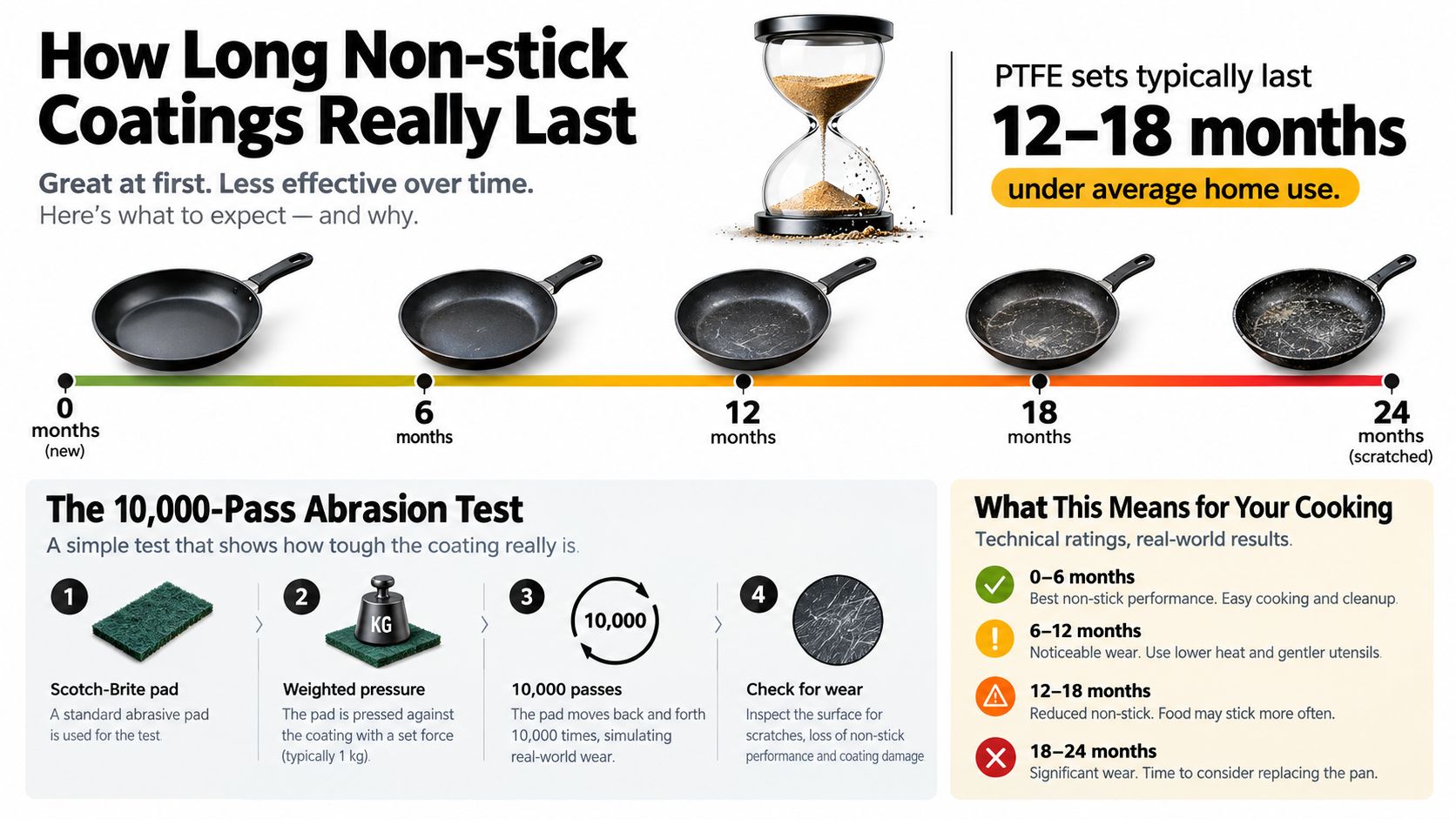
A coating's advertised durability means little unless you understand the test behind it. In Australia, CHOICE's leading consumer test method for non-stick frypans uses a 10,000-pass mechanical abrasion benchmark with a Scotch-Brite scourer under a 10 kg load. Durability contributes 25% of the overall frypan score, alongside 50% performance and 25% ease of use, as explained in CHOICE's induction cookware testing method.
That test doesn't mean your pot will last exactly 10,000 cooking events. It creates a repeatable stress test so one product can be compared with another. Your kitchen adds different pressures, including pan stacking, sharp utensils, burnt-on residue, dishwasher detergent and heat spikes.
Recognise the end before the food does
A failing coating rarely announces its retirement. It becomes less dependable until every meal feels like a test.
Look for these signs:
- Release has changed: Eggs need oil, fish tears, and rice leaves a stubborn film.
- The surface looks cloudy: Patchy gloss, dull zones or discolouration indicate uneven wear.
- The coating is visibly damaged: Scratches, chips or lifting around rivets mean the surface is no longer intact.
- Particles appear: Grey or black flecks in food are a clear reason to stop using the pan.
- Cleaning gets harder: If gentle washing no longer removes ordinary residue, the release layer has lost its function.
Once the release layer has degraded, cleaning won't restore it. Seasoning may make some uncoated materials more forgiving, but it won't rebuild a damaged manufactured coating. Replace coated cookware when the surface flakes, peels or repeatedly sticks, rather than trying to extract a few more frustrating meals from it.
The Titanium Alternative That Skips Coating Entirely
The most direct way to avoid coating failure is to remove the coating. Solid titanium cookware has no PTFE film, ceramic sol-gel layer or PFOA treatment between the food and the pan body. That changes the ownership model from replacing a worn surface to learning how the metal cooks.
Everti describes its cookware as 99.7% pure titanium and provides an SGS-verified material certificate. The important point is construction. The food-contact surface is the same metal throughout the pan body, not a sprayed layer bonded over another substrate. You can read the product approach in Everti's titanium cookware set guide.
Titanium won't behave like a brand-new PTFE pan straight from the box. It can stick if you use high heat, add food before the surface is ready or expect dry cooking immediately. A controlled seasoning routine builds a polymerised oil layer, and regular use develops a patina that can improve release rather than gradually stripping away as a coating does.
Material comparison
| Property | Titanium (Everti) | PTFE Non-stick | Ceramic Non-stick |
|---|---|---|---|
| Food-contact surface | Solid titanium | Fluoropolymer coating over metal | Ceramic sol-gel coating over metal |
| Initial release | Requires heat and oil technique | Very slick from first use | Slick when new |
| Scratch tolerance | High compared with coated surfaces | Needs gentle utensils | Needs gentle utensils |
| Main wear concern | Cooking technique and surface patina | Abrasion and overheating | Loss of release and surface damage |
| Coating-related end of life | None | Replace when coating fails | Replace when coating fails |
| Material verification | Product certificate supplied by the brand | Varies by manufacturer | Varies by manufacturer |
The learning curve is the price of permanence
Season titanium gradually. Heat the pan moderately, use a thin film of suitable cooking oil, let the oil polymerise through repeated use, and avoid treating the first meal as a laboratory demonstration. Eggs may need more fat and patience at the beginning, but the surface becomes more forgiving as the patina develops.
That makes titanium a poor choice for someone who wants zero technique and a slick surface tonight. It's a strong choice for a cook who wants to stop replacing sets because the release layer has worn out. The end-of-life question is also simpler. Titanium is a metal that can enter scrap-metal recovery streams, rather than a coated pan that requires special handling because the surface can complicate recycling.
Don't buy titanium because a label promises effortless non-stick cooking. Buy it because you prefer a durable, uncoated cooking surface and are prepared to use it properly.
Matching the Right Set to Your Kitchen Habits
There isn't one sensible non stick pot set for every Australian kitchen. Your cooking frequency, cooktop, storage and tolerance for technique should decide the purchase.
| Kitchen Scenario | Recommended Set Type | Expected Lifespan | Best For |
|---|---|---|---|
| Fast weeknight meals | Mid-range PTFE set | Short to moderate service life | Eggs, pasta, quick sautés and low-fat cooking |
| Small kitchen | Compact ceramic set | Shorter service life than many owners expect | Limited storage and occasional use |
| Induction cooktop | Induction-compatible coated or uncoated set | Depends on surface and construction | Kitchens that require magnetic bases |
| Long-term value focus | Solid titanium set | Designed around long-term use rather than coating replacement | Braises, rice, soups and regular cooking |
| Rental or short-term home | Budget PTFE set | Suits temporary ownership | Low upfront cost and immediate release |
| Children learning to cook | Scratch-tolerant uncoated set | Long service potential with proper use | Kitchens where utensil mistakes are likely |
For weeknight speed
A mid-range PTFE set is still the practical choice if you cook quick meals and want easy release immediately. It handles eggs and delicate foods with less technique than stainless steel or titanium, and it makes sense when the purchase is judged over a shorter ownership period.
Don't pay extra for a massive collection if you only use a frypan and one saucepan. More pieces mean more storage, more stacking and more surfaces that can be damaged.
For small kitchens
A compact ceramic set can reduce cupboard clutter, particularly if you cook occasionally and value a lighter, visually tidy collection. Go in with realistic expectations about release retention and use low to medium heat, hand-washing and protective storage from the beginning.
If your cooktop is induction, check the actual base rather than relying on a general “all cooktops” claim. The cookware needs a ferromagnetic component to work correctly. Many aluminium-based non-stick and ceramic designs require a steel induction plate, and some sets aren't compatible.
For long ownership
Choose solid titanium when your priority is an uncoated surface and you're willing to build skill. It suits soups, rice and braises particularly well because those foods reward steady heat and controlled cooking rather than instant egg-slide performance.
Families should consider the utensil reality. A coated set needs protection from accidental metal contact, while titanium is more forgiving when someone reaches for the wrong spoon. That doesn't make poor heat control harmless, but it removes one common route to scratching a release layer.
Maintenance and End-of-Life Handling
Care determines whether a coated set remains useful or becomes a cupboard burden. The routine is simple, but only if everyone in the household follows it.
Wash coated cookware by hand with warm water, mild detergent and a soft sponge. Use silicone, wood or other manufacturer-approved utensils, keep heat low to medium, avoid aerosol cooking sprays and place protectors between stacked pieces. Let a hot pan cool before washing it, because sudden temperature changes can warp the base or stress the surface.
Practical rule: If you wouldn't use a tool on a delicate glass surface, don't use it on a non-stick coating.
Dishwashers are convenient, but detergent, heat and movement can shorten the useful life of a coated surface. A dishwasher cycle may not destroy a pan immediately, yet repeated exposure adds unnecessary wear. Hand-washing is the sensible default when preserving release matters.
Know when replacement is the responsible option
Stop using the set if you see coating lifting, flaking, deep scratches or exposed base metal. Persistent sticking is also a functional warning, especially when it continues after gentle cleaning and correct heat control. CHOICE advises discarding damaged or flaking cookware, so don't scrape at a loose edge and keep cooking around it.
Repair usually isn't realistic for a factory-applied coating. A replacement may be the only safe practical solution once the food-contact surface has failed. Keep the lids if they remain sound, but don't keep a damaged pot in service just because the lid still fits.
Plan disposal before buying
Pots and pans don't belong in household recycling bins, according to CHOICE's guidance on worn cookware. Local options may include council programs, Recycle Smart, retailer take-back schemes, scrap-metal specialists and dedicated reuse channels. Check the available route before putting a coated pan in the bin, because the coating and mixed materials can complicate ordinary recycling.
The ownership cost of a non stick pot set includes replacement and disposal, not just the checkout price. If you choose coated cookware, protect it and accept its finite surface life. If you want to remove that recurring failure point, compare the care required for an uncoated titanium set with the cost and inconvenience of repeated replacements.
Everti offers uncoated titanium cookware for cooks who want a durable alternative to PTFE and ceramic surfaces, with material verification supplied by the brand. If you're ready to stop treating worn coatings as an unavoidable kitchen expense, visit Everti and compare its titanium range.