

If a scalloped edge looks easier to eat from, does that really help you gather food, carry the plate, or wash it clean? That's the question most styling advice skips. A wavy rim changes the outline of a plate, but it doesn't automatically change how well the plate works.
This guide separates look from function. You'll learn what the scallop does and doesn't do, how it compares with a straight rim, which standards matter in Australia, and how to test a plate before you commit to a set of scalloped dinner plates.
Where Scalloped Plates Came From and What the Edge Does
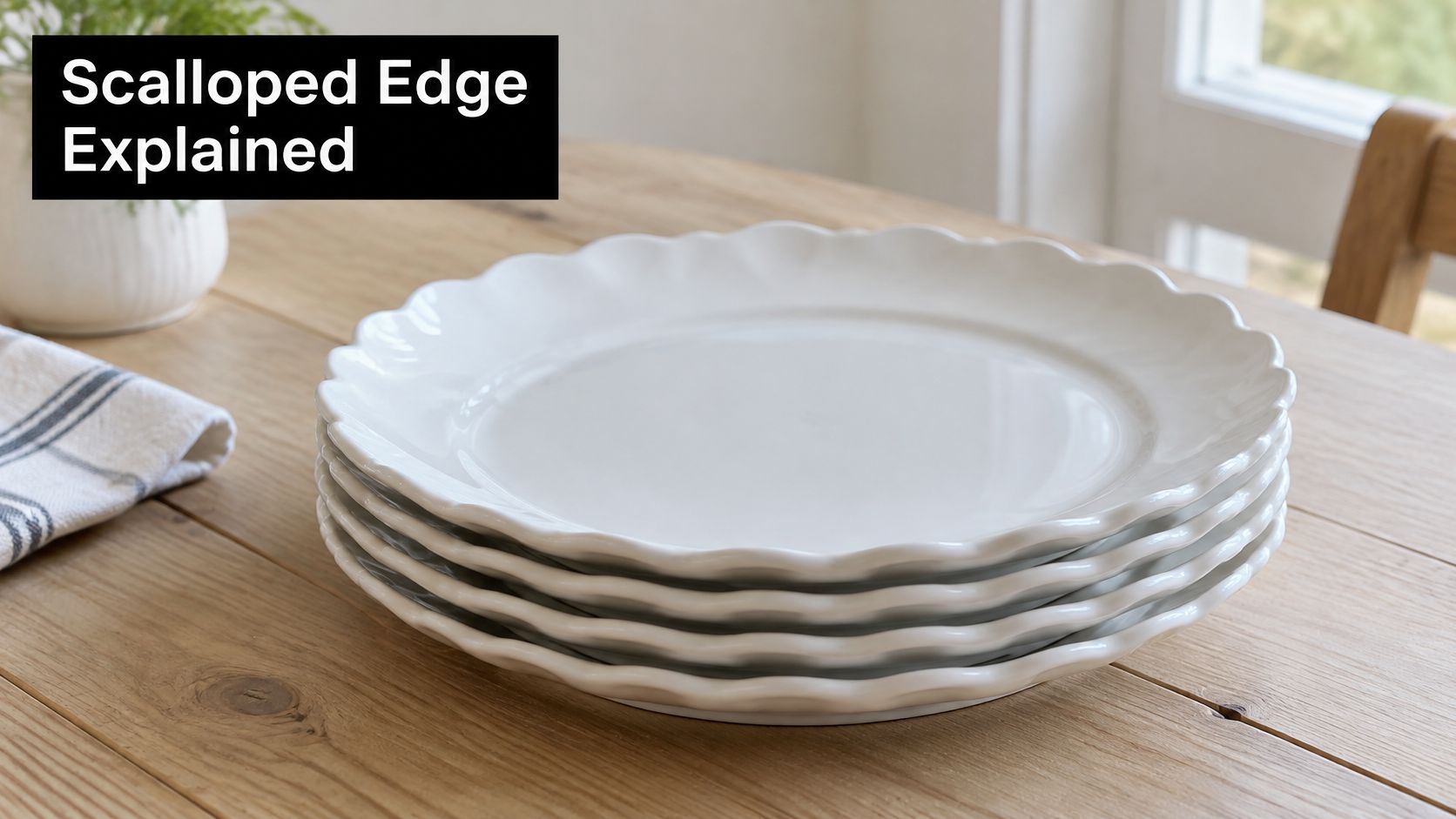
A scalloped dinner plate has a rim that rises and dips in a row of rounded waves instead of running as one continuous circle. Think of the crimped edge of a pie crust. The flat centre, called the well, and the raised outer rim are still there. The scallop changes only the outline, not the basic job of holding food.
Australian examples sit inside a mixed local and imported history. The National Museum of Australian Pottery collection of more than 2,500 objects from 133 Australian pottery companies between 1788 and 1920 includes bread plates, jugs and cheese covers. That record shows decorative plate forms were part of a wider move from imported tableware toward locally made household ceramics, even as imports remained important.
Why an Old Plate in Australia May Not Be Australian Made
During the nineteenth century, Australia's ceramic market rarely exceeded 2% of British ceramic exports, and approximately 80% of those British wares were ironstone made in Staffordshire. Ironstone, transfer printing and lower cost production made durable ware easier to ship long distances. The end of Mason's patent in 1827 also helped ironstone become popular everyday tableware in Britain and overseas markets like Australia.
So a scalloped plate in an older Australian home might reflect three things at once. It could have been made in Britain, sold through a local shop, and chosen because it suited colonial taste. Design availability isn't the same as local manufacture, and that distinction stops people misreading age or origin from shape alone.
A scalloped edge is a design choice, not proof of quality, age or place of manufacture.
Today, judge the plate in your hand, not its silhouette. Rim construction, glaze condition and documented testing tell you more than the wave does. The same caution applies to other scalloped home pieces, which is why guides on topics like how to size scalloped mirrors focus on measuring the actual outline rather than assuming the decorative edge behaves like a straight one.
Which Suits Your Table
The short answer is simple. Scalloped rims usually win on presentation, while straight rims usually win on storage, cleaning and day to day wear. The table below puts scalloped dinner plates and straight rim plates side by side on the same criteria, so you can see where the trade off lands for your household.
| Factor | Scalloped rim | Straight rim |
|---|---|---|
| Look and style | Decorative, traditional or romantic, reads as a feature | Clean and minimal, reads as modern or neutral |
| Stacking and storage | Waves can stop plates nesting flush, using more shelf space | Nests tightly, stores in less space |
| Chip exposure | Several peaks, so more edge points where a knock can start | One continuous edge with fewer exposed points |
| Cleaning time | Recesses need a brush and a visual check | Wipes in one pass, easy to inspect |
| Matching other ware | Works best as a statement plate beside plain pieces | Pairs with almost any set, including mixed sets |
| High-turnover or commercial use | Harder to keep consistent across many washes | Easier to standardise and inspect at scale |
| Best fit | Formal settings, display, photography, occasional use | Daily family use, heavy dishwashing, commercial service |
The Rows That Surprise Most Buyers
Stacking catches people out first. You measure the diameter, assume eight plates will sit like your current set, then find the waves lift each plate slightly off the one below. That extra height matters in a shallow drawer, a plate rack, or a cupboard where you're already close to the shelf above. If you can, stack four in the shop and compare the height with a straight rim set.
Chip exposure is the second surprise. Picture a smooth wall versus a row of small peaks. A straight rim spreads contact along one continuous edge, while each scallop peak is a separate place where a knock against a tap, bench or another plate can land. That doesn't make every scalloped plate fragile. It means rim thickness and finish matter more, because there are more exposed points to protect.
Cleaning follows the same logic. A straight rim lets you wipe, glance and put the plate away. Scallop recesses ask for a brush and a second look, especially after sauced or oily food. If you're washing for a large family every night, that small extra step adds up.
Matching is easier to manage. A scalloped plate works best as the statement piece beside plain side plates, bowls and glassware. A straight rim is more forgiving if you mix sets, replace breakages, or borrow extra pieces for a crowd.
Don't let outline decide everything on its own. Rim height and inner shape often affect eating more than the wave does, and material and testing affect durability more than style. Use the table to narrow your likely fit, then apply the checks in the following sections to the exact model you're considering.
Does the Scallop Help Diners or Only Look Good
Many buyers assume a wavy edge must help scoop food. It might, but only in limited circumstances, and it's not the same as a plate designed for easier eating. The key distinction is between a shallow decorative scallop on the outer outline and a defined raised inner rim that food can be pushed against.
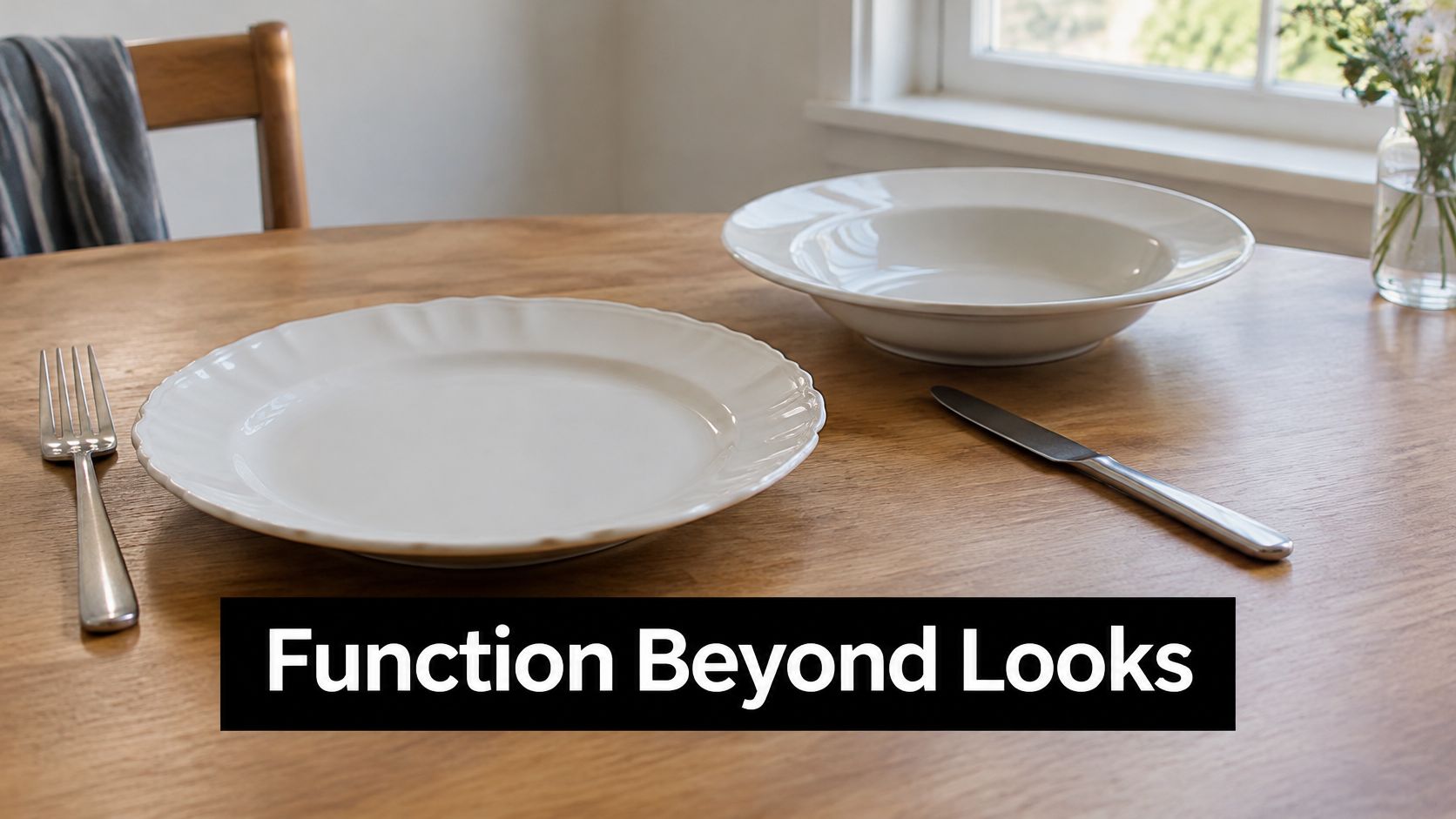
Australian adaptive tableware guidance indicates that raised or built-up rims can support one-handed eating, reduce spillage, and assist people with limited dexterity, tremors, low vision, or reduced coordination. Notice the words raised and built up. A continuous inner lip gives peas or rice somewhere to stop when a spoon or fork pushes them across the plate.
A shallow outer scallop may not do that job. Its interrupted profile has dips where food or a utensil can slip through, and the highest points may sit outside the area where you're gathering food. It can look helpful while adding little practical support.
What to Measure for Independent Eating
For older Australians, people with arthritis, and diners with motor impairments, look beyond appearance. The measures that matter are these:
- Rim height and continuity: A defined, unbroken inner edge is easier to scoop against than separate waves.
- Plate stability: A plate that slides forces the diner to chase it, and a non slip base is a separate feature from the rim.
- Colour contrast: Food should stand out clearly against the plate for diners with low vision.
- Weight and grip: The plate still needs to be lifted, carried or steadied safely, sometimes with one hand.
- Depth and slope: Deep or sloped sides can help contain food, but they perform a different function from decorative scalloping.
A Simple Test You Can Run
Put the same foods on a scalloped plate and a straight rim or raised rim plate. Try peas, rice, pasta and a sauced dish, because each moves differently. Scoop with one hand, then with the utensils the diner normally uses, and watch where food gathers, where it escapes, and whether the plate shifts on the table.
Practical rule: If food slips through the dips or the plate moves while scooping, the scallop is decoration for that diner, not assistance.
An ornamental scallop shouldn't be treated as equivalent to purpose built adaptive tableware. Some diners may enjoy scalloped dinner plates and manage them well. Others will do better with a continuous raised rim, a stable base and a shape matched to their hands, vision and usual meals.
Materials and Standards Worth Checking Before You Buy
Material decides how a scalloped rim copes with knocks, heat and repeated washing. Shape gets the attention in photos, but the ceramic body and glaze do the work. If you're comparing scalloped dinner plates, start with what they're made from, then look for documented performance.
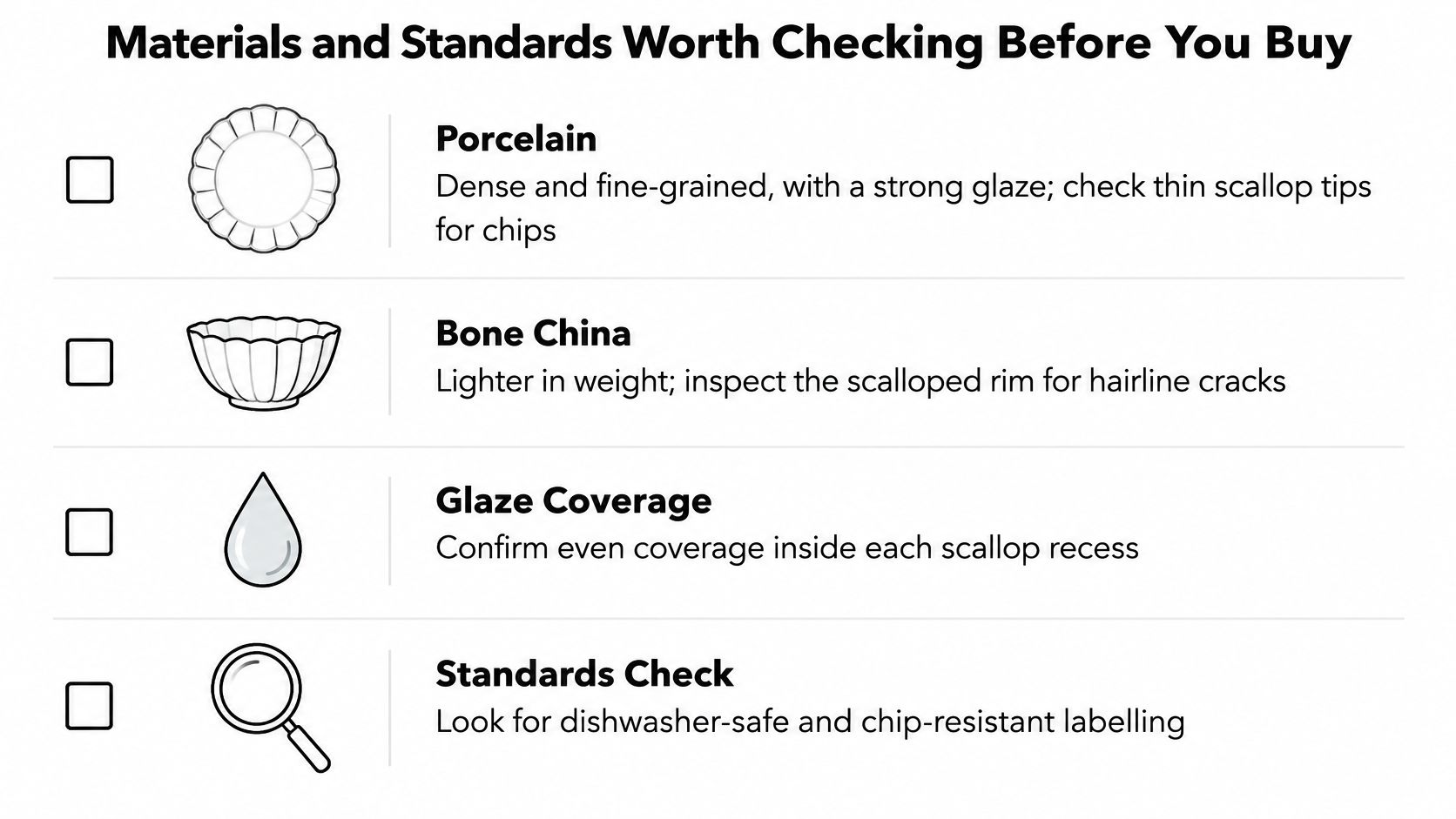
Porcelain is dense and fine grained, and it's common for dinnerware because it takes a smooth, strong glaze. Thin scallop tips can still chip if they take repeated contact. Bone china is lighter and often translucent, which suits formal settings, but delicate peaks deserve careful inspection for hairline cracks. Stoneware is thicker and heavier, with a sturdier feel for casual use, though it usually looks less refined. Ironstone is heavy and durable, the sort of ware that historically suited long distance trade and everyday service.
None of those names guarantees a good plate. Firing quality, rim thickness, glaze adhesion and the finish inside each recess can vary within the same material category. A well made porcelain plate may outlast a poorly finished stoneware one, and a thick rim may cope better than a thin decorative peak.
The Australian Standard That Matters
In Australia, ceramic tableware should be assessed against AS 4371:2012, which addresses chipping and thermal shock and sets maximum permissible lead and cadmium release limits for general use ceramic tableware. Those two performance areas are especially relevant here. More edge geometry means potentially more impact sites than a plain continuous rim, so small chips can start during stacking, handling or dishwashing and worsen with later knocks.
Thermal shock is about sudden temperature change. When a plate moves between hot food, the fridge, a dishwasher or an unevenly heated surface, rapid differences create internal stress. An existing rim defect can act as a stress point and increase the risk of a crack spreading. That's why a tiny chip isn't only cosmetic.
Lead and cadmium limits matter because glaze is the food contact surface, including inside every scallop recess. If you're weighing material safety more broadly, Everti's guide to choosing non toxic dinnerware materials is a useful companion, but you still need the manufacturer's statement for the exact plate.
| Check | What to look for | Why it matters on a scalloped rim |
|---|---|---|
| Standard compliance | Documented compliance with AS 4371:2012 | Confirms chipping, thermal shock and lead and cadmium limits were assessed |
| Chipping performance | Stated test results or a rated impact performance | Scallop peaks are the most exposed points on the plate |
| Thermal shock | Stated resistance to temperature change, with a clear range | Rim defects act as stress points when plates move between hot food and the fridge |
| Lead and cadmium release | Manufacturer statement that release limits are met | The glaze is the surface that contacts food, including inside every scallop |
| Glaze coverage | Fully glazed food surfaces, including scallop recesses | Unglazed texture holds residue and is harder to clean and inspect |
| Appliance ratings | Explicit dishwasher, microwave, oven and fridge limits | A scalloped shape does not prove that a model is dishwasher or oven safe |
| Edge finish | Smooth rim with no sharp burrs or uneven glaze | Rough edges cut hands and are the usual starting point for chips |
Use the checklist as evidence, not as a wish list. Ask for documented compliance and explicit test results, confirm a smooth intact food contact surface, and check appliance limits for that model. Appearance and a material name can't tell you how the rim was reinforced or which temperatures the maker validated.
How to Clean and Inspect Scalloped Plates Safely
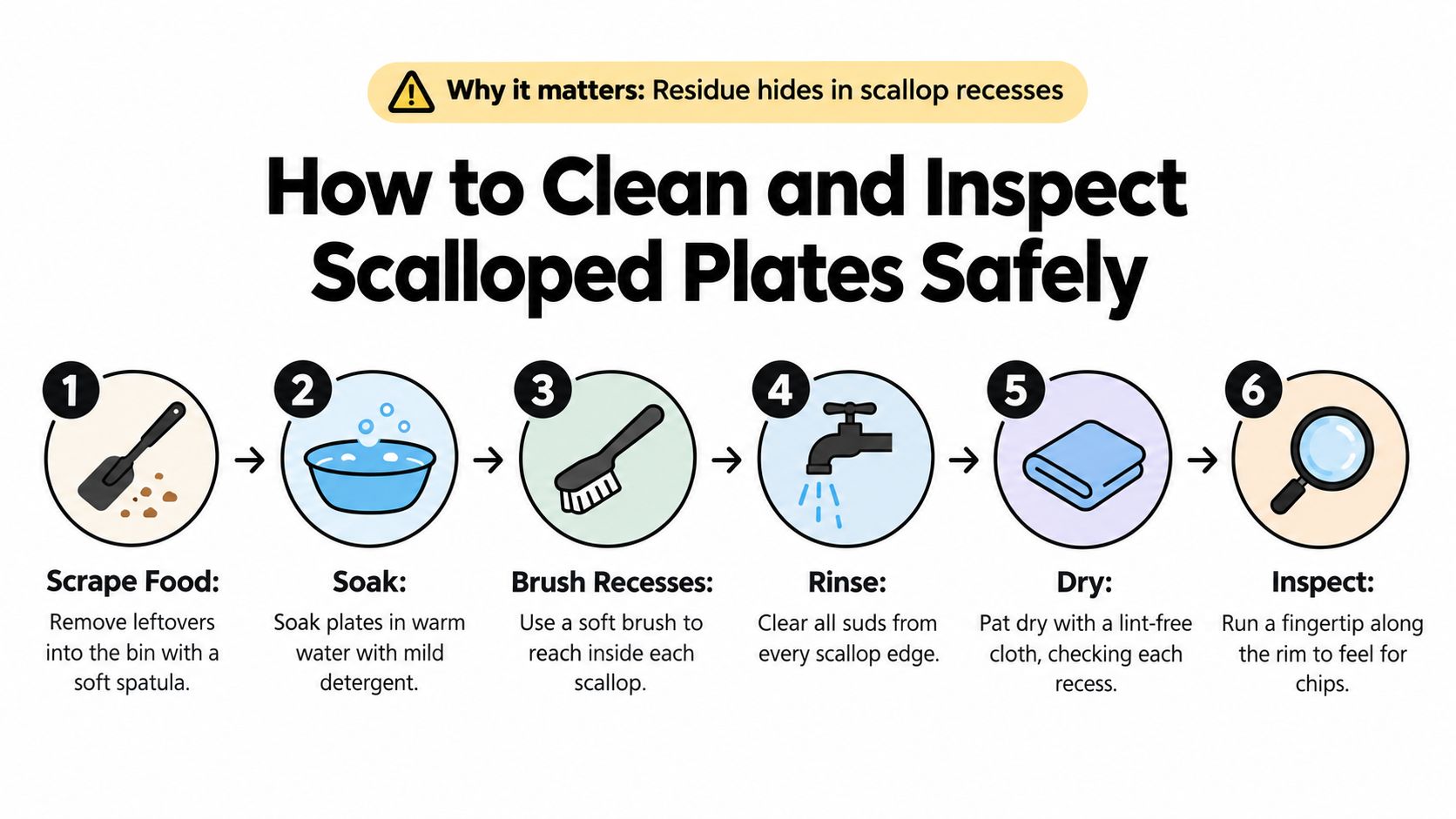
Scallop recesses can hold residue and moisture where you won't see them at a glance. That matters because a plate should have a smooth, easily cleanable, non absorbent food contact surface, and damaged glaze makes washing and inspection less reliable. Australia New Zealand Food Standards Code Standard 1.4.3 permits articles to contact food only when they don't create a foreseeable bodily hazard, a principle reflected in Australian ceramic tableware guidance on contaminant migration and food contact safety.
A Routine That Reaches the Recesses
- Scrape food into the bin first: Use a soft spatula before washing, rather than pushing scraps around the sink. Removing the bulk of food stops recesses filling with loose residue during rinsing.
- Rinse or soak in warm water: Warm water helps lift soft food from each dip before detergent and brushing. Don't leave plates soaking if the manufacturer advises against it.
- Load the dishwasher with space: Face scalloped edges toward the spray and don't let plates nest tightly against each other. Water needs a path into the recesses, and contact between peaks increases chip risk.
- Brush each recess when hand washing: A soft brush reaches where a flat cloth bridges over the dips. Run a fingertip around the edge afterwards to feel for grit, roughness or a missed patch.
- Dry fully before stacking: Moisture trapped between stacked rims can leave odour and residue in the recesses. Air dry or pat dry with a lint free cloth, checking each wave as you go.
- Inspect monthly under good light: Turn each plate slowly, look for chips, cracks and lost glaze, and feel the rim with a fingertip. Peaks and the inner curves deserve the closest look because damage there is easy to miss.
- Retire chipped or cracked plates: Take them out of food service rather than keeping them for everyday use. A chip exposes or roughens the surface, traps residue and can enlarge under repeated impact.
Once glaze is breached at the rim, cleaning gets harder and the defect has a starting point to grow.
Commercial settings should treat that retirement step as an operating rule, not a judgement call at the sink. Smooth cleanable surfaces and resistance to cracking and chipping are practical requirements when many plates move quickly through washing and service. Home users benefit from the same discipline, especially with older or second hand pieces.
Dishwasher, microwave, oven and fridge use should follow the manufacturer instructions for the exact model. A product listing for one scalloped porcelain plate doesn't prove another plate has the same limits. Storage matters too, and Everti's advice on storing plates and bowls without wasting cupboard space can help you separate rims so clean plates aren't chipped before their next use.
Styling Scalloped Plates Without Overcrowding the Table
Treat a scalloped plate like lace on a dress. It works best when the rest of the outfit stays simple, because the eye needs somewhere to rest. If every plate, bowl, napkin and glass is patterned or shaped, the scallop stops reading as a feature and the table starts to feel crowded.
Pair scalloped dinner plates with a plain bread or side plate in a matching or neutral colour. A straight rim side plate in the same finish can sit beside or above the dinner plate without competing. Keep cutlery and glassware simple, then choose one accent colour for napkins or a centrepiece so the setting has contrast without another pattern fighting the rim.
A Layout You Can Copy
For eight settings, place each scalloped dinner plate on a neutral placemat or charger. Add straight rim side plates, plain bowls only if the menu needs them, and clear or lightly tinted glassware. White on white gives a formal look where shadow defines the waves, while blue on white makes the outline easier to see. Busy florals and checks can work, but they need more restraint elsewhere.
If your dining table itself has a shaped edge, Tyner Furniture's scalloped table buying guide is worth reading for proportion and placement ideas before you layer shaped plates on top. Two scalloped outlines can complement each other, but they can also blur together if the colours and scale are too similar.
- Keep one pattern family: Use the scalloped set as the feature rather than repeating waves on every piece.
- Repeat colour, not shape: Echo the plate colour in napkins or glassware to tie settings together.
- Leave breathing room: Space settings so neighbouring rims don't visually merge into one busy border.
For more arrangements that keep the feature piece clear, browse table setting ideas for balanced everyday and formal layouts. Then do a quick final check. Remove one piece from a setting, step back, and see whether the scallop reads more clearly. If it does, leave that piece off the table.
Confirm the Right Plate Before You Buy
Choose by use, not by photo. For family daily use, pick a straight rim or a shallow scallop with fully glazed recesses, documented AS 4371:2012 compliance and clear dishwasher ratings. You'll value easy stacking, quick inspection and a rim that tolerates frequent handling.
For dinner parties, display or photography, a scalloped plate is a good choice if the rim is intact, glaze coverage is complete and appliance limits are confirmed. Occasional use gives you the look without asking the edge to cope with constant stacking and washing.
For commercial or high turnover service, favour a straight rim with documented chipping and thermal shock results. Staff need to inspect and standardise many pieces quickly, and damaged items need to leave service without debate. A simpler edge makes that system easier to run consistently.
For adaptive dining, test before you buy. Use peas, rice, pasta and a sauced dish, and look for a raised, continuous inner rim and a stable base rather than relying on a decorative scallop alone. The right plate is the one the diner can use comfortably with their usual utensils and foods.
Reject any plate that can't document the checks you need, even if the shape is exactly what you wanted.
Take the buyer checklist from the materials section to the shop or product page. Match standard compliance, glaze coverage, edge finish and appliance ratings to the model in hand, not to a similar looking plate in the same range. This week, confirm those three essentials, compliance, glaze and ratings, before you order a full set.
If you're building a table around hygienic, long lasting materials, Everti offers SGS verified titanium kitchen and table essentials designed in Melbourne for clean, durable everyday use. Compare its uncoated cutting boards, cookware, drinkware and tableware against the same principles used here, documented material quality, smooth cleanable surfaces and clear care limits, then choose the pieces that fit how you cook and serve.