

You're standing at the stove with a saucepan in one hand and a spoon in the other, trying not to scratch the pan while the sauce thickens. A silicone cooking spoon looks like the easy answer, but the question isn't whether it looks soft or feels heatproof, it's whether the specific spoon in your hand was made, tested, and documented well enough to earn your trust.
What a Silicone Cooking Spoon Is Made Of
A good silicone spoon usually earns its place through simple construction. It is often moulded as one piece, so sauce has fewer places to hide, there is no metal edge to clang against a pan, and there is no rigid coating that can chip after repeated use.
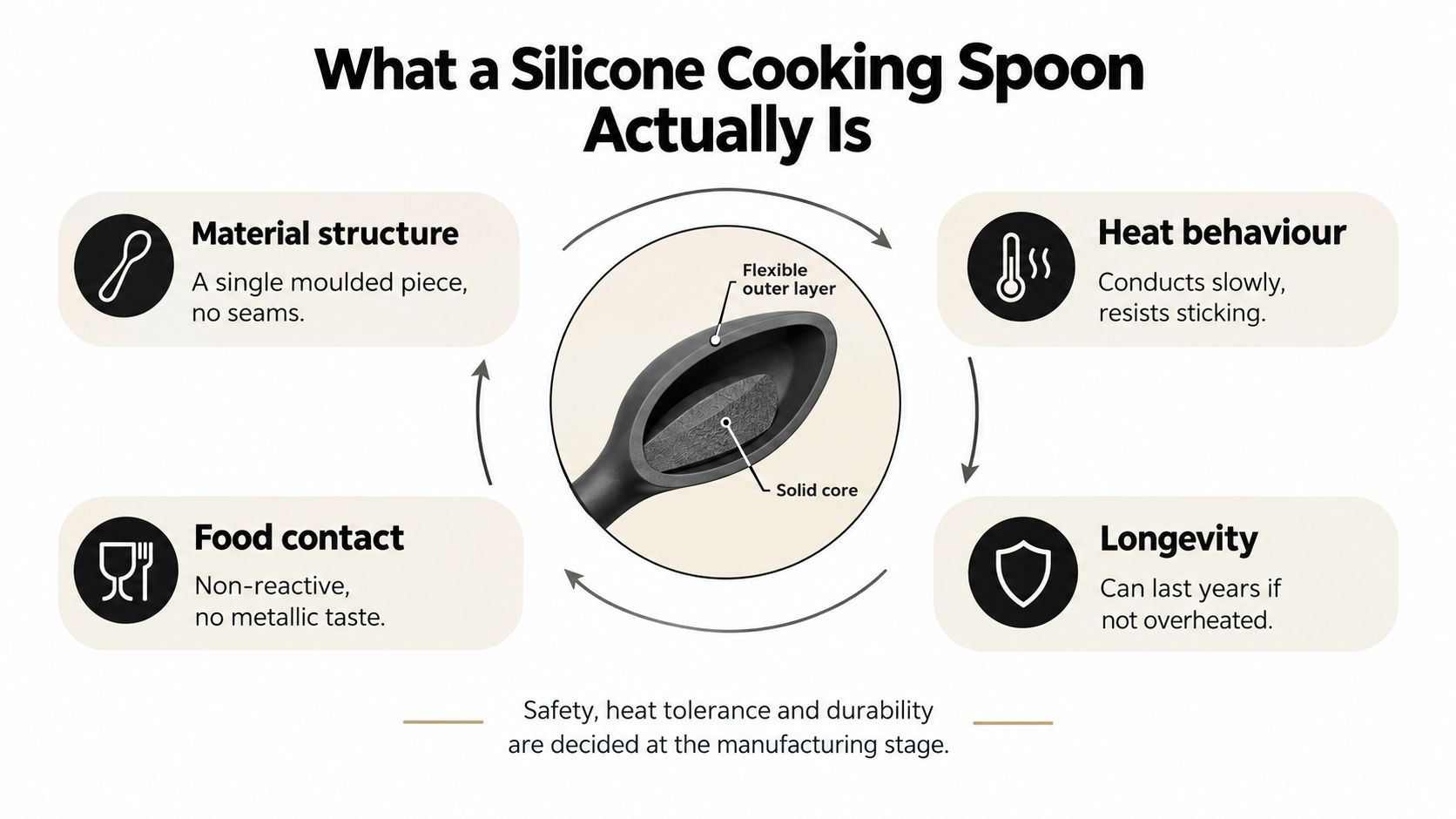
What cooks usually mean by silicone
In kitchen language, food-grade silicone means a flexible polymer made for food contact, not a random soft plastic. Australian chemistry commentary describes silicone utensils as “quite inert” and not prone to easy degradation, but that only helps if the product is properly formulated and used within the maker's temperature guidance (ABC News).
The label still matters. “Silicone”, “silicone-coated”, “BPA-free”, and “heat-resistant” do not mean the same thing. A spoon can be made from silicone and still be poorly finished, loosely specified, or backed by very little evidence about food-contact performance.
Practical rule: if a spoon's description is broad but the paperwork is thin, treat it as a utensil, not a safety promise.
Why the paperwork matters more than the colour
Silicone gets its reputation from the material family, but you buy a finished utensil, not a laboratory sample. Pigments, fillers, reinforcement, curing, and surface treatment can all affect how a spoon feels, smells, and holds up in a hot pan, so documentation matters as much as shape or brand.
That is why shoppers get mixed signals. A bright red spoon can be perfectly sensible, and a plain grey one can be poorly made. The only reliable clue is whether the seller can show what was tested, under what conditions, and for what food-contact use.
Heat Resistance, Food Safety, and What “Food-Safe” Really Means
A silicone cooking spoon can look reassuring in a hot pan, yet the label on the packet only tells part of the story. In kitchen use, food-safe means the utensil should perform as intended without passing unwanted substances into food under normal conditions. That is a documentation question as much as a material question.
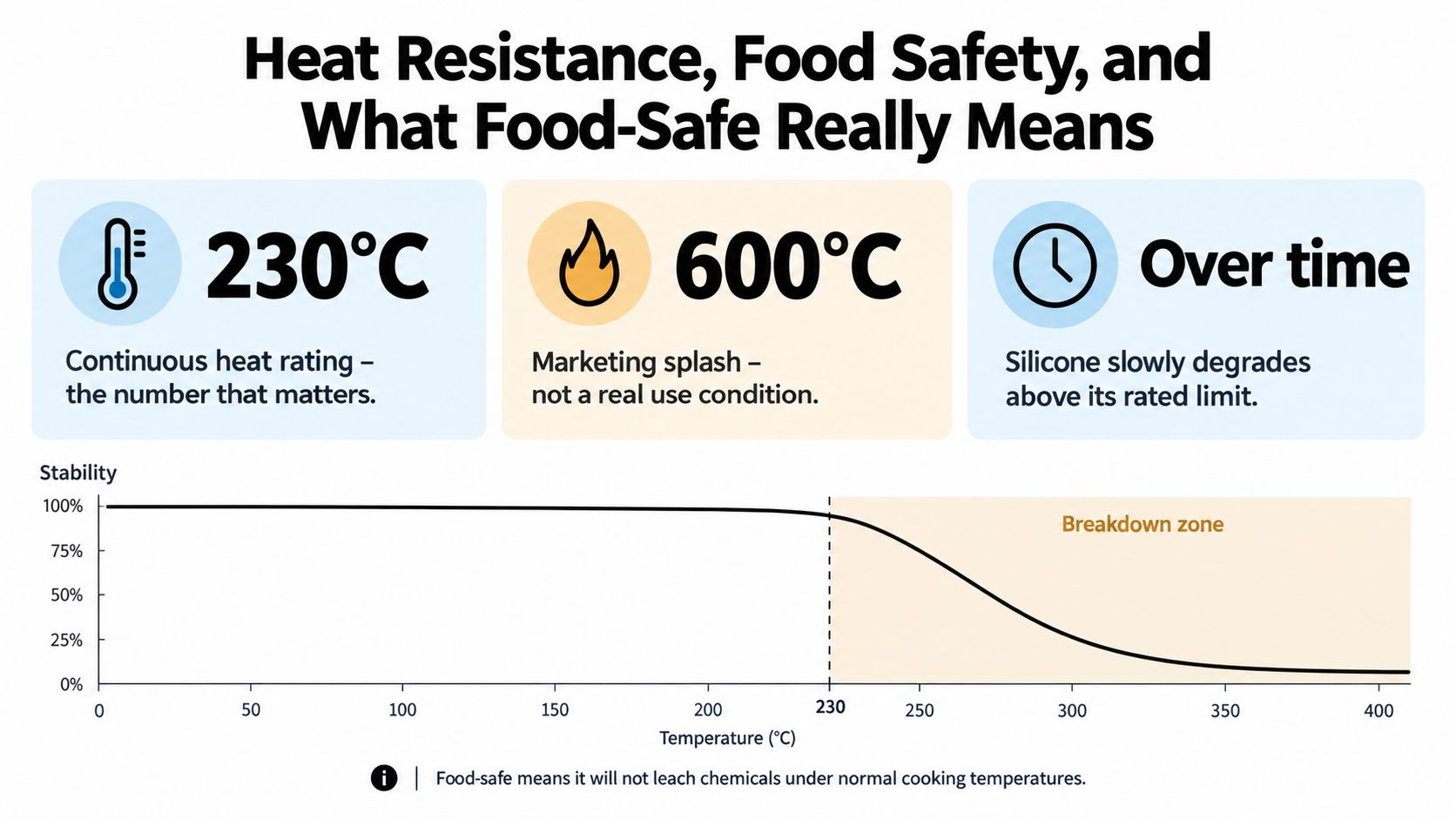
Reading the temperature claim correctly
A temperature rating matters most when it refers to continuous use, not the biggest number printed on the box. A spoon can survive a quick stir and still be a poor choice if its formulation has not been checked for repeated food contact under realistic cooking conditions.
Testing looks at what moves out of the material and into food, not just whether the spoon keeps its shape for a moment. A useful benchmark in industry testing is an overall migration limit of 10 mg/dm², with food simulants such as 3% acetic acid, 10% ethanol, 95% ethanol, and isooctane used to see how materials behave in contact with different kinds of food. That kind of evidence gives a clearer picture than a heat claim alone (SGS Australia).
Why Australia leans on documentation
Australia regulates food-contact safety through FSANZ's wider framework, but it does not have a single dedicated mandatory migration standard for finished silicone utensils. FSANZ places responsibility on manufacturers and retailers to make sure materials suit their intended use and do not contaminate food, while Standard 1.4.1 covers chemical contaminants and migrants linked with food-contact materials (FSANZ).
That leaves buyers relying on supplier evidence. A proper file should identify the silicone grade, the intended temperature range, food-contact suitability, and migration testing under relevant food simulants. Credible testing often points to U.S. FDA or German LFGB benchmarks, but the key point is the paperwork attached to the finished spoon, not the marketing line on the front of the pack (SGS Australia).
If you are comparing kitchen materials more broadly, the same habit helps with other safety concerns too. This guide on avoiding microplastics in food is useful background because it shows why material identity alone is not enough.
A spoon is not food-safe because the label says so. It is food-safe when the seller can show testing, conditions, and materials that match real cooking.
What “BPA-free” does and doesn't tell you
BPA-free is a narrow claim. It tells you one chemical is not part of the story, but it says nothing about fillers, pigments, adhesives, or whether the finished spoon was tested as a complete utensil. A buyer can feel reassured by the label and still miss the bigger question, which is whether the whole product was checked for migration and use conditions.
The cleanest reading of the evidence is the combination of material identity, temperature range, migration testing, and intended food-contact use. That is the difference between a slogan and a kitchen decision you can stand behind.
Silicone vs Wood, Stainless Steel, and Titanium
Choosing a spoon is really a choice between different kinds of trade-offs. Silicone protects coatings and feels forgiving, wood is gentle and familiar, stainless steel is rigid and tough, and titanium brings exceptional durability, hygiene, and lightness, but each of them behaves differently in the hand and in the sink.
A quick comparison
| Material | Heat Tolerance | Cookware Gentleness | Hygiene | Durability | Best For |
|---|---|---|---|---|---|
| Silicone | Good for normal cooking, if properly rated | Excellent on non-stick | Good if the surface stays intact | Moderate, depends on formulation and care | Scraping, stirring, folding, gentle pan work |
| Wood | Good, but varies by species and finish | Gentle | Good if washed well and dried fully | Moderate, can crack or stain | Thick sauces, everyday stirring, a warm feel |
| Stainless Steel | Very high | Low on delicate coatings | Very good | High | Searing, heavy mixing, long-life utility |
| Titanium | Very high | Low on delicate coatings | Excellent | Very high | Durable tools, hygienic everyday use, long service life |
Where silicone wins, and where it doesn't
Silicone is the obvious pick for a non-stick pan or any job where you want the tool to glide rather than bite. It's also comfortable when you need to scrape the curve of a saucepan or stir a sauce without leaving metal marks, and that's why it shows up everywhere from curry pots to baking benches.
But silicone has softer edges than metal, so it isn't the best answer when you need force. If you're pressing fond off a hot pan bottom, working through heavy browning, or trying to lift stuck bits that need a firmer edge, a stainless steel spoon or a rigid utensil will usually do the job better.
Wood sits in a useful middle ground. It's kinder than metal, more rigid than silicone, and familiar in soups and sauces, but it asks for better drying and more care over time. Titanium, meanwhile, earns its place when you want a strong, hygienic, long-life utensil and you don't need the softness that protects delicate coatings. For a different angle on hard-wearing kitchen tools, this piece on ceramic cooking utensils gives a useful comparison point.
What the claims on packaging usually miss
A lot of packaging leans on phrases like “EU certified” or “FDA-grade”, but those words only matter if they're tied to the actual spoon in your hand. The useful question is not whether the factory has heard of a standard, it's whether the finished utensil was made and checked against one that fits food contact.
Good buying logic: choose the material for the job, then ask whether the finished product has the documents to match the promise.
Which Spoon Fits Which Cooking Job
A spoon makes sense only in context. The best choice for a tomato sauce isn't always the best choice for cast iron, and the tool you want for kid-led baking isn't the same one you'd reach for during a hard sear.
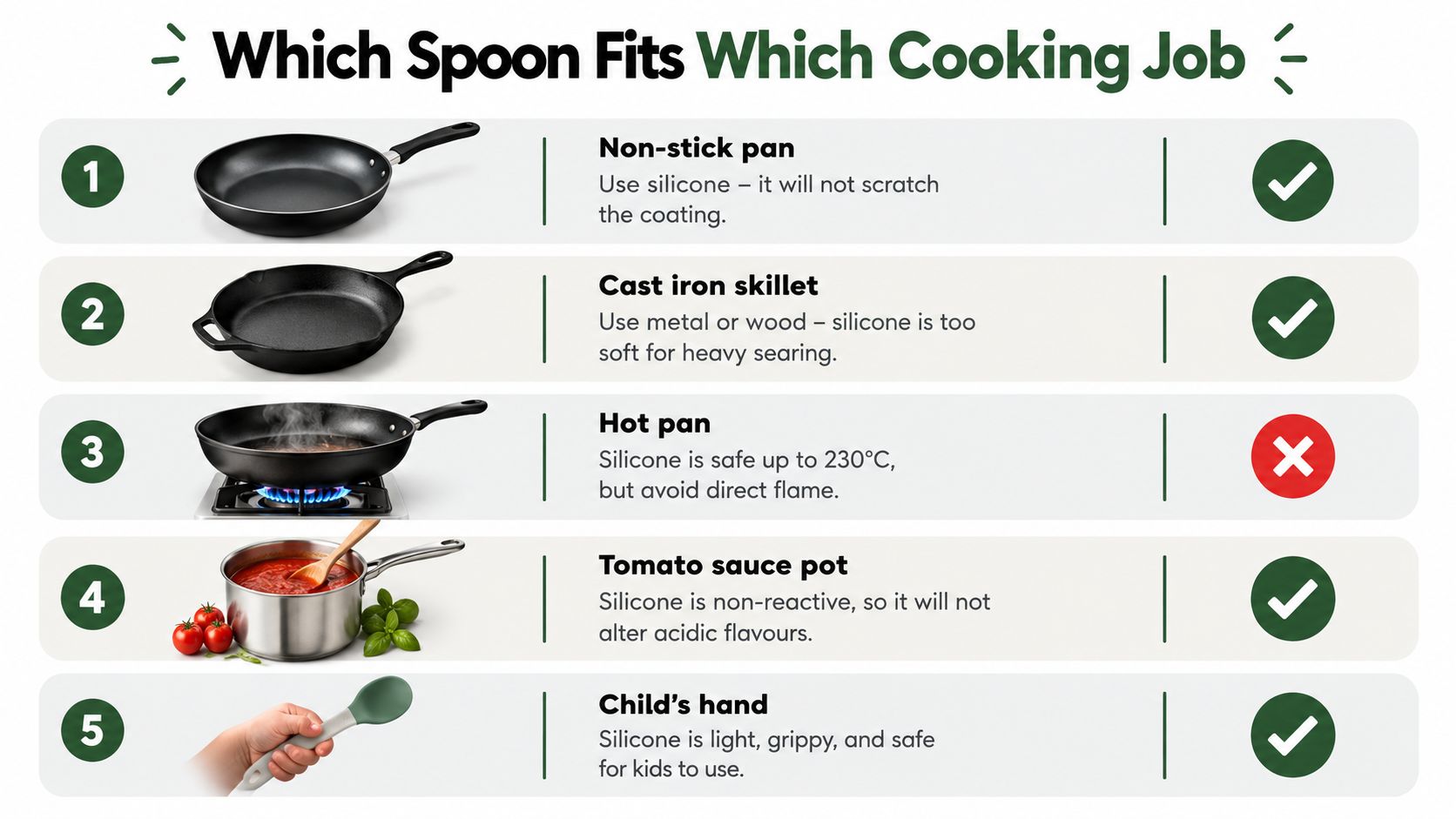
Matching material to task
| Cooking Job | Best Fit | Why |
|---|---|---|
| Non-stick pan | Silicone | Gentle on coatings and easy to scrape clean |
| Cast iron searing | Stainless steel or wood | Better rigidity for firm stirring and lifting |
| Hot sauce pot | Silicone or wood | Both handle stirring well without scratching |
| Acidic tomato sauce | Silicone or titanium | Non-reactive and easy to clean |
| Baking prep | Silicone | Useful for folding, scraping, and mixing |
| Kid cooking | Silicone | Light, grippy, and forgiving in small hands |
A silicone spoon feels right when you're folding batter, stirring a risotto, or working around the rounded corners of a saucepan. It stays comfortable in a pot of tomato sauce because it doesn't bring a metallic taste, and that's handy when the flavours are delicate or the sauce has been simmering for a while.
The job changes when the pan gets rougher or the heat becomes more demanding. Cast iron searing, deep browning, and heavy scraping reward a rigid utensil, so wood, stainless steel, or titanium often becomes the better fit. Silicone can still survive normal heat, but that isn't the same as being the best tool for a forceful task.
For a simple browsing option while comparing spoon shapes, you can look at a browse pony spatula and notice how tool shape changes the way a cook moves food around a pan. Shape matters as much as material.
One more practical detail
Silicone is easy to live with because it's forgiving in ordinary use and comfortable for quick, messy jobs. That's why many cooks keep one nearby for sauce pots and non-stick pans, then reach for something firmer when the work turns heavy or the pan surface is rugged.
Cleaning, Dishwashers, and When to Replace
Cleaning is where a lot of silicone spoons prove their value, or show their weak spots. A spoon that seems fine after cooking can still hold onto odour, feel a little tacky, or look unchanged while the surface has started to fatigue.
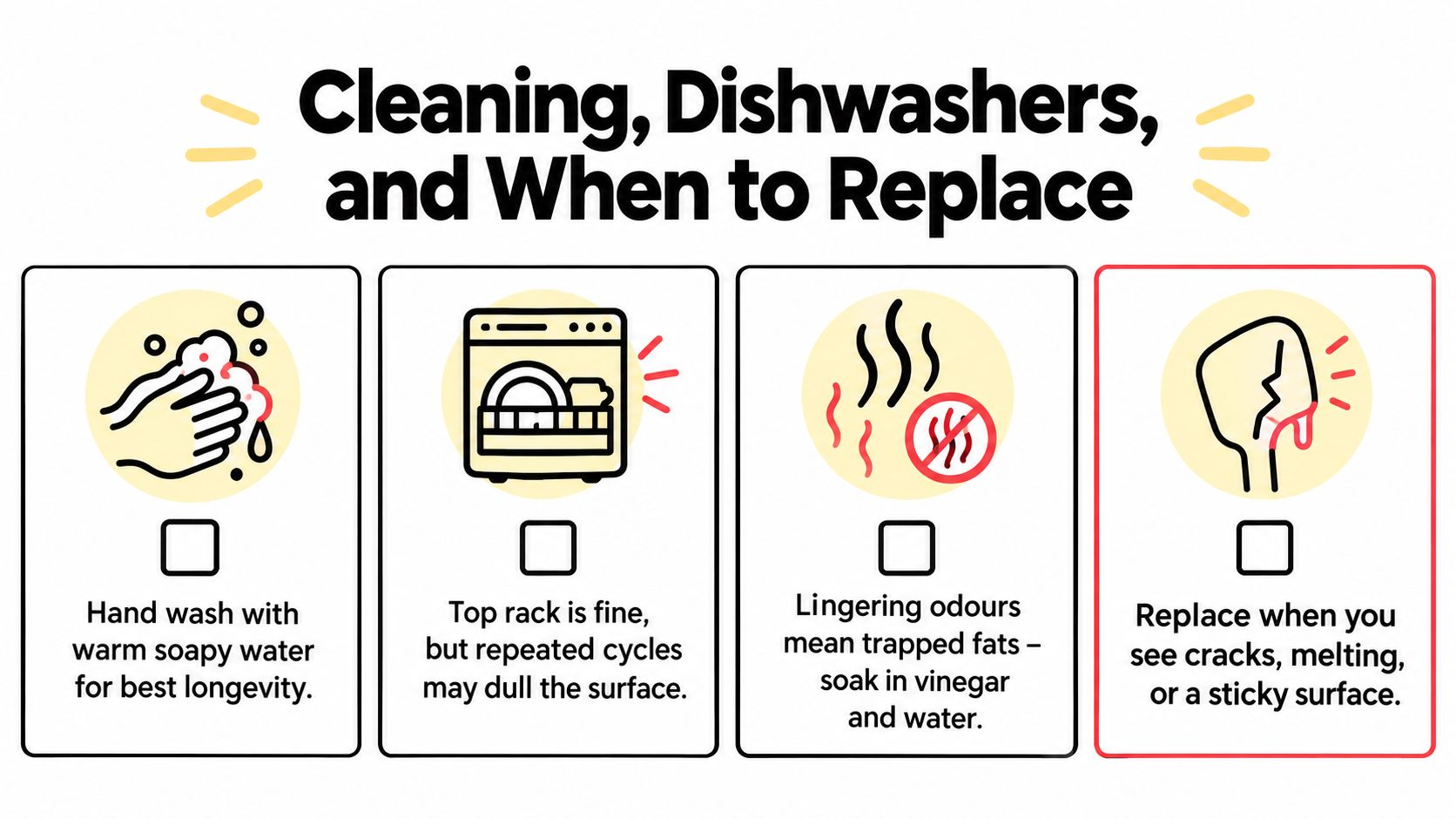
How to clean it without shortening its life
A quick wash in warm soapy water is the gentlest routine, especially if you want the spoon to keep its original feel for longer. Dishwasher use is convenient, and Australian guidance notes that a modern six-star WELS dishwasher can clean a full 15-place setting using less than 10 litres of water and can use significantly less water and energy than handwashing (YourHome).
That said, cleaning efficiency and utensil longevity aren't the same thing. Repeated high-heat cycles, strong detergent exposure, and drying temperatures can slowly affect the spoon's surface feel, especially if the product was made from lower-quality silicone or loaded with fillers.
When the spoon should be retired
A spoon doesn't need to break in half before you replace it. Watch for tackiness when dry, whitening or micro-cracks, swelling, visible surface transfer, or a persistent smell that stays after washing.
If a spoon smells wrong after cleaning, that smell is already telling you something about its surface or absorbed fats.
For stubborn odours, some cooks soak the utensil, then wash it again, but the more important judgment is whether the smell keeps coming back. Once the surface has changed enough to trap odour, the spoon is no longer behaving like a clean tool, even if it still looks usable.
Dishwasher sense, not dishwasher faith
A dishwasher can make practical sense when you're running a full load, because that's where the resource savings are most believable. But “dishwasher-safe” doesn't mean “lasts forever in the top rack”, and it certainly doesn't mean the spoon can ignore repeated heat, detergent, or rough treatment from other utensils.
A useful reminder comes from household maintenance habits in related kitchen gear, including this guide for Queensland homebrewers, where cleanliness depends on method, not just on the word “safe”. The same logic applies here, if the surface starts to change, the utensil has become a maintenance issue.
How to Choose a Silicone Cooking Spoon That Will Last
The smartest purchase starts with evidence, not a colour swatch. A spoon that feels nice in the shop can still be a poor buy if nobody can show what the material is, what temperatures it was meant for, and how the finished utensil performed in food-contact testing.
Ask for the right documents
Before you buy, look for a supplier declaration that names the silicone grade, the intended food-contact conditions, the maximum use temperature, and any migration testing performed. If the seller can only offer a vague “food-grade” or “non-toxic” claim, you still don't know whether the pigments, fillers, handle, or adhesives were checked as part of the finished spoon.
Check the spoon with your hands
A well-made spoon usually feels like one coherent object. The transition from handle to head should be smooth, the surface should feel even, and there shouldn't be a hidden plastic core pretending to be silicone.
A few quick shop checks help more than a glossy label:
- Twist the handle gently. A poor spoon may feel too soft, oddly hollow, or badly joined.
- Compress the head. Good silicone should spring back cleanly rather than stay dented.
- Smell it. Strong chemical odour is a warning sign, not a bonus feature.
- Look at the seams. Crisp edges, rough joins, and uneven texture often mean lower care in manufacture.
Use it like you mean it
At home, the first few uses tell you a lot. Stir a broth, wash the spoon, dry it, and check whether the surface feels tacky, whether the colour changes near the head, and whether any smell lingers after cleaning. If the utensil starts to swell, crack, or leave a surface transfer, retire it before it becomes a hygiene problem.
For a broader shopping checklist around silicone utensils in Australia, this Everti guide on silicone utensils in Australia gives a helpful local reference point. For a gift-list style way to think about durable household tools, the complete baby shower gift list is a good reminder that the best kitchen picks are the ones people can use for years, not just admire on day one.
Silicone Spoon Questions Worth Asking Before You Buy
Is silicone really safer than plastic utensils? Often, yes, but only when you're comparing properly made food-contact silicone with ordinary plastic tools. Silicone's value comes from its heat stability and non-reactive behaviour, yet the finished spoon still needs documentation, because “silicone” alone doesn't guarantee a clean formulation.
How hot can a silicone cooking spoon really get? The useful number is the maker's continuous use rating, not a flashy one-off claim. Once a spoon is used beyond its intended heat range, the material can start to age faster, even if it doesn't visibly melt.
Why does silicone sometimes absorb smells? Odour usually comes from trapped fats or surface fatigue, not from the idea of silicone itself. If cleaning no longer fixes it, or the smell keeps returning, that's a sign the utensil has reached the edge of its useful life.
How does silicone compare with titanium? Titanium is the stronger long-life choice when you want durability, hygiene, and a rigid tool that can handle tough use. Silicone is the gentler choice for cookware protection and scraping, so the better option depends on whether you're protecting a coating or demanding a harder-working edge.
Everti offers titanium kitchen and table essentials designed for cooks who want tools that feel clean, last well, and make less guesswork necessary. If you're weighing silicone against longer-life materials, visit Everti to explore durable options that suit everyday cooking with a more evidence-first mindset.