

You've got one hungry person, one saucepan, and just enough ingredients for dinner. A small pot can rescue that moment beautifully. It heats a modest portion quickly, keeps washing-up under control, and lets you turn a handful of vegetables, noodles or beans into a proper meal without filling the fridge with containers.
The same pan can also ruin dinner. A single-serve curry catches on its base while the surface still looks loose. Milk rises before you can reach the hob. A small amount of mince browns at the edges but remains undercooked in the centre. These failures aren't random. They come from treating a small pot as a reduced version of a large pot, rather than as a different heat-management tool.
Promise and Pitfalls of Small Pot Cooking
A single serving can shift from ready to scorched in the time it takes to rinse a spoon. That narrow margin explains both the appeal and the quiet trouble of small pot cooking. You heat only the food you plan to eat, wash a compact vessel, and avoid producing a full recipe for one person. A small saucepan handles porridge, grains, soup, sauces, jam, reheating and modest portions of legumes with little surplus.
The same efficiency can encourage careless habits. Portion sizes get estimated by eye, a pan containing “only a little” gets left unattended, and a bubbling surface is mistaken for safe doneness. Small volumes change temperature quickly, leaving less time to correct an overheated base, uneven cooking or food held too long in the pot. Food safety and waste control therefore belong in the basic method, not as afterthoughts.
Practical rule: A small pot demands closer attention because the food has less thermal and physical room to absorb errors.
Australian cooking has long adapted vessels to available fuel, ingredients and circumstances. European cooking practices arrived with the First Fleet in 1788. Camp cooking later relied on sturdy steel camp ovens and earlier three-legged cast-iron pots. The saucepan also became part of multicultural urban food culture, including Chinese takeaway traditions and dishes such as chow mein, chop suey and sweet-and-sour pork, as described in this history of Australian food.
The modern appeal is straightforward, but each benefit carries a stovetop trade-off:
- Less surplus can mean less waste when ingredients are used before spoiling and remaining food is stored correctly.
- A smaller water volume responds quickly to heat, helping with boiling and reheating while making cold additions harder to manage.
- A compact base can concentrate heat, so thick sauces and dairy mixtures need stirring and controlled heat to avoid catching.
- A tiny batch can look cooked before its centre is safe, particularly when bubbling or surface colour hides uneven heating.
- A small container may cool efficiently, provided the food moves into a suitable shallow container instead of remaining in a deep pot.
Small pot cooking works best as a discipline of matching ingredient mass, pot surface area and burner output. Portion size is only one decision. Vessel shape affects evaporation, material affects heat distribution, and the lid determines whether the meal simmers, steams or reduces. Managing those relationships deliberately makes the pan predictable, while also limiting avoidable waste and unsafe holding.
How Pot Size and Burner Choice Shape Heat Transfer
Heat transfer starts at the burner, moves through the base and then spreads into the food. If the flame or heated zone extends well beyond the pot base, heat travels up the sidewalls and into the surrounding air instead of entering the food efficiently. If the burner is too small, the pot may eventually cook well, but it takes longer to recover after you add cold ingredients.
Australian household energy data gives useful context. Cooking accounts for approximately 5% of total household energy demand, while stovetop cooking represents about 6% of household appliance energy use, according to this Australian cooktop fact sheet. In 2021, cooking energy was divided approximately equally between electricity and gas. The same source places gas stovetop efficiency at approximately 30%, compared with about 70% for conventional electric resistance cooking, with induction capable of higher efficiency.
Those figures don't tell you the waste from a particular saucepan. They do explain why pot placement and heat management matter across both gas and electric kitchens. A well-matched pan transfers heat into the food more directly. An oversized burner can overheat the rim while the centre of a thick sauce remains slow to respond.
Thermal inertia changes the pace
A small saucepan containing a modest amount of water reaches a boil much faster than a large pot containing several times the volume. That speed is useful for noodles, blanching and reheating, but the food also loses heat quickly when you add refrigerated ingredients. Reduce the burner before adding them, then raise it briefly to restore a steady simmer rather than leaving the setting at full power.
The base is usually the hottest zone. The lower layer of a thick curry, custard or tomato sauce receives direct heat while the upper layer lags behind. Stirring scrapes that hot layer into the cooler mixture and evens out the temperature. A narrow, deep vessel also gives steam less room to escape, so a lid can turn a quiet simmer into a boil-over quickly.
Use the table as a matching principle, not as a promise of a universal efficiency percentage. Cooktop designs, pan materials and flame control vary, and the supplied Australian data doesn't establish a fixed heat-waste figure for each diameter combination.
| Burner Size (cm) | Recommended Pot Base (cm) | Mismatch Effect | Approx. Heat Waste % |
|---|---|---|---|
| Not specified by the verified data | Base should broadly match the heated zone | Oversized burner heats sidewalls and surrounding air | Not established |
| Not specified by the verified data | Use the smallest suitable zone for the pan | Undersized zone gives slow recovery and uneven cooking | Not established |
| Not specified by the verified data | Follow the cooktop maker's induction-zone guidance | Poor alignment can reduce responsive heating | Not established |
For induction cooking, check the manufacturer's zone guidance and vessel compatibility before relying on a pan. This guide to cookware for induction is a useful reference when a small pot needs to sit securely over a compact cooking zone.
Choosing the Right Small Pot and Setting Up
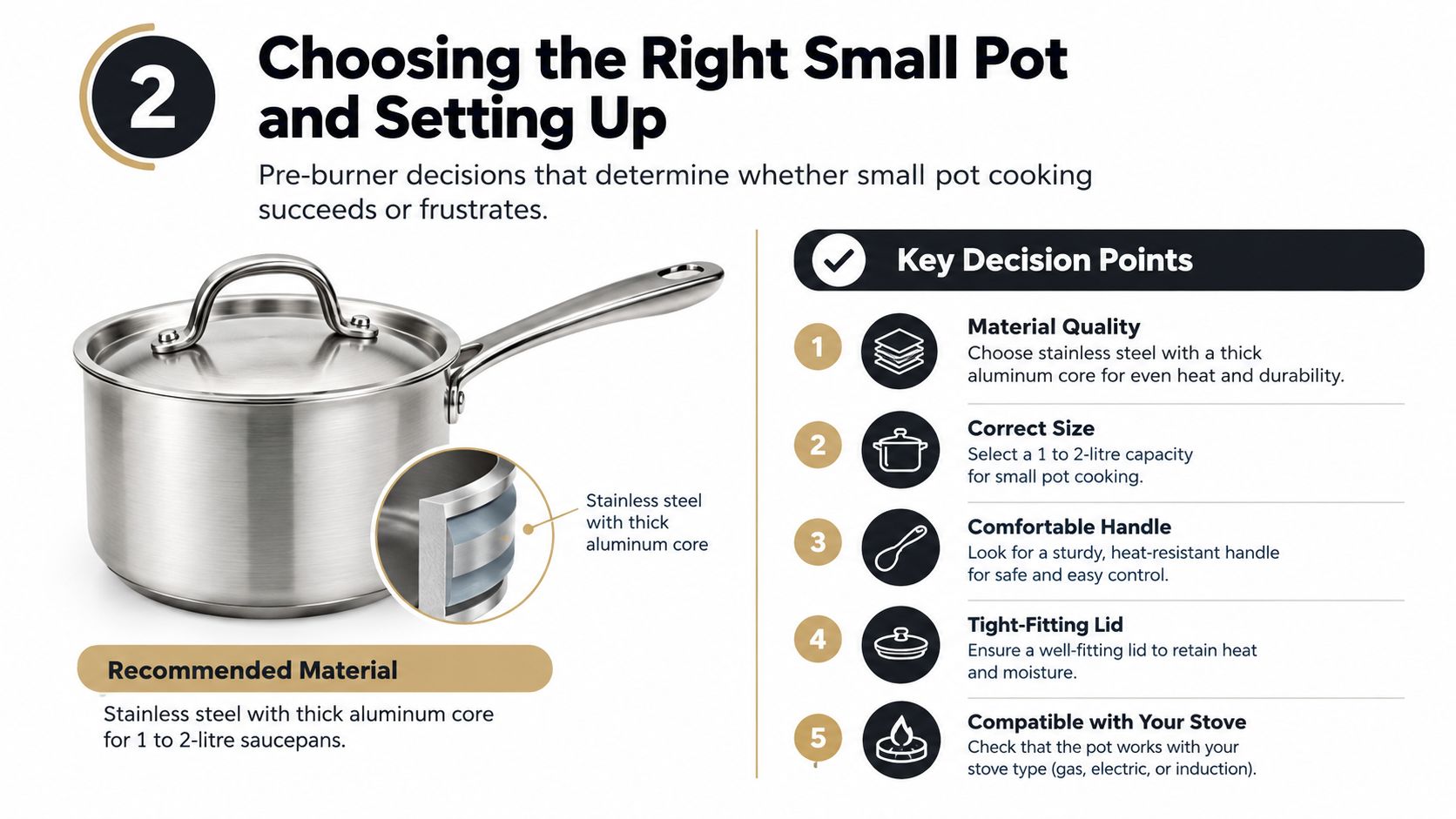
A practical small-pot kit doesn't need a cupboard full of specialised vessels. Start with a 1 to 2-litre saucepan that has a stable base, a comfortable handle and a lid that sits securely without sealing so tightly that steam cannot escape when you need a simmer.
Stainless steel is a dependable general-purpose choice when it has an aluminium or copper core. That conductive layer spreads heat more evenly than a thin, single-layer base, which helps with sauces and grains. Heavy cast iron holds heat steadily and suits slow simmering, but it reacts more slowly when you need to lower the temperature. Non-stick works well for eggs and delicate reductions, provided you use suitable utensils and avoid aggressive preheating.
Inspect the details before cooking
A good lid matters more than many cooks expect. A lid that sits slightly askew lets you control evaporation during a simmer, while a snug lid supports steaming. A pouring rim reduces spills when you transfer soup or sauce, and a handle that stays cool enough to grip gives you a quick way to move the pot off the burner.
Look for these practical features:
- A thick, even base: It buffers the direct heat that causes thin patches of sauce to burn.
- A useful lid: You need both a covered steaming position and a controlled vent for simmering.
- A manageable handle: A small pot becomes awkward when the handle extends over another hot zone.
- A compatible insert: A small steamer basket can expand the vessel's use without requiring another large pot.
- A nesting shape: Compact storage helps keep the pot accessible, which makes you more likely to use it for one-person meals.
Preheat with restraint
Place the empty pot over low heat briefly, then add oil once the metal has warmed. The aim isn't to make the vessel blazing hot. Small cookware reaches working temperature quickly, and aggressive dry heating can leave a burnt base before the first ingredient enters.
Have the ingredients measured and the utensils ready before you turn on the burner. A small pot doesn't give you much time to search for a spoon while onions catch or milk rises. A trivet beside the cooktop also earns its place. Moving the vessel off the heat is often more effective than just turning the dial down, especially on electric elements that remain hot after adjustment.
A compact set can cover this routine without adding duplicate equipment. See the mini cookware set guide when comparing nesting options, handle design and the tasks you want one small vessel to cover.
Stovetop Techniques That Actually Work in Small Pots
Small pots reward controlled heat rather than constant high heat. The three techniques I use most are shallow simmering, steaming and reduction. Each needs a different relationship between the lid, the water content and the burner.
Shallow simmering
For soup, curry, grains in sauce and braised vegetables, bring the mixture up to temperature over medium heat, then lower the burner until you see occasional bubbles rather than a constant rolling boil. Keep the lid askew. That position retains enough heat to maintain the simmer while allowing excess steam to escape.
Stir thick mixtures from the bottom at regular intervals, and scrape around the perimeter where the base meets the sidewall. If the mixture is dense or contains little free liquid, stir more often. A sudden thickening is a signal to add liquid or move the pot off the heat, not to turn the burner higher.
Steaming
Add a shallow bed of water, place the food above it on a suitable insert, and seal the lid. The water should produce steam without boiling so violently that it splashes into the food. Keep the burner at the lowest setting that maintains steady steam, then check the water level if the process takes time.
Steam is gentler than direct contact with the base, but it doesn't make overcrowding safe or guarantee even cooking. Arrange pieces with space between them and turn larger items when the method allows it.
Reducing
Reduction needs evaporation, so use a wide lid offset or leave the vessel uncovered. Begin at medium heat to establish movement, then reduce the setting as the liquid thickens. A sauce can go from loose to stuck surprisingly quickly because there is less liquid to buffer the base.
Milk needs particular care. Warm it gradually and stay close to the pot. Oil needs the same discipline. If it begins smoking, take the pot off the heat and let it settle rather than adding wet ingredients to a dangerously hot surface.
The useful swap: If your hob has poor low-end control, use a heat diffuser or place a heatproof bowl over a water bath for delicate sauces. Slower heat is easier to manage than repeatedly lifting a pot that is already scorching.
For a visual process guide, use the embedded demonstration below.
Food Safety in Small Batches
Small pots shorten cooking times, but they do not make food safety self-correcting. A bubbling surface cannot confirm that the centre of poultry, mince or a thick dumpling is safe. Food Standards Australia New Zealand advises keeping cold food at 5°C or colder and hot food at 60°C or hotter. Poultry, minced or rolled meat, sausages, hamburgers and offal should reach at least 75°C in the centre. These limits are set out in the FSANZ temperature-control guidance.
Use a clean food thermometer and measure the thickest or coolest point. Insert the probe sideways into meat or poultry. For a thick sauce, stew or rice mixture, stir first, wait briefly for the heat to even out, then test more than one spot. Steam and surface bubbles are poor substitutes for a centre reading.
A simple temperature routine
The table separates safety targets from cooking-quality decisions. Reaching the target verifies temperature, while excessive boiling can still ruin texture. Use the lowest heat that cooks the food thoroughly.
| Food | Minimum Internal Temperature | Rest Time | Key Check |
|---|---|---|---|
| Poultry, mince, sausages, hamburgers and other listed high-risk foods | 75°C | Not specified by FSANZ guidance | Measure the thickest centre |
| Hot-held cooked food | 60°C or hotter | Not applicable | Check the food, not only the surrounding steam |
| Chilled food | 5°C or colder | Not applicable | Check after cooling in a suitable container |
| Rapidly reheated food | 70°C or hotter for rapid reheating, with 75°C at the centre used in leftover guidance | Not specified | Stir dense food and test the centre |
Small-batch cooking needs a repeatable routine because confidence is a poor safety check. FSANZ consumer tracking found that only 8.0% of respondents always used a thermometer to check whether chicken was cooked, while 43.8% never did so, according to this food safety knowledge and concerns report. The report also found that only 35.3% always refrigerated or froze leftovers within two hours, and 34.2% always ate refrigerated leftovers within two to three days.
Cool the food as deliberately as you cooked it
FSANZ advises cooling cooked food from 60°C to 21°C within two hours, then from 21°C to 5°C within the following four hours, as explained in its food preparation and cooking guidance. Stop cooking promptly, divide the food into shallow, heat-conductive containers and let heat escape without exposing the food to contamination. A full, deep pot cools slowly, so do not place one directly in the refrigerator or stack hot containers tightly. See this food preparation safety guide for handling and storage steps.
Healthdirect advises keeping cooked food at room temperature for no longer than two hours where possible. Food held for two to four hours should be eaten immediately, while food held for more than four hours should be discarded. Reheat food rapidly until the centre is steaming hot, and avoid warming and cooling the same portion repeatedly.
Fermented foods and beverages require the same attention to clean equipment, controlled storage and process discipline. For a small-batch example beyond saucepan cooking, organic kombucha from Pep Tea illustrates why preparation and storage controls matter.
Waste, Leftovers and the Batch Size Question
Cooking one serving at a time sounds like the obvious waste solution, but the smallest possible batch isn't always the most efficient one. A single portion may leave half a tin of tomatoes, a few stems of herbs, a small amount of stock or an awkward piece of vegetable behind. Those fragments are easy to forget, especially when the next meal uses different ingredients.
Australian research published in 2025 reports that leftovers account for about one-third of household food waste, while household food waste represents nearly 34% of total Australian food waste. A recent Australian survey also found that 42% of respondents saw time and difficulty as the biggest barriers to reducing food waste, while 90% agreed that households share responsibility. These figures are reported in this research on food waste and leftovers in Australia.
The better question is not “How do I cook one portion?” It is “Which quantity gives me the least total waste after preparation, storage and reheating?” Cooking two portions once can reduce repeated chopping, packaging and washing-up. It can also use a whole can or a complete bunch of vegetables rather than forcing you to store several partial ingredients.
Choose foods that accept a second life
Some dishes improve or hold their texture after careful reheating:
- Grain bowls: Keep grains and wet toppings separate when possible, then warm the components in the small pot.
- Braised legumes: Beans and lentils generally tolerate gentle reheating, especially when stored with enough cooking liquid.
- Tomato-based sauces: Cool them promptly, store them in a shallow container and reheat until thoroughly hot.
Other foods are poor candidates for planned leftovers. Crisped proteins lose their crust, fresh herbs fade, and coated foods become soft. Cook those in a quantity you can finish, or store the components separately so you can rebuild the meal rather than reheating everything together.
Decision rule: Cook for two when the recipe stores and reheats well. Cook for one when the food depends on crispness, freshness or a texture that won't survive the second heating.
Portioning is where small-pot cooking becomes a waste-management system. Label the container, record what it contains and place it where you'll see it. A slightly larger batch handled promptly can outperform several isolated servings, because the relevant measure is not pan size. It's the amount of food, packaging and effort that reaches the bin.
A Reliable Small Pot Cooking Checklist
Keep this near the cooktop until the routine becomes automatic.
Before the burner
- Match the base: Choose the smallest suitable burner or induction zone and keep the heated area aligned with the pot base.
- Check the vessel: Use a stable saucepan with an even base, a workable lid and enough headroom for bubbling.
- Prepare everything: Measure ingredients, place the spoon nearby and set out a trivet before heating.
- Warm gradually: Preheat over low heat, add oil once the pan is warm and never leave an empty thin pot over an aggressive setting.
During cooking
- Choose the lid position: Use the lid askew for a shallow simmer, seal it for steaming and leave it open or offset for reduction.
- Stir the base: Scrape dense sauces and grains from the bottom at regular intervals, increasing the frequency as the mixture thickens.
- Control recovery: After adding cold ingredients, raise the heat only long enough to restore a steady simmer.
- Check the centre: Use a clean thermometer for high-risk foods and verify the thickest or coolest point rather than trusting colour or surface bubbles.
After cooking
- Serve promptly: Move the food off the heat when it reaches the desired doneness. Don't let a thin layer continue cooking on a hot base.
- Cool shallow: Divide leftovers into shallow containers and follow the FSANZ cooling sequence.
- Reheat once: Warm the portion rapidly and check the centre before eating.
- Soak early: Fill the saucepan with water while residue is still soft. Scraping a burnt base later wastes time and can damage the finish.
Avoid overcrowding, skipped preheating, guessed doneness and a high burner under a nearly dry sauce. Those habits turn the very qualities that make small pots useful, quick response and concentrated heat, into their main failure points.
Everti offers compact titanium cookware for lightweight outdoor cooking and boiling water, along with kitchen tools suited to organised preparation around small-pot meals. Visit Everti to explore durable options for a more deliberate cooking and prep routine.