

Yes, the best water filter for microplastics is usually a system that uses reverse osmosis or a high-quality carbon block filter with a sub-micron rating. These technologies are specifically built to trap the tiny plastic particles that simpler filters just can't catch, making sure your drinking water is as pure as possible.
The Invisible Threat In Your Drinking Water
The water coming out of your tap might look crystal clear, but it can be carrying an unseen passenger. We're talking about microplastics—miniscule fragments of plastic, often smaller than a grain of sand, that have quietly become one of the most widespread contaminants in our water.
You can think of it as a sort of ‘plastic dust’. This dust comes from the breakdown of larger plastic items like bottles, bags, and packaging, not to mention the synthetic fibres from our clothes that get washed down the drain. From there, these tiny particles make their way through rivers, treatment plants, and eventually, into the pipes that lead straight to our homes.
The presence of these particles isn't just an abstract environmental issue; it’s a direct concern for our own health and wellbeing. Every time we drink a glass of water, we could also be ingesting these plastic fragments, introducing foreign materials into our bodies.
Why This Matters for Your Health
The sheer scale of plastic pollution is staggering, and it has a direct link to the water we drink every day. Here in Australia, the plastic waste crisis has hit alarming levels.
The 2023 National Waste Report found that Australia generated around 3.5 million tonnes of plastic waste last year alone. Of that massive amount, only a measly 13% was actually recycled, leaving the rest to pollute our environment. That means nearly 3 million tonnes of plastic waste ended up in Australia's ecosystems in a single year, adding heavily to the microplastic contamination in our waterways.
The problem is so pervasive that some bottled water brands have even been found to contain more microplastics than tap water, proving that even sources we think are ‘pure’ can be affected. You can learn more about the environmental impact of plastic waste and how it gets into our water.
This widespread contamination makes it clear why having a reliable line of defence in your own kitchen is so important. It’s all about taking back control over the quality of your water.
Understanding the source and scale of the problem helps us see why an effective water filter for microplastics is so crucial. It’s not just about making water taste better; it’s about actively removing unwanted pollutants that you and your family would otherwise be drinking every single day.
This guide will walk you through everything you need to know. We’ll look at how these particles end up in your glass and, most importantly, what you can do about it. The right filtration system acts as a final, critical barrier, ensuring what you drink is clean, safe, and free from this invisible threat. Let’s connect this global environmental issue to a practical solution for your home.
How Water Filters Actually Capture Microplastics
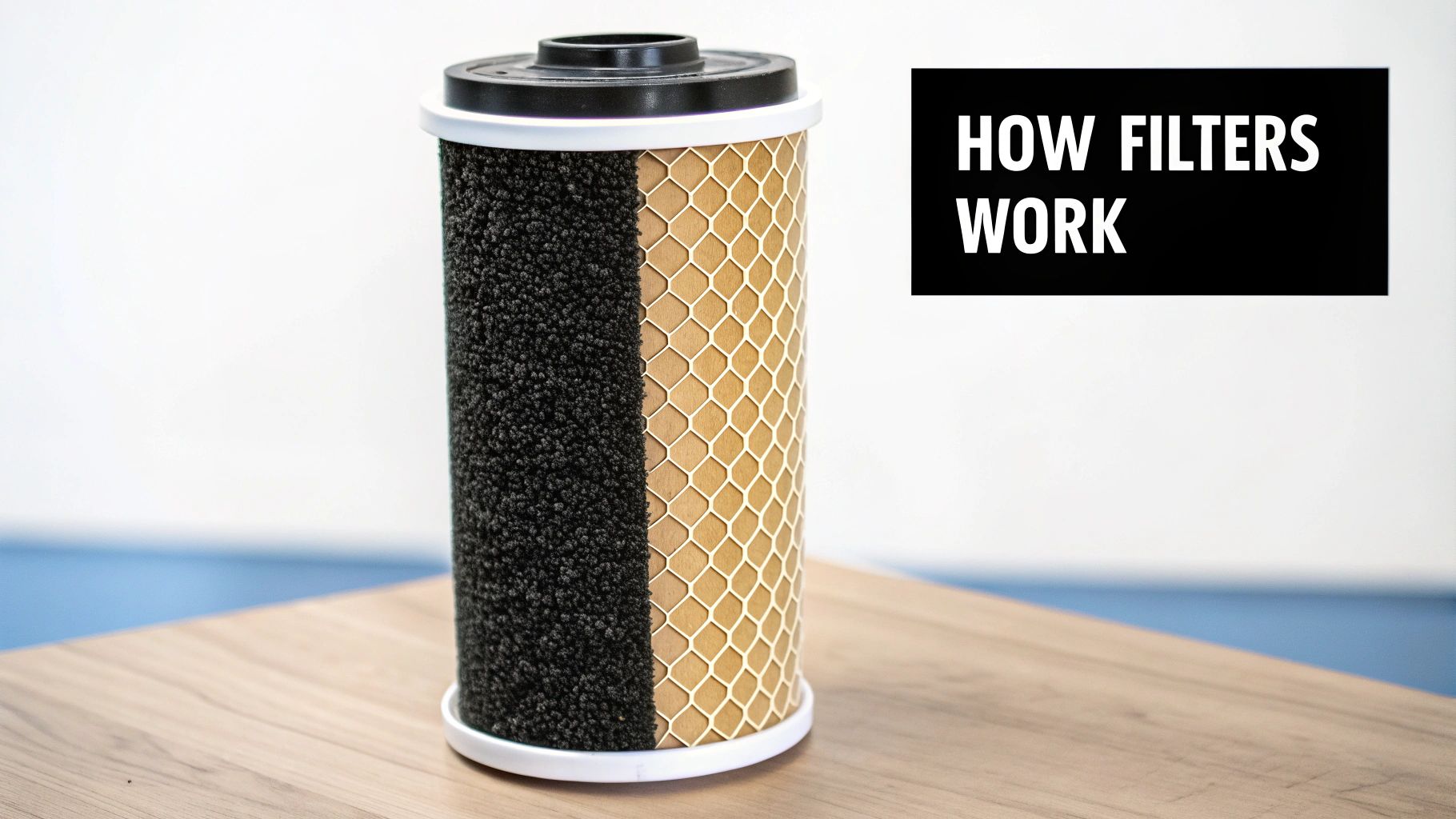
It sounds a bit like magic, doesn't it? How can a simple filter possibly catch something so small it’s completely invisible? The technology inside a quality water filter for microplastics is actually quite clever and relies on a one-two punch: physical blocking and a kind of magnetic attraction.
These two key processes are known as mechanical filtration and adsorption. Once you get your head around how they work together, you’ll see exactly how your filter creates a robust barrier between those tiny plastic particles and your drinking glass.
Mechanical Filtration: The Microscopic Sieve
The most straightforward job of a filter is to physically block things from passing through. That's mechanical filtration in a nutshell. Think of it as an incredibly fine sieve or a microscopic net. Water molecules are small enough to sail right through the openings, but larger particles like silt, sediment, and—crucially—many microplastics get caught.
The power of this "net" all comes down to its micron rating. A micron is just a tiny unit of measurement, equal to one-millionth of a metre. A filter's rating tells you the size of the particles it’s designed to stop. This number is everything when you're dealing with microplastics, which can range from a few microns right down to the nanoscale.
To put it in perspective:
- A single human hair is about 50-70 microns thick.
- The smallest object the naked eye can spot is around 40 microns.
- Many microplastics floating in our water measure between 1 and 10 microns.
This tells us you need a filter with a seriously small micron rating to do the job. A filter rated at 1 micron will stop particles of that size and larger. For the best possible defence against the smallest fragments, you'll want to look for "sub-micron" filters, which have a rating of less than 1 micron.
Adsorption: The Contaminant Magnet
So, mechanical filtration is a great first line of defence, but what about the particles that are even smaller than the filter's pores? That’s where adsorption comes into play. It's important not to mix this up with absorption (like a sponge soaking up water). Adsorption happens on a surface.
The easiest way to think about it is like static cling. You rub a balloon on your hair, and your hair sticks to the balloon's surface. Adsorption in a water filter works on a similar principle, causing contaminants to "stick" to the filter material itself.
The go-to material for this job is activated carbon. This isn't just any charcoal; it's been treated to create a ridiculously porous surface. In fact, just a single gram of activated carbon can have a surface area the size of a football field.
As water flows past, chemicals and certain microscopic particles are drawn to this massive surface area and get trapped. This process is brilliant at grabbing not only tiny microplastics but also chlorine, pesticides, and other compounds that give water a bad taste or smell.
To help you visualise the different ways filters work, here’s a quick rundown of the main technologies.
Microplastic Filtration Methods at a Glance
| Filtration Technology | How It Works | Effectiveness on Microplastics | Common Filter Types |
|---|---|---|---|
| Mechanical Filtration | Uses a fine physical barrier (like a sieve) to block particles larger than its pore size. | Highly effective, but depends entirely on the filter's micron rating. Sub-micron is best. | Ceramic filters, sediment filters, carbon block filters. |
| Adsorption | Uses media like activated carbon with a huge surface area to attract and trap contaminants. | Effective for very small microplastics and other chemicals that might slip past a mechanical filter. | Activated carbon filters (granular or block), some gravity-fed filters. |
| Reverse Osmosis (RO) | Forces water through a semi-permeable membrane, leaving almost all contaminants behind. | Extremely effective, removing even the tiniest nanoparticles down to 0.0001 microns. | Under-sink RO systems, some countertop models. |
| Distillation | Boils water to create steam, then condenses it back into pure liquid, leaving contaminants behind. | Very effective, as plastics and other contaminants do not vaporise with the water. | Countertop distillers. |
Each of these methods offers a different level of protection, but the real power comes when they are combined.
Why You Need Both Methods Working Together
The most effective water filters on the market don't just rely on one trick. They use a multi-stage approach where mechanical filtration and adsorption work as a team.
A high-performance carbon block filter is a perfect example. The tightly packed block of carbon acts as a sub-micron mechanical filter, physically stopping particles. At the same time, the activated carbon material itself provides that huge surface area for adsorption, grabbing the chemical contaminants and ultra-fine particles that might otherwise get through. This dual-action design delivers a far more thorough clean, giving you real peace of mind.
Comparing The Top Filtration Technologies
Now that we have a solid grasp of how filters work, it’s time to pit the leading technologies against each other. Choosing the right water filter for microplastics is a balancing act between performance, cost, and how it fits into your daily life. Let's break down the most effective options—Reverse Osmosis, Activated Carbon, and Multi-Stage Systems—to see which one makes the most sense for your home.
This is a decision more and more Australian households are making. Our local water purification market is booming, driven by a growing awareness of our health and concerns about what’s actually in our tap water. The market was valued at a hefty USD 557.03 million in 2023 and is expected to rocket to USD 1435.71 million by 2031. This surge is pushing innovation, leading to new reverse osmosis systems that can eliminate up to 99.99% of contaminants, including those pesky microplastics.
Reverse Osmosis (RO) Systems
Reverse Osmosis, or RO, is pretty much the gold standard in water purification. Think of it like a high-security checkpoint for your water. Its secret weapon is a semi-permeable membrane with pores so incredibly tiny that only pure water molecules can get through. Everything else gets rejected.
The effectiveness is staggering. RO membranes can filter down to 0.0001 microns, a scale so small it easily removes not just microplastics but also viruses, bacteria, heavy metals like lead, and other dissolved solids. If you’re after the absolute purest drinking water possible, an RO system is tough to top.
But, as with most things, this level of performance has a few strings attached.
- Pros: Delivers unmatched purification, removing the widest possible range of contaminants, including the tiniest nanoparticles.
- Cons: It creates wastewater as part of the process, can be more expensive to install, and strips out beneficial minerals along with the nasties.
Removing minerals like calcium and magnesium can leave the water tasting a bit "flat" or empty to some people. To counter this, some homeowners explore options like a water alkalizer machine to enhance their filtered water, which can reintroduce beneficial minerals and balance the pH.
Activated Carbon Block Filters
Activated carbon filters are easily one of the most common and accessible solutions out there. But we’re not talking about the loose, grainy carbon you find in a basic water jug. We’re focused on high-performance, solid carbon block filters.
These filters are made by compressing finely powdered activated carbon into a dense, solid block. This creates a powerful one-two punch of mechanical filtration and chemical adsorption. The tiny pores in the block—often rated at 1 micron or less—act as a physical net to catch microplastics. At the same time, the massive internal surface area of the carbon acts like a magnet, pulling out chemicals like chlorine and pesticides.
Carbon block filters offer a brilliant, dual-action approach. They serve as both a physical barrier for particles and a chemical trap for impurities, delivering fantastic results without the wastewater or complexity of an RO system.
They are a fantastic middle-ground solution, giving you robust protection against microplastics while dramatically improving the taste and smell of your water.
- Pros: Very effective at removing microplastics and common chemicals, more affordable than RO, simple to install and maintain, and leaves healthy minerals in the water.
- Cons: Isn't as effective as RO at removing dissolved solids or certain heavy metals.
Multi-Stage Filtration Systems
Why settle for one type of filtration when you can combine the strengths of several? That’s the whole idea behind multi-stage systems. They package different filter cartridges into a single unit to create layers of comprehensive protection.
A typical multi-stage setup might look something like this:
- Sediment Pre-Filter: This is the first line of defence. It catches the big stuff like silt, sand, and rust, which helps protect the finer, more sensitive filters downstream.
- Carbon Block Filter: This is the workhorse. It takes on the heavy lifting of removing microplastics, chlorine, and other organic compounds through both physical filtration and adsorption.
- Post-Filter: An extra carbon filter or another specialised media is often used as a final polishing step to ensure the water tastes and smells perfectly clean and fresh.
Some more advanced systems even throw in extras like UV sterilisation to neutralise any bacteria and viruses. This layered approach means each filter stage can focus on its specific job, leading to longer filter life and consistently pure water. To get a better sense of how different technologies stack up, you can explore a comprehensive water filtration systems comparison that digs into their specific strengths. This "all-bases-covered" method ensures you’re protected from visible sediment right down to invisible microplastics.
Key Features To Look For In A Water Filter
Navigating the world of water filtration can feel a bit overwhelming, but if you focus on a few key features, you'll be able to find a genuinely effective water filter for microplastics. Think of this as your buyer's checklist—a straightforward guide to cut through the marketing noise and zero in on the specs that actually matter for high-performance purification.
The All-Important Micron Rating
The single most critical feature to look for is the filter's micron rating. This number tells you exactly how small a particle the filter can physically block. Given that many microplastics are incredibly tiny, a low micron rating is absolutely non-negotiable.
You really want to be looking for filters with a sub-micron rating, which means the pores in the filter media are smaller than one micron. To be truly effective against the vast majority of plastic particles found in tap water, a rating of 1 micron or less is essential. Anything higher than that simply won't provide the reliable barrier needed for true peace of mind.
This chart gives you a clear picture of where different filtration technologies rank when it comes to tackling the smallest contaminants.
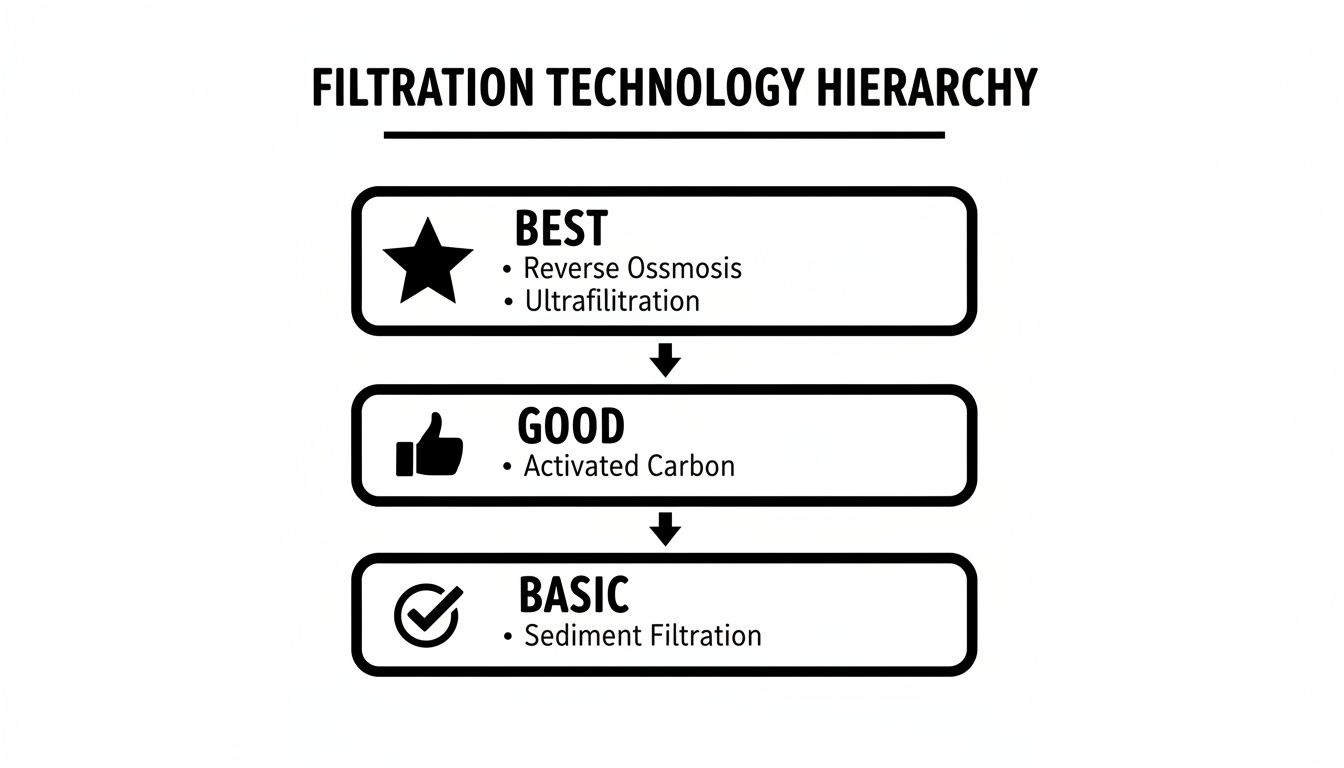
As you can see, the hierarchy clearly places technologies like Reverse Osmosis right at the top. That's because they can filter down to the nanoscale, offering the most comprehensive protection you can get.
Look for Independent Certifications
So, how can you be sure a filter actually does what it claims on the box? This is where independent certifications from organisations like the NSF (National Sanitation Foundation) come in. These aren't just fancy marketing badges; they represent rigorous, third-party proof that a filter meets specific, measurable standards.
When you're shopping around, keep an eye out for these key certifications:
- NSF/ANSI 42: This standard certifies that a filter reduces aesthetic things like chlorine, which improves the taste and smell of your water. It’s nice to have, but it doesn’t cover health-related contaminants.
- NSF/ANSI 53: Now this one is crucial. It certifies the reduction of contaminants with known health effects, like lead, cysts, and certain volatile organic compounds (VOCs).
- NSF/ANSI 401: This standard is specifically designed to test for 15 emerging contaminants, a group that can include certain microplastics, pharmaceuticals, and pesticides. A filter with this stamp of approval has been properly tested to remove these modern-day pollutants.
A filter that carries both NSF/ANSI 53 and 401 certifications provides a powerful, verified defence against a wide spectrum of invisible threats, including many microplastics. It’s the closest thing to a guarantee of quality you can get.
Evaluate Filter Lifespan and Long-Term Costs
A water filter isn't a one-and-done purchase; it’s a long-term commitment that requires ongoing maintenance. Before you buy, always check the filter's rated lifespan (usually measured in litres or months) and, just as importantly, the cost of the replacement cartridges. A system that seems like a bargain upfront can quickly become expensive if it needs frequent and costly replacements.
To work out the true cost, just divide the price of a replacement filter by the number of litres it can process. This gives you a "cost per litre," which makes it much easier to compare different models on a level playing field. More often than not, a durable, long-lasting filter provides better value and less hassle over time.
Choosing The Right System Type For Your Home
Finally, you need to think about how a filtration system will actually fit into your daily life. The best technology in the world is only useful if it’s convenient for you to use every day.
- Countertop Systems: These are incredibly simple to install, usually just connecting directly to your existing tap. They're a fantastic option for renters or anyone who wants a straightforward solution without making permanent changes to their kitchen.
- Under-Sink Systems: Installed neatly out of sight beneath the kitchen sink, these systems feed a dedicated filter tap. They offer a clean, clutter-free look and often have a higher capacity and more advanced multi-stage filtration than their countertop cousins.
- Whole-House Systems: For the most complete protection, a whole-house system treats every drop of water entering your home. This means cleaner water from every single tap, protecting you from microplastic exposure not just in the water you drink, but also in the shower and bath.
A Holistic Approach To Reducing Plastic Exposure
Fitting a high-quality water filter for microplastics is a fantastic and crucial step. Think of it as the final line of defence, ensuring the water that actually reaches your glass is as pure as possible. But to really get a handle on the problem, we need to zoom out and look at the whole picture of plastic in our lives.
While filtering your tap water is essential for catching the plastics already in the system, a truly robust strategy also means cutting down your exposure at the source. This is all about making conscious choices, especially in the kitchen, to reduce how much plastic you and your family come into contact with every day.
Beyond The Tap: Your Kitchen Audit
The kitchen is often called the heart of the home, but it can also be a hidden hotspot for microplastic exposure. Many of the tools we use every day can shed tiny plastic particles straight into the food we're preparing, completely sidestepping even the best water filter.
One of the worst offenders? The everyday plastic cutting board. Every slice and chop creates tiny grooves that not only trap bacteria but also release countless microplastic fragments into your food. If you want to go deeper on this, you can learn more about the safety of plastic cutting boards and see why switching is one of the smartest moves you can make.
The goal is to create a system where you are not just filtering out plastic particles, but actively preventing them from entering your food and water in the first place. This two-pronged approach offers the most comprehensive protection.
Take a look around your kitchen. Are you storing leftovers in plastic containers? Using non-stick pans with coatings that are starting to flake? Each of these is a potential source of plastic exposure that, thankfully, is easy to change.
Actionable Steps For A Lower-Plastic Lifestyle
You don't have to overhaul your entire life overnight. A few simple swaps can make a massive difference to your daily plastic contact. The key is to gradually shift towards durable, inert materials that won’t break down or leach unwanted extras into your food and drink.
Here are a few practical ideas you can start with today:
- Switch to Safer Food Storage: Ditch the plastic food containers and opt for glass, stainless steel, or even pure titanium. These materials are non-porous, don't hold onto smells, and won't shed microplastics.
- Choose Your Cookware Wisely: Go for cookware made from cast iron, stainless steel, or ceramic instead of coated non-stick pans, which can degrade, especially at high heat.
- Rethink Your Utensils: Swap out plastic spatulas and spoons for ones made of wood, bamboo, or stainless steel. They won't risk melting or shedding particles into your cooking.
- Avoid Plastic Wrap: Try using beeswax wraps, silicone lids, or just a simple plate to cover a bowl of leftovers. It's a small change that eliminates a common single-use plastic.
These habits work hand-in-hand with filtering your water, building a complete strategy for a healthier, lower-plastic home.
The Broader Environmental Connection
Cutting back on your personal plastic use does more than just protect your family; it contributes to solving the bigger problem. The less plastic we all use, the less ends up polluting our environment and, eventually, our waterways. This is incredibly relevant here in Australia, where our stunning harbours are facing a serious microplastic threat.
Take the Seabin project in Sydney Harbour, for example. This incredible technology has already filtered over 36.6 billion litres of water, and the most common litter they find is microplastics. What's really telling is their data shows microplastic collection jumps by 27% with every single millimetre of rain, showing how stormwater runoff is a major highway for these pollutants. You can discover more about these findings and the fight against marine plastic pollution on their website. It’s a powerful reminder that our small, individual choices really do help reduce contamination at its source.
Common Questions About Microplastic Filters
Even after getting a handle on the technology, there are always a few lingering questions that pop up when you're trying to pick the right water filter for microplastics. Let's clear up some of that final uncertainty so you can make a choice with total confidence. Think of this as a quick-fire round to tackle the most common head-scratchers.
We'll dive into the questions we hear most often and give you practical, straightforward answers.
Can A Standard Pitcher Filter Remove Microplastics?
This is easily the most popular question, and the short answer is: not really. Your average supermarket water pitcher is designed to make your tap water taste and smell better, mainly by reducing chlorine. They typically use a bed of loose granular activated carbon, which just isn't dense enough to reliably snag those microscopic plastic particles.
Sure, they might trap a few of the larger microplastic bits by sheer luck, but they don't have the sophisticated, fine-pored structure needed for consistent removal. If you're serious about capturing these tiny contaminants, you need a system with a certified micron rating of 1 or less. Look for an official certification like NSF/ANSI 401, which specifically tests a filter's ability to reduce emerging contaminants like microplastics.
Does Boiling Water Get Rid Of Microplastics?
Surprisingly, the answer is yes, to an extent. Recent studies have shown something pretty amazing: boiling hard tap water (water that’s rich in minerals) causes the calcium carbonate to form tiny crystals. These crystals can trap or encapsulate nanoplastics and microplastics, clumping them together.
Once the water cools, these clumps settle as a solid residue, which you can then remove by simply pouring the water through a coffee filter. The catch? Its effectiveness really hinges on how "hard" your water is. It works much better with high-mineral water than with soft water. So, while it’s a fascinating, low-cost trick, it's not a foolproof solution. For reliable, day-in-day-out removal, a dedicated and certified filtration system is still the best way to go.
How Often Should I Change My Water Filter?
This is non-negotiable: you absolutely must follow the manufacturer's replacement schedule. A water filter isn't magic; it works by physically trapping and holding onto contaminants. Over time, it gets full. Imagine a sponge that can only soak up so much water before it’s completely saturated.
Once a filter is clogged with microplastics and everything else it has pulled from your water, its performance plummets. A saturated filter won't just stop trapping new particles—it can actually start leaching the contaminants it previously captured back into your water. It’s crucial to understand the importance of regularly changing your water filter to keep your water safe.
Most under-sink filters need a new cartridge every 6 to 12 months, but always check the guidelines for your specific model. It’s the only way to guarantee it's still protecting you and your family.
Are Whole-House Filters Good For Removing Microplastics?
Yes, a whole-house filter can be a fantastic and incredibly effective solution, as long as you choose the right system. A simple, single-stage sediment filter won't cut it, but a multi-stage unit is a powerful defence.
A quality whole-house system will usually include:
- A sediment pre-filter with a low micron rating (think 5 microns or less) to catch the bigger stuff and protect the more delicate filters that come after it.
- A carbon block filter to then tackle the finer microplastics, along with chlorine and other chemical contaminants.
This kind of setup means that every single tap in your home—from the kitchen sink to the shower—is delivering water with far fewer microplastics. It's a complete shield for drinking, cooking, and bathing. For those aiming for the highest possible purity, it’s common to pair a whole-house system with a dedicated under-sink reverse osmosis unit just for drinking water.
Choosing to filter your water is a huge step toward a healthier lifestyle. The next step is making sure the containers you drink from are just as clean. You might find our guide on choosing between titanium and stainless steel water bottles helpful as you build a complete strategy for cutting down on plastic exposure.
At Everti, we believe a healthier home starts with the purity of the materials you use every single day. Our SGS-verified 99.9% pure titanium kitchen essentials, from cutting boards to drinkware, are designed to eliminate microplastic exposure at the source. Make the switch to a cleaner, safer kitchen by exploring our collection today. Shop the Everti Titanium Collection