

Around 2.5 million pots and pans are thrown away in Australia every year, so the practical answer is to buy cookware that matches your stovetop, cooking habits and care routine, rather than choosing on appearance alone. Durable, safe cookware costs more to replace less often and can help reduce the waste created by short-lived pans.
That figure works out to roughly 7,000 items sent to landfill every day, while the average pot or pan remains in use for only around three years. These are market estimates reported in connection with a retailer-led cookware recycling initiative, not official Australian government waste statistics, but they still show the scale of the problem clearly. A pan that warps, loses its coating or develops a loose handle becomes a household expense long before it becomes a cooking failure.
The right purchase depends on a few practical questions. Do you cook mainly on induction, gas or electric? Do you need easy release for eggs, high-heat performance for steak, or a pot that can simmer acidic sauces without fuss? Do you prefer a coating, or would you rather learn the technique required by uncoated steel?
Safe handling matters too. Cookware can't compensate for poor food hygiene, unsafe temperature control or cross-contamination. Advice on practical healthy cooking tips is useful alongside any cookware decision, particularly if your kitchen routine includes raw poultry, seafood and ready-to-eat food.
Why Cookware Choices Matter in Australia
A common Australian kitchen story starts with a bargain frypan. It works beautifully for a short period, then the surface loses its release, the base begins to wobble and the handle feels less secure. The household buys another pan, often choosing by discount or colour, and the cycle continues.
Australia discards approximately 2.5 million pots and pans each year, equivalent to about 7,000 items sent to landfill daily, according to reporting on a 2024 cookware recycling initiative by Inside Retail. The same report estimated that Australians spend approximately AUD 988 million on cookware annually, while the average item lasts only around three years. Those figures are industry estimates, but they make durability a commercial and household issue, not just an environmental talking point.
The real buying questions
A good decision starts with use rather than branding. A heavy stainless-steel skillet may be excellent for browning, but frustrating if you mainly cook delicate fish and want effortless release. A ceramic-coated pan may suit low and moderate heat, but it isn't the right tool for repeated high-heat searing. Cast iron can last for years with care, yet its weight and maintenance put some cooks off.
This guide focuses on the decisions that make a measurable difference in an Australian kitchen:
- Material: Choose between stainless steel, cast iron, carbon steel, ceramic-coated cookware and titanium according to heat behaviour and maintenance.
- Stovetop: Check induction compatibility before buying, rather than assuming a flat metal base will work.
- Safety: Separate sensible use of PTFE from broader concerns about PFAS regulation and damaged coatings.
- Workflow: Make cleaning, raw-food separation and temperature checking easy enough to follow every day.
- Longevity: Treat replacement frequency and end-of-life handling as part of the purchase decision.
The strongest cookware choice isn't always the most expensive set. It's the pan you can use correctly, clean without damaging and keep in service when cheaper alternatives would already be failing.
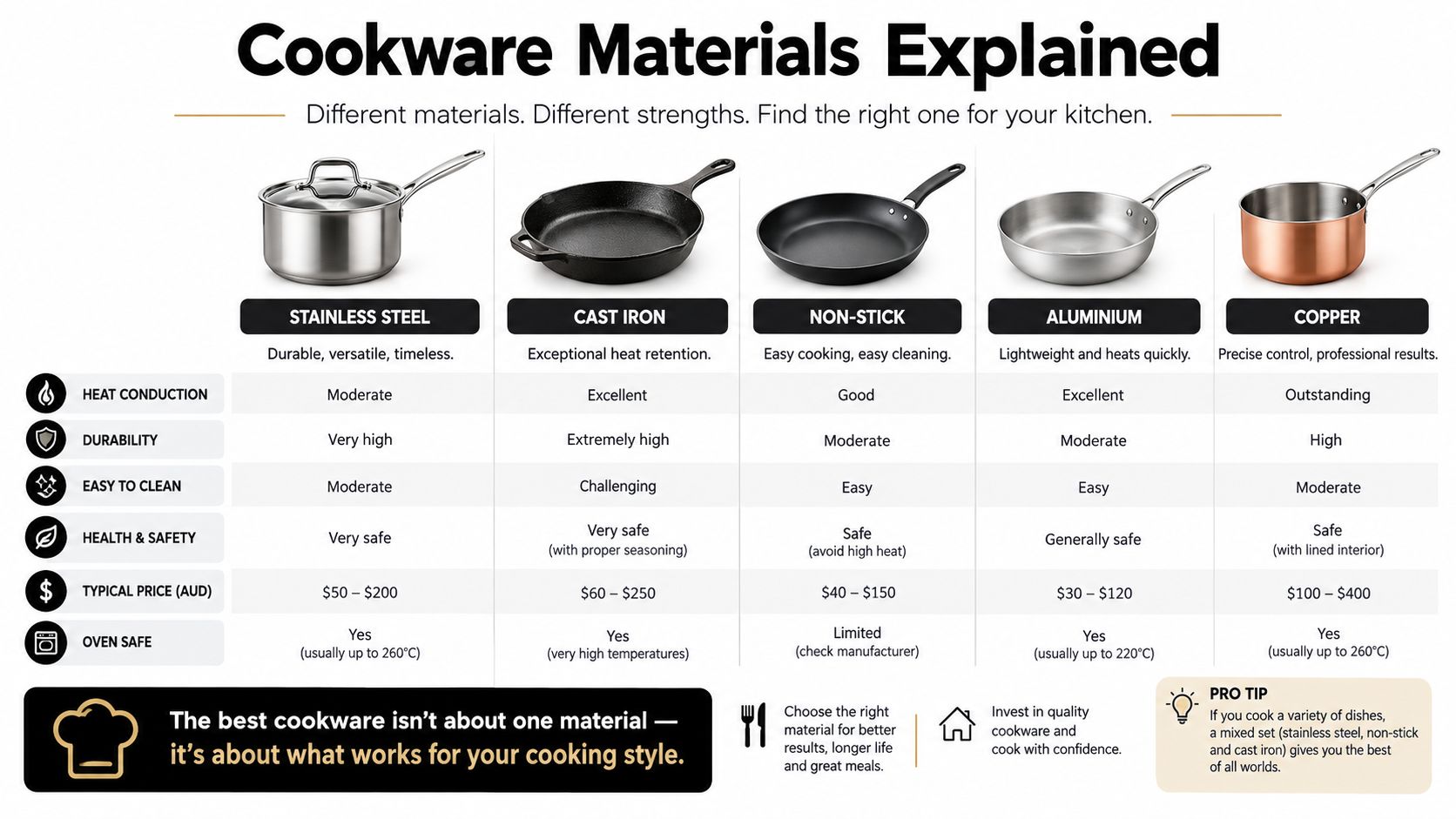
Cookware Materials Explained
Material determines how a pan responds when you add food, reduce heat or move from stovetop to oven. It also determines how much technique and maintenance you'll need.
Stainless steel
Stainless steel is the dependable workhorse. It resists corrosion, tolerates high heat and doesn't depend on a surface coating for its cooking performance. A quality multi-layer pan can spread heat more evenly than a thin, inexpensive one, but stainless steel still demands technique.
Preheat the pan, add oil once the surface is ready, then place dry food into it. If you move food too early, proteins can stick. Once browning has formed, they usually release more cleanly. Stainless steel is particularly useful for searing, pan sauces, boiling and oven finishing, although stuck residue may require soaking or a non-abrasive cleaner.
Cast iron
Cast iron holds heat exceptionally well, which makes it effective for hard searing, shallow frying and dishes that need a stable cooking temperature. The compromise is weight and slower responsiveness. It also needs seasoning if the cooking surface is uncoated, and long contact with acidic ingredients can affect the seasoning and the food.
Enameled cast iron avoids much of that reactivity and works well for braises, stews and baking. Its mass is still a factor, so check that you can safely lift a full pot before committing to a large piece.
Carbon steel
Carbon steel gives you much of cast iron's heat capacity in a lighter, faster-reacting form. It suits stir-frying, searing and omelettes once the surface has developed seasoning. It can rust if left wet, and acidic simmering can strip the seasoning, so drying and light oiling are part of normal ownership.
For a more detailed comparison of how the two materials behave, see this guide to stainless steel versus carbon steel.
Ceramic-coated cookware
Ceramic-coated pans offer easy food release without a PTFE surface, which appeals to cooks who want convenient non-stick performance with a different coating system. They're generally best used with moderate heat and soft utensils. The coating remains the component most vulnerable to wear, so abrasive cleaning, overheating and careless stacking can shorten its useful life.
Titanium
Titanium cookware is lightweight, corrosion-resistant and uncoated when made from pure titanium. It doesn't behave exactly like a conventional non-stick pan, so preheating and oil control still matter. Its appeal is strongest for cooks who prioritise low material reactivity, easy handling and a surface that isn't dependent on a conventional coating.
The practical ranking is straightforward. Choose stainless steel for versatility, cast iron for heat retention, carbon steel for responsive high-heat cooking, ceramic-coated cookware for convenient release and titanium when low weight and an uncoated construction are central to your decision.
Coated vs Uncoated Cookware Safety
The phrase “non-toxic cookware” often hides several different questions. Is the pan safe during normal cooking? What chemicals were used in its manufacture? What happens when the surface is overheated, scratched or discarded? Those questions need separate answers.
Australian regulators don't currently regard PTFE-coated cookware as a human-health or environmental chemical concern when it's used appropriately. That doesn't mean a PTFE pan should be treated as indestructible. Avoid heating an empty coated pan aggressively, follow the manufacturer's heat limits and replace cookware when the surface is visibly degrading.
Understanding the Australian regulatory position
PTFE, PFOA and PFAS aren't interchangeable terms. PTFE is the material commonly associated with traditional non-stick surfaces. PFOA is a different substance that was phased out of Australian manufacturing in 2013. From 1 July 2025, Australia banned the import, export and manufacture of PFOA, PFOS and PFHxS, as reported by ABC News.
That policy change doesn't mean every existing coated pan is suddenly unsafe. It does mean shoppers should read claims precisely rather than treating “PFOA-free” as a complete description of a product. Ask what the actual cooking surface is, how it should be heated and what the manufacturer says about replacement and disposal.
Coated and uncoated options compared
| Option | What works | What doesn't |
|---|---|---|
| PTFE-coated | Easy release and straightforward cooking at controlled heat | Overheating, metal damage and assuming the surface will last indefinitely |
| Ceramic-coated | Convenient release without a PTFE surface | High heat, abrasive cleaning and rough stacking |
| Stainless steel | High-heat browning, durability and no coating to wear away | Expecting effortless release without preheating and oil |
| Cast iron or carbon steel | Strong searing, long service and a seasoned surface | Leaving them wet or cooking acidic food for long periods without considering the seasoning |
| Titanium | Lightweight, corrosion-resistant, uncoated construction | Treating it like a disposable coated non-stick pan and ignoring preheating technique |
A damaged coating deserves attention. Deep scratches, peeling, exposed substrate or a surface that has become difficult to clean are practical reasons to retire the pan, regardless of the label. “PFAS-free” also isn't a guarantee of better cooking or longer life. Heat control, release, handle design and end-of-life disposal remain part of the safety decision.
For a closer look at the everyday trade-offs, compare non-stick pots and pans with uncoated alternatives before buying a full set.
Choosing Cookware for Your Stovetop
A pan can be well made and still be the wrong purchase if its base doesn't suit your cooktop. Check compatibility before comparing colours, handles or lid designs.
Induction
Induction requires a ferromagnetic base. Put a magnet against the underside of the pan. It should adhere firmly, not merely pull weakly against a small steel disc. If the magnet doesn't stick, the cookware won't work directly on a standard induction zone.
A flat base matters just as much. Induction transfers energy through the cookware, so a pan that sits unevenly or has a base smaller than the cooking zone may heat inconsistently. Match the base diameter to the zone where possible, and avoid dragging cookware across a glass surface.
Australian analysis measured heat-up efficiencies of approximately 83.0% to 86.1% for three induction cooktops, compared with 75.5% for a tested ceramic-resistance cooktop, according to the Climate Council's gas and electricity analysis. Efficiency isn't the only consideration, but it reinforces the value of choosing cookware that couples properly with the induction zone.
Heat and handle checks
The same Australian analysis found an average maximum temperature of 352°C for induction, compared with 220°C for gas. That higher localised exposure means you should check handle materials, lid knobs and coating limits rather than assuming every oven-safe label covers aggressive stovetop use.
- Gas: Prioritise a stable base and handles that keep your hands away from the flame. A pan that extends beyond the burner can heat unevenly.
- Electric coil: A flat, solid base helps maintain contact with the element. Avoid bases that rock or have visible distortion.
- Ceramic and halogen: Use cookware with a smooth underside and lift rather than slide it across the glass.
- Induction: Test with a magnet, confirm the manufacturer's compatibility statement and select a base that sits flat.
If you're renovating or planning a more functional cooking wall, the placement of a water source can also affect how easily you fill large pots. Options such as Melbourne pot filler tiles may be worth considering as part of the splashback and pot-filling layout, not as a substitute for compatible cookware.
For more detail on base construction and induction use, see this guide to what cookware works for induction.
The Cookware Decision Workflow
The simplest way to avoid a disappointing purchase is to decide in a fixed order. Start with the work your pans must do, then verify the equipment they'll sit on, then consider material, safety and price.
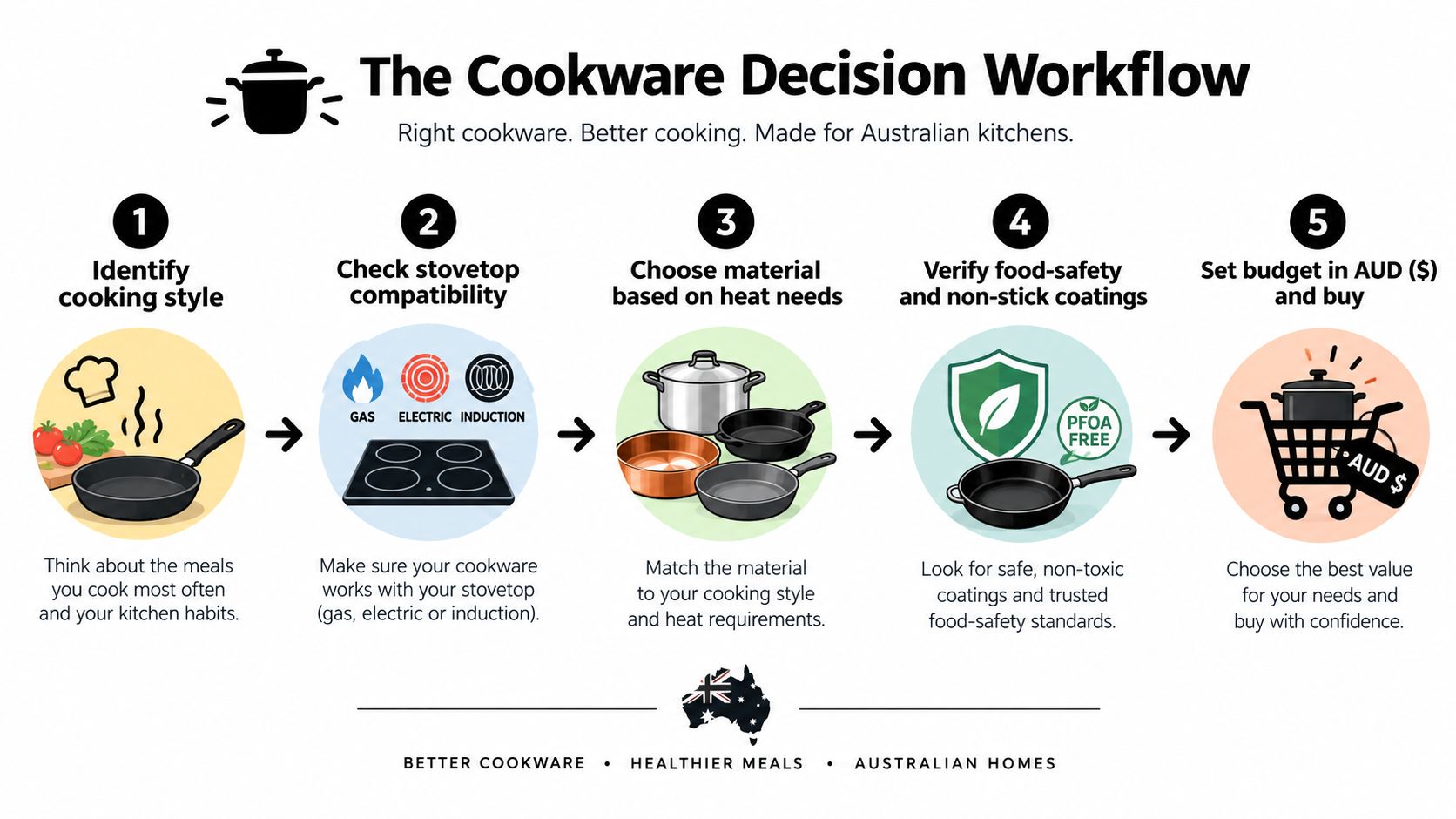
Start with cooking style
A cook who sears meat and reduces sauces needs a different primary pan from someone who mostly reheats soup and cooks eggs. Write down the meals you make most often.
- Searing and browning: Choose stainless steel, cast iron or carbon steel.
- Eggs and delicate fish: Choose a well-maintained coated pan or learn controlled preheating with seasoned steel.
- Boiling and simmering: Choose a stable stainless-steel saucepan or a heavy pot with a dependable lid.
- Braising and baking: Choose cast iron or another oven-capable material with secure handles.
Don't buy a large set just because every piece looks useful. A skillet, saucepan and medium pot that suit your routine are more valuable than unused shapes taking up cupboard space.
Check the equipment
Confirm the stovetop before selecting material. For induction, use the magnet test and inspect the base diameter. For glass surfaces, look for a flat underside without burrs or rough machining. Check whether handles, lids and coatings can tolerate the temperatures you use.
Build safety into the workflow
Food safety is partly a cookware issue and mostly a behaviour issue. Food Standards Australia New Zealand's 2025 tracker found that raw poultry was considered high risk by 81.0% of respondents, yet only 8.0% said they always use a thermometer to check whether chicken is cooked, while 43.8% never do so, according to FSANZ's food safety tracker.
Use a separate board or clearly separated preparation area for raw poultry and ready-to-eat food. Clean pan rims, lid handles and utensil contact points, because splashes and hands can move contamination beyond the cooking surface. Use a food thermometer when poultry is the concern rather than relying only on colour or texture.
Practical rule: Choose cookware that makes the safe action easy. A pan with a secure lid, comfortable handles and a surface you can clean thoroughly is more useful than one with impressive marketing claims.
Finally, set a realistic budget in Australian dollars and buy one suitable piece before committing to a complete range. Your best cookware is the item that fits your stove, recipes, storage and cleaning habits at the same time.
Investing in Durable Cookware
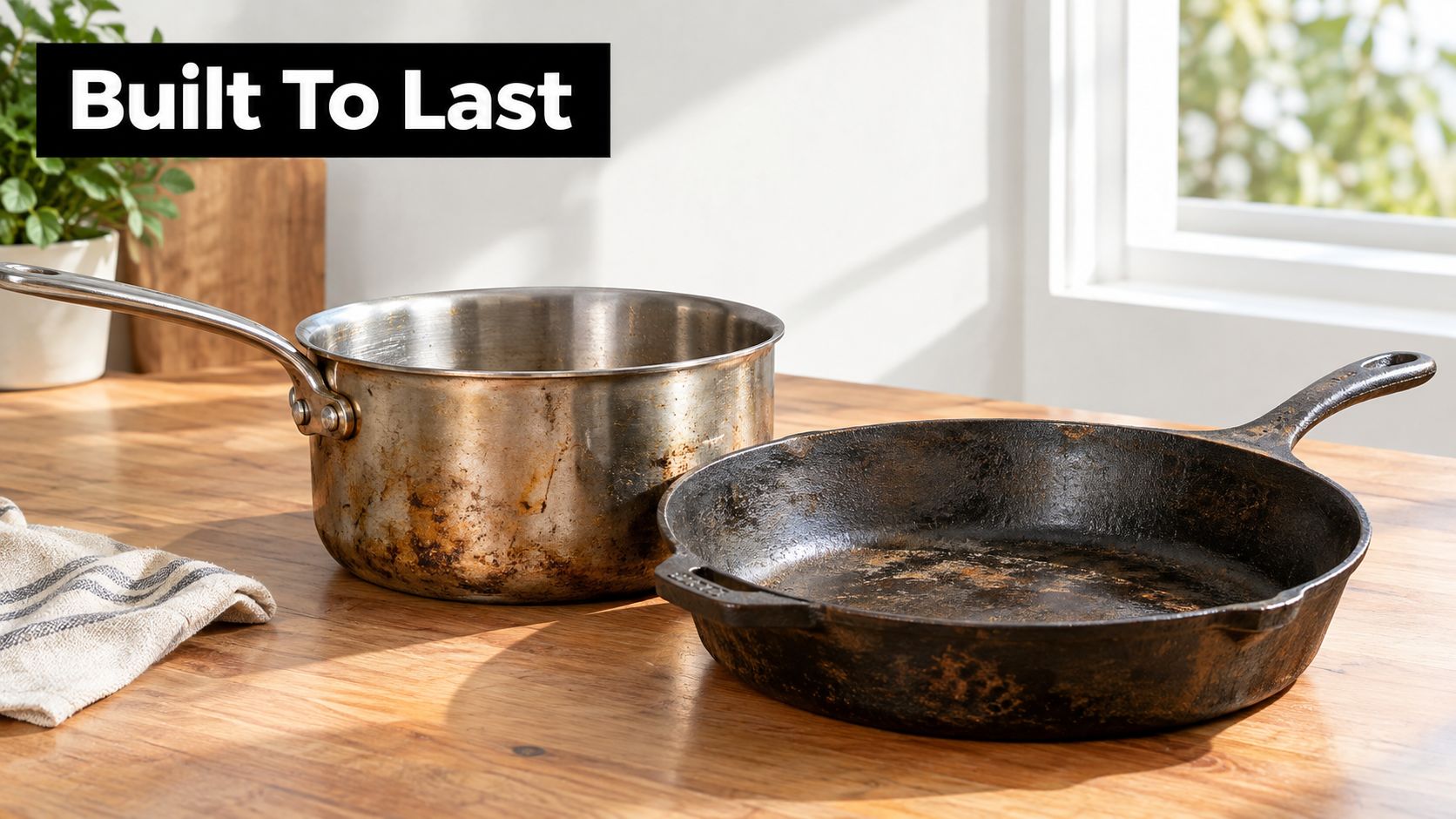
The cheapest pan is rarely the cheapest over its full service life. If the surface fails quickly, the household pays through repeated purchases, wasted food from sticking and the time spent managing damaged cookware.
Australia's dedicated kitchen-and-cookware retail industry was valued at approximately AUD 1.5 billion in 2025–2026, with about 1,264 businesses and approximately 7,212 people employed in 2025, according to IBISWorld's industry estimate. The category is large and competitive, so shoppers face plenty of choice, but a crowded retail market doesn't make every product equally durable.
Pay for the property you need
Premium cookware makes sense when the construction solves a real problem. A thick stainless-steel pan may spread heat more consistently than a thin one. Cast iron can provide stable heat for searing and baking. Carbon steel offers high-heat performance with less weight. Titanium can reduce handling weight while providing an uncoated cooking surface.
The wrong premium purchase is still wasteful. A very heavy Dutch oven isn't a good choice for someone who struggles to lift it safely. A delicate coated pan won't become an heirloom because it carries a premium price. A durable material only delivers value when the owner uses and maintains it appropriately.
Everti offers pure titanium cookware, including uncoated pans marketed to Australian customers. Its publisher information describes 99.9% titanium, SGS verification and a lifetime warranty, so buyers should still review the specific product details, care instructions and warranty terms before ordering.
The value calculation is practical rather than romantic:
- Estimate use: Choose pieces you'll reach for frequently.
- Check failure points: Look at the base, handle attachment, lid fit and cooking surface.
- Account for care: Decide whether you'll season steel or hand-wash a coating.
- Plan the end of life: Keep packaging and product information, and investigate local recycling options when replacement becomes necessary.
This approach helps break the replacement cycle reflected in Australia's cookware disposal estimates. It also turns sustainability into something measurable at home: fewer failed purchases, fewer discarded pans and more consistent cooking.
A durable pan should earn its place through repeated use, not sit untouched because it's too heavy, too demanding or poorly matched to your stove.
Care, Maintenance, and Replacement
Good cookware lasts longer when cleaning and storage follow the material. Most failures come from predictable habits, such as shocking a hot pan with cold water, scraping a coating with metal or leaving carbon steel damp overnight.
Clean according to the surface
Let cookware cool before washing, especially on glass and ceramic surfaces. For stainless steel, soak stuck residue and use a non-abrasive cleaner rather than attacking it immediately with a harsh scourer. A short simmer with water can loosen browned food without aggressive scraping.
Ceramic-coated and PTFE pans need softer treatment. Use warm water, mild detergent and a soft sponge, then dry them fully. Don't stack them without protection. A cloth or pan protector between pieces can prevent the scratches that turn a usable surface into a replacement problem.
Cast iron and carbon steel need a different routine. Remove food, wash without prolonged soaking, dry over low heat and apply a thin film of oil when appropriate. If the seasoning becomes patchy, scrub back only as far as needed, dry thoroughly and rebuild the surface gradually through normal cooking and seasoning.
“Dishwasher safe” describes what a product can tolerate under stated conditions, not necessarily the gentlest method for long service. This explanation of what dishwasher safe really means is a useful reminder to distinguish convenience from best-care practice.
Inspect the parts people ignore
Check the pan rim, underside, lid edge and handle junction during cleaning. Food residue can collect in seams, rivets and grips, while a loose handle can turn a routine lift into a burn or spill.
Replace cookware when you find:
- Structural damage: A warped base rocks on the stovetop or no longer couples evenly with induction.
- Surface failure: A coated interior is peeling, heavily scratched or difficult to clean despite normal washing.
- Handle problems: Screws loosen repeatedly, rivets move or heat damage affects the grip.
- Persistent corrosion: Rust or pitting continues after appropriate cleaning and drying.
Don't put a damaged pan into general waste without checking local options. Retailer-led collection programs have shown that cookware can be diverted from landfill, so look for Australian recycling or take-back initiatives when a pan has reached the end of its safe working life. The best replacement is one that fixes the reason the previous pan failed, whether that means a flatter base, a more durable material or a simpler care routine.
If you want to replace short-lived cookware with uncoated titanium options designed for repeated kitchen use, explore the cookware and kitchen essentials available from Everti. Review the material details, stovetop compatibility and care guidance, then choose the piece that fits your everyday Australian kitchen rather than buying more than you need.