

The usual advice, buy a wok for Asian food and a skillet for everything else, is too crude to help you choose well. A crowded wok on an unsuitable Melbourne cooktop can make a disappointing stir-fry, while a well-matched skillet can brown the same ingredients beautifully. Buy for your burner and your cooking habits, not the cuisine printed on the packaging.
The skillet vs wok decision starts with what happens when cold food hits hot metal. Shape matters, but so do the base, the material and how much dinner you're trying to cook at once.
Why the Skillet vs Wok Question Is More Useful Than the Answer
A skillet and a wok aren't competing versions of the same tool. They support different ways of cooking, and Australian households have inherited good reasons to own both.
The skillet fits European and Anglo-Australian habits built around pan-frying, searing and preparing flatter foods. The wok belongs to Chinese and broader Asian cooking traditions organised around movement, staged additions and ingredients gathered towards the centre.
Those traditions aren't a recent cookware-shop invention. The Museum of Chinese Australian History documents approximately 200 years of Chinese Australian history, placing the wok's cultural context within generations of migration and everyday life. In a Melbourne kitchen, choosing between these pans is partly about what your family cooks, not what's fashionable.
The better pan isn't the one with the strongest reputation. It's the one whose working surface matches your meal and whose base matches your stove.
Buy for the job you repeat
Start with your ordinary dinner, not your most ambitious recipe. If you regularly leave food undisturbed while it browns, you're describing a skillet habit; if you add ingredients in stages and combine them towards the end, you're describing a wok habit.
Your willingness to maintain the pan matters too. A pan that suits your technique but demands care you won't give it is a poor purchase.
- Look at the cooking surface. Judge the area where food contacts the base, rather than the width across the rim.
- Consider the complete construction. Thickness, conductive layers and base design tell you more than a material name alone.
- Check the practical fit. The pan should sit securely, suit your cooktop and remain manageable when filled.
My recommendation is to treat cooktop compatibility as the entry requirement, then choose the construction and shape that support your most frequent meals. Don't buy a specialist tool hoping it will automatically improve a technique you rarely use.
Shape, Surface Area and Heat Response
Put a steak in a skillet and its broad underside can meet the cooking surface. Put that same steak in a curved wok and the contact changes completely. That difference, rather than the overall capacity of the vessel, explains much of the performance gap.
A skillet has a shallow profile and a broad, flat base, usually with upright or gently flared sides. A wok forms a deeper bowl, with sloping walls leading down to a smaller central cooking zone.
The distinction is easiest to see in the working surfaces.
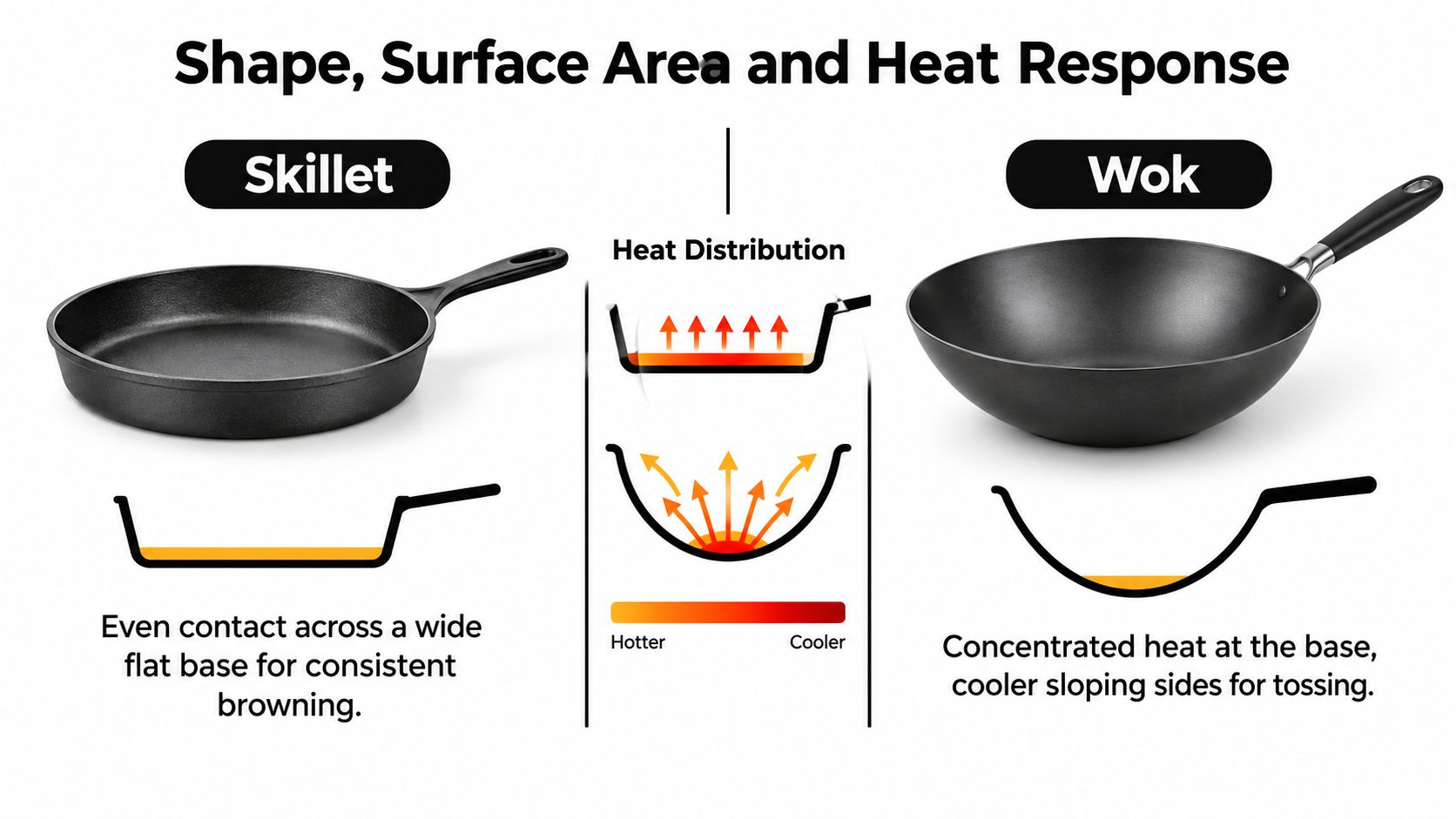
Contact cooking versus staged cooking
The skillet gives ingredients room to sit against hot metal. That makes it the more straightforward choice when you want an even layer of browning without continually rearranging the food.
A wok gives you somewhere to move ingredients away from the hottest centre. You can bring food down to cook, move it up temporarily, then gather everything together when it's time to finish.
- For a skillet, arrange before you agitate. Give food usable space against the base instead of treating the pan like a mixing bowl.
- For a wok, organise before you start. Have your ingredients ready so you can move through the cooking stages without stopping.
- For either pan, watch the food rather than the rim. A large-looking vessel doesn't guarantee a large effective searing area.
For an uncoated stir-fry wok, preheat until the added oil shimmers, then work in modest batches. Don't interpret that as permission to heat every coated pan until it smokes; follow the product's instructions.
The complication on a flat electric or induction cooktop is that the burner interacts with the base, not the whole bowl. Rounded geometry alone doesn't create useful heat where your ingredients need it.
Keep the mental model simple: skillet means broad contact; wok means concentrated cooking with space to move food aside. Neither shape rescues an overloaded pan.
How Material Changes the Whole Argument
I'd take a well-constructed pan in an unglamorous material over an impressive label attached to the wrong build. Material names aren't complete performance specifications.
A thin carbon-steel wok generally responds to burner adjustments faster than a thick cast-iron skillet. Cast iron offers greater heat retention for sustained searing, while stainless steel's lower thermal conductivity is commonly addressed with bonded aluminium or copper layers, as explained in this cookware materials comparison.
That doesn't make bare stainless steel incorrectly named or unusable. It means construction matters more than the word stainless.
Separate retention from recovery
Heat retention describes how well a pan holds stored heat. Recovery describes what happens after you add food and the burner must replace the energy being used.
A heavy skillet can resist an initial temperature drop, yet still take time to recover if the burner can't supply enough power. A responsive wok lets you change direction quickly, but it also needs a sensible load and a suitable heat source.
For a closer buying comparison, use this guide to stainless steel vs carbon steel alongside the actual specifications of the pans you're considering.
Material performance across skillet and wok
| Material | Heat response in a skillet | Heat response in a wok |
|---|---|---|
| Carbon steel | A responsive option whose behaviour depends on thickness and base size | Thin construction suits rapid, sequential cooking |
| Cast iron | Greater heat retention suits sustained searing; burner adjustments take longer to affect a heavy pan | Heavy construction trades quick response for stored heat |
| Clad stainless steel | Conductive layers help distribute heat across the base | Assess the conductive construction rather than assuming the stainless label guarantees responsiveness |
My default wok recommendation is thin carbon steel, provided the base suits the stove. For a skillet, choose cast iron when sustained searing is the priority, or properly constructed clad stainless when you want a different balance of handling and general-purpose use.
Carbon steel can also bridge the gap as a flat skillet. Don't assume every carbon-steel pan behaves alike, though: compare thickness, usable base and how comfortably you can lift it.
What Each Pan Actually Cooks Best
Choose a skillet when the meal depends on food staying in contact with the base. Choose a wok when the meal depends on ingredients moving through a sequence.
The contrast is clear with steak and stir-fried vegetables.
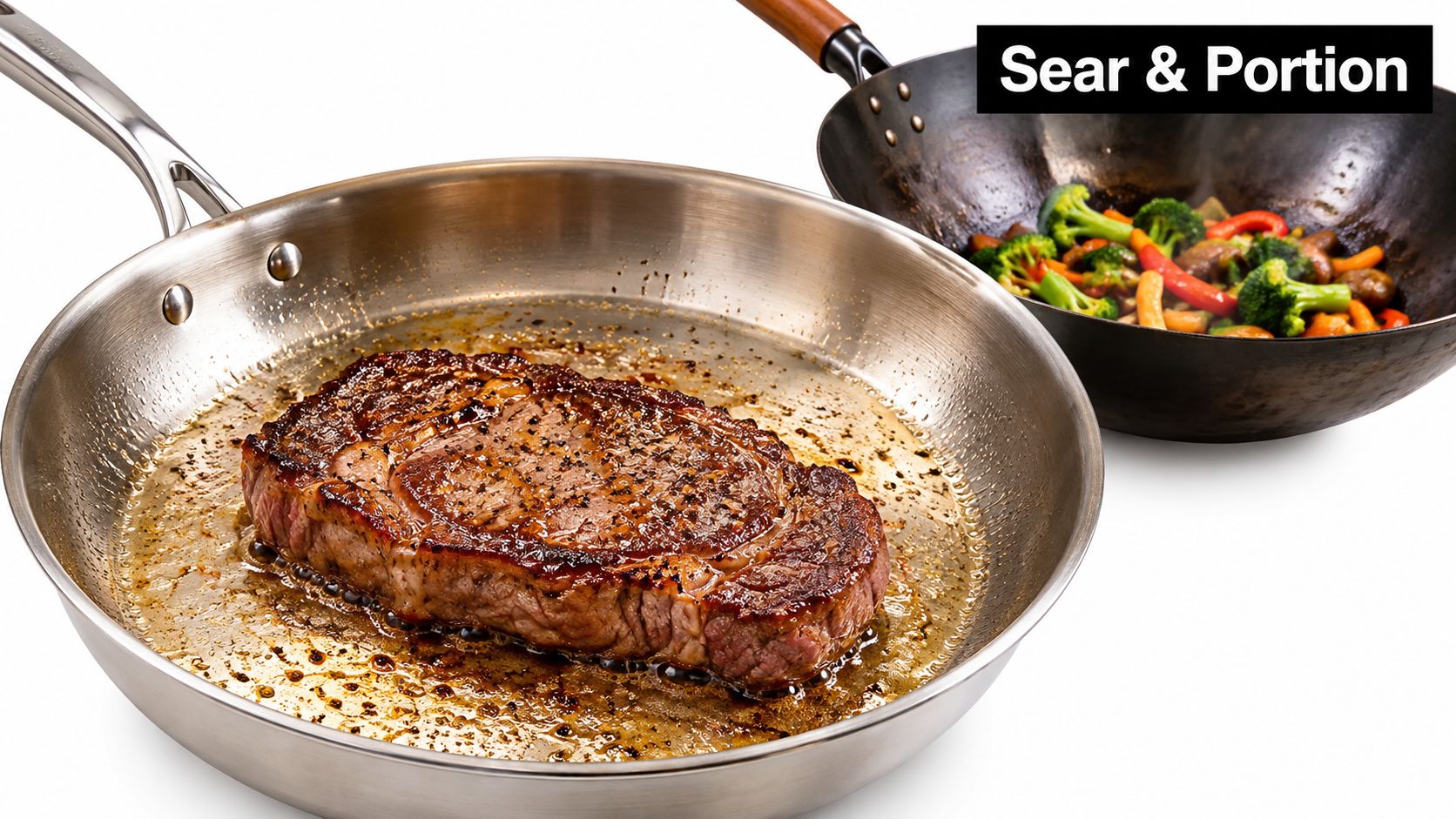
Match the method, not the passport
For smashed potatoes or chicken thighs cooked skin-side down, I'd reach for a skillet. You're trying to establish contact and leave it alone, not repeatedly toss dinner through a bowl.
Pancakes are another clear skillet job because a flat cooking surface is part of the result. For shakshuka, I'd favour the skillet's layout, while checking that the material and manufacturer's instructions suit the sauce.
- Use the wok for staged noodles. Cook components separately as needed, then combine them with the sauce rather than loading everything in together.
- Use the skillet for a deliberate sear. Arrange meat, tofu or vegetables so their browning surfaces meet the base.
- Use either vessel for shallow frying only when it suits the task. Stability, working space and manageable handling matter more than declaring a universal winner.
Watch the preparation and movement as closely as the pan choice in a stir-fry demonstration.
Let the batch prove the purchase
There's no honest universal batch weight to recommend without knowing your burner, pan and ingredients. Moist vegetables and refrigerated meat create a different demand from a lightly loaded batch of drier ingredients.
Try the same meal in manageable batches and watch how readily vigorous sizzling returns after each addition. Compare the browning, not just how dramatic the cooking looks.
Practical test: If the food releases liquid and sits simmering when you intended to sear it, reduce the load before blaming the pan.
A broad skillet can be the better browning tool for a crowded weeknight meal. The wok earns its place when you're willing to cook in stages.
Matching the Pan to Your Cooktop
Before buying cookware, check what your stove can use. A beautiful pan that rocks on the surface or won't register on induction is the wrong pan.
The basic compatibility differences are straightforward.
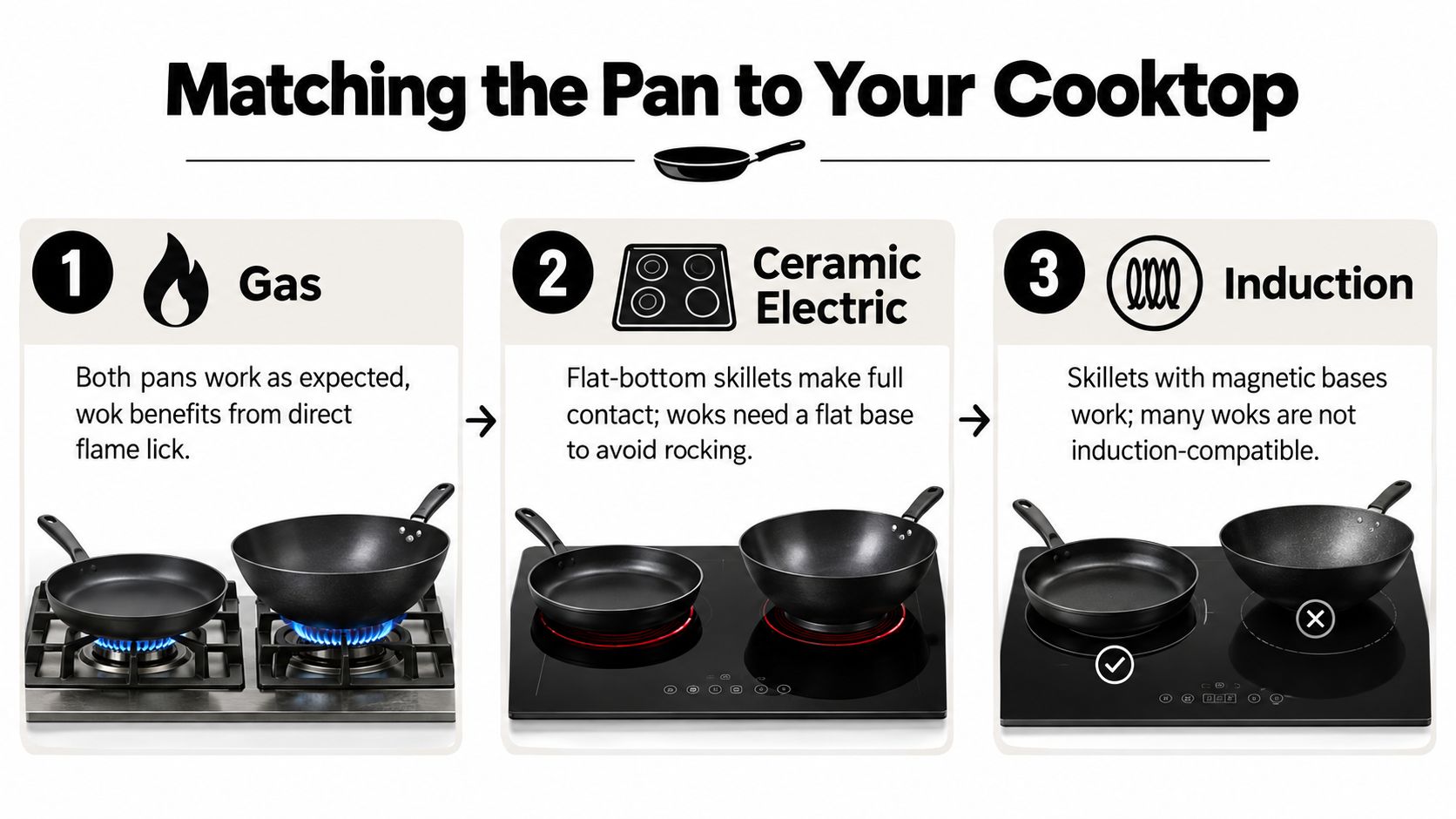
Gas and ceramic electric
Gas gives you broader freedom over cookware materials and shapes. Both vessels can work well, but a round-bottom wok still needs secure support compatible with the appliance.
On ceramic glass, I'd choose a flat, stable base. Don't improvise with a wok ring unless the appliance instructions permit it, and don't assume a round-bottom vessel will transfer heat effectively from a flat element.
The useful purchase for a ceramic kitchen is usually a skillet or a flat-bottom wok, not a traditional rounded wok bought for appearance.
Induction changes the shortlist
Induction requires a ferromagnetic base. Aluminium, copper and glass won't work by themselves, while suitable bonded magnetic construction can make otherwise incompatible materials usable, as Darebin's induction cooking guidance explains.
- Try a magnet against the underside. Attraction is a useful screening check, then confirm the manufacturer's induction rating.
- Compare the base with the cooking zone. Check the appliance's accepted cookware dimensions rather than judging by the pan's rim.
- Insist on stability. A sufficiently wide, flat magnetic base is more useful here than authentic rounded geometry.
A dedicated flat-bottom wok buying guide can help you assess that compromise before ordering.
CHOICE reports approximately 85% energy transfer for induction versus about 32% for gas. That's an efficiency comparison, not proof that every small induction zone can outperform every gas burner.
Judge the complete setup: available output, base compatibility and the quantity you'll cook. If you use different appliances indoors and outdoors, verify suitability for each rather than assuming one compatibility label covers everything.
Seasoning, Cleaning and Long-Term Care
Choose a maintenance routine you will follow. There is no point buying a seasoned pan if your normal habit is leaving cookware wet in the sink overnight.
For conventional uncoated carbon steel and cast iron, treat the seasoning as a working finish that needs protection and occasional attention. Follow the manufacturer's initial seasoning instructions rather than assuming the pan arrives ready for your preferred cooking method.
For help establishing that routine, Hans Grill's nonstick carbon steel care tips are a useful companion to the instructions supplied with your pan.
Keep the routine uncomplicated
My recommendation is to clean soon after cooking, use hot water and a soft brush for ordinary residue, then dry the pan promptly. For a seasoned surface, finish with a very thin wiped-on film of oil when the manufacturer recommends it.
- Skip prolonged soaking. Deal with stuck food deliberately rather than leaving the whole pan submerged.
- Check dishwasher instructions. Don't apply the same cleaning method to seasoned metal, clad stainless and coated cookware.
- Store carefully. Keep the pan dry and use a protective separator if you stack another vessel inside it.
Don't turn cleaning into a contest to preserve every mark, either. Food residue isn't something you need to keep; use the maker's guidance when a pan needs a more thorough clean or renewed seasoning.
Shape doesn't decide the care burden
A skillet isn't automatically easier to maintain than a wok. A cast-iron skillet and a carbon-steel wok can both require protective habits, while a different surface changes the routine.
Before choosing a coated option, compare its care requirements with a seasoned surface using this non-stick skillet pan guide. Keep temperature limits and utensil instructions attached to the specific product.
Buy the maintenance you can sustain, not the maintenance you intend to become disciplined about later.
I'd rather see you use a suitable pan confidently than own a specialist vessel you avoid because cleaning feels like homework.
Which Pan Should You Actually Buy
For a typical mixed-menu Melbourne household, buy the skillet first. Add a wok when you have a compatible stove and enough staged cooking in your routine to justify it.
That isn't a verdict against woks. It's a recommendation to buy the tool you'll reach for without rearranging your cooking habits.
Pick for your household
The induction or ceramic weeknight cook should prioritise a stable, appropriately sized skillet. Choose the construction around your preferred meals and handling needs, then check the exact cooktop compatibility before paying.
If noodles and stir-fries dominate your dinners, reverse that recommendation and choose a suitable flat-bottom carbon-steel wok. Don't buy a rounded wok and expect an accessory to solve every appliance mismatch.
The gas-cooking household that already enjoys stir-frying should buy the wok. You already have the technique and menu to use its shape properly, so the purchase supports an existing habit rather than an aspiration.
The household with limited storage should choose according to its most common cooking action. If that's laying food down to brown, get the skillet; if it's cooking components separately and tossing them together, get the wok.
Be sceptical of premium shortcuts
If titanium cookware is on your shortlist, ask what the product is made from. A material name doesn't tell you the complete base construction, cooking surface or compatibility.
Don't pay a premium on the assumption that titanium automatically delivers carbon steel's response or cast iron's heat retention. Ask for the product specifications and judge the complete pan against your intended use.
Use this order when replacing any vessel:
- Cooktop first. Remove incompatible options from consideration.
- Material second. Select the construction and care routine you want.
- Shape third. Match the working surface to your usual technique.
- Recipe flexibility fourth. Consider occasional meals only after the everyday job is covered.
Take a fridge magnet and your cooktop model details shopping. Take a clear description of what you cooked last week; that's a better buying guide than the most impressive demonstration in the shop.
Questions Worth Answering Before You Buy
Can a flat-bottom carbon-steel wok replace a skillet?
For some searing tasks, yes, if the food fits its usable base. I wouldn't choose it for a broad cut that needs extensive flat contact, and oven finishing depends on the entire product's rating, including handles, rather than the material alone.
Does a non-stick skillet make a wok redundant?
No. A surface treatment doesn't change the vessel's geometry or give a skillet the wok's space for moving ingredients between cooking stages.
Where do titanium pans fit?
Treat them as individual constructions, not a performance category. Check weight, base design, cooktop suitability and care instructions instead of assuming every titanium-labelled pan heats or retains heat the same way.
What temperature should high-risk food reach?
High-risk foods should reach 75°C at the centre, measured with a cleaned and sanitised thermometer, under Victorian food-safety guidance cited alongside the supplied Australian stir-fry guidance. Browning and vigorous sizzling aren't substitutes for checking the centre.
Everti offers titanium essentials for the kitchen and table, including cookware, cutting boards and tableware, with a Melbourne-based focus on enduring everyday tools. Visit Everti to compare the range, and check each cookware item's construction and cooktop suitability against the meals you make.